Outlook 2027 Series | IV. Huang Is Back, but Is the AI Market's Faith? Sorting the 2027 Supply Chain
What You Need to Know:
Jensen Huang formally returned to Nvidia on 11/23, clearing away market fears of a leadership vacuum and sparking a powerful rally in global equities. Yet now that the episode that rattled the global supply chain has passed, one question deserves a cool-headed look: Jensen Huang is back, but has the era of the market buying into AI unconditionally already come to an end?
Looking back at this year, the key bottlenecks in the AI supply chain centered on the challenges Nvidia faced in ramping its Vera Rubin platform, from lengthy HBM4 qualification and tight supply of glass fiber cloth, copper foil and ABF substrates, to its first adoption of CPO technology, a jump in power consumption, and the fine-tuning of liquid cooling. Despite repeated supply-side snags, Nvidia shipped on schedule in Q3, with Vera Rubin generating close to US$20bn in revenue in its first quarter. Management also raised its full-year 2027 revenue growth outlook from 70% to 75% and lifted supply chain purchase commitments sharply, from US$279bn last quarter to US$390bn, locking in capacity for compute expansion over the next two years.
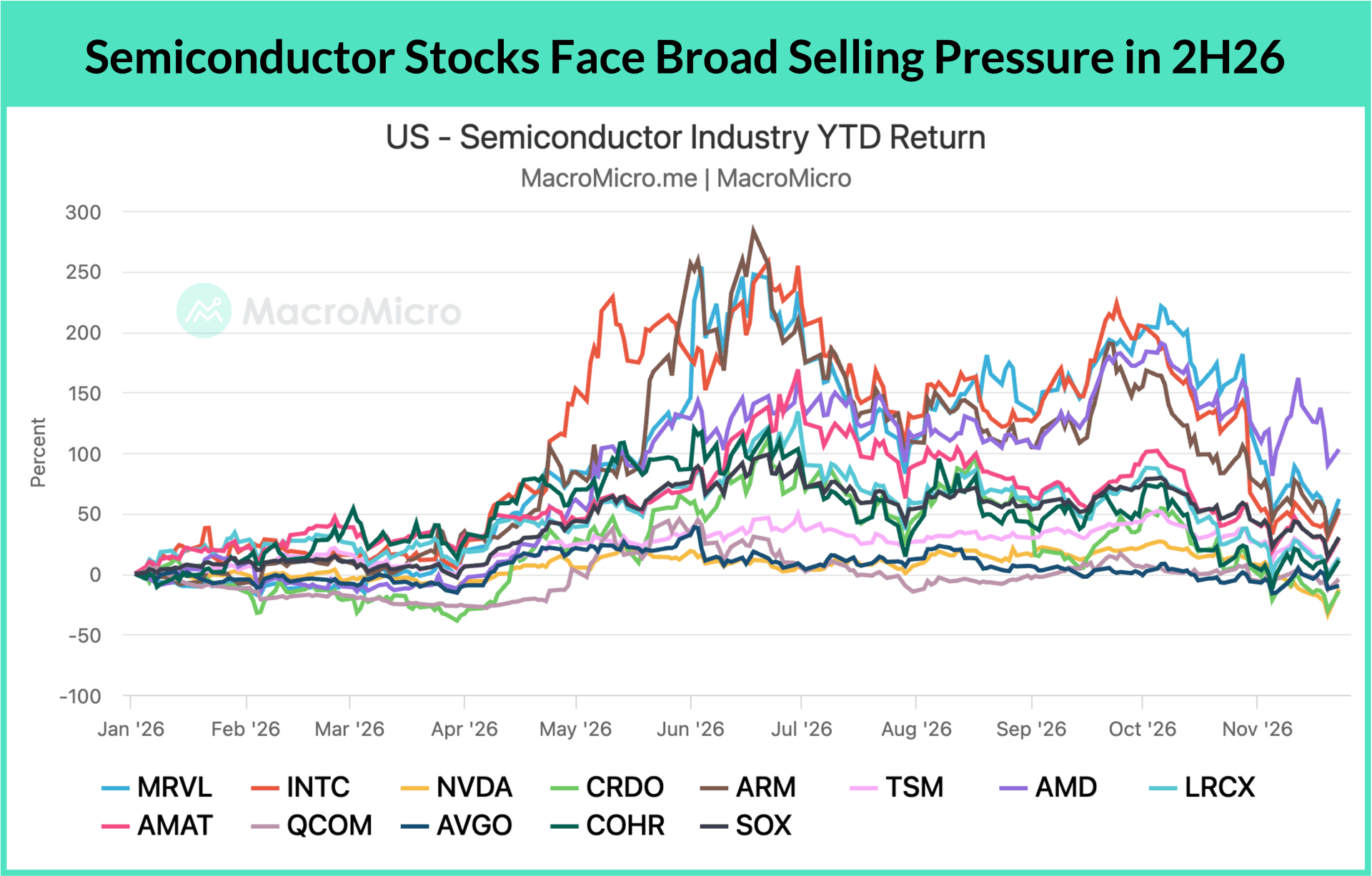
Under the playbook of the past two years, "tight supply + strong guidance" was supposed to be a guaranteed ticket to ever-higher share prices. Lately, however, the market is no longer automatically rewarding the "capacity bottleneck" narrative. Even though Huang's return has stabilized the technology roadmap and the order book, the episode pushed deeper variables into the open: single-point dependency risk, the US Commerce Department's broader controls on "remote compute services," and expectations that Democrats will step up scrutiny of data center energy use and environmental impact. Two key dates also still need close watching.
This is the fourth installment of our 2027 Outlook series, in which we take a deep dive into these concerns and the AI supply chain.
Key Takeaways:
- The AI supply chain faces two tests and one major uncertainty in 2027: a much higher growth base, rising export controls combined with Nvidia supply chain uncertainty, and data center bottlenecks.
- In 2027, we expect the AI supply chain to shift from a broad-based rally to divergence, with suppliers that combine hard demand and dominant market positions poised to stand out. We group the supply chain into two categories and give readers an overview of the competitive landscape across each segment.
- Our view that AI is driving a long-term productivity cycle is unchanged. Falling token prices are actually lifting usage and enterprise adoption; we continue to track rental prices for both current- and previous-generation compute.
1. AI Supply Chain Trends in 2027: Two Tests & One Major Uncertainty
Before breaking down individual components, we first take a top-down view of the core themes shaping the AI supply chain in 2027. Unlike this year, 2027 will no longer be a market where "whoever has capacity takes it all." The supply chain will face two tougher tests: whether growth momentum can hold up against a high base, and how rising export controls could reshuffle orders. At the same time, we continue to monitor the possibility that power-related uncertainty pushes back capex. Only by first understanding how these forces play out can we pinpoint which parts of the supply chain hold real pricing power.
Test 1: A Much Higher Base Puts Growth to the Test
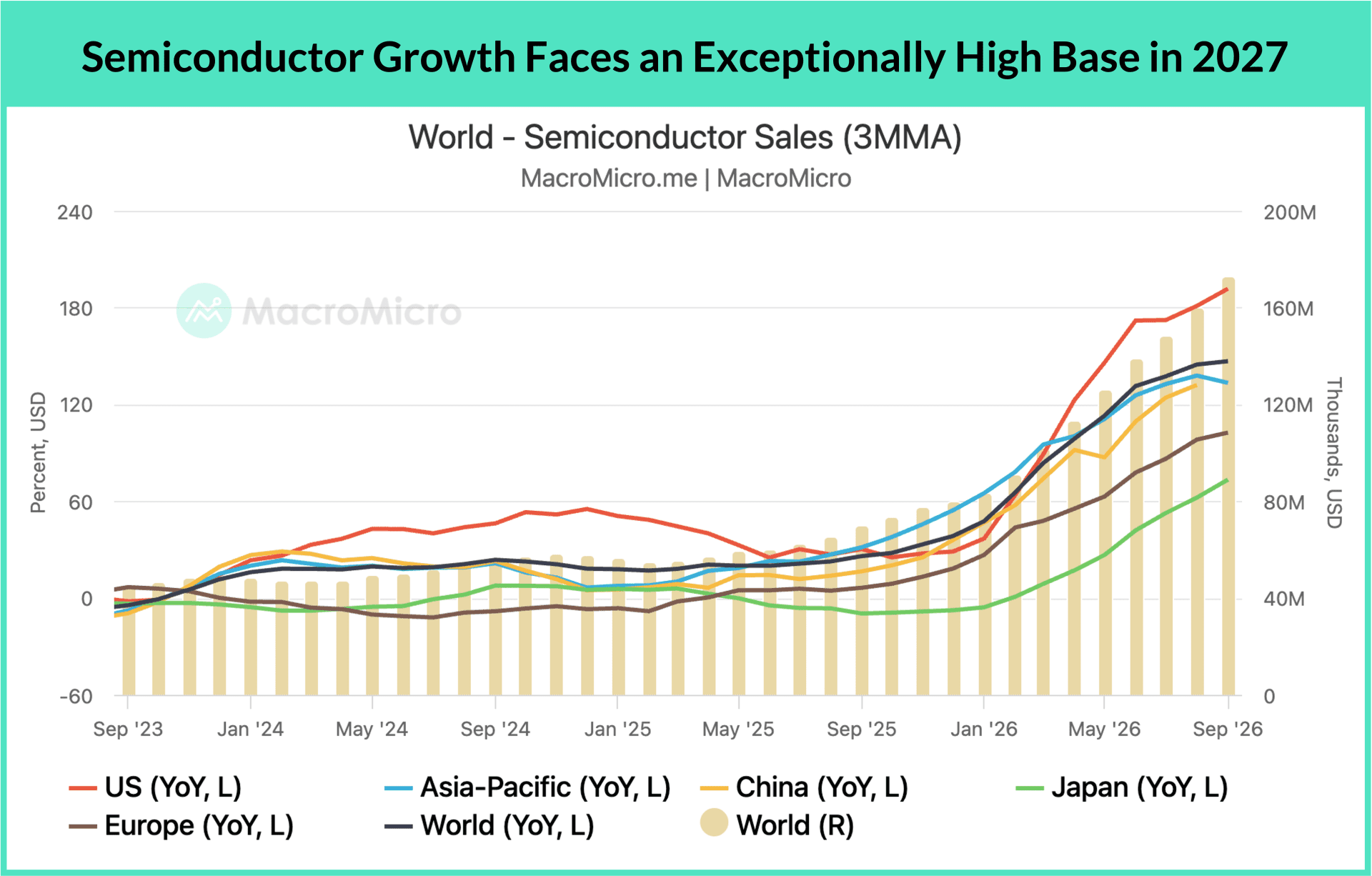
Propelled by the AI tailwind this year, global semiconductor sales reached US$1.24tn in January–September, up a remarkable 123%, with the US up 153%, Asia Pacific up 120%, Europe up 77%, China up 74% and Japan up 41%. This means every node of the AI supply chain will broadly face pressure from a much higher base in 2027. Even if absolute sales keep climbing, growth will naturally slow, and companies will face a higher bar on both valuations and earnings.
Test 2: Rising Export Controls & Nvidia Supply Chain Uncertainty
Jensen Huang's formal return on 11/23 has, for now, steadied confidence around AI financing and long-term product strategy. But the earlier string of leadership shake-ups, followed closely by the US Commerce Department's controls on high-end chips and remote compute, has clouded visibility on the 2027 compute landscape. Two key dates still need close watching:
- The December 1 US congressional hearing: Jensen Huang has agreed to testify before Congress. Senior officials at the White House and in the executive branch have already signaled tacit approval that there is "no national security risk," but lawmakers' questioning in public settings tends to be far sharper (especially from...
Already a subscriber? Click here to log in.
Full Access to Our Services

Comprehensive data at your service
with key indicators for investment insights

Exclusive flash reports
on key events and data

Create your own charts and analysis
including performance backtesting

Hub of professionals to engage
in meaningful discussions and insights
 Get answers from MM AI.
-
How will the AI supply chain evolve in 2027, given a higher growth base and rising export controls?
💡In 2027, the AI supply chain will shift from a broad-based rally to sharp divergence, facing two key tests: maintaining growth momentum against a much higher base and navigating rising export controls that could reshuffle orders. Unlike previous years, the market will no longer automatically reward capacity bottlenecks; instead, it will scrutinize capex and order visibility more rigorously. This shift also includes monitoring power-related uncertainties that might push back capital expenditures, making it crucial to identify segments with real pricing power.
-
What major uncertainty do data center bottlenecks and financing guarantees pose for the AI supply chain?
💡Data center bottlenecks and financing guarantees pose a major uncertainty for the AI supply chain, as they form a closed loop that may slow investment momentum. Policy restrictions are tightening in the US, with Democrats scrutinizing data centers' energy use and environmental impact, potentially slowing construction. Similarly, Southeast Asian expansion faces limits due to increased US Commerce Department reviews of AI chip exports and remote compute access. This uncertainty means that while AI compute demand's long-term trend remains unchanged, the timely completion and operation of data centers are becoming critical variables for near-term supply chain shipments and inventory risk, potentially disrupting the vast project financing and compute leasing structures.
-
How might the December 1 US congressional hearing on chip export controls affect Nvidia's stock?
💡The December 1 US congressional hearing on chip export controls could trigger sharp short-term swings in Nvidia's stock and the broader market. Although White House officials have signaled no national security risk, lawmakers, particularly China hawks and Banking Committee members, will likely question Jensen Huang sharply on details like loopholes in chip export controls and contact with foreign intelligence. This public scrutiny could expose sensitive information, creating market volatility despite tacit executive branch approval. Investors will closely watch for any revelations that might affect Nvidia's operational landscape and future outlook.
-
What are the implications of Nvidia's delayed 10-Q filing for investor scrutiny and market stability?
💡Nvidia's delayed 10-Q filing for its Q3 earnings has prompted closer market scrutiny of its internal audit and accounting details, potentially impacting investor confidence and market stability. Investors will be closely watching whether the 10-Q is filed smoothly and receives an "unqualified opinion" before the December 4 SEC deadline. Additionally, the footnotes in the filing are expected to disclose more about the financial impact of any internal investigation or related transactions, such as the previously reported Megaspeed transshipment probe. Any adverse findings or further delays could lead to increased investor uncertainty and negative market reactions.
-
What challenges do US and Southeast Asian data center expansions face from regulatory and political pressures?
💡US and Southeast Asian data center expansions face significant challenges from regulatory and political pressures. In the US, large data centers are encountering growing political and regulatory resistance, with Democrats focusing on their heavy energy use, grid resource strain, and environmental impact, which could slow construction and grid interconnection in North America. In Southeast Asia, expansion faces limits due to the US Commerce Department's intensified review of AI chip exports and remote compute access in Malaysia, Thailand, Indonesia, and Singapore, aimed at preventing Chinese companies from acquiring advanced compute through third countries. These pressures add uncertainty and risk to data center buildouts in both regions.
-
Which AI supply chain segments are resilient due to hard demand, dominant positions, and customer diversity?
💡AI supply chain segments demonstrating resilience due to hard demand, dominant market positions, and customer diversity include advanced process nodes and advanced packaging (CoWoS/2.5D), which held nearly 90% global market share in 2026. These segments possess extremely high technical barriers and demand that outstrips supply, with products critical for mass production in 2027. Their customer base spans both Nvidia GPUs and major cloud service providers' (CSPs) in-house ASICs, with as much as 35% of revenue from mainstream ASIC camps, ensuring order backfill capacity and providing fundamental protection against volatility.
-
Why do advanced process nodes and packaging like CoWoS/2.5D offer strong fundamental protection?
💡Advanced process nodes and packaging like CoWoS/2.5D offer strong fundamental protection because they are critical components in short supply with extremely high technical barriers, holding nearly 90% global market share in 2026, which grants them clear pricing advantage. Their customer base is highly diversified, spanning both Nvidia's GB and VR200 platforms and in-house ASICs from major cloud service providers (CSPs) like Broadcom, accounting for up to 35% of their revenue. This technological exclusivity and customer diversity ensure that even if GPUs and ASICs shift market share, the massive volume of in-house chip orders can seamlessly fill any capacity gaps, providing robust demand certainty and resilience against single-vendor dependency.
-
What impact will the US-China trade truce expiry and Section 301 tariffs have on the supply chain?
💡The expiry of the US-China trade truce and tariff suspension on January 10, 2027, along with the mid-February Q1 expiration of the US Commerce Department's AI chip export licenses covering Southeast Asia and remote compute, and the June enforcement of US Section 301 tariffs on Chinese semiconductors, will disrupt near-term order momentum across the supply chain. These clustered trade and regulatory deadlines in the first half of 2027 introduce considerable uncertainty and could lead to temporary order gaps and heightened market volatility, impacting the entire AI supply chain's stability and growth trajectory.
-
How does falling token prices and rising rental prices for compute indicate strong AI demand?
💡Falling token prices and rising rental prices for both current- and previous-generation compute indicate strong and persistent AI demand. Falling token prices are actively lifting usage and enterprise adoption of AI services, demonstrating increased accessibility and utility. Simultaneously, the continued rise in rental prices for compute signifies that training and inference capabilities remain in short supply, confirming that the underlying demand for AI compute has not diminished. These midstream and downstream indicators collectively affirm that despite supply chain uncertainties, real AI demand remains robust and continues to grow.
-
What market share will AI ASICs achieve by 2027, potentially surpassing GPUs for the first time?
💡AI ASICs are projected to achieve over half of the compute market by 2027, potentially surpassing GPUs for the first time. According to estimates from DIGITIMES and J.P. Morgan, global AI ASIC shipments will reach 15.26 million units in 2027. This shift is driven by the ramp-up of in-house chips like Google TPU, AWS Trainium, and Meta MTIA, as well as the rising demand for inference and AI agent applications. This indicates a formal transition from "GPU dominance" to an era where "GPUs and ASICs run side by side" in the compute market.
[Black Friday Is LIVE] Max AI Annual: 12 months + 2 bonus months. Save 30%+ with full MM AI access, unlimited charts, and 8+ exclusive 2027 outlook reports. Get the Offer

[Black Friday Is LIVE] Max AI Annual: 12 months + 2 bonus months. Save 30%+ with full MM AI access, unlimited charts, and 8+ exclusive 2027 outlook reports. Get the Offer