Global equities fell last week as tech and semiconductor stocks sold off. WTI topped $100, US inflation accelerated, CoreWeave CDS widened, and the Philadelphia Semiconductor Index and NASDAQ dropped 11.41% and 4.48%, respectively, while the dollar and Treasury yields later retreated.
This week’s WEFC covers oil-driven inflation, AI-chip demand, and CoreWeave financing risks.
This Week's WEFC Preview
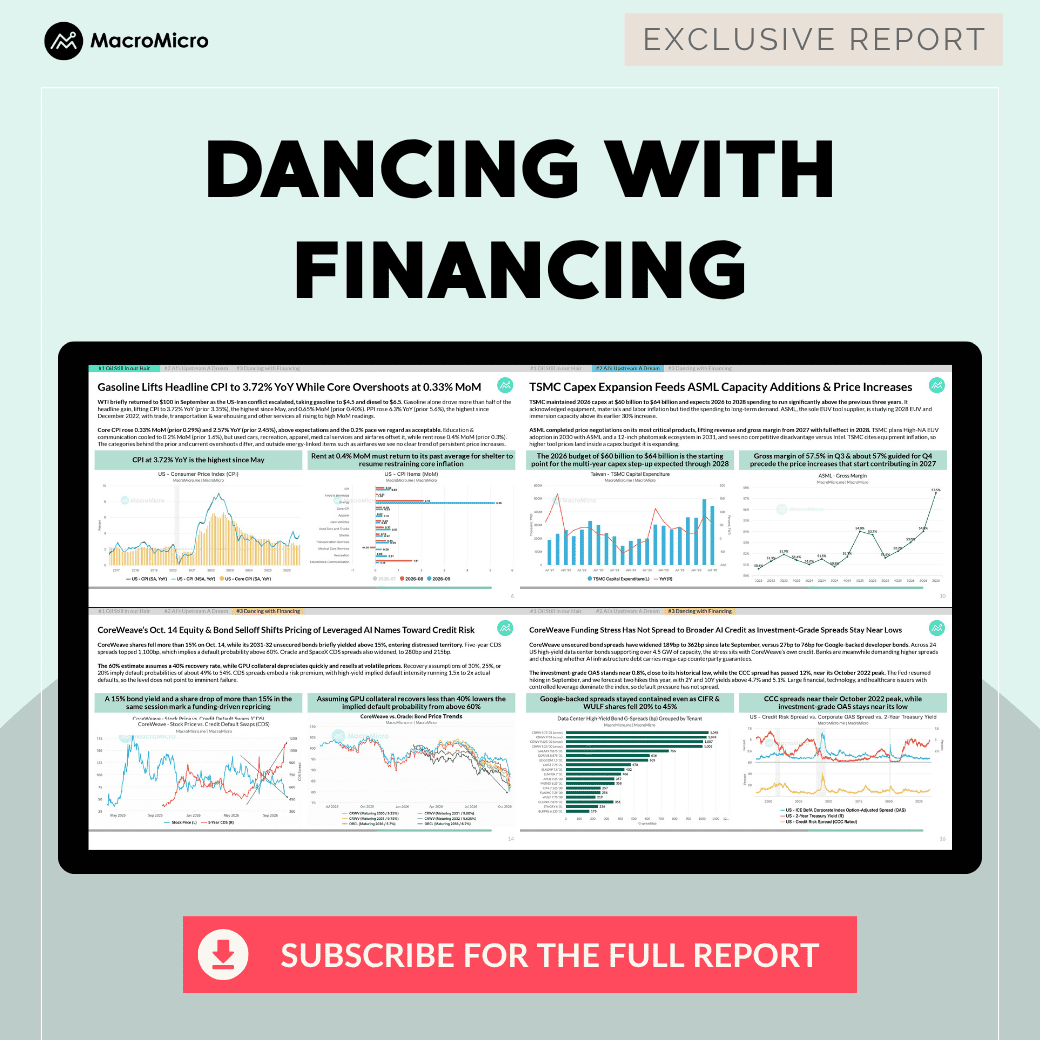
Oil Shock Reignites Inflation: October Pause, December Another Hike Likely
- Gasoline drove the headline CPI rebound. CPI reached 3.72% year over year and 0.65% month over month, its largest monthly rise in five months; the report says gasoline accounted for more than half of the monthly increase.
- Core inflation also overshot. Core CPI rose 0.33% month over month and 2.57% year over year; rent increased 0.4% month over month. The report views 0.2% monthly core inflation as an acceptable pace.
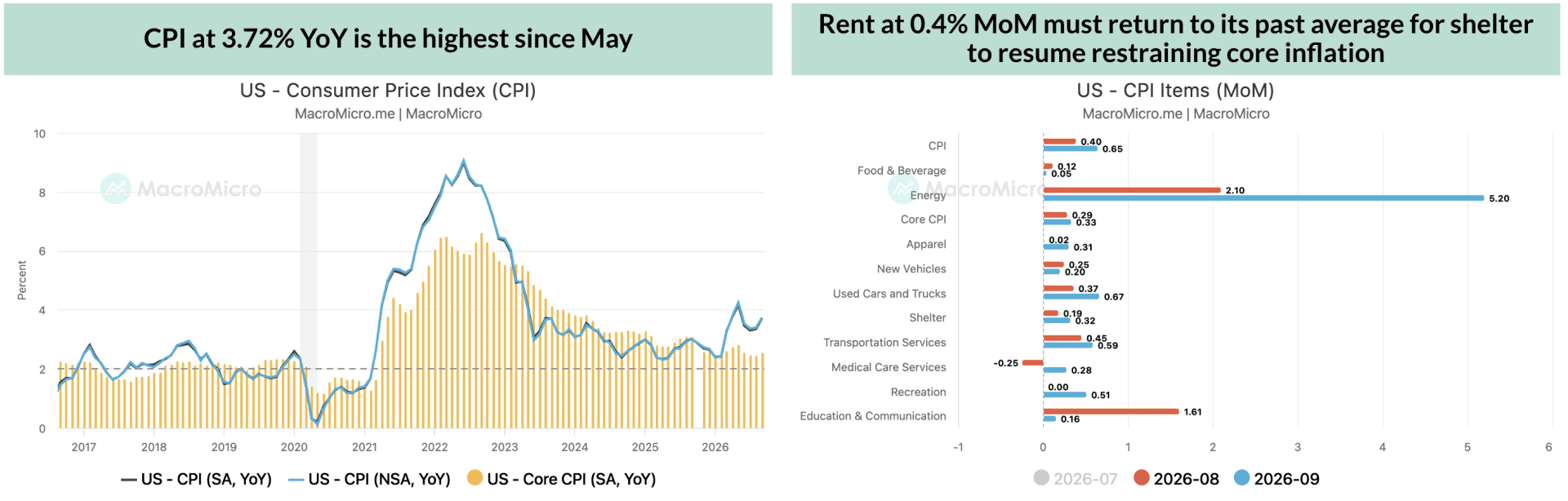
- The FedWatch path shifted toward a December hike. October hike odds fell from above 50% after the CPI release to 28.2% by October 15. The report expects an October hold, a December hike, two hikes in 2026, and a pause in 2027.
- Another core overshoot or rising expectations could change that call. The report says stronger AI capital spending could keep rates higher for longer and advises holding T-bills and cash while deferring long-duration bonds.
AI Chip Demand Extends the Semiconductor Investment Cycle
- CoreWeave’s market pricing moved into distressed territory. Shares fell more than 15% on October 14, unsecured bond yields briefly exceeded 15%, and five-year CDS spreads topped 1,100 basis points. The report’s default estimate exceeds 60% at a 40% recovery rate, but falls to roughly 49–54% under lower recovery assumptions.
AI Financing Risks Center on CoreWeave
- AI infrastructure is supporting bank growth. AI transactions generated more than half of year-to-date investment-banking fee growth; JPMorgan loans rose 10% to $1.5 trillion and net interest income rose 12% to $27 billion. Goldman Sachs revenue increased 28% to $18.3 billion.
Subscribe Now to Download the Full Report
About Weekly Economic and Financial Commentary (WEFC)
The MacroMicro WEFC is published weekly, delivering rigorous analysis and in-depth insights on the most critical market-moving events. Coverage spans equities, foreign exchange, bonds, commodities, global central banks, geopolitics, and the international political economy.
At its core is a concise, roughly 20-page Chart Pack designed to help you grasp market trends at a glance. Subscribe Now » to download the full PDF report, lock in the current offer before prices rise and secure your future upgrade to Max AI with full AI access.
Already a subscriber? Click here to log in.
Full Access to Our Services

Comprehensive data at your service
with key indicators for investment insights

Exclusive flash reports
on key events and data

Create your own charts and analysis
including performance backtesting

Hub of professionals to engage
in meaningful discussions and insights
 Get answers from MM AI.
-
How did gasoline prices influence the recent rise in US headline CPI?
💡Gasoline prices drove more than half of the monthly increase in the headline Consumer Price Index (CPI), which rebounded to 3.72% year over year and 0.65% month over month, marking its largest monthly rise in five months. This significant contribution from gasoline was a primary factor in the accelerated US inflation observed recently.
-
What caused the shift in FedWatch probabilities for a December interest rate hike?
💡The shift in FedWatch probabilities for a December interest rate hike was primarily caused by the acceleration of US inflation, particularly the gasoline-driven headline CPI rebound. Following the CPI release, October hike odds decreased from above 50% to 28.2% by October 15, while expectations for a December hike increased as the market priced in persistent inflationary pressures.
-
How is AI capital spending impacting the Federal Reserve's interest rate strategy?
💡AI capital spending is impacting the Federal Reserve's interest rate strategy by potentially keeping rates higher for longer. The report suggests that if stronger AI capital spending leads to sustained economic activity and inflationary pressures, the Fed may need to maintain a more hawkish stance than currently projected, thereby influencing the timing and magnitude of future rate adjustments.
-
How do TSMC and ASML's recent reports indicate robust AI chip demand?
💡TSMC and ASML's recent reports indicate robust AI chip demand as both companies reported demand exceeding supply. TSMC raised its 2026 US-dollar revenue growth outlook to approximately 44% after Q3 revenue beat expectations, and ASML's Q3 sales rose 55%, with management noting that supply in 2027–28 will not meet demand, extending to some customers inquiring about 2029–30 orders.
-
How will increased capacity spending affect semiconductor equipment pricing and margins?
💡Increased capacity spending will affect semiconductor equipment pricing and margins as ASML is studying more 2028 capacity and expects negotiated price increases to lift revenue and gross margin from 2027, with a full effect in 2028. TSMC also kept 2026 capital expenditure at $60–64 billion and anticipates spending through 2028 to exceed the prior three years, suggesting upward pressure on equipment pricing.
-
What is the impact of the N2 ramp on TSMC's gross margins in Q4?
💡The N2 ramp is expected to impact TSMC's gross margins in Q4 by causing an estimated 3–4 points of gross-margin dilution. Despite this, the Q4 gross-margin guidance remains between 65–67%, indicating that the company anticipates managing the initial costs associated with ramping up the advanced N2 node technology while still maintaining strong overall profitability.
-
What are the current market indicators of CoreWeave's financial distress?
💡Current market indicators of CoreWeave's financial distress include its shares falling more than 15% on October 14, unsecured bond yields briefly exceeding 15%, and five-year CDS spreads topping 1,100 basis points. These movements suggest significant investor concern regarding the company's financial health and ability to meet its obligations.
-
How is CoreWeave's free cash flow gap being funded by debt markets?
💡CoreWeave's free cash flow gap is being funded by debt markets, with the company covering a $10.5 billion free-cash-flow deficit in H1 by $11.53 billion of net new borrowing. This gap arose from H1 operating cash flow of approximately $3.66 billion against $14.12 billion of capital expenditures, indicating a heavy reliance on external financing to support its operations and growth.
-
Why is CoreWeave's credit stress not seen as a broader market issue?
💡CoreWeave's credit stress is not seen as a broader market issue because credit stress remains concentrated, with investment-grade spreads staying near 0.8% and CCC spreads exceeding 12%. CoreWeave's unsecured spreads widened 189 basis points to 362, significantly more than the 27–76 basis points for Google-backed developer bonds, indicating localized pressure rather than widespread default concerns.
-
What lessons from past funding cycles are relevant for current AI financing risks?
💡Lessons from past funding cycles relevant for current AI financing risks include the rapid closing of refinancing windows experienced by telecom and shale borrowers. This historical context highlights the importance of late-October guidance and close monitoring of large-platform capital expenditures and financing commentary, as AI-related investment-grade deals above $3 billion have already fallen to zero from September to mid-October.

