Global equities weakened last week as disappointing tech earnings and concerns about AI spending weighed on the markets. The S&P 500 fell about 0.6%, and the Nasdaq dropped roughly 2%. Investors also moved toward Treasuries, which pushed the 10-year yield down to around 4.93%. Additionally, markets were pricing in midterm uncertainty, with a Democratic sweep currently seen as the most likely outcome.
This week’s WEFC covers three themes: the Fed’s rate hold and the possibility of a December hike; resilient Q3 growth alongside energy-led inflation and thinner household savings; and the shift in AI investment from rising capex toward cash flow and monetization.
This Week's WEFC Preview
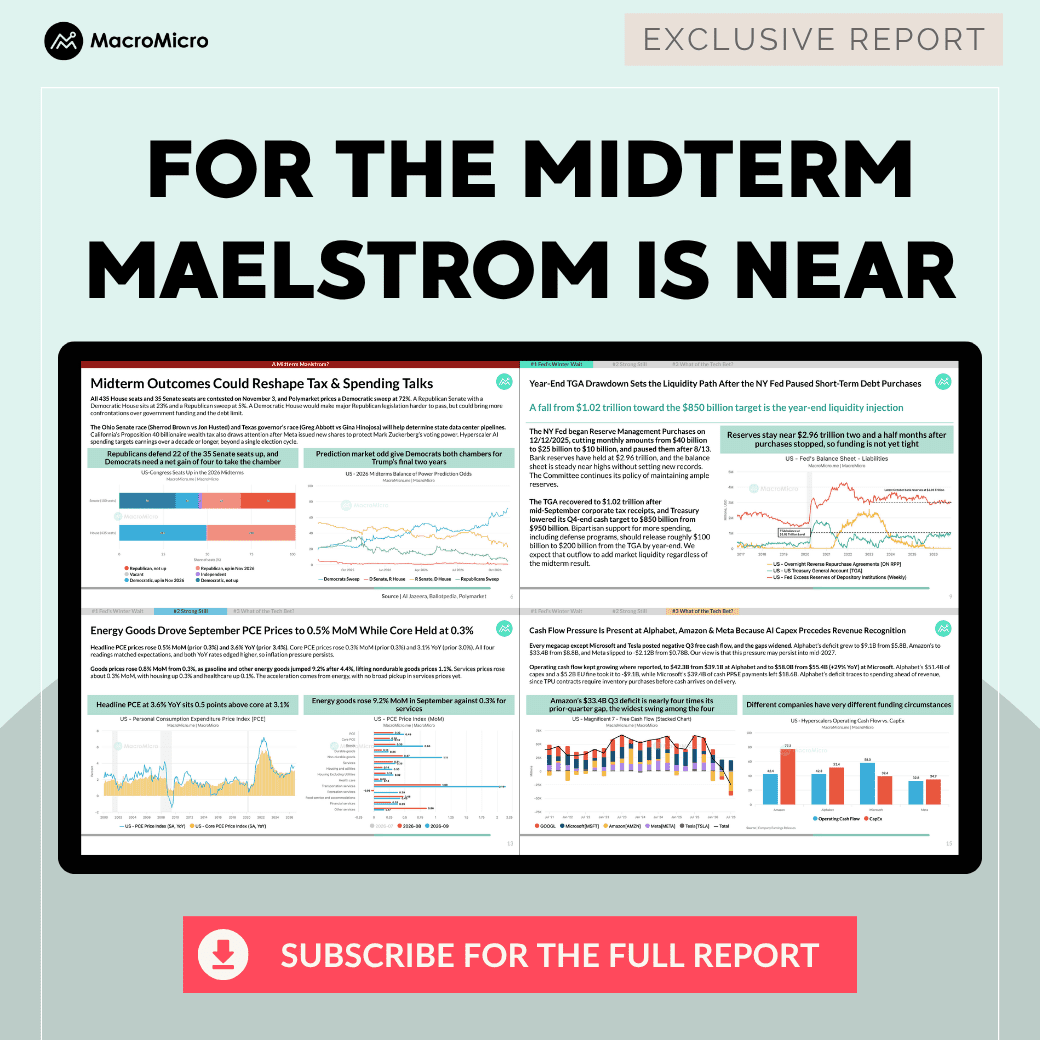
Tech Selloff Masks Broader Resilience as the Fed Holds
- Technology weakness drove the US equity decline. The S&P 500 fell about 0.6% and the Nasdaq roughly 2% as disappointing earnings and questions about AI returns weighed on large technology names; Intel dropped nearly 29% on its outlook.
- Other regions were more resilient. European equities generally advanced, Asian markets were mixed to softer, and investors moved toward Treasuries; the 10-year yield fell about 5–6 basis points to 4.93%–4.94% while the dollar index stayed near 102.
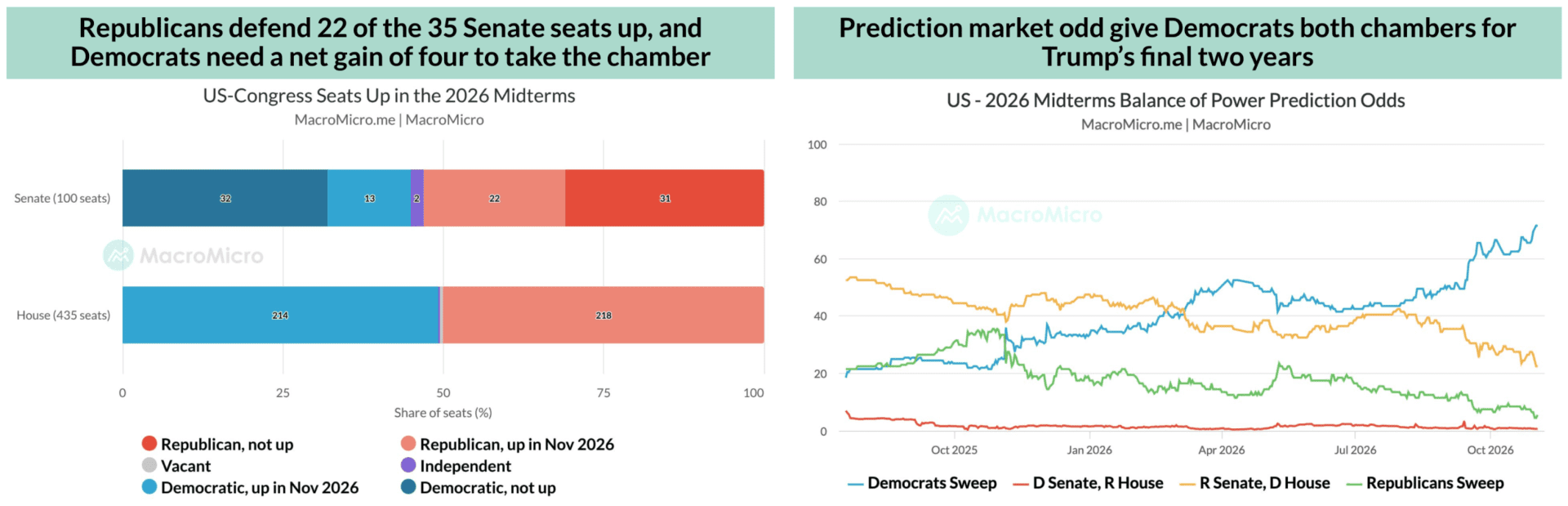
- Markets were also pricing midterm uncertainty. Polymarket put a Democratic sweep at 72%, a Democratic House with a Republican Senate at 23%, and a Republican sweep at 5%. A Democratic House could complicate Republican legislation and intensify funding and debt-limit disputes.
- The Fed held rates, while energy and geopolitics kept attention on inflation. Gold fell around 3% to the mid-$3,800s, while oil remained elevated amid supply concerns.
Fed Pauses as Credit Tightens and Year-End Liquidity Builds
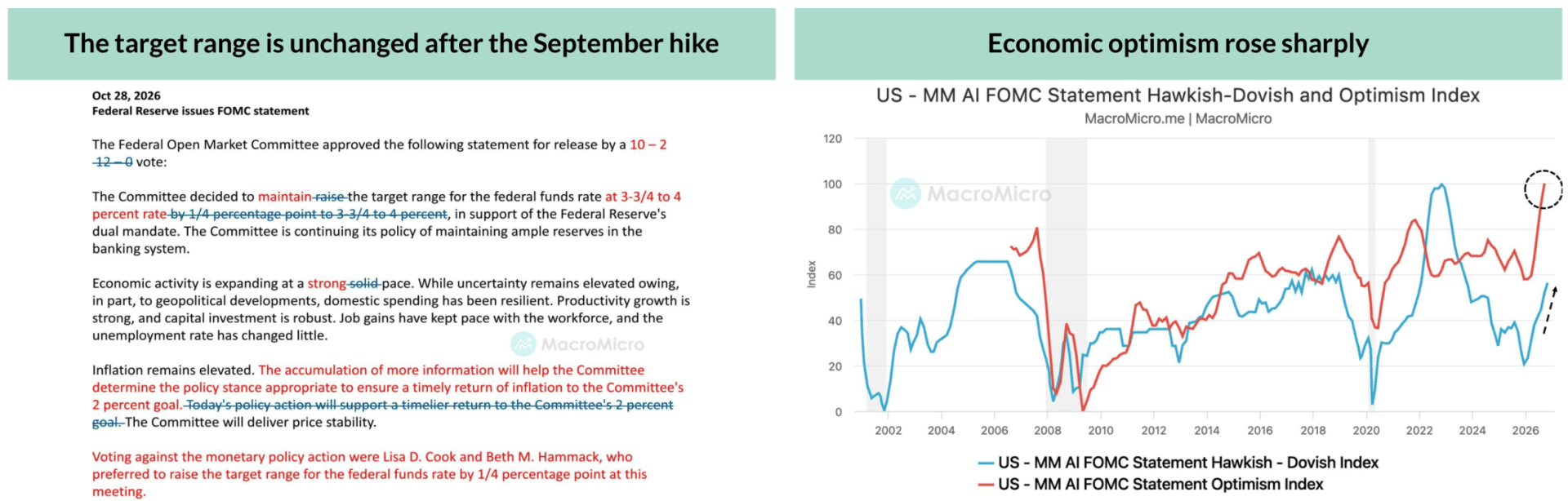
- The FOMC voted 10:2 to hold at 3.75%–4.00%. Lisa Cook and Beth Hammack dissented in favor of a 25-basis-point hike. The statement described the economy as strong, while the commentary read the decision as a pause without a renewed hawkish shift.
- Tighter credit and softer hiring supported the hold. Payrolls rose just 29,000 and unemployment reached 4.2%; the Fed cited wider spreads for some borrowers. Gasoline prices eased in October, limiting the near-term case for another inflation jump.
- Treasury cash drawdown may add liquidity by year-end. The Treasury lowered its Q4 cash target to $850 billion from $950 billion after the TGA reached $1.02 trillion. The report expects a $100–$200 billion outflow, while bank reserves remained near $2.96 trillion after NY Fed purchases paused.
- A December hike remains possible amid Q4 inflation risks. FedWatch odds rose to 87% from 78% before the meeting, even as the two-year yield fell below 4.73%. The report identifies oil and post-midterm US-Iran developments as key variables.

Subscribe Now to Download the Full Report
About Weekly Economic and Financial Commentary (WEFC)
The MacroMicro WEFC is published weekly, delivering rigorous analysis and in-depth insights on the most critical market-moving events. Coverage spans equities, foreign exchange, bonds, commodities, global central banks, geopolitics, and the international political economy.
At its core is a concise, roughly 20-page Chart Pack designed to help you grasp market trends at a glance. Subscribe Now » to download the full PDF report, lock in the current offer before prices rise and secure your future upgrade to Max AI with full AI access.
Already a subscriber? Click here to log in.
Full Access to Our Services

Comprehensive data at your service
with key indicators for investment insights

Exclusive flash reports
on key events and data

Create your own charts and analysis
including performance backtesting

Hub of professionals to engage
in meaningful discussions and insights
 Get answers from MM AI.
-
How did disappointing tech earnings affect global equity markets last week?
💡Disappointing tech earnings, combined with concerns about AI spending, led to a weakening in global equity markets last week, causing the S&P 500 to fall approximately 0.6% and the Nasdaq to drop roughly 2%. This downturn was specifically driven by underperforming large technology names, including Intel, which saw its share price decline nearly 29% due to its outlook.
-
Which factors supported the Federal Open Market Committee's decision to hold rates?
💡The Federal Open Market Committee's decision to hold rates at 3.75%–4.00% was supported by tighter credit conditions and softer hiring data, with payrolls rising just 29,000 and unemployment reaching 4.2%. The Fed also noted wider spreads for some borrowers, and easing gasoline prices in October further limited the immediate case for another inflation jump.
-
What were the key drivers behind the accelerated 3.4% annualized Q3 GDP growth?
💡Accelerated Q3 GDP growth of 3.4% annualized was primarily driven by strong consumer spending, which grew 3.8% and contributed approximately 2.5 percentage points, and significant investment. Private investment rose 19.4%, including 12.7% growth in nonresidential fixed investment, with inventory rebuilding also adding about 1.6 points to the overall growth.
-
What caused September PCE inflation to edge higher, particularly energy prices?
💡September PCE inflation edged higher primarily due to a sharp increase in energy prices, with energy goods prices jumping 9.2% month over month. Overall, headline PCE rose 0.5% month over month and 3.6% year over year, while core PCE increased 0.3% and 3.1% respectively, indicating that energy costs were a key inflationary factor.
-
How did AI infrastructure spending affect free-cash-flow deficits for tech giants?
💡AI infrastructure spending is significantly widening free-cash-flow deficits for several major tech giants, with Alphabet reporting a $9.1 billion Q3 deficit, Amazon $33.4 billion, and Meta $2.12 billion. This trend is expected to persist into mid-2027, as companies invest heavily in AI capabilities, although Microsoft remained positive with an $18.6 billion free cash flow.
-
How do substantial backlogs indicate continued AI investment trends?
💡Substantial backlogs indicate continued robust AI investment trends, as evidenced by Google Cloud's backlog rising $47 billion quarter over quarter to $561 billion and Microsoft's commercial RPO reaching $677 billion, up 73% year over year. These large and growing backlogs signify strong demand for cloud services and AI-related infrastructure, reinforcing the ongoing investment trajectory in the sector.
-
What were the key reasons for Intel's nearly 29% drop in share price?
💡Intel's share price dropped nearly 29% due to a disappointing outlook that contributed to broader technology weakness in the US equity market. This decline was part of a larger trend where concerns about AI returns and underwhelming earnings weighed on large technology names, leading to a significant market reaction.
