Last week, the U.S. and Iran reopened talks on a temporary agreement over the Strait of Hormuz, helping risk sentiment recover. Combined with Friday’s weaker-than-expected nonfarm payrolls report, which lowered the market-implied probability of another Fed rate hike, the 10-year U.S. Treasury yield, the Dollar Index, and oil prices all moved lower. Gold surged more than 7%, while global equities rebounded sharply. South Korea’s market, however, still fell 5.1%, suggesting that fading price-hike narratives and deleveraging pressure remain unresolved. See this week’s WEFC analysis for details.
Subscribe Now to Download the Full Report
This Week's WEFC Preview
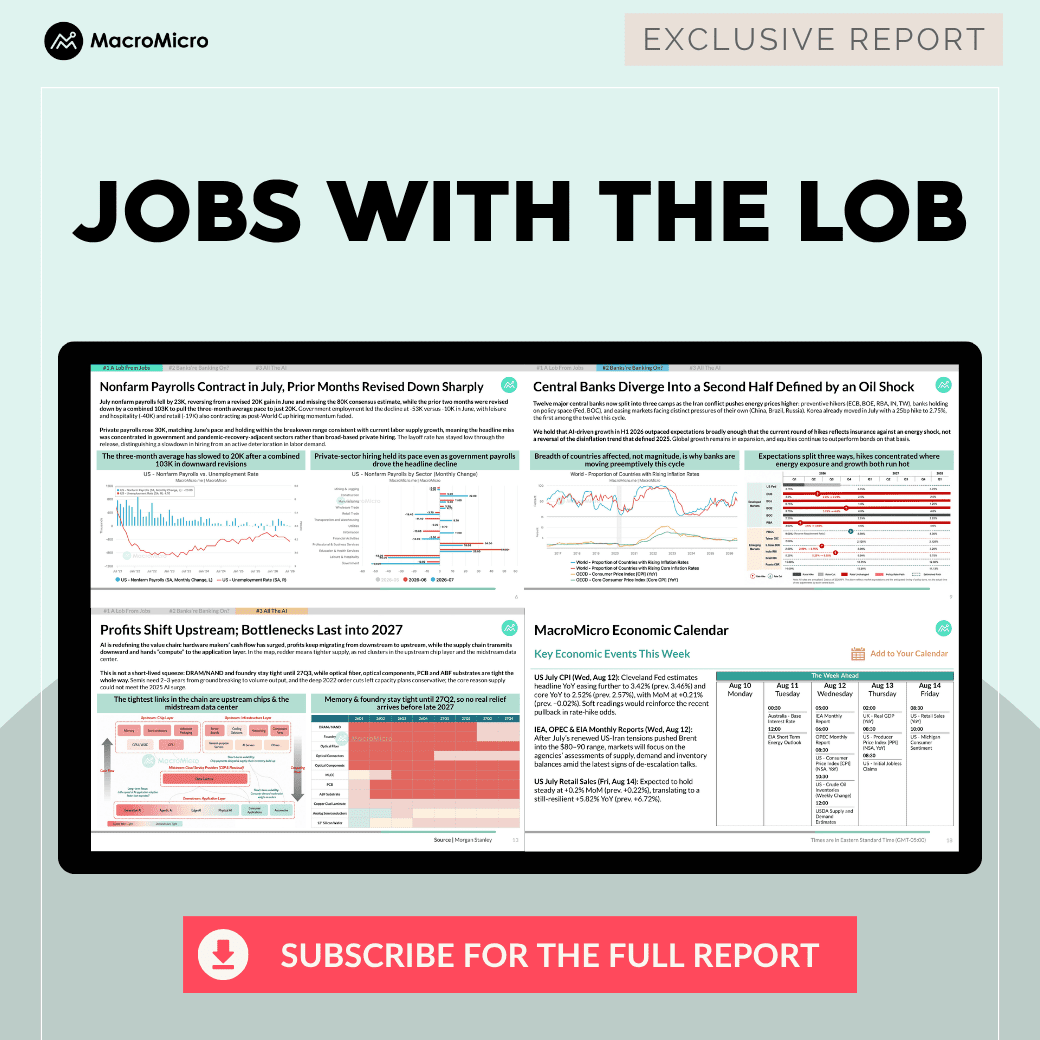
Weak Jobs Data Turns the Fed’s Hawkish Case into a CPI-Dependent Trade:
The July jobs report did more than cool a hawkish Fed narrative; it exposed how thin the case for another near-term hike has become. Payrolls slipped by 23,000, prior months were revised down by 103,000, and wage growth stayed contained at 3.2% year over year. With the Fed already holding at 3.50%–3.75%, markets are now treating the next CPI print as the real swing factor—not employment strength—as September hike odds fall below 50%. That shifts risk from terminal-rate fear toward data-dependency and curve relief.
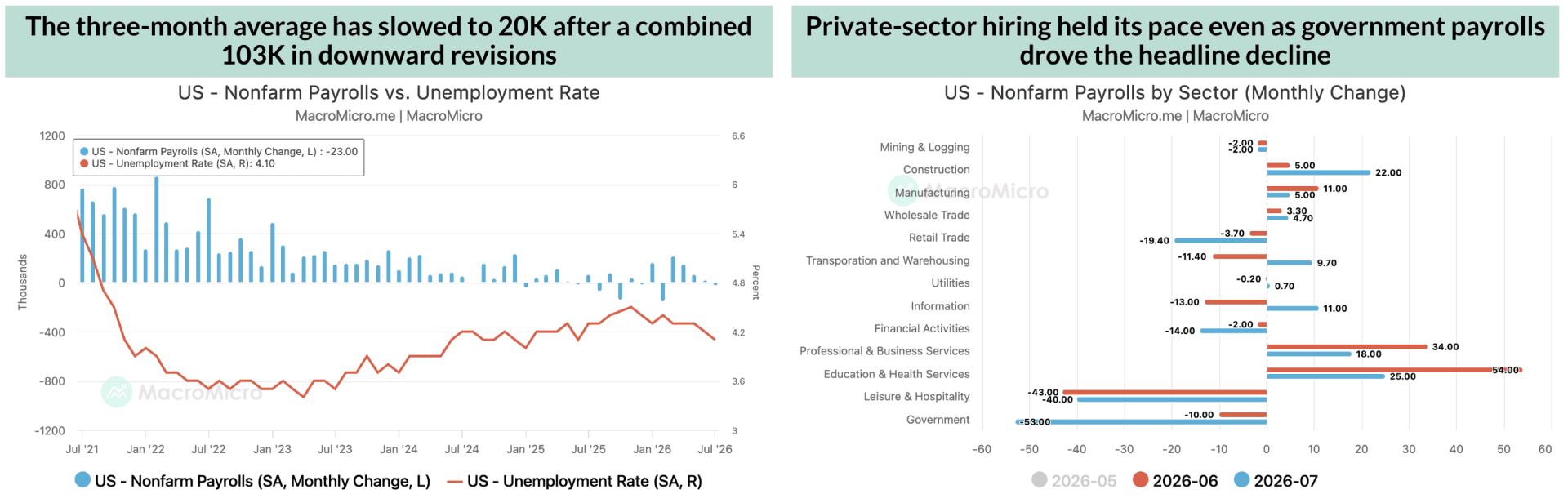
AI Supply Chain Power Is Shifting Toward Bottleneck Owners:
The most important AI signal is no longer only Nvidia’s order book; it is the capex behavior of the suppliers that must physically deliver the cycle. TSMC’s record second-quarter profit and upgraded 2026 capex plan to $60–64 billion point to confidence in advanced-node and CoWoS demand, while SK Hynix’s multiyear expansion underscores how HBM remains the scarcest strategic input. The implication is powerful: AI winners may increasingly be determined by bottleneck control, not just model leadership or end-market revenue narratives.
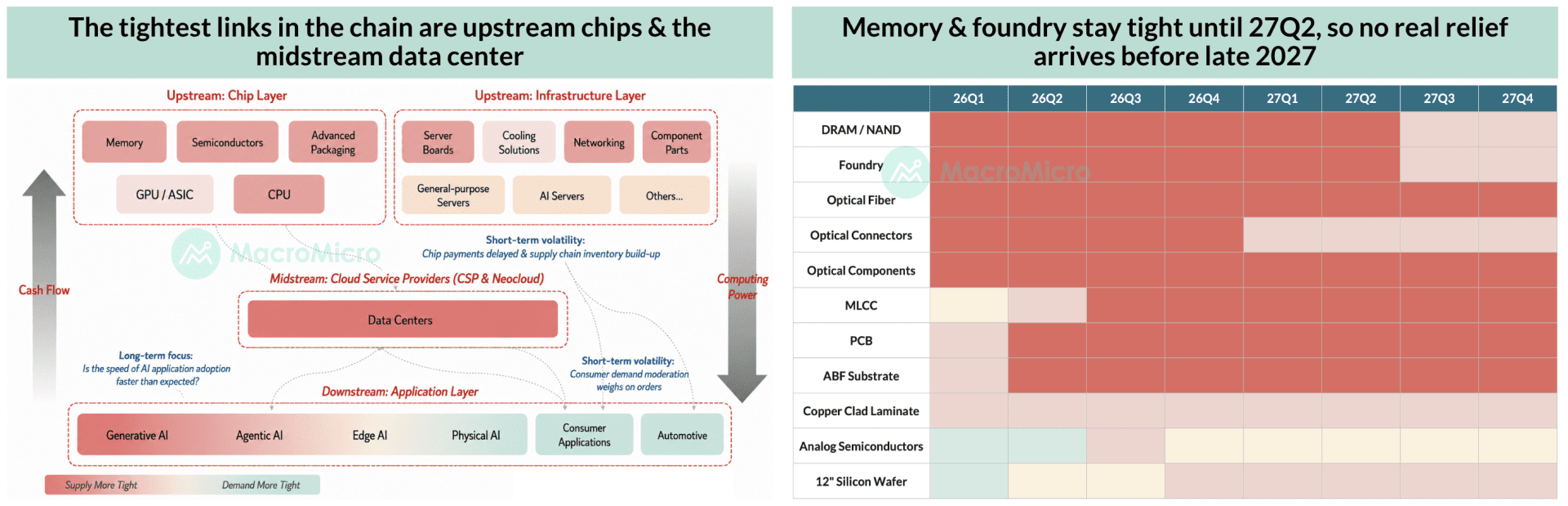
Central Banks Are No Longer Moving in the Same Direction:
Global monetary policy is moving from synchronized caution to sharper regional divergence. The Fed has lost some room to sound hawkish after weaker payrolls, the ECB is balancing energy-driven inflation risks against fragile growth, the BoE is holding Bank Rate at 3.75% while warning against inflation persistence, and the BoJ is facing rising pressure to accelerate hikes. For markets, the key shift is that currency and energy shocks—not domestic demand alone—may set the next phase of rate volatility across yield curves.
Subscribe Now to Download the Full Report
About Weekly Economic and Financial Commentary (WEFC)
The MacroMicro WEFC is published weekly, delivering rigorous analysis and in-depth insights on the most critical market-moving events. Coverage spans equities, foreign exchange, bonds, commodities, global central banks, geopolitics, and the international political economy.
At its core is a concise, roughly 20-page Chart Pack designed to help you grasp market trends at a glance. Subscribe Now » to download the full PDF report, lock in the current offer before prices rise and secure your future upgrade to Max AI with full AI access.
Already a subscriber? Click here to log in.
Full Access to Our Services

Comprehensive data at your service
with key indicators for investment insights

Exclusive flash reports
on key events and data

Create your own charts and analysis
including performance backtesting

Hub of professionals to engage
in meaningful discussions and insights
 Get answers from MM AI.
-
How did the July jobs report impact the Federal Reserve's hawkish stance on interest rate hikes?
💡The July jobs report significantly cooled the Federal Reserve's hawkish stance, making the case for another near-term hike much thinner. Payrolls decreased by 23,000, and prior months were revised down by 103,000, causing September hike odds to fall below 50%. This shifts the market's focus from terminal-rate fears to data-dependency, particularly on the next CPI print, rather than employment strength, for future rate decisions.
-
Why is the next CPI print now considered a critical factor for the Federal Reserve's September hike decision?
💡The next CPI print is now considered a critical factor for the Federal Reserve's September hike decision because the July jobs report weakened the hawkish narrative, making employment strength less of a determinant. With payrolls down 23,000 and prior months revised lower by 103,000, markets are now treating inflation data as the primary swing factor, causing September hike odds to fall below 50%.
-
Which companies are emerging as key beneficiaries of AI supply chain bottlenecks, beyond Nvidia?
💡Beyond Nvidia, TSMC and SK Hynix are emerging as key beneficiaries of AI supply chain bottlenecks. TSMC's record second-quarter profit and upgraded 2026 capex plan of $60–64 billion reflect confidence in advanced-node and CoWoS demand. SK Hynix's multiyear expansion highlights the strategic importance of High Bandwidth Memory (HBM) as a scarce input, positioning these companies as critical players in AI infrastructure.
-
How is global monetary policy evolving from synchronized caution to regional divergence among central banks?
💡Global monetary policy is evolving from synchronized caution to sharper regional divergence, with central banks no longer moving in the same direction. The Federal Reserve's hawkish stance has weakened after weaker payrolls, while the European Central Bank balances energy-driven inflation against fragile growth. The Bank of England maintains its rate at 3.75% due to inflation persistence, and the Bank of Japan faces pressure to accelerate hikes, indicating disparate policy paths globally.
-
What pressures are causing the Bank of Japan to consider accelerating interest rate hikes?
💡The Bank of Japan is facing rising pressure to accelerate interest rate hikes as global monetary policy moves from synchronized caution to sharper regional divergence. This pressure is likely driven by domestic economic conditions and potentially by currency and energy shocks, which are influencing the next phase of rate volatility across global yield curves, moving the BoJ away from its ultra-loose policy stance.
