Markets last week focused on China and the US extending their trade truce by two months. Equities rallied broadly over the week before edging lower on September 28. Hawkish Fed remarks pushed the 10-year Treasury yield to fresh highs, briefly above 5.2%, lifting October hike odds, while gold fell 2.36%.
This week's WEFCcovers the two-month US-China truce, the US outlook and our preventive-hike call, new highs in global bond yields, and oil supply bottlenecks.
This Week's WEFC Preview
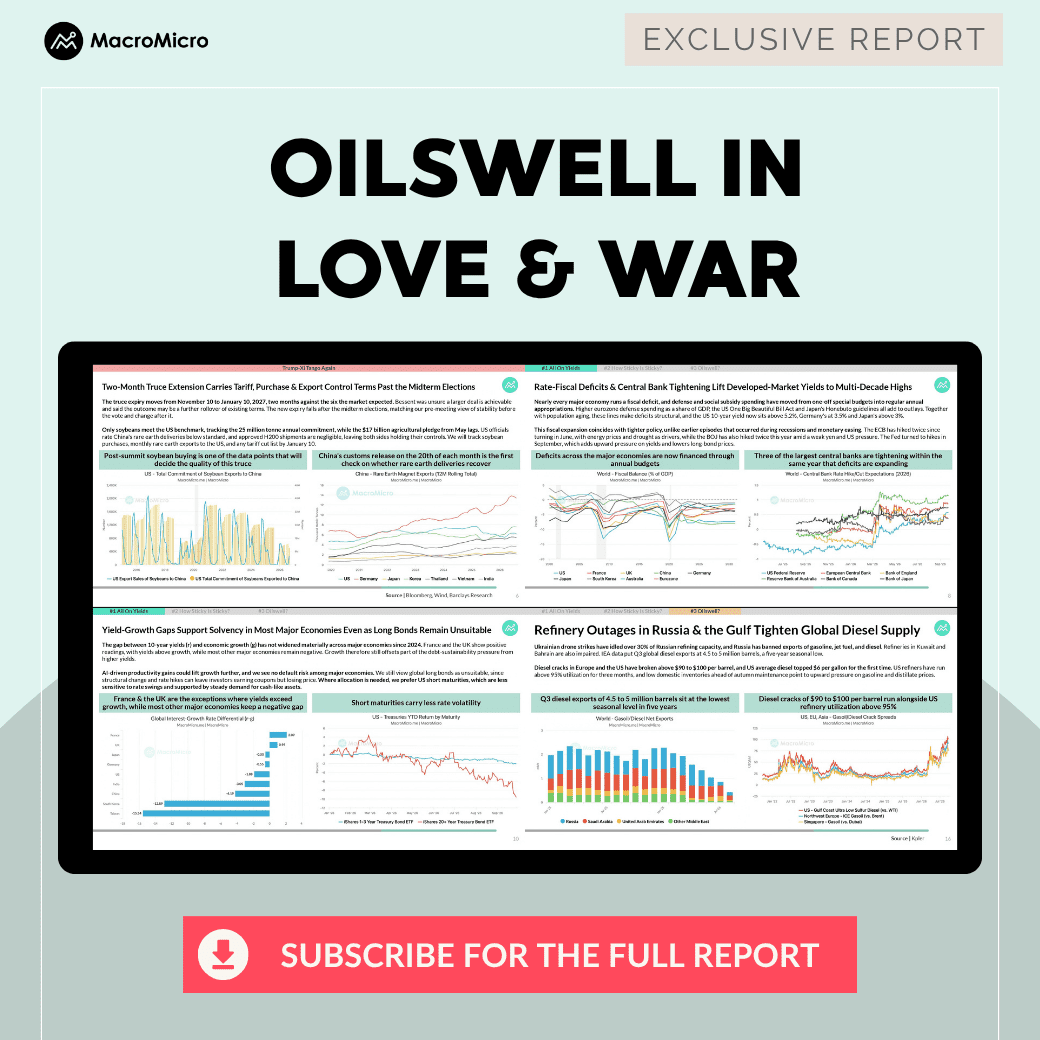
1. US-China Talks Deliver Only a Two-Month Truce
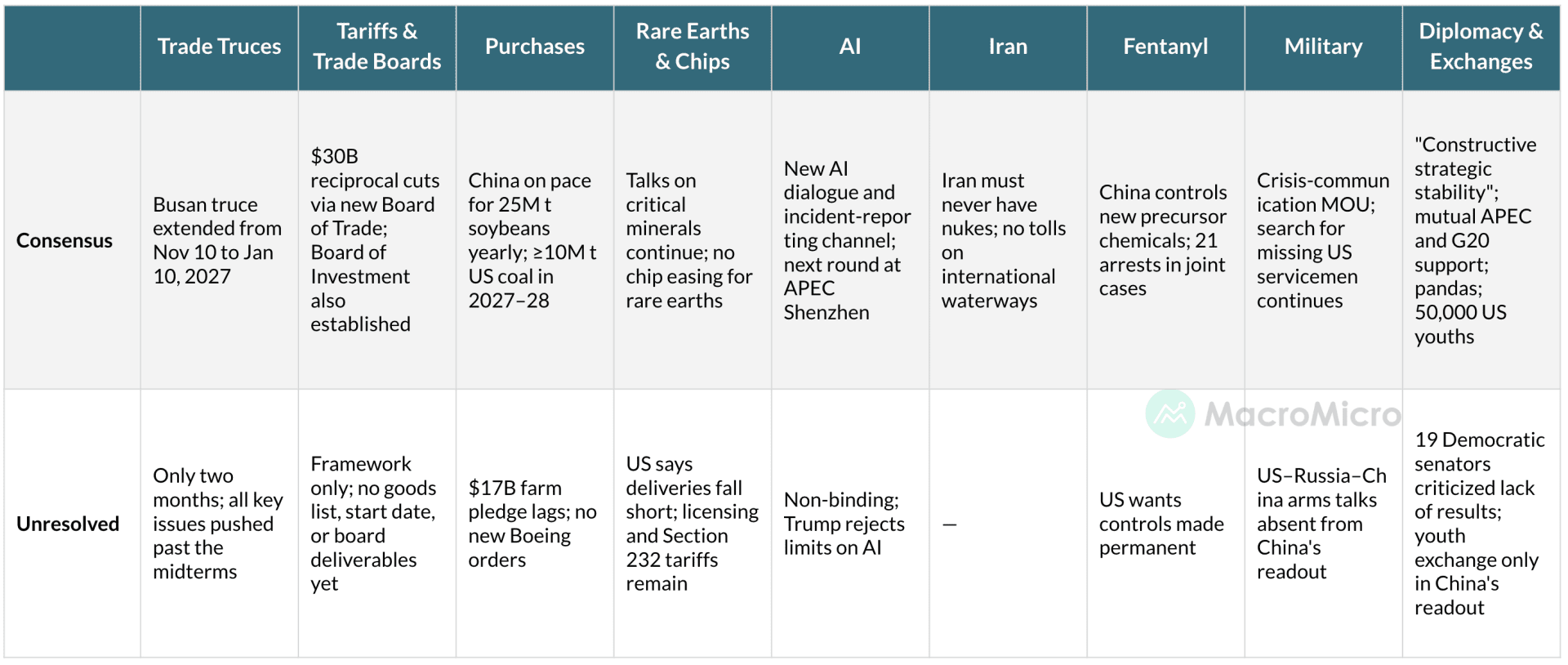
- The truce was extended by only two months. Expiry moves from November 10 to January 10, 2027, against the six-plus months the market expected. Bessent was unsure a larger deal is achievable and said the outcome may be a further rollover of existing terms.
- The new cliff falls after the midterm elections. Tariffs, purchases, rare earths and tech controls are all pushed to the next round, matching our pre-meeting view of stability before the vote and change after it.
- The summit's only named new deliverable is an AI incident channel. The $30 billion tariff cut remains a framework with no list, and there were no Boeing, rare-earth or chip breakthroughs.
- Only soybeans meet the US benchmark. Purchases track the 25 million tonne annual commitment, but the $17 billion agricultural pledge from May lags. US officials rate China's rare earth deliveries below standard, and approved H200 shipments are negligible, so both sides keep their controls.
- Execution, not wording, will judge the truce. We will track soybean purchases, monthly rare earth exports to the US, and any tariff cut list before January 10.
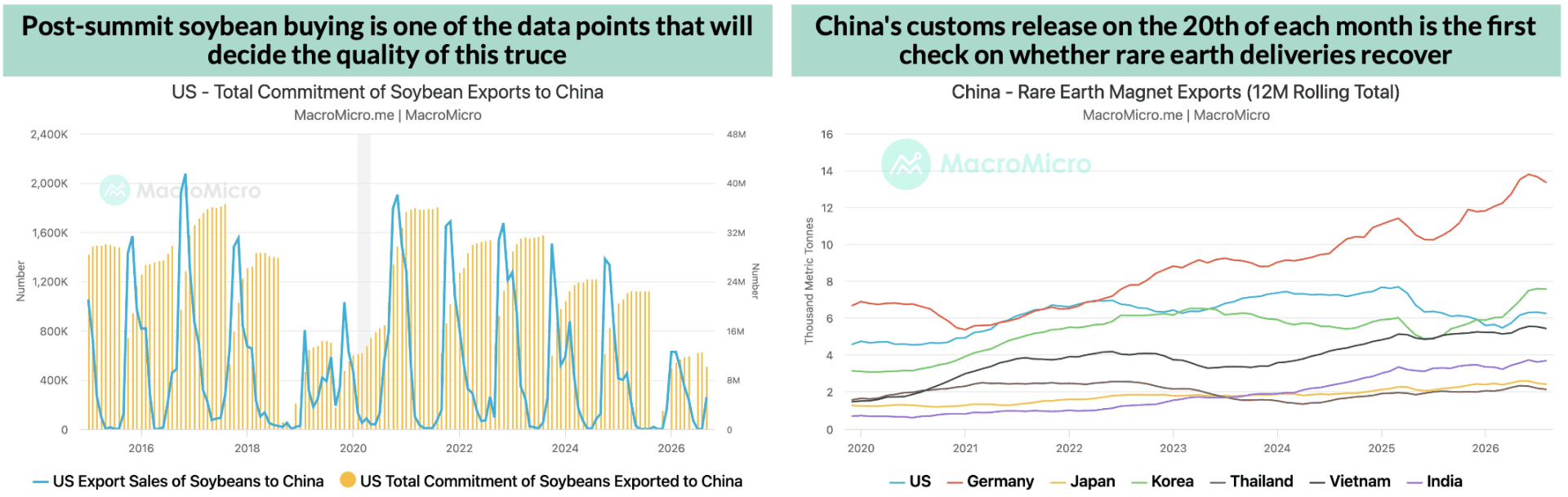
▌Related Charts & Articles: US - Total Commitment of Soybean Exports to China · China, US, Australia, Myanmar - Rare Earths Mine Production (USGS Estimates) · China - Rare Earth Mine Production & Global Share
US Economic Outlook: Inflation Risk Remains Low, and We Expect a Preventive Hike
- Core progress stalled, prompting the September hike. Core CPI held at 2.5% YoY while headline edged up to 3.4% (prior 3.3%); core momentum firmed to 0.3% MoM (prior 0.2%), slightly above expectations.
- There is no stickiness outside oil. The headline-core gap widened to 0.9 points from 0.8, which makes it an oil question. Core goods eased to 0.1% MoM, core services at 0.3% is short of an extreme high, and sticky CPI YoY sits at a new low since 2021, so a small preventive hike is sufficient.
Subscribe Now to Download the Full Report
About Weekly Economic and Financial Commentary (WEFC)
The MacroMicro WEFC is published weekly, delivering rigorous analysis and in-depth insights on the most critical market-moving events. Coverage spans equities, foreign exchange, bonds, commodities, global central banks, geopolitics, and the international political economy.
At its core is a concise, roughly 20-page Chart Pack designed to help you grasp market trends at a glance. Subscribe Now » to download the full PDF report, lock in the current offer before prices rise and secure your future upgrade to Max AI with full AI access.
Already a subscriber? Click here to log in.
Full Access to Our Services

Comprehensive data at your service
with key indicators for investment insights

Exclusive flash reports
on key events and data

Create your own charts and analysis
including performance backtesting

Hub of professionals to engage
in meaningful discussions and insights
 Get answers from MM AI.
-
What is the duration of the US-China trade truce extension?
💡The US-China trade truce has been extended by two months, moving its expiry from November 10 to January 10, 2027. This extension was shorter than the six-plus months the market expected, and observers like Bessent are uncertain if a larger deal is achievable, suggesting a potential further rollover of existing terms.
-
What new deliverable was named during the US-China summit regarding AI?
💡The only new deliverable named during the US-China summit regarding AI is the establishment of an AI incident channel. Other significant issues such as the $30 billion tariff cut list, Boeing purchases, rare-earth breakthroughs, and chip agreements remain unresolved, consistent with a pre-meeting view of stability before the midterm elections and potential changes thereafter.
-
How did core CPI and headline CPI change in the US recently?
💡Core CPI in the US recently held at 2.5% YoY, while headline CPI edged up to 3.4% from a prior 3.3%. Core momentum firmed to 0.3% MoM, slightly above expectations, leading to a September hike, primarily due to the widening gap between headline and core inflation driven by oil prices.
-
What factors suggest that US inflation stickiness is primarily oil-related?
💡US inflation stickiness is primarily oil-related because the headline-core CPI gap widened to 0.9 points from 0.8, indicating that inflation outside of oil remains subdued. Core goods eased to 0.1% MoM, core services are at 0.3% (not an extreme high), and sticky CPI YoY sits at a new low since 2021, suggesting a small preventive hike is sufficient to manage inflation.
-
Why do preventive hikes fit a strong US economy?
💡Preventive hikes fit a strong US economy because equities can continue to rise when interest rate increases are accompanied by strong earnings momentum. Key indicators to track are oil prices and sticky CPI YoY, as these factors will determine the necessity and impact of future preventive rate adjustments in a robust economic environment.
-
What factors are contributing to the structural increase in global government deficits?
💡Structural increases in global government deficits are largely driven by defense and social subsidy spending being integrated into regular annual budgets. Examples include higher eurozone defense spending, the US One Big Beautiful Bill Act, and Japan's Honebuto guidelines, pushing 10-year yields above 5.2% in the US, 3.5% in Germany, and 3% in Japan.
-
Which major economies show government bond yields exceeding their GDP growth rates?
💡France and the UK are the major economies that show government bond yields exceeding their GDP growth rates (r-g). Despite this, the analysis indicates no immediate default risk among major economies, though it suggests that long bonds remain unsuitable, with a preference for US short maturities due to less rate volatility.
-
What are the current inventory levels for visible and Cushing crude oil?
💡Visible and Cushing crude oil inventories currently sit at multi-year lows. This critically thin buffer makes sharp price swings more frequent and raises the likelihood of non-linear risks, with future scenarios heavily dependent on geopolitical events such as a US-Iran ceasefire or an extended war into 2027.
-
How have Middle East oil exports been constrained recently?
💡Middle East oil exports have been constrained recently by the US naval blockade since July 12, which cut Iranian exports to near zero, and a drone attack on Saudi Arabia's east-west pipeline. Consequently, Saudi Red Sea loadings halved to about 2 million barrels in August, and Saudi output of 6.24 million b/d was its lowest since 1990.
-
What impact have Ukrainian strikes had on Russian refining capacity and diesel exports?
💡Ukrainian strikes have idled over 30% of Russian refining capacity, significantly tightening diesel supply. This resulted in Q3 diesel exports of 4.5–5 million barrels, a five-year seasonal low, causing cracks to exceed $90–$100 and pushing US diesel prices above $6 per gallon due to reduced availability.

