Global equities were mixed last week. The Fed's first hike in three years pushed the 10-year Treasury yield above 5.0%, a near two-decade high, though tech rebounded with the Nasdaq up 0.72%. German and French stocks fell 1.03% and 1.4%. The dollar index rose 1.1%, while the yen weakened toward 157 despite a BOJ hike. WTI fell back below $100.
This week's WEFC covers three themes: the Fed's hiking path, fiscal limits on global central banks, and AI bottlenecks moving down the hardware stack.
This Week's WEFC Preview
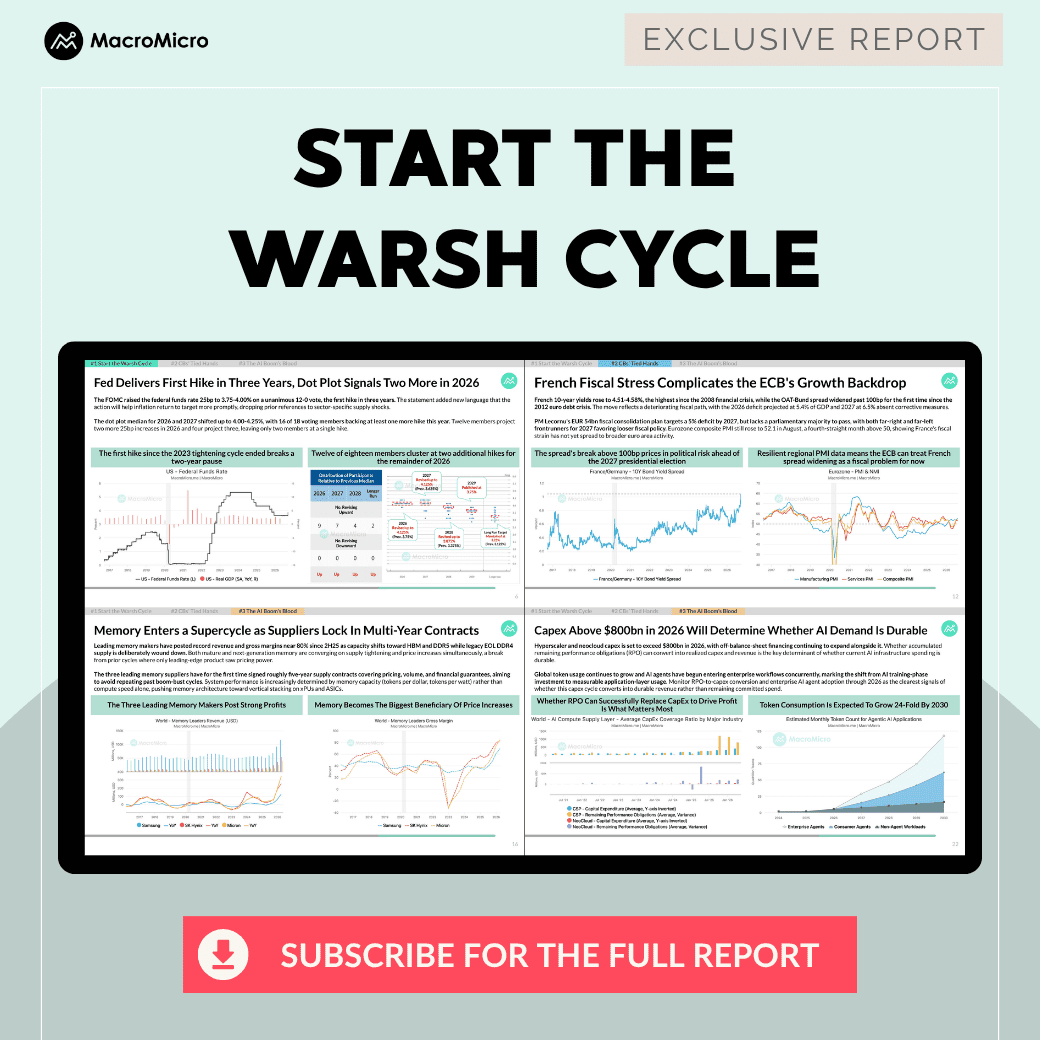
Fed Turns the Corner as Growth Absorbs Higher Rates
- Fed hikes 25bp to 3.75-4.00% in a unanimous 12-0 vote, its first hike in three years. The statement added that the action will help inflation return to target more promptly, dropping prior references to sector-specific supply shocks.
- Dot plot points to two more hikes in 2026. The 2026-2027 median shifted up to 4.00-4.25%, with 16 of 18 members backing at least one more hike this year; twelve project two more 25bp moves and four project three.
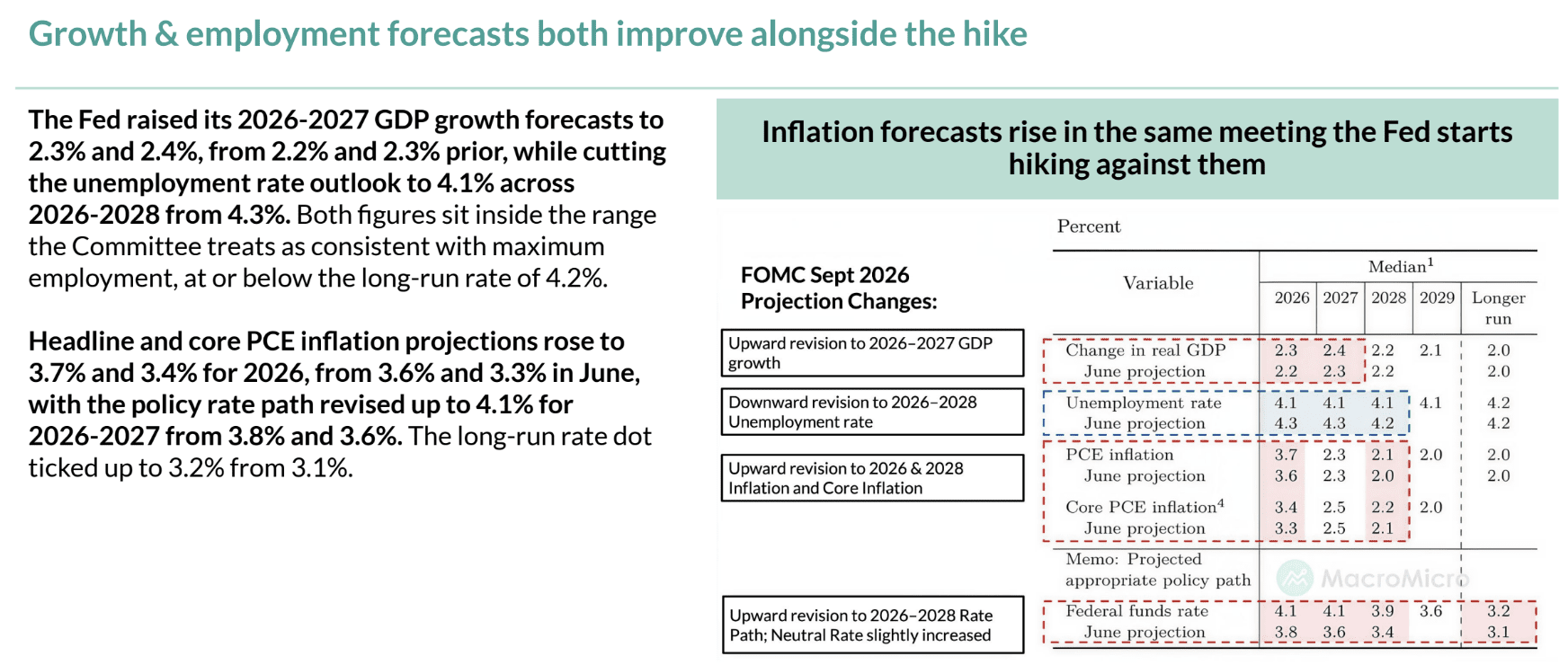
- SEP shows growth and employment improving alongside the hike. 2026-2027 GDP forecasts rose to 2.3% and 2.4%, the unemployment outlook fell to 4.1% for 2026-2028 from 4.3%, and 2026 headline/core PCE rose to 3.7%/3.4%. The long-run rate dot ticked up to 3.2%.
- Reserves hold near $3tn despite the end of bill purchases. Reserves stayed at $2.99tn after RMP purchases stopped in August, while a lower Q4 TGA target of $850bn implies $100-200bn of drawdown available to support reserves.
- Warsh frames the hike as an overdue correction; MM sees growth absorbing the rate path. Warsh cited stronger data, unconvincing summer inflation, and shifting geopolitical risk, noting conditions are hard to call restrictive. The Cleveland Fed nowcast puts September core CPI at a contained 0.2% MoM, retail sales accelerated to 6.01% YoY, and futures price a majority chance of an October hike.
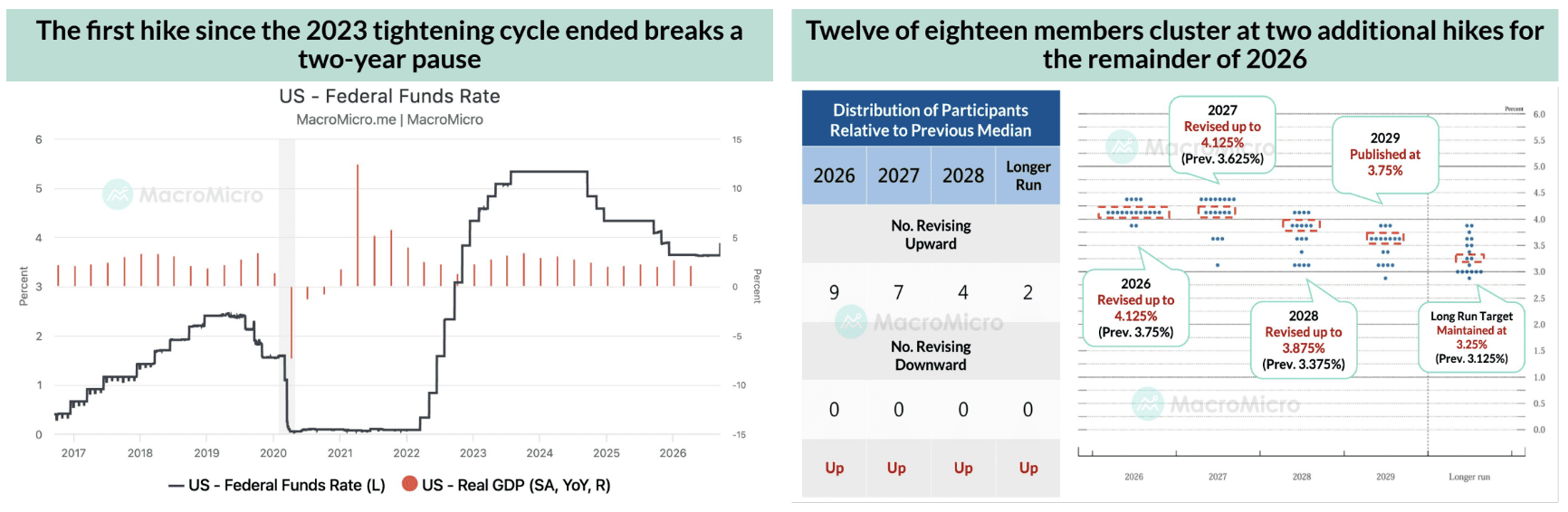
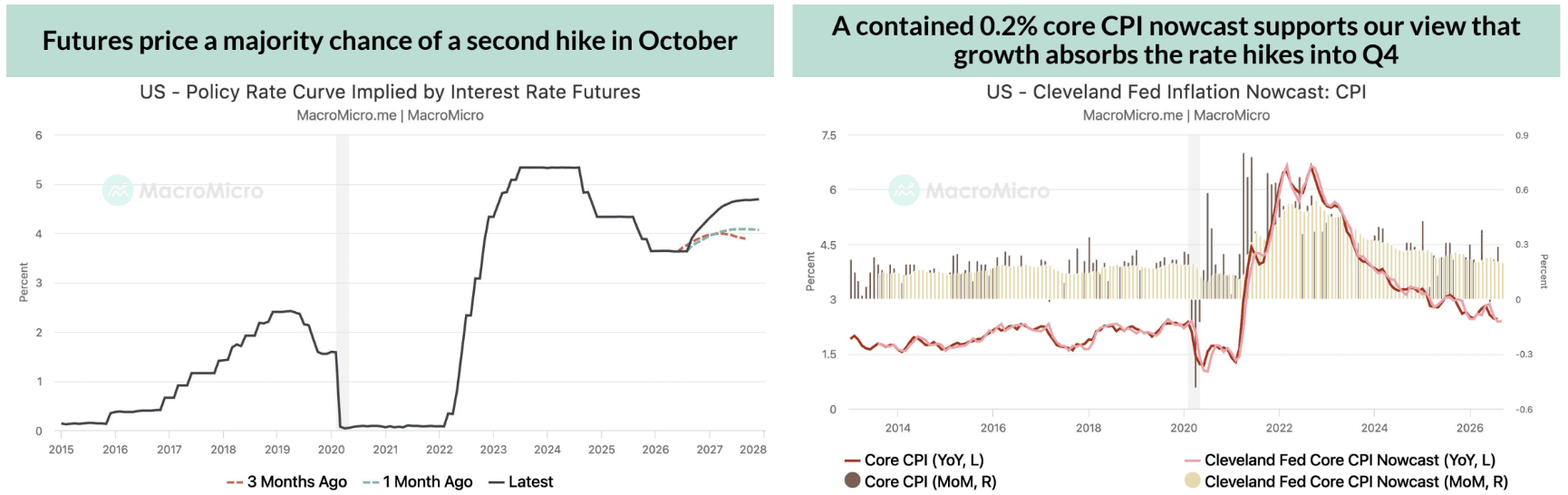
▌Related Charts & Articles:US Policy Rate Curve Implied by Futures · Cleveland Fed Inflation Nowcast · US Federal Funds Rate · Dot plot distribution
2. Global Tightening Runs Into the Sovereign Debt Wall
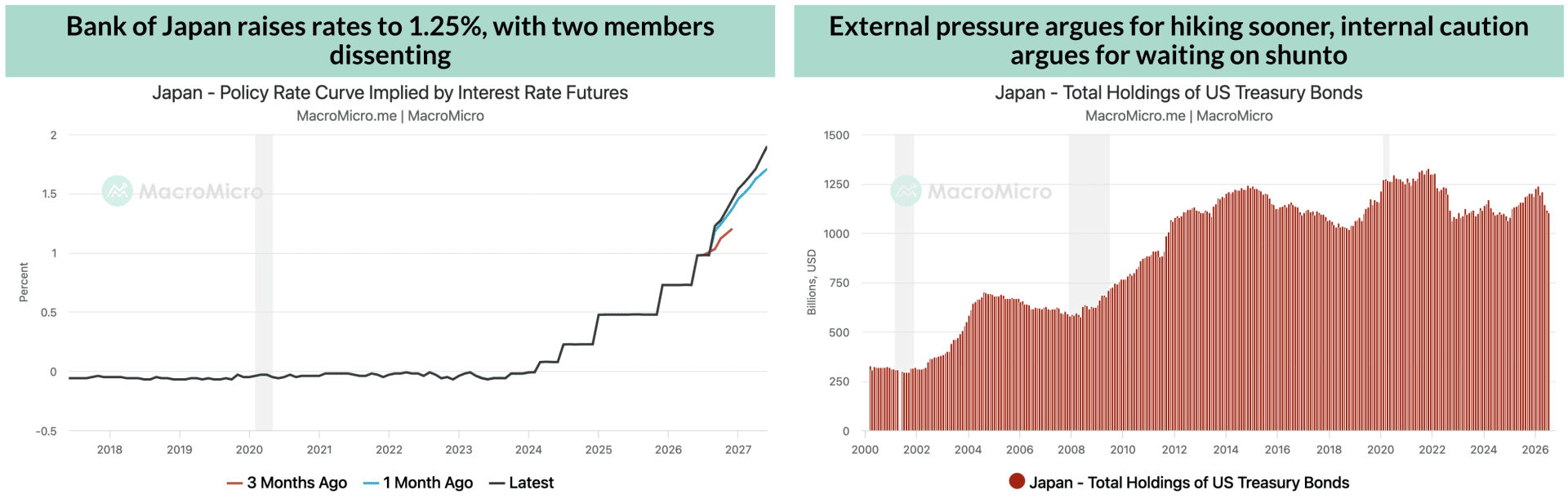
- BOJ hikes to 1.25% on a 7-2 vote, but constraints cap further moves. Two Takaichi appointees dissented as core CPI sits below 2%, Q3 real consumption weakened, and the FY2027 budget request hit a record JPY 143.1tn. Japan's USD 87.8bn of August foreign securities sales gives Washington a stake in further hikes; Ueda flagged the 2027 shunto as the key data point.
- ECB delivers its second 2026 hike, taking the deposit rate to 2.50%. August HICP accelerated to 3.3% on a 14.3% YoY jump in energy prices, while core eased to 2.4% and services to 3.0%, framing the move as an insurance hike against entrenchment.
- French fiscal stress complicates the ECB backdrop. French 10-year yields rose to 4.51-4.58% and the OAT-Bund spread broke above 100bp, as deficits are projected at 5.4% and 6.5% of GDP in 2026-2027. Euro area composite PMI of 52.1 shows the strain has not yet spread.
- BOE holds at 3.75% and reshapes QT to clear the path for a November hike. Three members dissented for an immediate hike with CPI at 3.1%. Pausing active gilt sales cut the 30-year yield 12bp to 5.74%.
- Sovereign debt capacity has replaced inflation as the limit on hikes. The US and Germany need 0.8-1.1 additional points of growth to stabilize debt, while Japan needs 1.6, France 2.0, and the UK 2.3, mapping onto this week's three constrained hikers.
Subscribe Now to Download the Full Report
Note: Due to the holiday, next week's WEFC release will be delayed to Tuesday, September 29.
About Weekly Economic and Financial Commentary (WEFC)
The MacroMicro WEFC is published weekly, delivering rigorous analysis and in-depth insights on the most critical market-moving events. Coverage spans equities, foreign exchange, bonds, commodities, global central banks, geopolitics, and the international political economy.
At its core is a concise, roughly 20-page Chart Pack designed to help you grasp market trends at a glance. Subscribe Now » to download the full PDF report, lock in the current offer before prices rise and secure your future upgrade to Max AI with full AI access.
Already a subscriber? Click here to log in.
Full Access to Our Services

Comprehensive data at your service
with key indicators for investment insights

Exclusive flash reports
on key events and data

Create your own charts and analysis
including performance backtesting

Hub of professionals to engage
in meaningful discussions and insights
 Get answers from MM AI.
-
How did the Fed's first rate hike in three years impact the 10-year Treasury yield and tech stocks?
💡The Fed's first rate hike in three years pushed the 10-year Treasury yield above 5.0%, reaching a near two-decade high. Despite this, tech stocks rebounded, with the Nasdaq index rising by 0.72%.
-
How does MacroMicro interpret the economic conditions in light of the Fed's recent interest rate hike?
💡MacroMicro interprets the economic conditions, following the Fed's rate hike, as growth being able to absorb the higher rates. This perspective is supported by the Cleveland Fed nowcast projecting September core CPI at a contained 0.2% MoM, retail sales accelerating to 6.01% YoY, and futures pricing a majority chance of an October hike, suggesting resilient economic activity.
-
What factors are constraining the Bank of Japan's ability to implement further monetary tightening?
💡The Bank of Japan's ability to implement further monetary tightening is constrained by several factors, including core CPI remaining below 2%, weakened Q3 real consumption, and a record FY2027 budget request of JPY 143.1tn. Additionally, Japan's significant August foreign securities sales, totaling USD 87.8bn, give Washington a vested interest in further hikes, while BOJ Governor Ueda has identified the 2027 shunto (spring wage negotiations) as a crucial data point.
-
How did the ECB's second 2026 hike affect Eurozone HICP and what are the underlying inflation drivers?
💡The ECB's second 2026 hike, which raised the deposit rate to 2.50%, occurred as August HICP accelerated to 3.3% due to a 14.3% YoY jump in energy prices. While core HICP eased to 2.4% and services to 3.0%, the move was framed as an insurance hike to prevent entrenchment of inflation.
-
What adjustments did the Bank of England make to its Quantitative Tightening program?
💡The Bank of England held its policy rate at 3.75% and reshaped its Quantitative Tightening (QT) program to clear the path for a potential November hike. This adjustment involved pausing active gilt sales, which subsequently cut the 30-year yield by 12 basis points to 5.74%. This decision was made despite three members dissenting for an immediate hike, with CPI at 3.1%.
-
What indicates the memory market is entering a supercycle, particularly for HBM and DDR5?
💡The memory market is entering a supercycle, particularly for HBM and DDR5, evidenced by leading manufacturers posting record revenues and gross margins near 80%. Additionally, for the first time, the top three suppliers have signed roughly five-year supply contracts, signaling sustained demand and pricing power as capacity shifts to these advanced memory types.
-
Where are the current AI supply chain bottlenecks beyond chip manufacturing, impacting packaging and substrates?
💡Current AI supply chain bottlenecks extend beyond chip manufacturing into packaging, substrates, and printed circuit boards (PCBs). Specifically, chiplet integration increases demand for ABF (Ajinomoto Build-up Film) and CoWoS (Chip-on-Wafer-on-Substrate) interposer area, while CCL (Copper Clad Laminate) suppliers face tight supply of glass fiber cloth and copper foil as specifications move to M7-M9 grades, indicating scarcity in these critical components.
-
How will the growth in token consumption and AI agents impact enterprise workflows by 2030?
💡The growth in token consumption, expected to increase 24-fold by 2030, and the increasing integration of AI agents will significantly impact enterprise workflows by making them more automated and efficient. This expansion implies a deeper penetration of AI into business operations, leading to transformative changes in how tasks are performed, data is analyzed, and decisions are made across various industries.
