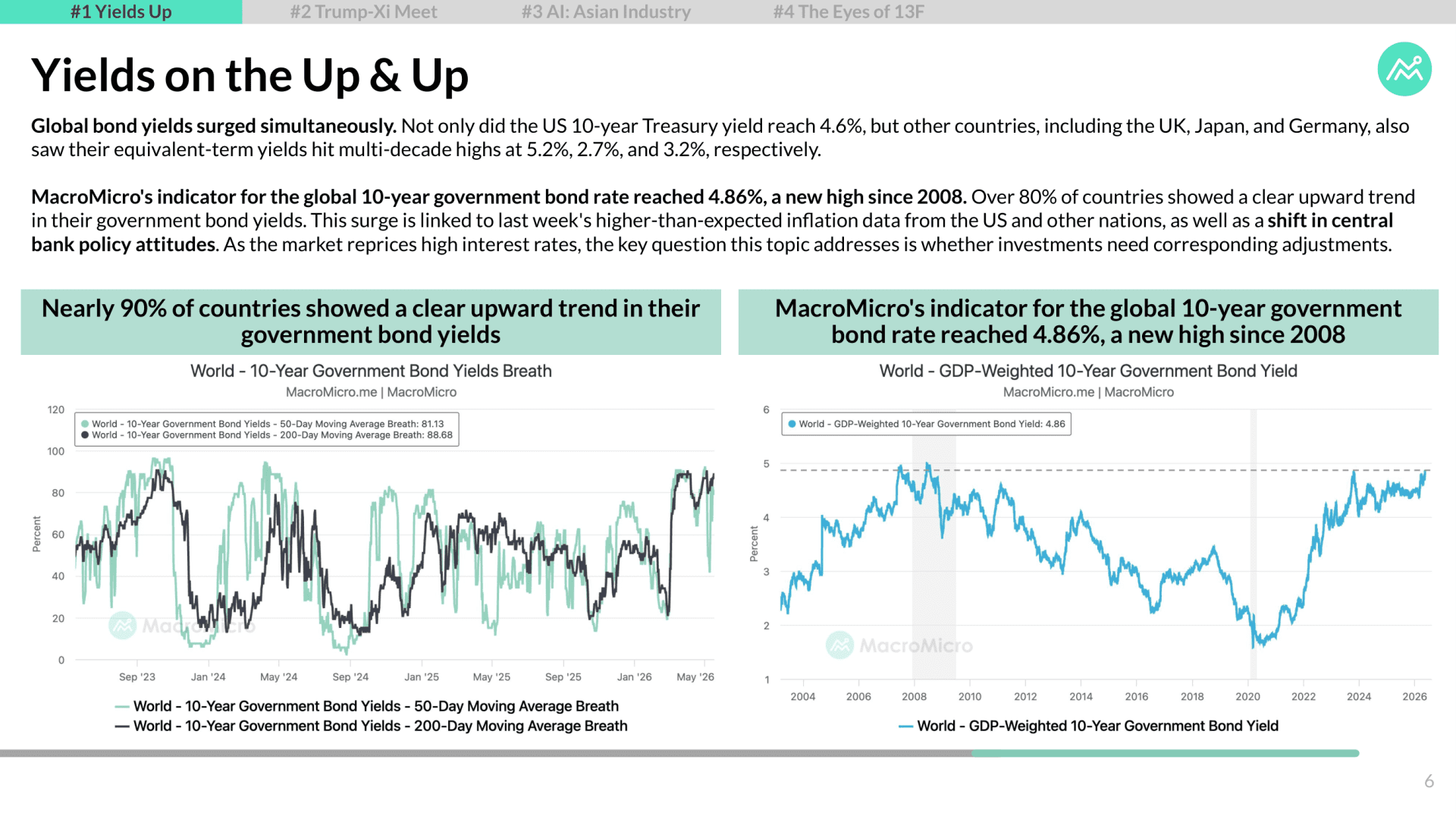
From May 13 to 15, President Trump returned to Beijing for the first time in nine years and held his first meeting with Xi Jinping this year. Although the summit ended in a peaceful tone, markets were unconvinced. Global bond yields surged together, with the US 30-year Treasury yield reaching 5.15%, its highest level since the Global Financial Crisis, while yields in the UK, Germany, and Japan also hit multi-decade highs.
Why did bond markets react so pessimistically? This week’s WEFC explains what investors are really worried about.
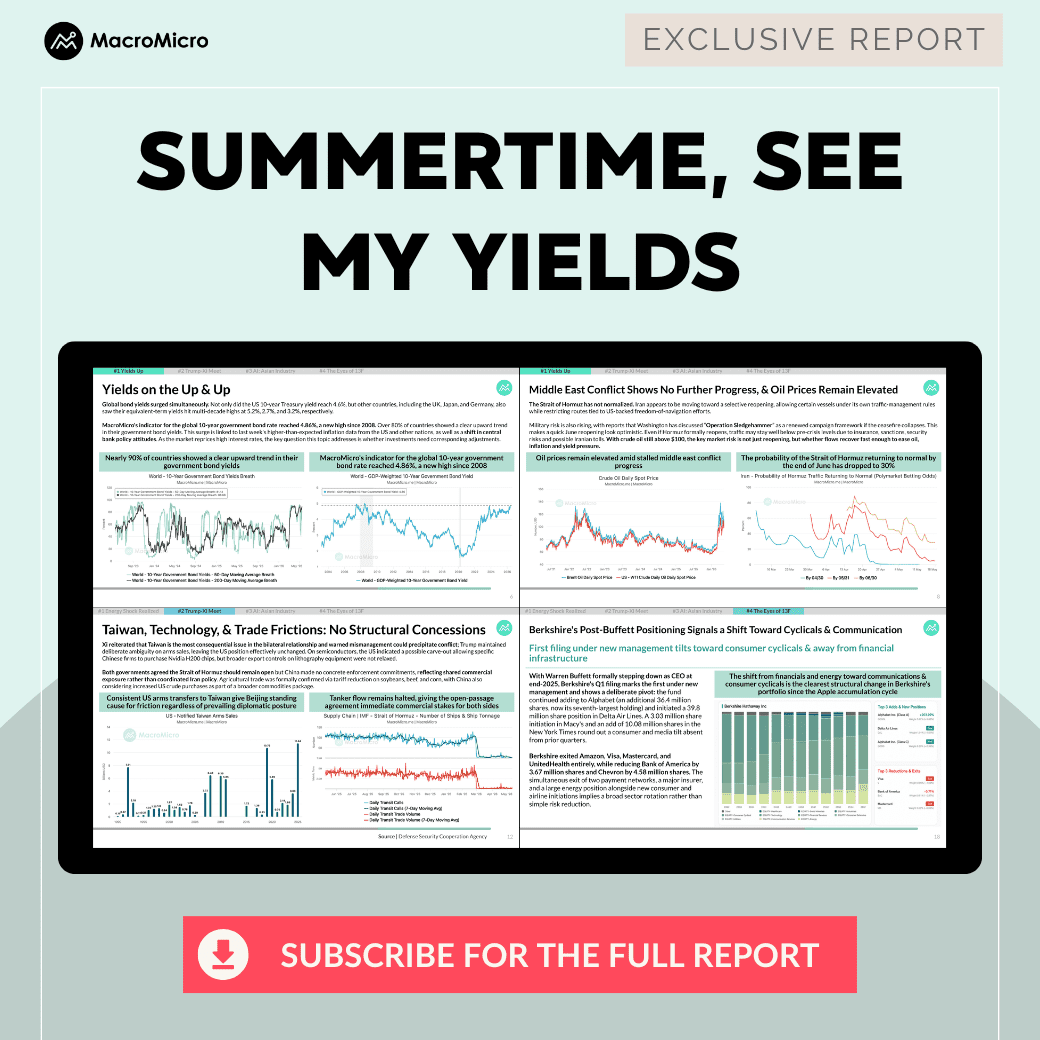
Key Focus of This Week’s Report
1. The Global Yield Reset Has Begun: The move above 4.6% in US 10-year yields matters less as an isolated rate shock than as confirmation of a synchronized global bond selloff. With nearly 90% of countries seeing yields trend higher and the global 10-year rate reaching a post-2008 high, investors are being forced to reassess whether long-duration exposure still provides protection. The key implication is blunt: assets that depend on rate cuts look exposed, while equities tied to nominal growth, AI productivity, and pricing power may still deserve capital even in a higher-rate world.
2. Taiwan’s AI Supply Chain Is Becoming a National Growth Engine: The sharper takeaway is not that both markets benefit from AI, but that they benefit in different ways. Taiwan’s 13.69% Q1 GDP growth, 73% electronics and ICT export share, and 127% trade-to-GDP ratio make it the clearest macro signal for AI hardware demand. Korea, however, has the more compressed equity setup: GDP growth was only 3.6%, yet the KOSPI rose 81% year-to-date as DRAM prices jumped more than 40% for two straight quarters. Taiwan confirms the cycle; Korea monetizes the scarcity.
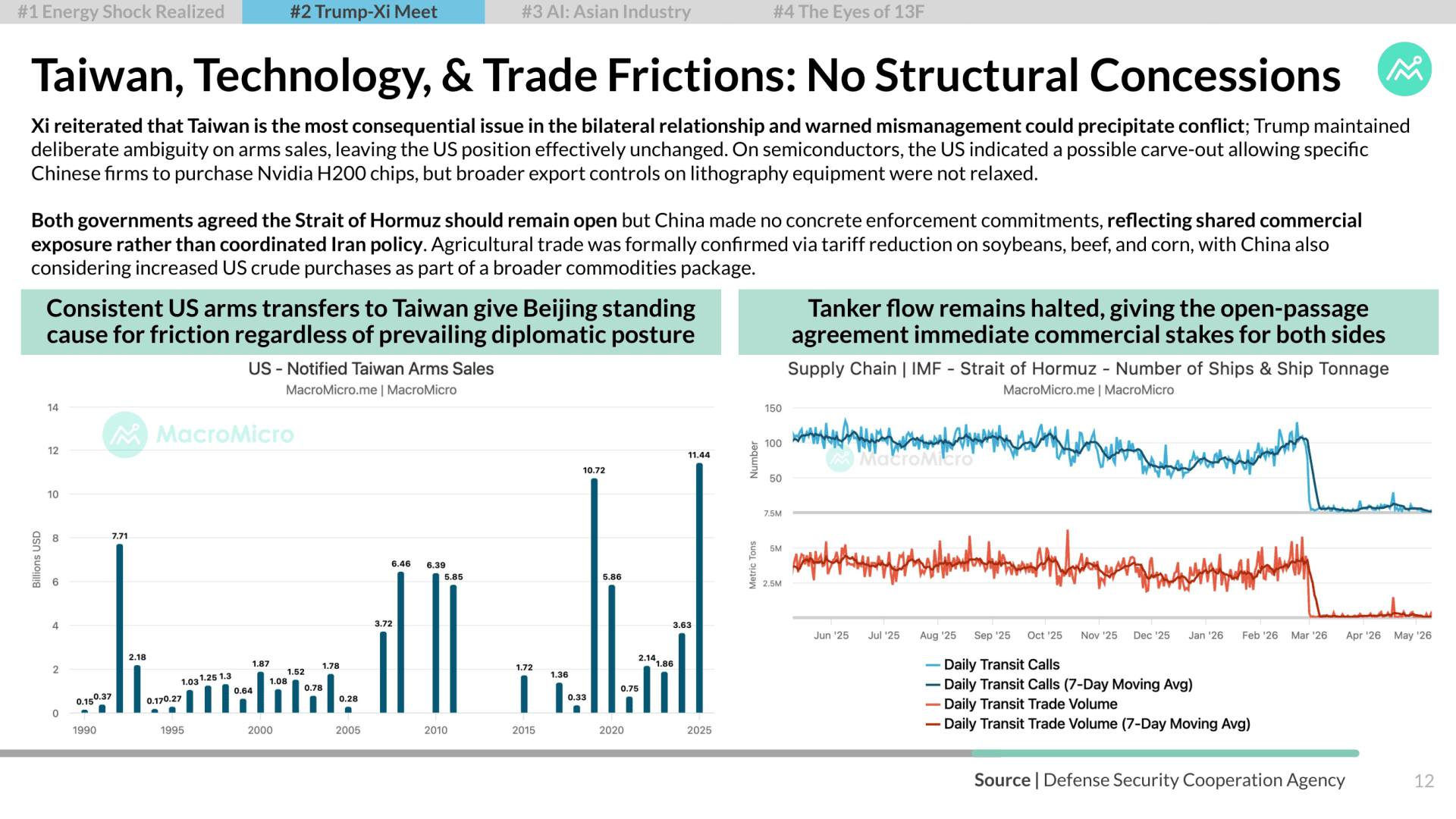
3. Trump-Xi: A Managed Truce:Trump and Xi met in Beijing during the week of May 11–17, marking their first meeting in nine years and giving markets a diplomatic anchor after months of trade and geopolitical uncertainty. Commercial commitments, Boeing purchases, and a negotiation framework signal that both sides want to prevent disorderly escalation. Yet the absence of binding trade resolution, no structural semiconductor concessions, and continued Taiwan ambiguity mean the hard issues remain unresolved. The September White House visit now becomes the real checkpoint. Investors should treat the meeting as a volatility suppressant, not a regime shift, because technology controls, Taiwan risk, and commodity-security tensions remain active market variables.
4. Smart Money Is Chasing AI Infrastructure, Not the Application Layer: Institutional positioning shows a clear distinction between confidence in AI hardware and caution toward broad equity valuations. Major funds are converging on semiconductors, memory, and infrastructure names such as TSMC, Nvidia, Broadcom, Micron, and Marvell, while software exits and macro hedges are becoming harder to ignore. Soros adding AI longs while making SPY puts its largest holding captures the message: investors still want exposure to the AI buildout, but not unconditional beta. The smartest trade is selective participation, with protection against overextended index-level valuations.
⏰ Limited Time | Lock in your price today and auto-upgrade to our Flagship AI Plan → Join Max Annual>>
About Weekly Economic and Financial Commentary (WEFC)
The MacroMicro WEFC is published weekly, delivering rigorous analysis and in-depth insights on the most critical market-moving events. Coverage spans equities, foreign exchange, bonds, commodities, global central banks, geopolitics, and the international political economy.
At its core is a concise, roughly 20-page Chart Pack designed to help you grasp market trends at a glance. Subscribe Now » to download the full PDF report.
Already a subscriber? Click here to log in.
Full Access to Our Services

Comprehensive data at your service
with key indicators for investment insights

Exclusive flash reports
on key events and data

Create your own charts and analysis
including performance backtesting

Hub of professionals to engage
in meaningful discussions and insights
 Get answers from MM AI.
-
Why did global bond yields surge after the Trump-Xi meeting?
💡Global bond yields surged after the Trump-Xi meeting due to investor pessimism, with the US 30-year Treasury yield reaching 5.15%, its highest since the Global Financial Crisis, and yields in the UK, Germany, and Japan also hitting multi-decade highs. The market reaction indicates that despite a peaceful tone, investors remain unconvinced by the summit's outcome, particularly regarding unresolved hard issues like trade resolution and semiconductor concessions.
-
How does Taiwan's AI supply chain contribute to national growth?
💡Taiwan's AI supply chain significantly contributes to national growth, evidenced by its 13.69% Q1 GDP growth and 73% electronics and ICT export share. The nation's high 127% trade-to-GDP ratio positions it as the clearest macro signal for AI hardware demand, driving its economic expansion through robust global supply chain integration.
-
What differentiates Korea's AI market benefit from Taiwan's?
💡Korea's AI market benefit differentiates from Taiwan's through monetization of scarcity rather than confirming the cycle, as shown by its compressed equity setup with GDP growth of only 3.6%, yet the KOSPI rising 81% year-to-date due to DRAM prices jumping more than 40% for two consecutive quarters. Taiwan, conversely, signals AI hardware demand through its GDP growth and export share.
-
How should investors view the Trump-Xi meeting's market impact?
💡Investors should view the Trump-Xi meeting's market impact as a volatility suppressant, not a regime shift. While it provided a diplomatic anchor, the fundamental hard issues like technology controls, Taiwan risk, and commodity-security tensions remain active market variables, suggesting that selective participation with protection against overextended valuations is the smartest trade.
-
Where are major funds positioning in the AI sector?
💡Major funds are positioning in the AI sector by converging on semiconductors, memory, and infrastructure names, reflecting confidence in AI hardware. This strategic focus is evident through investments in companies such as TSMC, Nvidia, Broadcom, Micron, and Marvell, while software exits and macro hedges are increasingly noticeable.
