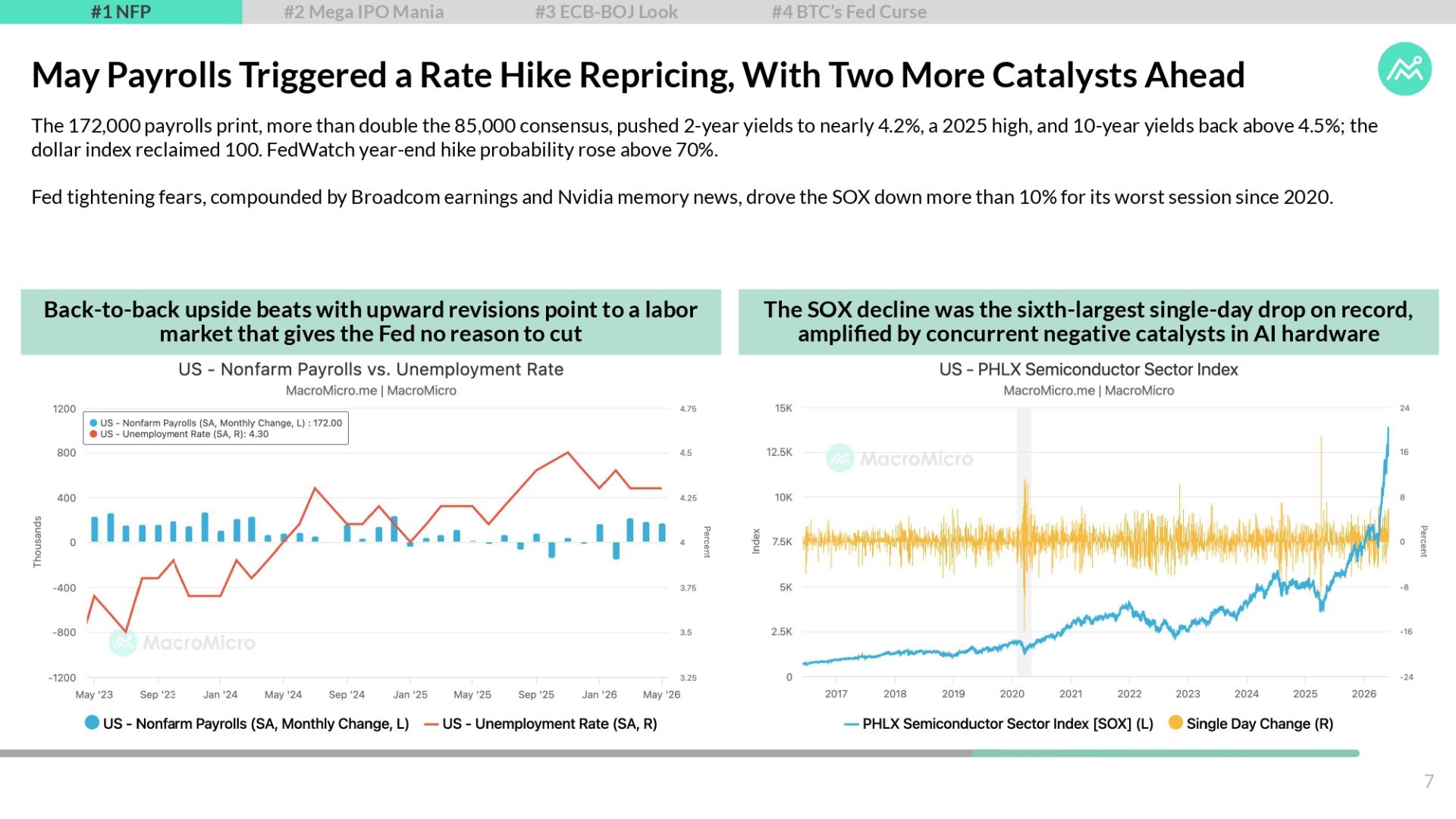
Stronger US payrolls reignited rate-hike fears last Friday, triggering a global equity selloff. SOX plunged more than 10%, hit by Broadcom’s earnings miss and Nvidia Rubin memory-spec news, marking its worst day since 2020 and sixth-largest drop ever.
This week, we analyze why this may be the wrong panic button, how SpaceX’s IPO could challenge the largest listing in history, and what the ECB’s expected rate-hike restart means for markets. Read this week’s WEFC analysis for our full take.
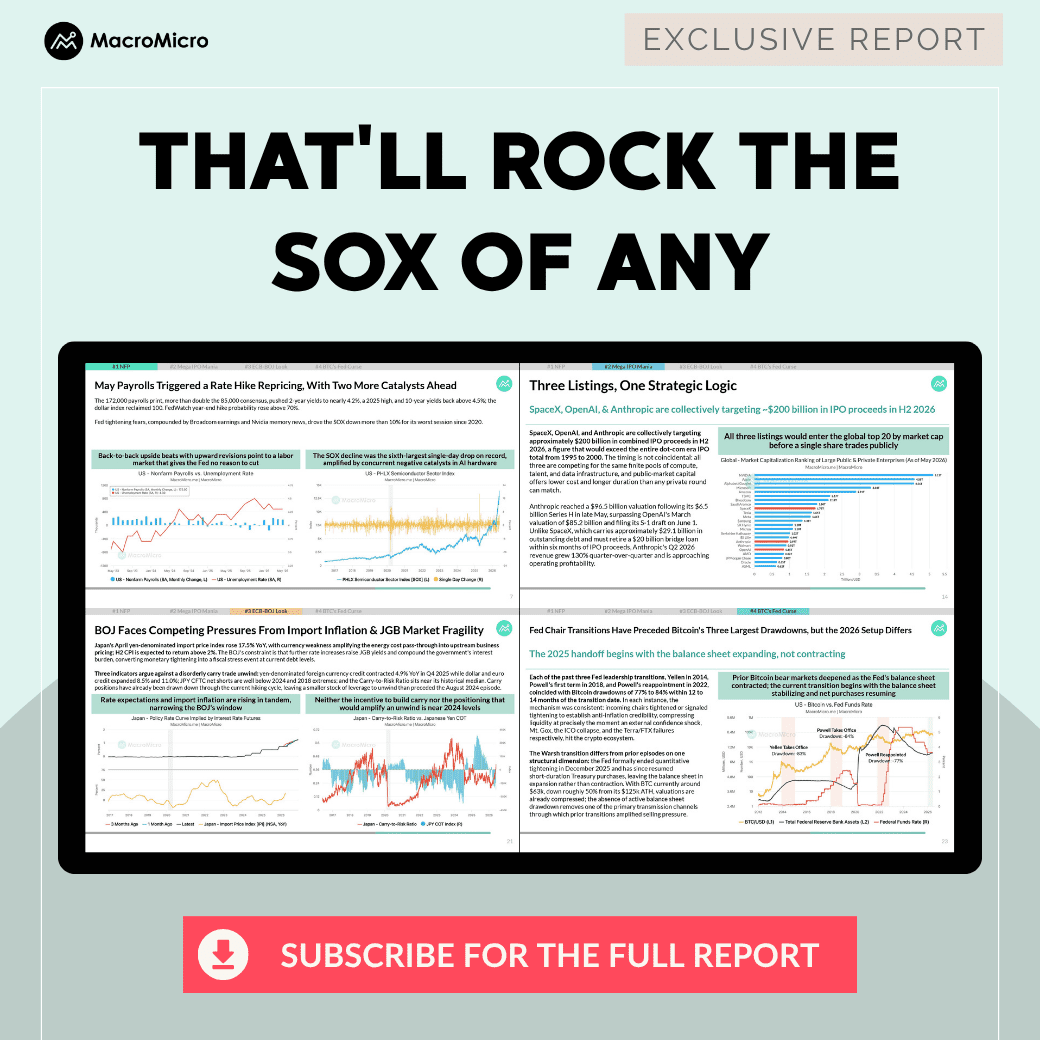
Key Focus of This Week’s Report
-
Why a -10% SOX Collapse May Be the Wrong Panic Button: We analyze Friday’s semiconductor rout not as a simple reaction to payrolls or one earnings miss, but as a sudden stress test for the AI trade under higher yields. We think the key tension is whether crowded positioning is masking a healthier backdrop: stronger employment, less tariff anxiety, and valuations still near post-pandemic averages.
-
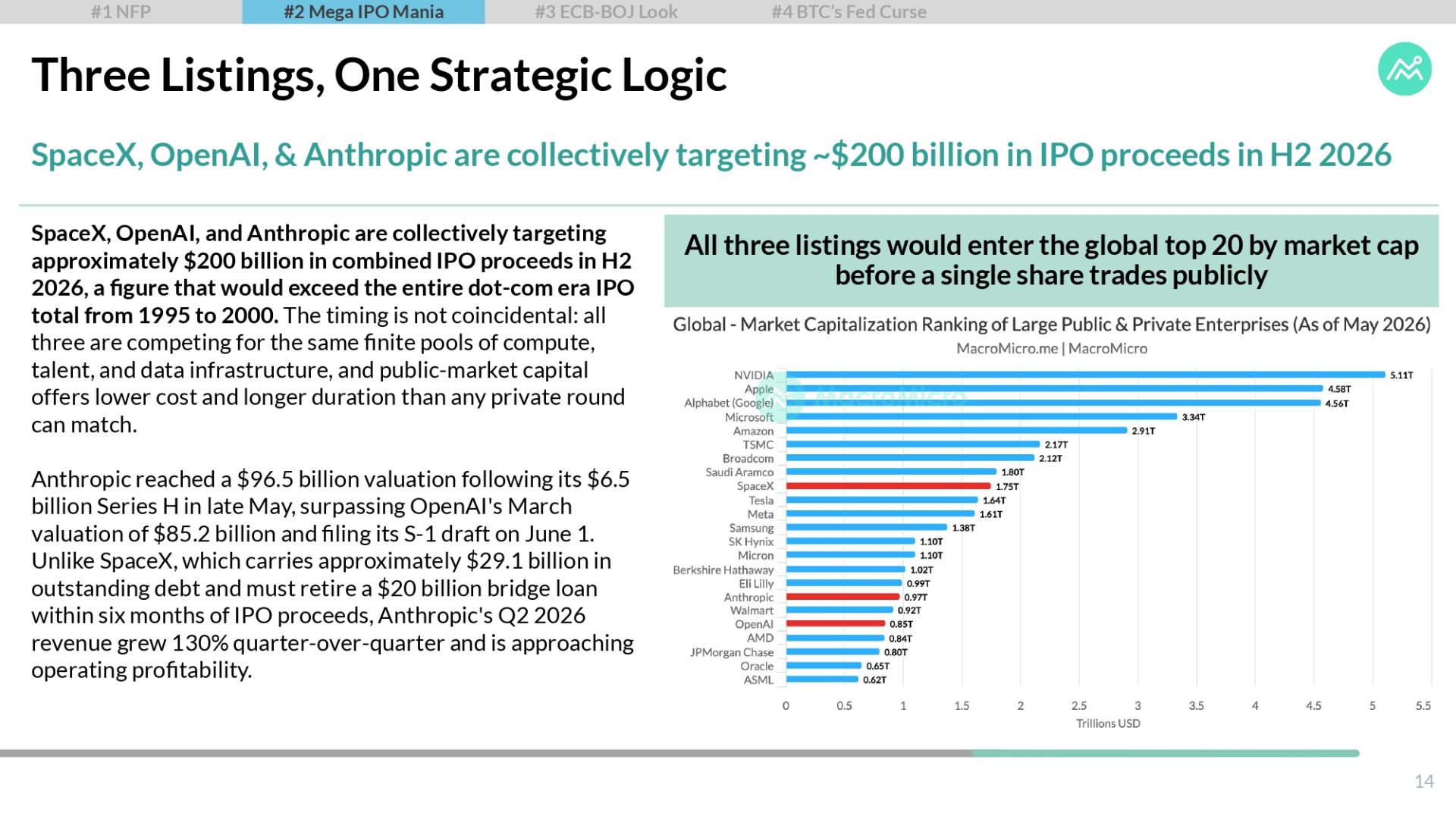
The IPO Wave Is a Battle for AI Capital: We analyze the IPO wave as a financing shift, not just a risk-on signal. SpaceX, OpenAI, and Anthropic are moving public because compute, debt, talent, and data-center costs are outgrowing private markets. We think the real hook is which company can make today’s valuation look rational after listing, when first-day excitement fades and fundamentals take over.
-
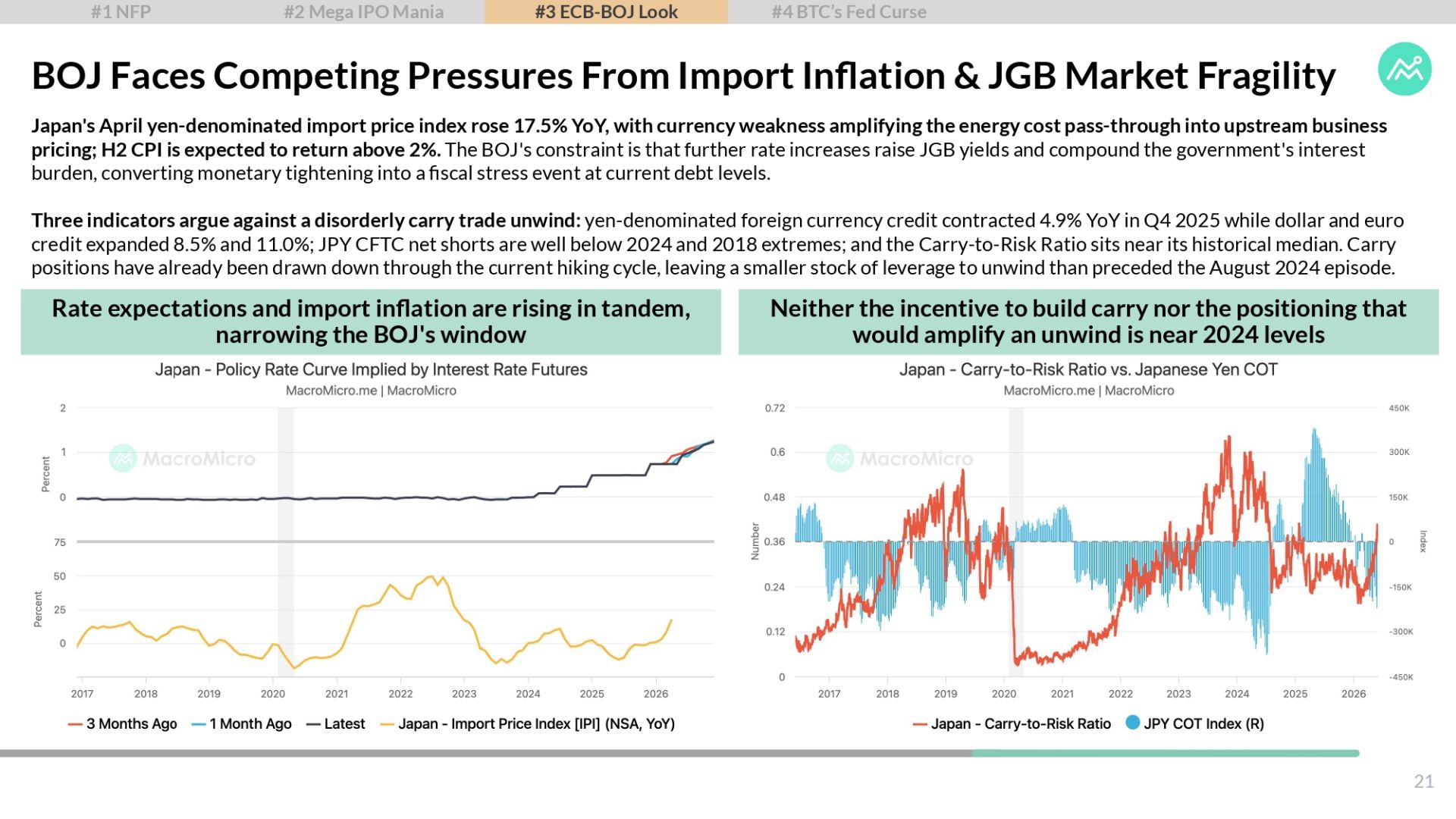
ECB and BOJ Hikes Are About Hidden Inflation Channels: We analyze the ECB and BOJ as facing inflation risks that look narrow today but may spread through less visible channels. Europe’s issue is energy feeding into wages and services; Japan’s is yen weakness colliding with JGB fragility. We think the key is not just whether they hike, but what their next signal reveals about policy tolerance.
-
A New Fed Chair Could Revive Bitcoin’s Most Dangerous Pattern: We analyze the Warsh transition through Bitcoin’s weakest historical window: past Fed chair changes have lined up with major drawdowns. But we think the comparison only matters if investors separate policy tone from liquidity conditions. A tougher inflation message could hurt crypto, yet today’s balance-sheet backdrop is meaningfully different from prior crashes.
About Weekly Economic and Financial Commentary (WEFC)
The MacroMicro WEFC is published weekly, delivering rigorous analysis and in-depth insights on the most critical market-moving events. Coverage spans equities, foreign exchange, bonds, commodities, global central banks, geopolitics, and the international political economy.
At its core is a concise, roughly 20-page Chart Pack designed to help you grasp market trends at a glance. Subscribe Now » to download the full PDF report.
Already a subscriber? Click here to log in.
Full Access to Our Services

Comprehensive data at your service
with key indicators for investment insights

Exclusive flash reports
on key events and data

Create your own charts and analysis
including performance backtesting

Hub of professionals to engage
in meaningful discussions and insights
 Get answers from MM AI.
-
Why did the SOX index experience a significant collapse, and was it an overreaction?
💡The SOX index plunged more than 10%, experiencing its worst day since 2020 and its sixth-largest drop ever, due to stronger US payrolls reigniting rate-hike fears, Broadcom’s earnings miss, and Nvidia Rubin memory-spec news. This collapse is analyzed not as a simple reaction but as a sudden stress test for the AI trade under higher yields, suggesting it may be an overreaction to a healthy economic backdrop.
-
Why are companies like SpaceX and OpenAI pursuing IPOs, and what does it signify for AI capital?
💡Companies like SpaceX, OpenAI, and Anthropic are pursuing IPOs because their substantial costs for compute, debt, talent, and data centers are outgrowing private market funding capabilities. This trend signifies a shift in financing for AI capital, indicating that these high-growth sectors increasingly rely on public markets to secure the vast capital required for expansion and innovation.
-
How might energy prices and wage growth influence the ECB's decision-making regarding interest rates?
💡Energy prices and wage growth significantly influence the ECB's decision-making regarding interest rates, as Europe's primary inflation risk involves these factors feeding into services. This dynamic suggests that even if inflation appears narrow currently, the spillover from energy costs into broader economic sectors through wage demands could necessitate a rate-hike restart to control escalating inflationary pressures.
-
What role does yen weakness and JGB fragility play in the Bank of Japan's inflation strategy?
💡Yen weakness and JGB fragility play a crucial role in the Bank of Japan's inflation strategy by posing a significant risk of inflation spreading through less visible channels. The interaction of a depreciating yen, which increases import costs, with the vulnerability of Japanese Government Bonds could accelerate inflationary pressures, pushing the BOJ towards a policy of interest rate hikes.
-
What historical pattern links past Fed chair transitions to Bitcoin's major drawdowns?
💡Past Fed chair transitions have historically lined up with Bitcoin’s weakest historical window, coinciding with major drawdowns. This pattern suggests a correlation between changes in central bank leadership and significant cryptocurrency market volatility, although the underlying causes may involve a shift in policy tone or market liquidity conditions.
