Fed Chair Warsh's hawkish opening remarks at Jackson Hole on Friday sent US equities into a volatile reversal, unwinding the semiconductor gains Nvidia's earnings had driven earlier in the week — the Philadelphia Semiconductor Index closed down 2.31%. The 10-year Treasury yield held elevated near 4.7%, while the dollar index rebounded sharply on Friday to reclaim the 99 level.
This week's WEFC covers four themes: Warsh reigniting the inflation fight and what it means for September; Nvidia's AI engine shifting into overdrive; Asia's rate-hike cycle coming back to life; and gold breaking free as rates, the dollar, and fiscal risks align.
This Week's WEFC Preview
Weekly Market Roundup: Equities Mixed as Semis Reverse
- Nvidia's beat lifted semis on Thursday, Warsh reversed them on Friday. The Philadelphia Semiconductor Index gave back its gains after Fed Governor Warsh's hawkish Jackson Hole opening speech, finishing the week down -2.31%.
- Regional equity performance diverged with no clear global direction. MSCI Emerging Asia and the Europe Stoxx 50 both closed roughly flat; Taiwan (+4.21%) and Vietnam (+3.72%) led, while the Philippines (-6.49%) lagged.
- The 10-year US Treasury yield stayed elevated near 4.7%. Rates offered no relief to equities through the week.
- The dollar index rebounded clearly on Friday, reclaiming 99. Gold came under simultaneous pressure and retreated to around $4,500/oz.
- Oil prices showed little change. Commodity markets were the quiet corner of an otherwise event-driven week.
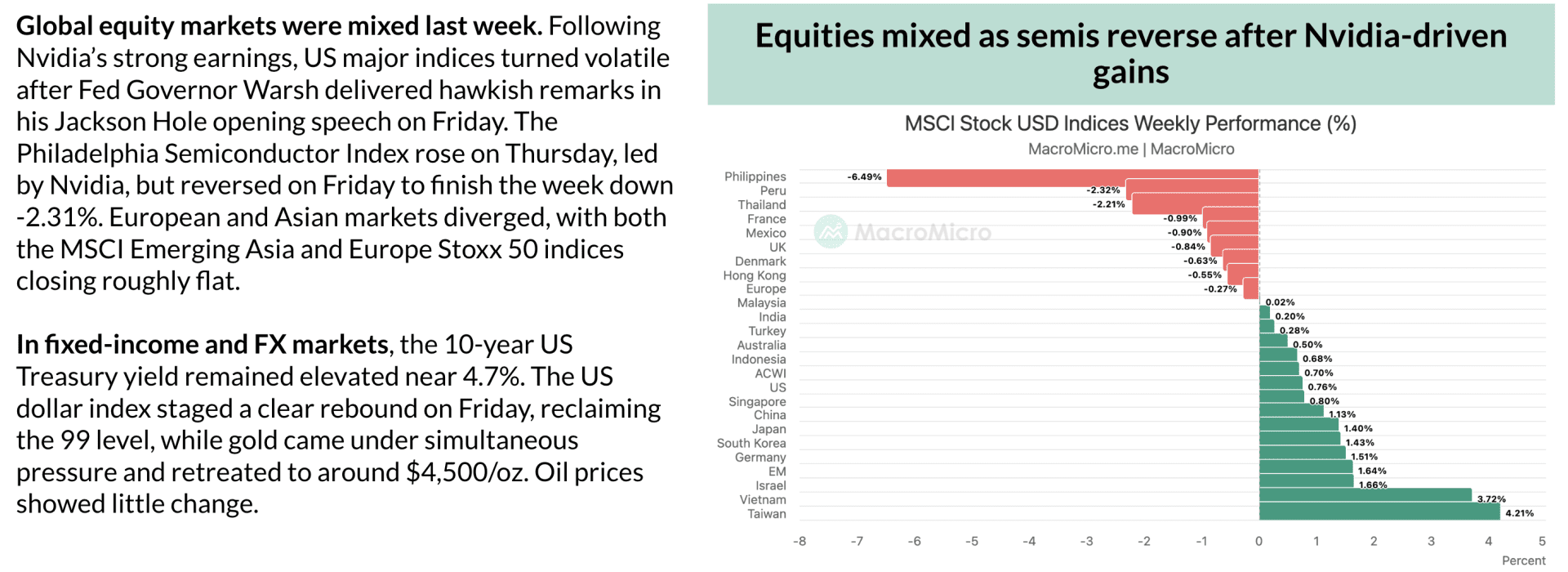
Performance data covers the week of Monday, August 24 to Sunday, August 30.
▌Related Charts:S&P sectors · Forex market · Commodity market · Bond market
Warsh Tees Up: September Hike Odds Push Above 50%
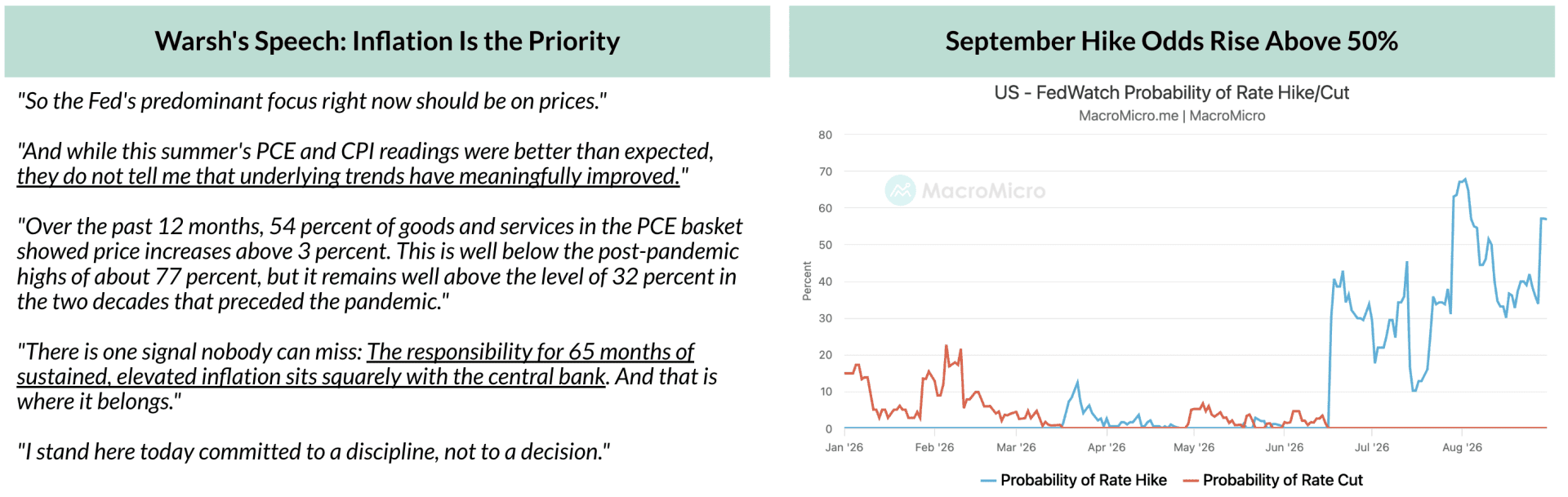
- Warsh made prices, not jobs, the Fed's stated priority. PCE runs at 3.7% and, in his words, the summer's softer readings "do not tell me that underlying trends have meaningfully improved." Labor at 4.1% is consistent with full employment.
- He would retire routine forward guidance as a crisis-era legacy. Warsh declined to commit to any reaction function or rule: "committed to a discipline, not to a decision."
- He struggles to call financial conditions restrictive. Equipment and intangibles investment is growing near 9%, over half AI-related; profits are up more than 20%; credit spreads sit near historic lows. 54% of the PCE basket is rising above 3%, versus 32% pre-pandemic.
- Markets read that as a hike signal, pushing September odds above 50%.
- The real test is the September 30 core PCE print, estimated at +0.27% MoM — enough to keep volatility alive even if the Fed stays put on September 16.
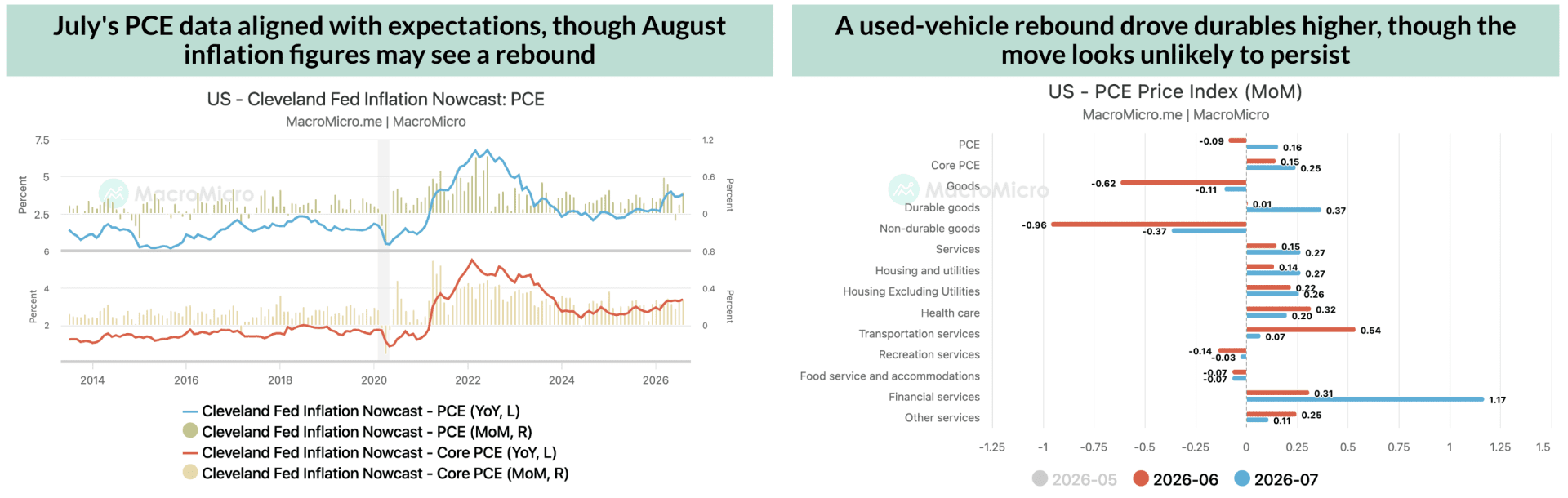
▌Related Charts:PCE price index · PCE items MoM
Central Bank of Nvidia: Demand Is Locked In, Supply Is the Constraint
- FY26Q2 beat on both lines. Revenue reached $96.22bn, up 106% YoY versus $92.16bn consensus, with non-GAAP diluted EPS of $2.22 against $2.09 estimated. Data center revenue hit $89bn, up 117% YoY.
- Growth is broadening beyond the hyperscalers. Hyperscalers contributed $48.71bn (+13% QoQ) versus ACIE at $40.31bn (+25% QoQ); sovereign AI within ACIE rose over 300% YoY and networking set a record on Spectrum-X, up over 260% YoY.

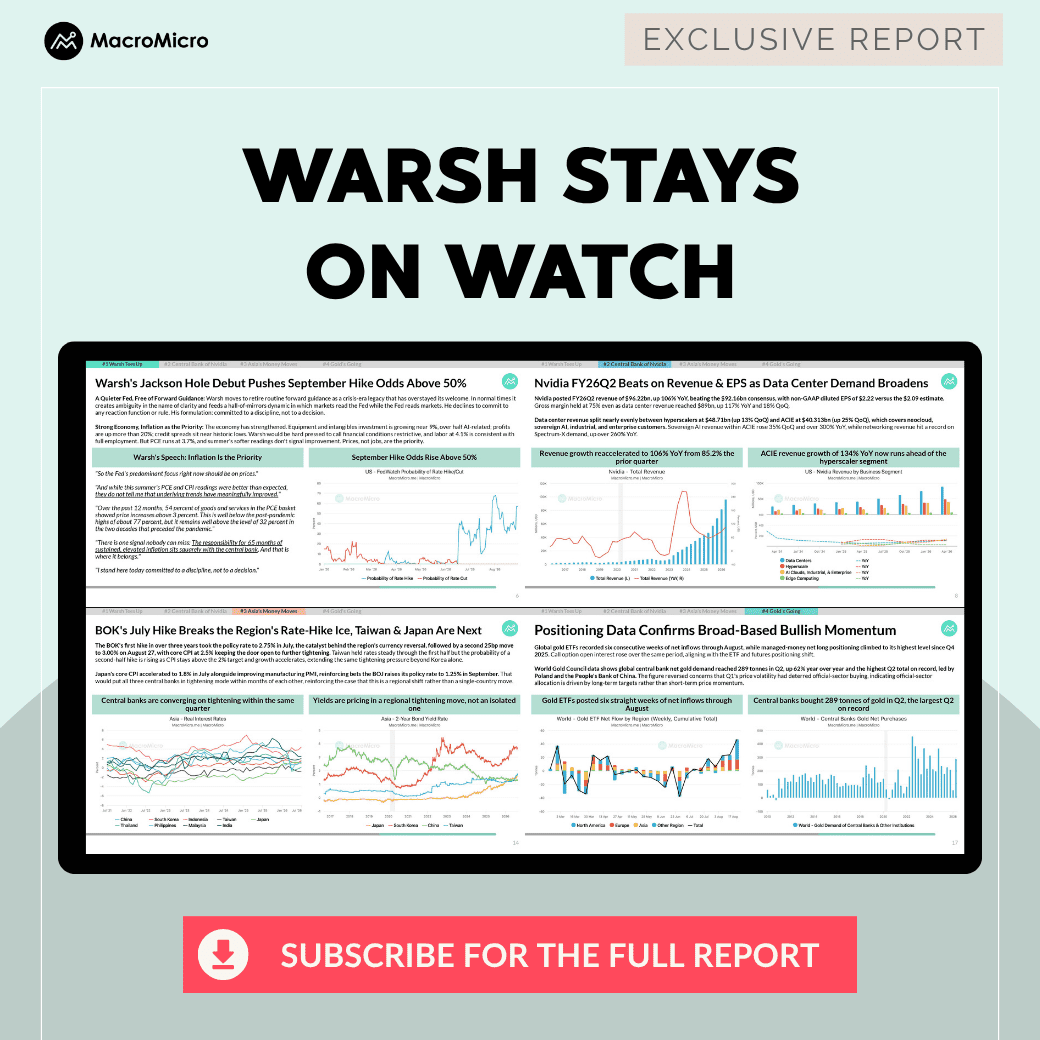
Subscribe Now to Download the Full Report
About Weekly Economic and Financial Commentary (WEFC)
The MacroMicro WEFC is published weekly, delivering rigorous analysis and in-depth insights on the most critical market-moving events. Coverage spans equities, foreign exchange, bonds, commodities, global central banks, geopolitics, and the international political economy.
At its core is a concise, roughly 20-page Chart Pack designed to help you grasp market trends at a glance. Subscribe Now » to download the full PDF report, lock in the current offer before prices rise and secure your future upgrade to Max AI with full AI access.
 Get answers from MM AI.
-
What was the Fed's stated priority according to Warsh's Jackson Hole speech?
💡According to Warsh's Jackson Hole speech, the Fed's stated priority is prices, not jobs. He indicated that current PCE readings at 3.7% and softer summer readings do not suggest meaningful improvement in underlying inflation trends, while a 4.1% labor rate is consistent with full employment.
-
Why did Warsh struggle to call current financial conditions restrictive?
💡Warsh struggled to call current financial conditions restrictive because equipment and intangibles investment is growing near 9%, with over half being AI-related, corporate profits are up more than 20%, and credit spreads remain near historic lows. Additionally, 54% of the PCE basket is rising above 3%, compared to 32% pre-pandemic.
-
What moved market pricing for a September rate hike above 50%?
💡Warsh's speech, rather than economic data, moved market pricing for a September rate hike above 50%. Despite July PCE landing in line (headline at 0.16% MoM and core at 0.25% MoM), markets interpreted his hawkish stance on inflation as a strong signal for a hike.
-
What were Nvidia's Q2 FY26 revenue and EPS results?
💡Nvidia's Q2 FY26 results exceeded expectations on both lines, with revenue reaching $96.22 billion, a 106% year-over-year increase against a $92.16 billion consensus. Non-GAAP diluted EPS was $2.22, surpassing the $2.09 estimate, driven by data center revenue hitting $89 billion, up 117% year-over-year.
-
How is Nvidia's growth broadening beyond traditional hyperscalers?
💡Nvidia's growth is broadening beyond traditional hyperscalers, as evidenced by ACIE (AI Cloud and Enterprise) revenue increasing by 25% quarter-over-quarter, outpacing hyperscaler growth of 13% quarter-over-quarter. Sovereign AI within ACIE rose over 300% year-over-year, and networking set a record on Spectrum-X, up over 260% year-over-year.
-
What is Vera Rubin's role in Nvidia's FY27Q3 revenue guidance?
💡Vera Rubin underpins Nvidia's FY27Q3 revenue guidance, with its entry into volume production in early August expected to contribute approximately 20% of data center revenue. The guidance projects roughly $108 billion in revenue, ±2%, notably with zero embedded China data center revenue.
-
Which Asian central bank initiated the region's rate-hike cycle in July?
💡The Bank of Korea (BOK) initiated Asia's rate-hike cycle in July with its first move in over three years, raising the policy rate to 2.75%. This was followed by a second 25bp hike to 3.00% on August 27, responding to core CPI at 2.5%.
-
Which Asian economies are expected to follow Korea in raising interest rates?
💡Taiwan and Japan are expected to follow Korea in raising interest rates. Taiwan's second-half hike probability is rising as its CPI remains above the 2% target, while Japan's core CPI accelerated to 1.8% in July, reinforcing bets on a Bank of Japan move to 1.25% in September.
-
What drove gold's rally of approximately 15% in August?
💡Gold rallied approximately 15% in August, moving from $4,100 to near $4,700 per ounce, reaching its highest since May 2026. This surge was driven by three FOMC dissents in July and softer employment, inflation, and retail sales data, which collectively pressured real rates and the dollar.
-
How did the US Treasury's long-bond buyback cap influence markets?
💡The US Treasury's doubling of its long-bond buyback cap influenced markets by signaling a fiscal-side substitute for Operation Twist, with the minimum rising to $4 billion per operation for 10 to 30-year maturities and indications of further expansion. This move impacts bond market liquidity and investor sentiment.
