Our MacroMicro Q2 2026 Economic Outlook explored two of the market's most pressing questions: How much damage can the US-Iran conflict inflict on the global economy, and what risks could threaten the AI investment cycle that continues to drive markets higher? With MacroMicro's own Vivianna, Vice Research Director, at the helm, this latest session examined the transmission mechanisms of elevated oil prices, the resilience of global demand, and the increasingly important role of credit conditions in sustaining AI-related investment. While geopolitical headlines continue to dominate the news cycle, our analysis suggests that the more important risks remain hidden beneath the surface.
1. $100 Oil Remains the Critical Threshold for Demand Destruction
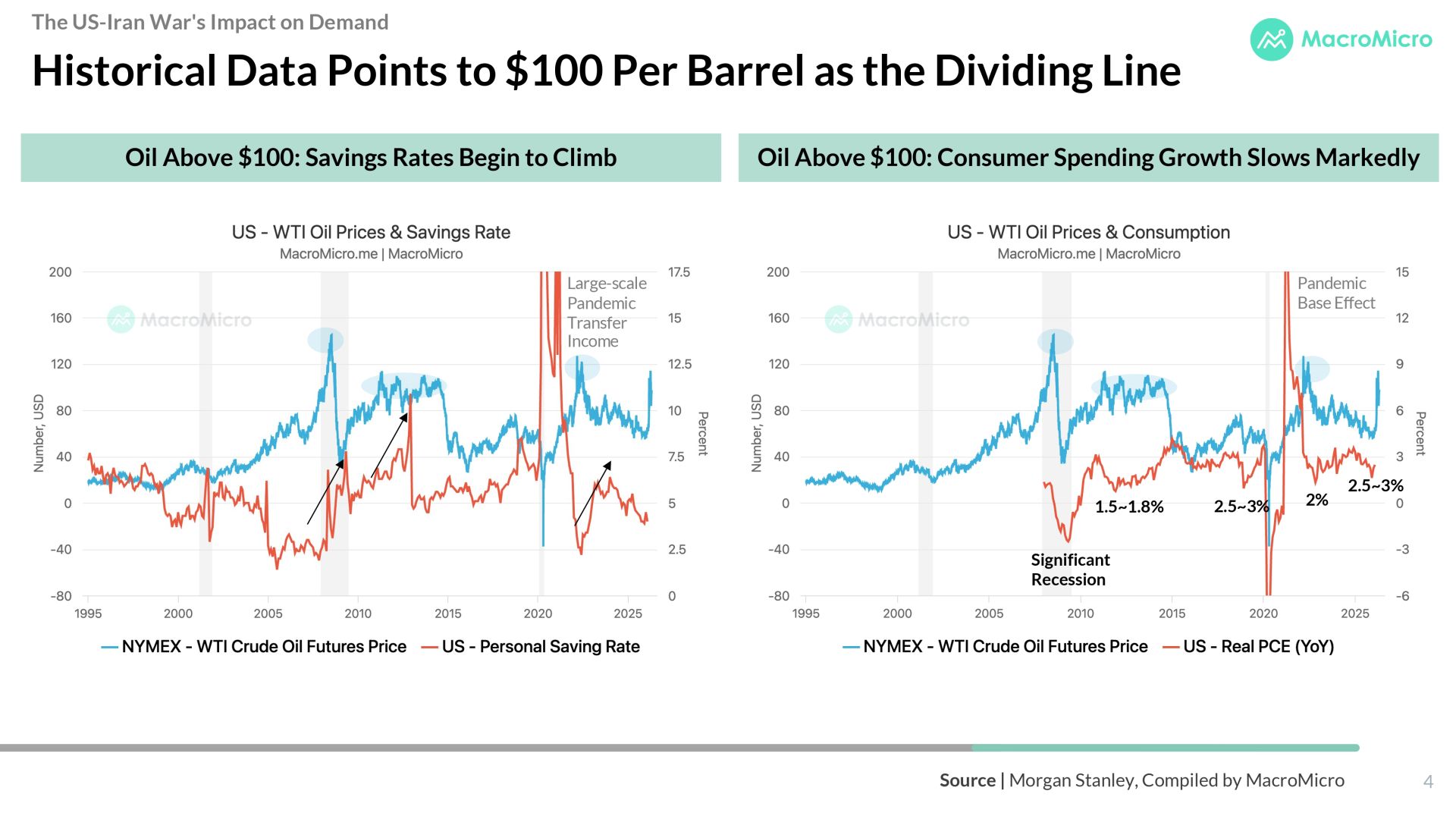
To understand the true threat of the US-Iran conflict, we must separate temporary price shocks from structural demand destruction. Currently, energy price hikes are being buffered by upstream hedging and government stabilization policies. The real danger emerges only if crude oil stays above the $100 mark for an extended period, historically over a quarter. Past data shows that $100 oil acts as a ceiling for consumer spending, forcing households to cut discretionary purchases and spike their precautionary savings.
Fortunately, global oil markets are in a much stronger position than in 2022. Structural factors like energy transitions and declining demand from China have created an oversupply buffer. If the Strait of Hormuz conflict concludes within 120 days, the global supply shock will be limited to just 3% to 5%, keeping aggregate demand largely intact.
2. Inflation Scenarios & Fed Policy Hinge on Conflict Duration
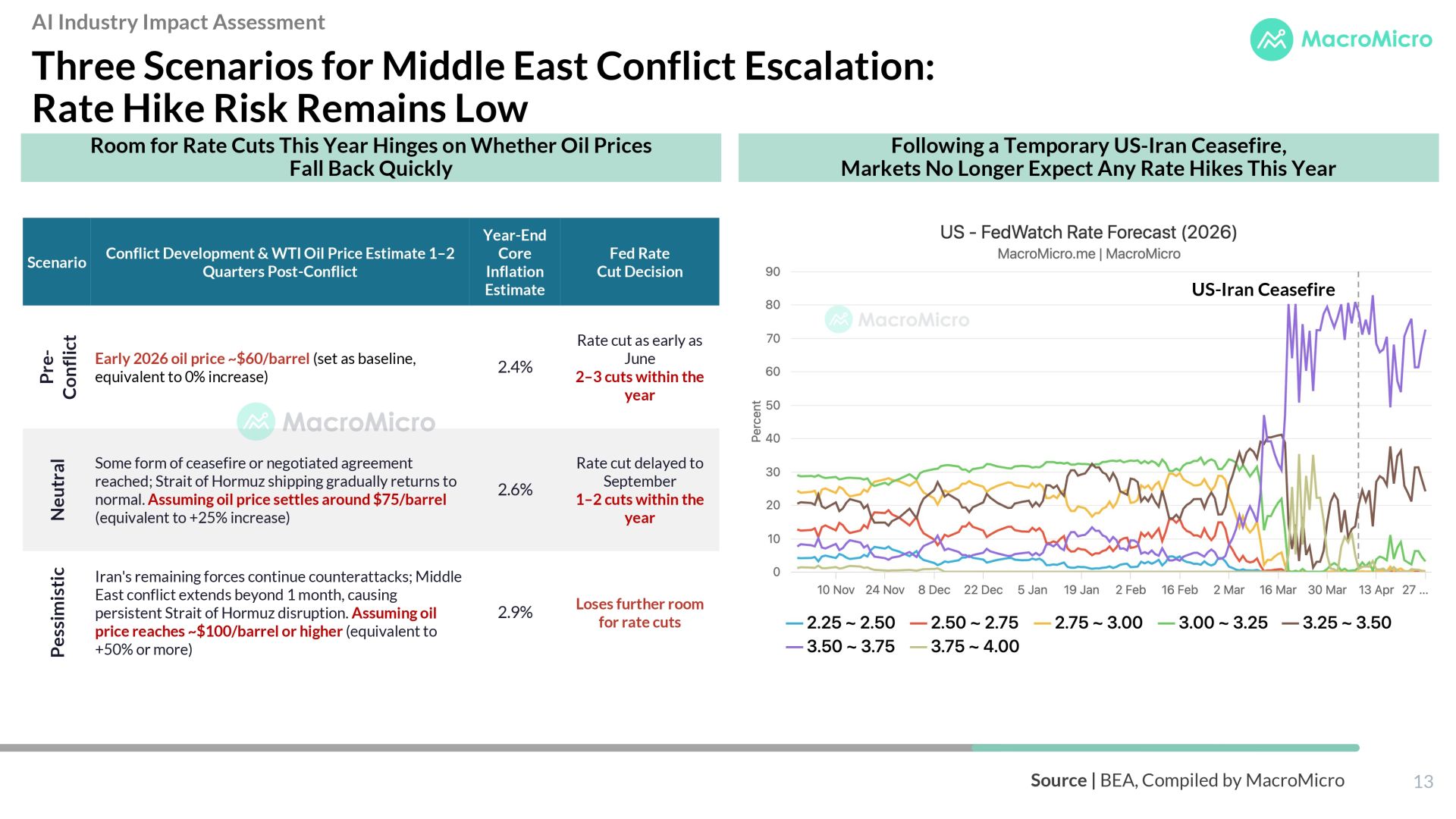
The US monetary environment today is fundamentally different from the crisis of 2022. Because real interest rates remain above the neutral rate, the Federal Reserve is already in restrictive territory and has no immediate urgency to hike rates aggressively. The primary concern is whether flexible inflation (volatile energy prices) bleeds into sticky inflation (services and housing).
Looking ahead, we have outlined three scenarios based on the duration of Middle East tensions. In our baseline optimistic scenario of $60 oil, the Fed retains room for two to three rate cuts this year. In our neutral scenario, where an agreement is reached and oil settles around $75 to $80, rate cuts would likely be delayed to September, leaving room for one to two cuts. Only in our pessimistic scenario, where oil persists above $100, would core PCE remain stuck near 3%, effectively erasing the possibility of rate cuts entirely.
3. AI Transitions to Enterprise Infrastructure, But Capital is the Hidden Vulnerability
Despite geopolitical noise, the tech sector's earnings forecasts have seen record upward revisions. This resilience stems from AI's evolution from a variable operational expense to a fixed, structural necessity. The rise of Agentic AI means tools are no longer just generating content but completing complex tasks, driving robust subscription revenues that are traditionally insulated from business cycle fluctuations.
However, the true invisible risk to the AI boom is not demand, but...
🎥 MM Max Annual subscribers can now stream the full Q2 MEO replay. Better yet, all MM Max Annual subscribers will be automatically upgraded to MacroMicro AI when it launches, unlocking AI-powered investment analysis grounded entirely in MacroMicro's trusted database of macroeconomic, industry, and corporate data.
Already a subscriber? Click here to log in.
Full Access to Our Services

Comprehensive data at your service
with key indicators for investment insights

Exclusive flash reports
on key events and data

Create your own charts and analysis
including performance backtesting

Hub of professionals to engage
in meaningful discussions and insights
 Get answers from MM AI.
-
What oil price threshold triggers demand destruction in the global economy?
💡The critical oil price threshold that triggers demand destruction in the global economy is when crude oil stays above the $100 mark for an extended period, historically over a quarter. This sustained price level acts as a ceiling for consumer spending, forcing households to reduce discretionary purchases and increase precautionary savings, which ultimately impacts aggregate demand.
-
How do structural factors currently impact global oil market stability compared to 2022?
💡Global oil markets are in a much stronger position now compared to 2022 due to structural factors such as ongoing energy transitions and declining demand from China, which have collectively created an oversupply buffer. This improved structural resilience means that if the Strait of Hormuz conflict concludes within 120 days, the global supply shock will be limited to just 3% to 5%, thereby keeping aggregate demand largely intact.
-
How does the duration of Middle East tensions affect Federal Reserve rate cut possibilities?
💡The duration of Middle East tensions directly influences Federal Reserve rate cut possibilities, with three scenarios outlined: in an optimistic scenario with $60 oil, the Fed retains room for two to three rate cuts this year. In a neutral scenario where oil settles around $75 to $80, rate cuts would likely be delayed until September, allowing for one to two cuts. Only in a pessimistic scenario, where oil persists above $100, would core PCE remain stuck near 3%, effectively eliminating the possibility of rate cuts entirely.
-
What is the primary hidden vulnerability for the current AI investment boom?
💡The primary hidden vulnerability for the current AI investment boom is not demand, but capital. A significant portion of data center financing relies on corporate free cash flow generated outside of AI operations, and these private funding channels are inextricably tied to the broader credit cycle, making AI financing highly sensitive to the macro interest rate environment.
-
What impact would elevated oil prices have on AI industry financing through Fed policy?
💡Elevated oil prices, if sustained, could force the Federal Reserve to tighten credit conditions, which would critically impact AI industry financing. Because AI financing is highly sensitive to the macro interest rate environment, primarily relying on corporate free cash flow and private funding channels tied to the broader credit cycle, tighter credit conditions would pose a significant threat to the AI investment boom.
-
Are Non-Bank Financial Institutions (NBFIs) posing systemic risks to the financial system?
💡Non-Bank Financial Institutions (NBFIs) are not currently posing systemic risks to the financial system, as major traditional banks have relatively low exposure to NBFIs, mostly below 20%. This lending is heavily concentrated in very safe, short-term reverse repo mechanisms. Data on Business Development Companies (BDCs) also confirms that key vulnerability metrics remain stable, with non-accrual and Payment-in-Kind rates well below alert thresholds.
-
How does US domestic financial stability influence its geopolitical strategy in the Middle East?
💡US domestic financial stability significantly influences its geopolitical strategy in the Middle East, as the current administration prioritizes internal economic stability and managing the national debt over acting as the world's policeman. Being a net energy exporter further insulates the US from direct supply shocks, allowing it to focus on domestic financial realities as a guide for its foreign policy actions.
-
What role do US Treasury yields play as a constraint on US geopolitical actions?
💡US Treasury yields serve as a hard boundary and ultimate constraint on US geopolitical posturing. With nominal GDP growth at approximately 4.5%, any scenario where the 10-year Treasury yield approaches or exceeds this 4.5% level risks pushing the US into an unsustainable debt spiral. Historically, when yields near this red line, the administration aggressively shifts toward negotiations and market stabilization, ensuring that a prolonged, endless conflict is not a viable option.
-
What are the key questions for investors regarding oil market disruptions and inflation expectations?
💡For investors, the key questions regarding oil market disruptions and inflation expectations are whether disruptions persist long enough to trigger demand destruction and whether inflation expectations begin to accelerate. These factors are crucial for assessing the true threat of the US-Iran conflict beyond temporary price shocks and for understanding their impact on the global economy.
-
What is the critical issue for the AI investment cycle, besides demand?
💡Besides demand, the critical issue for the AI investment cycle is financing. The AI boom relies heavily on corporate free cash flow and private funding channels, which are inextricably tied to the broader credit cycle. Therefore, the stability of AI investment hinges on credit conditions remaining stable and the Federal Reserve avoiding a return to aggressive monetary tightening.
