Our MacroMicro Q3 2026 Economic Outlook tackled the question now sitting behind every AI trade: is the trillion-dollar buildout actually turning into trillion-dollar returns? With MacroMicro's own Research Vice Director Vivianna at the helm, this latest session traced the AI ecosystem through three lenses — money, margin, and macro — from the collapse in inference pricing to the US-China contest now unfolding across compute, defense, and currency. While headlines fixate on capex figures, our analysis suggests the more decisive story is unfolding in monetization speed, supply chain pricing power, and the restocking cycle building beneath the surface.
1. AI Monetization Is Arriving Faster Than Any Prior Tech Cycle
The starting point for this year's outlook is monetization, representing the "money" in our three Ms. LLM inference prices have fallen dramatically across every intelligence tier, and that collapse in cost is doing exactly what the Jevons paradox predicts: as efficiency rises and unit prices drop, enterprise demand explodes rather than shrinks. Enterprise AI spending has surged across nearly every industry since the start of the year, and AI-native software companies are reaching $100M in ARR far faster than the SaaS incumbents that came before them.
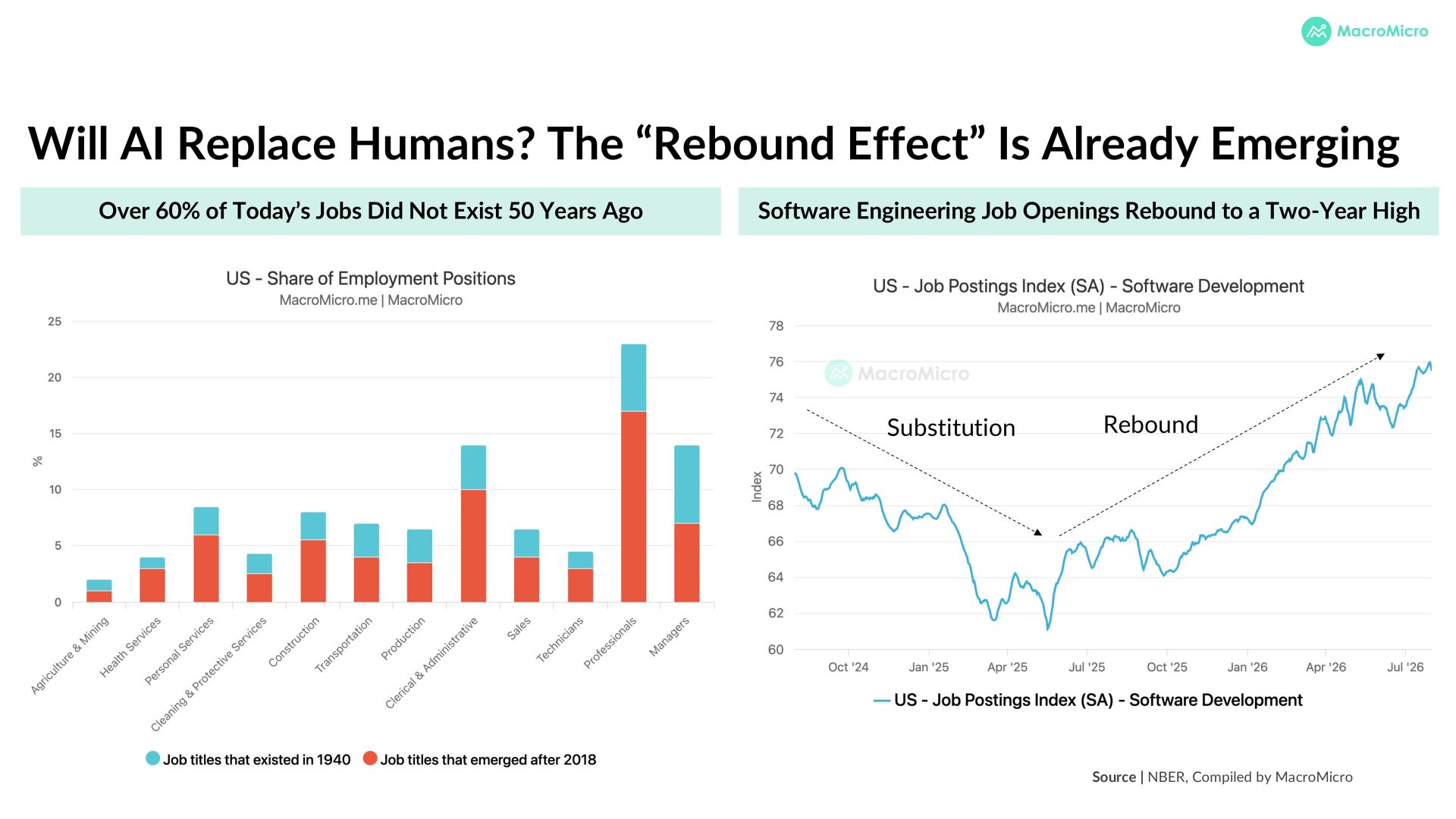
This momentum is also showing up in the labor market. Historical technology waves follow a predictable sequence: a substitution effect, followed by a rebound effect. Some jobs disappear first, but new roles appear shortly after. Over 60% of today's job titles did not even exist 50 years ago, and we are already seeing that rebound in real time. After heavy software engineering layoffs last year, job postings in the field have bounced back to a two-year high.
Crucially, this adoption is converting directly into hard financial results. Anthropic’s first profitable quarter arrived in Q2 2026, years ahead of the market's original 2028 estimate. We see this as confirmation that the AI ecosystem has officially entered the third and decisive phase of the productivity cycle: after technological breakthrough (Phase 1) and application acceleration (Phase 2), we are now in commercial monetization (Phase 3). This is the phase where infrastructure and applications begin reinforcing each other and profits compound. It's the same phase that turned the internet and smartphones into multi-trillion-dollar industries.
2. Pricing Power Has Flipped Upstream, & It's Structural, Not a Warning Sign
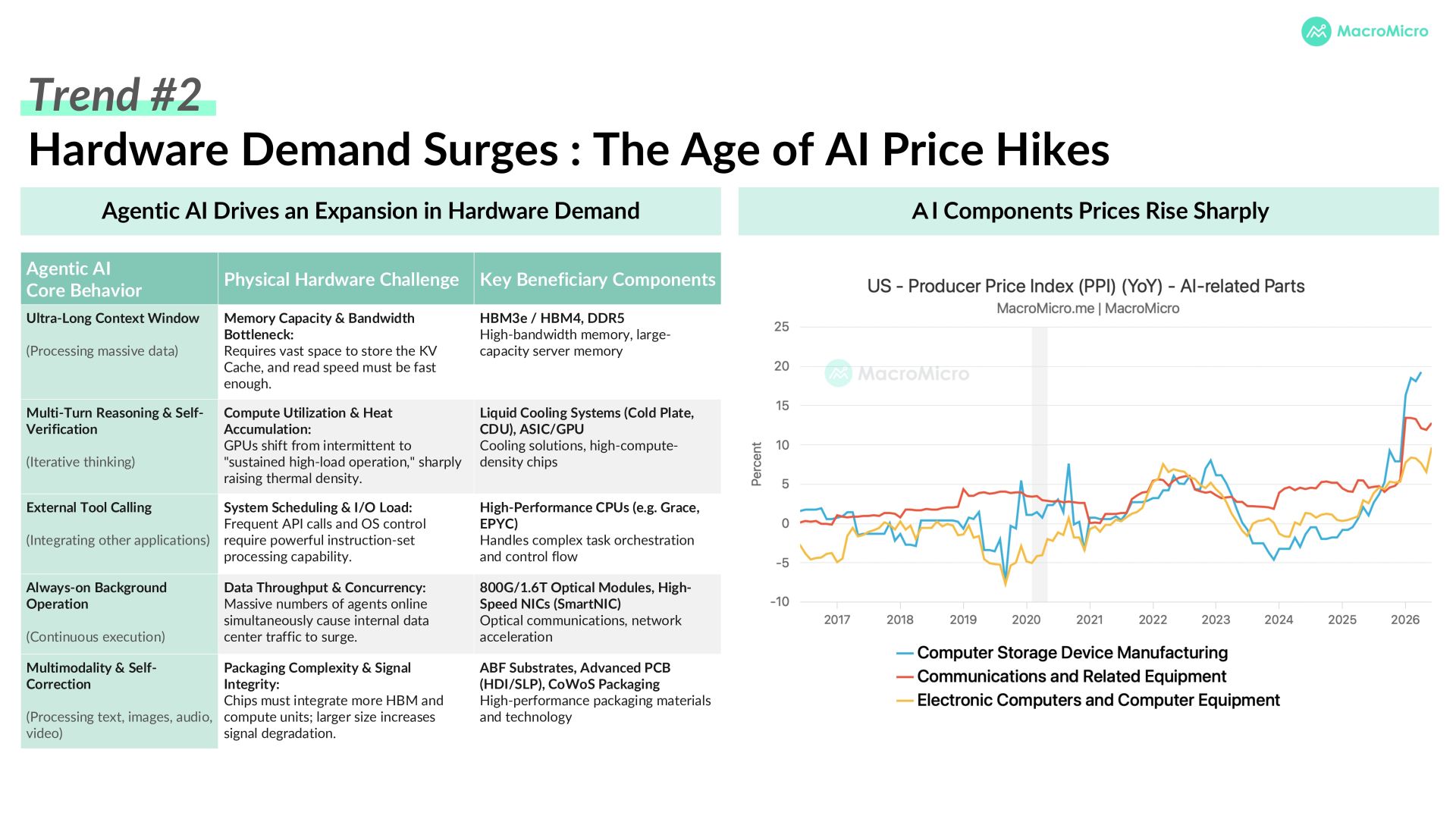
The flip side of surging adoption is soaring hardware demand, bringing us to our second M, margin. Agentic AI’s reliance on multi-turn reasoning, external tool calling, and ultra-long context windows is pushing demand far beyond AI accelerator chips alone. Thermal density and data throughput constraints are triggering price hikes across liquid cooling, optical transceivers, advanced packaging, and memory, driving AI hardware producer prices past their 2021 cycle peak.
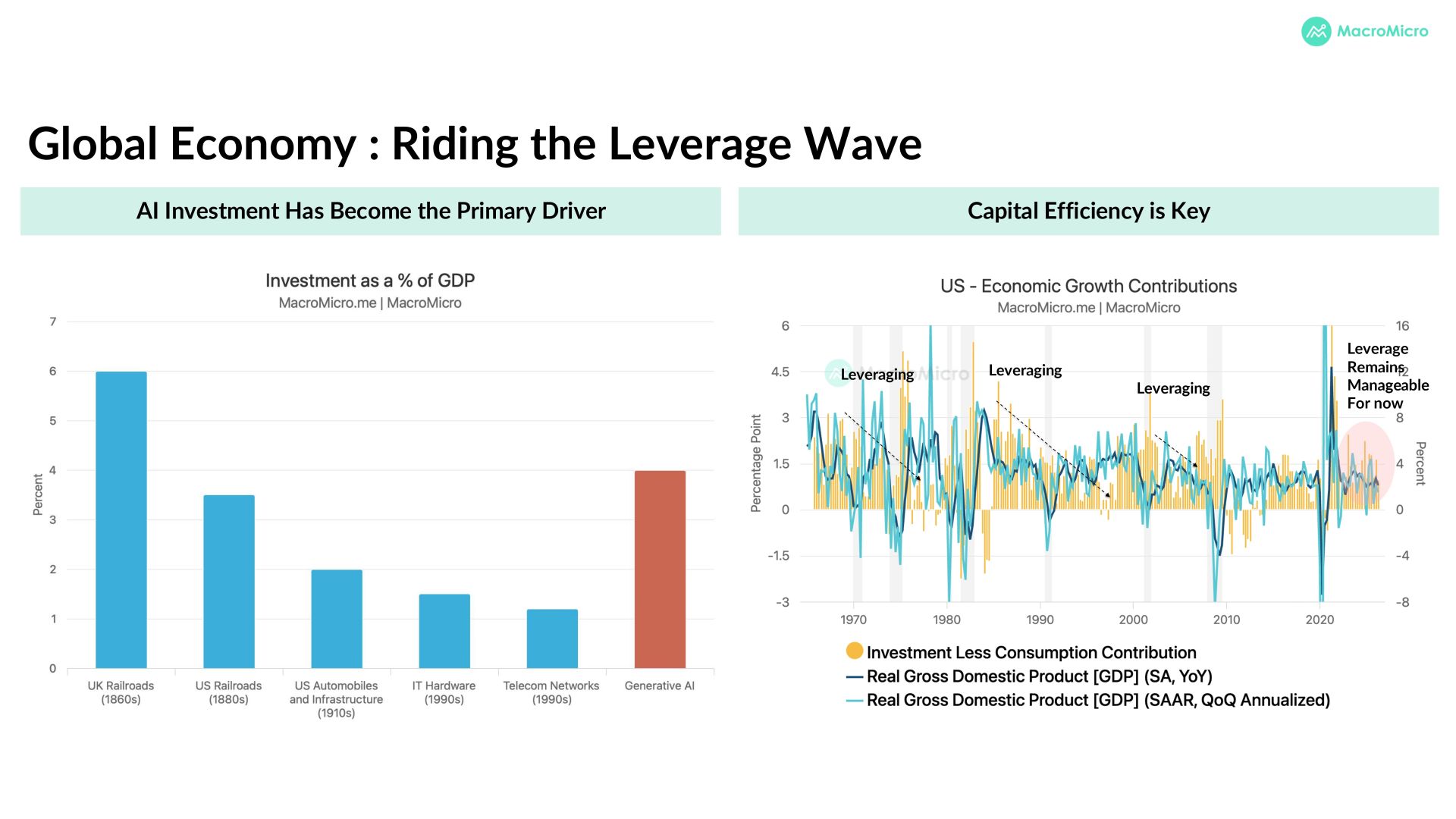
In the short term, this is not a red flag for the macro economy. Because investment is the primary engine driving global growth today, these price increases simply inflate nominal GDP through larger CapEx prints. When price hikes stem from real productivity demand rather than an artificial capacity squeeze, they trigger a virtuous cycle: buyers pay more, but they unlock greater operational output and revenue, which funds further spending.
However, this dynamic has inverted the traditional technology value chain. Pricing power has flipped from a standard pyramid into an inverted pyramid, concentrating value upstream at the top of the stack (foundry, memory, and packaging). This leaves midstream Cloud Service Providers (CSPs) caught in the middle as their cumulative CapEx crosses the massive $1 trillion threshold (projected to reach $1.3 trillion by next year).
Can hyperscalers afford these checks? In the medium term, yes: their spending is still running behind their backlog growth (RPO), giving them immense revenue visibility. But further downstream, liquidity is beginning to fray. MacroMicro's exclusive PAYDEX Liquidity Index (developed with Dun & Bradstreet) reveals that while upstream chipmakers and midstream infrastructure players maintain pristine balance sheets, downstream LLM developers are beginning to diverge, showing early payment delays amid fierce price competition. If delayed payments begin spreading upstream, that is when margin risk turns into credit risk.
3. Manufacturing Has Entered Active Restocking, But Watch for Inventory Mismatch
This is where our third M, macro, enters via the physical supply chain. Semiconductor manufacturing typically runs on a three-to-four-year inventory cycle. Today, that playbook is being rewritten: the industry is riding an extended second expansion wave, pulling global manufacturing into what we classify as an active restocking phase, visible in surging exports across Taiwan, South Korea, and Japan.
Rising inventory is not inherently dangerous, but it requires distinguishing between genuine demand-driven stocking and unwanted inventory accumulation. Because physical bottlenecks will not disappear overnight, the primary vulnerability to monitor is inventory mismatch: having 99% of server components ready on the factory floor, but being unable to ship because you are missing that 1% critical bottleneck chip.
In the near term, this friction is concentrated across three vulnerable pockets. First, server assemblers like Inventec and Wistron have noted that second-half revenue growth is constrained by short-lead bottlenecks rather than assembly capacity, forcing them to carry bloated inventories of non-constrained long-lead parts. Second, consumer components...
Already a subscriber? Click here to log in.
Full Access to Our Services

Comprehensive data at your service
with key indicators for investment insights

Exclusive flash reports
on key events and data

Create your own charts and analysis
including performance backtesting

Hub of professionals to engage
in meaningful discussions and insights
 Get answers from MM AI.
-
How rapidly is AI monetization occurring compared to previous technology cycles?
💡AI monetization is occurring faster than any prior technology cycle due to the dramatic fall in LLM inference prices, which, according to the Jevons paradox, has caused enterprise demand to explode. AI-native software companies are reaching $100M in Annual Recurring Revenue (ARR) much quicker than previous SaaS incumbents. This rapid adoption is translating into significant financial results, as evidenced by Anthropic achieving profitability in Q2 2026, years ahead of the market's initial 2028 projections, marking the entry into the commercial monetization phase of the productivity cycle.
-
How has pricing power shifted within the AI technology value chain?
💡Pricing power has inverted within the AI technology value chain, shifting from a standard pyramid to an inverted pyramid, concentrating value upstream at the top of the stack including foundry, memory, and packaging. This shift is driven by surging hardware demand due to agentic AI's reliance on multi-turn reasoning and ultra-long context windows, leading to price hikes across components like liquid cooling, optical transceivers, and advanced packaging. Midstream Cloud Service Providers (CSPs) are consequently caught in the middle as their cumulative CapEx is projected to reach $1.3 trillion by next year.
-
Are midstream Cloud Service Providers able to afford rising CapEx costs?
💡Midstream Cloud Service Providers (CSPs) are able to afford rising CapEx costs in the medium term because their spending currently lags behind their backlog growth (RPO), providing them with immense revenue visibility. While their cumulative CapEx is projected to cross $1 trillion and reach $1.3 trillion by next year, this investment is considered sustainable for now. However, liquidity is beginning to fray further downstream among LLM developers, who are experiencing early payment delays amid fierce price competition, posing a potential credit risk if these delays spread upstream.
-
How does MacroMicro's PAYDEX Liquidity Index assess financial health across the AI supply chain?
💡MacroMicro's exclusive PAYDEX Liquidity Index, developed with Dun & Bradstreet, assesses financial health across the AI supply chain by tracking payment behaviors. The index reveals that upstream chipmakers and midstream infrastructure players, such as Cloud Service Providers, maintain pristine balance sheets. In contrast, downstream LLM developers are beginning to show early payment delays amid fierce price competition, indicating a divergence in financial health. This divergence suggests that margin risk could evolve into credit risk if these delayed payments begin to spread upstream in the supply chain.
-
Which inventory mismatches pose a primary vulnerability in the AI supply chain?
💡Inventory mismatch poses a primary vulnerability in the AI supply chain, specifically when 99% of server components are ready on the factory floor but cannot be shipped due to the absence of a critical 1% bottleneck chip. This friction is concentrated in three areas: server assemblers (e.g., Inventec, Wistron) face constraints from short-lead bottlenecks, forcing them to carry bloated inventories of non-constrained long-lead parts; consumer components are pressured by weak end-demand for smartphones and PCs; and older-generation compute clusters, used as loan collateral, are exposed to rapid architectural iteration as hyperscale data centers consolidate.
-
When is the critical timeline for new fab and packaging capacity hitting the market?
💡The critical timeline for new fab and packaging capacity hitting the market en masse is 2028. This is when multi-year capacity expansions will officially become available. The primary risk associated with this timeline is whether physical AI and edge devices will have scaled up sufficiently to absorb this substantial supply. If not, the current active restocking cycle could face an abrupt macro correction, potentially leading to oversupply and market imbalances across the semiconductor manufacturing industry.
-
What is the distinction between manufacturing and assembly bottlenecks in the AI supply chain?
💡The distinction between manufacturing and assembly bottlenecks in the AI supply chain is structural. Manufacturing bottlenecks, such as those in foundry, advanced packaging, and HBM memory, represent severe, physical capacity deficits that require billions of dollars and years of lead time to build greenfield facilities, leading to persistent price pressure. Assembly bottlenecks, conversely, stem from architectural validation and technical node transitions, like thermal cooling challenges in advanced server architectures, and are typically resolved through engineering spec adjustments rather than new physical infrastructure.
-
Which type of AI supply bottleneck will resolve more quickly: manufacturing or assembly?
💡Assembly-side AI supply bottlenecks will resolve more quickly through engineering spec adjustments, such as addressing thermal cooling challenges in advanced server architectures. In contrast, manufacturing-side constraints, including those in foundry, advanced packaging, and HBM memory, will require a multi-year runway to clear due to their structural nature, demanding billions of dollars and years to build new physical capacity. This distinction explains the uneven restocking wave observed across the supply chain, where manufacturing segments show real end-demand outstripping inventory growth.
-
How is AI productivity impacting the US-China geopolitical contest for hegemony?
💡AI productivity is profoundly impacting the US-China geopolitical contest for hegemony by serving as a macroeconomic necessity for the United States to generate GDP growth required to sustain its record sovereign debt. This rivalry is unfolding across economic, military, and monetary spheres. In the economic realm, AI acts as a productivity accelerator and secures critical supply chains; militarily, defense AI reshapes the global balance of power; and monetarily, the competition extends to digital currency architectures and global payment rails, ensuring continued public and private capital underwriting for the AI buildout.
-
Which factors determine whether AI capital expenditure converts into durable value?
💡Factors determining whether AI capital expenditure converts into durable value include sustained exponential token volume growth outpacing falling inference prices, validating the Jevons paradox for monetization. For margins and the supply chain, the critical variable is the ability of downstream counterparty liquidity to withstand an inverted pricing structure where upstream bottleneck nodes hold significant power. Lastly, for the broader cycle, the primary risk involves whether short-term inventory mismatches can clear before the massive 2028 capacity wave hits the market. The ongoing geopolitical contest between the US and China also ensures continuous underwriting of the AI buildout.
