What You Should Know
In the AI era, the global electronics supply chain has officially entered a new round of restructuring. Large language models such as Claude, Gemini, and DeepSeek have emerged one after another, rapidly intensifying competition among AI models. AI development has also progressed from large-scale training toward widespread inference, and is now moving further into the era of AI Agents. As applications continue to expand, AI-driven demand for computing power, hardware, and infrastructure continues to broaden.
To gain a more comprehensive understanding of this AI transformation, we have restructured the global AI supply chain and independently built a tracking framework covering the upstream, midstream, and downstream segments. We have organized key indicators and representative companies across each stage of the supply chain, with the goal of helping users track the AI industry's business cycle, capital expenditure, and changes in demand through data.
Key Takeaways
- This time, we take a closer look at indicator trends across the upstream and midstream segments of the AI supply chain, dividing the supply chain into three major categories:
- Most Resilient Moats: Revenue and gross margins are growing sharply, while the industries are highly concentrated and possess technological monopolies (such as foundries / memory), making them the largest current bottlenecks in the AI supply chain.
- Rising Technology & Usage: Revenue and gross margins are gradually increasing (such as OSAT/ABF/CCL/PCB/thermal management/optical communications), transforming these segments from supporting roles into "indispensable" parts of the supply chain.
- Highly Competitive, High-Risk Industries: Revenue and gross margins are under pressure, while intense industry competition (such as assembly manufacturers), relatively low technological barriers, and upstream cost pass-through create greater risks.
I. Our AI Supply Chain Hub Is Officially Live!
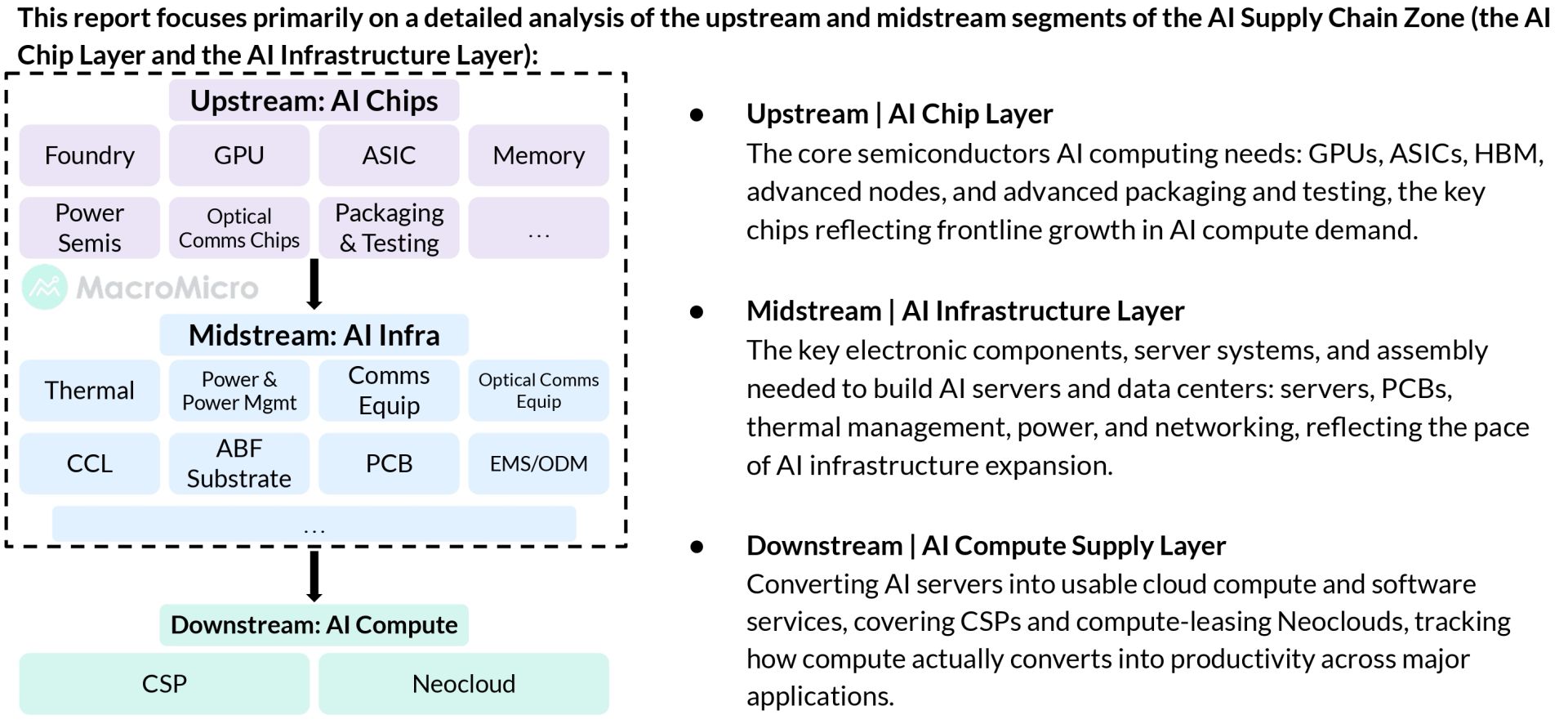
Note: The companies included in the AI Supply Chain Map are for reference only. MacroMicro will regularly maintain the coverage list and add new industries to ensure data accuracy.
AI Supply Chain Overview: Three Profit Categories
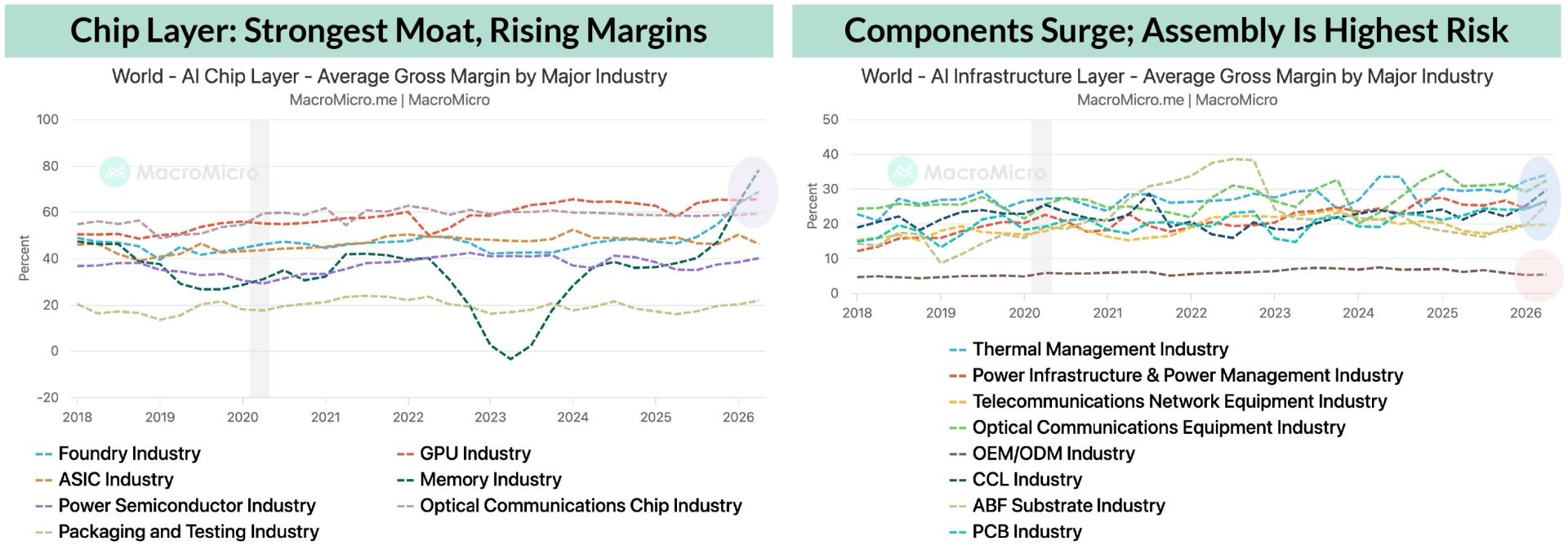
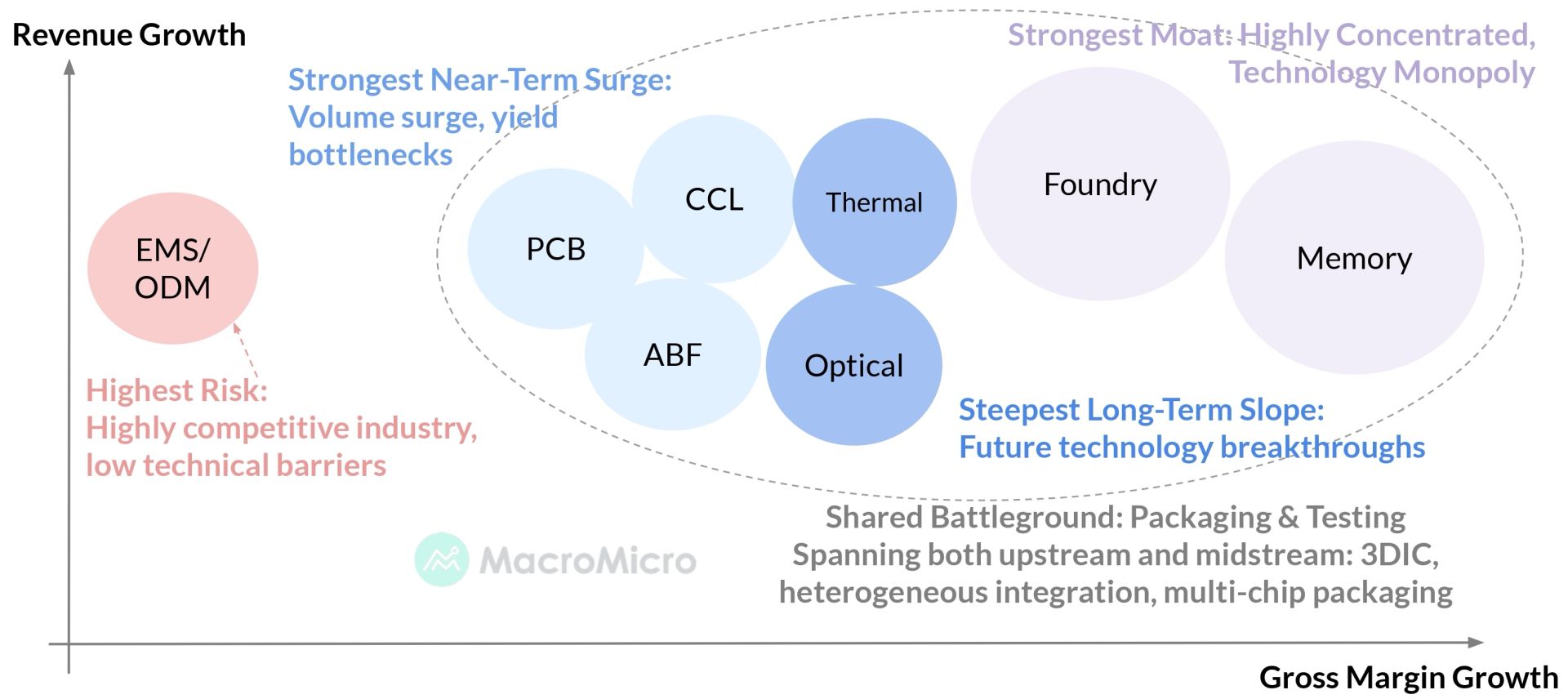
This time, we take a closer look at gross margin trends across the upstream and midstream segments of the AI supply chain, dividing the supply chain into three major categories:
- Strongest moat: Revenue and gross margin are growing sharply, and the industry is both highly concentrated and technologically monopolistic (e.g. foundry/memory). This is also where the biggest AI supply bottleneck currently lies.
- New technology & rising volumes: Revenue and gross margin are climbing steadily (e.g. ABF/CCL/PCB/thermal management/optical communications), shifting from a supporting role to an "indispensable" link in the chain.
- Highly competitive, high risk: Revenue and gross margin are under pressure in this highly competitive industry (e.g. assembly), with low technical barriers and costs passed down from upstream.
II. Most Resilient Moats: Highly Concentrated Industries, Technological Monopolies
1. Foundries: The Core of AI Chips, & the Strongest Pricing Power!
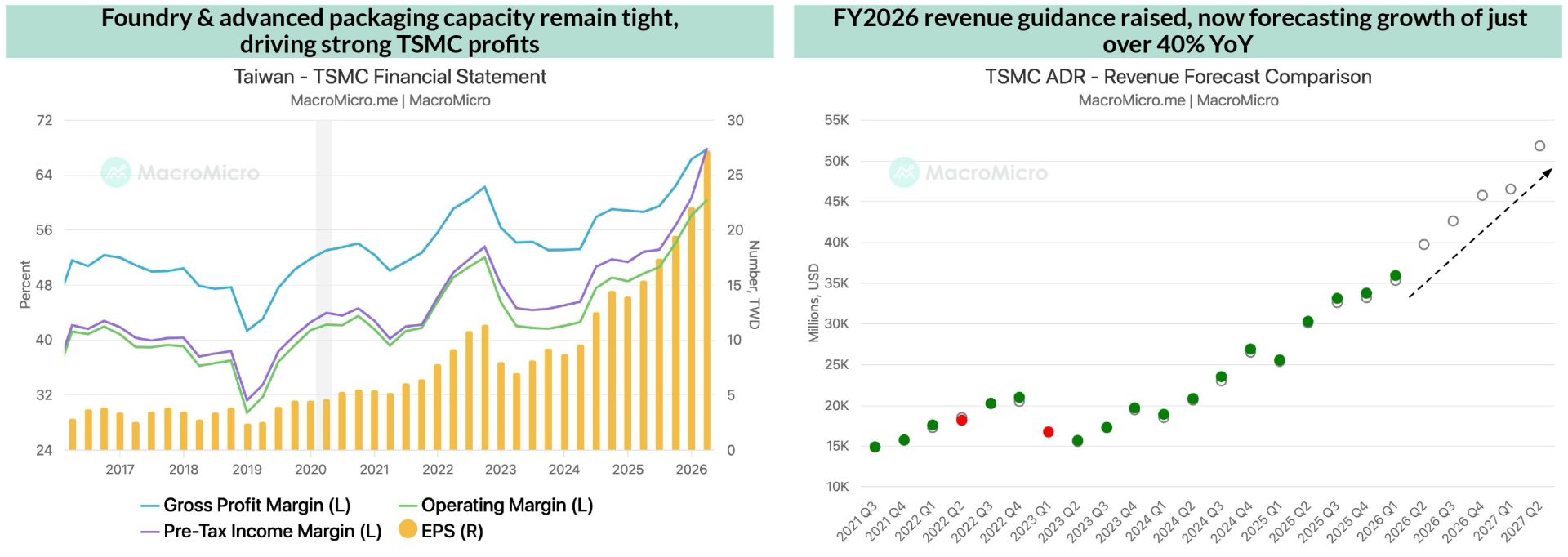
- TSMC's latest earnings show all three profitability metrics hitting record highs simultaneously in 2Q26, reflecting how strong AI demand keeps passing further upstream and is starting to translate into price-increase dividends for foundry and advanced packaging. The scarcity of advanced process capacity has also made foundry one of the segments with the strongest pricing power in the AI supply chain.
- At the same time, TSMC's revenue guidance for 3Q26 calls for USD 44.6 to 45.8 billion (July and August revenue already announced total roughly USD 30.7 billion), once again beating market expectations. It has also raised its full-year 2026 USD revenue growth guidance from “over 30%” to “just over 40%”, underscoring the foundry industry's strong profitability and pricing power.
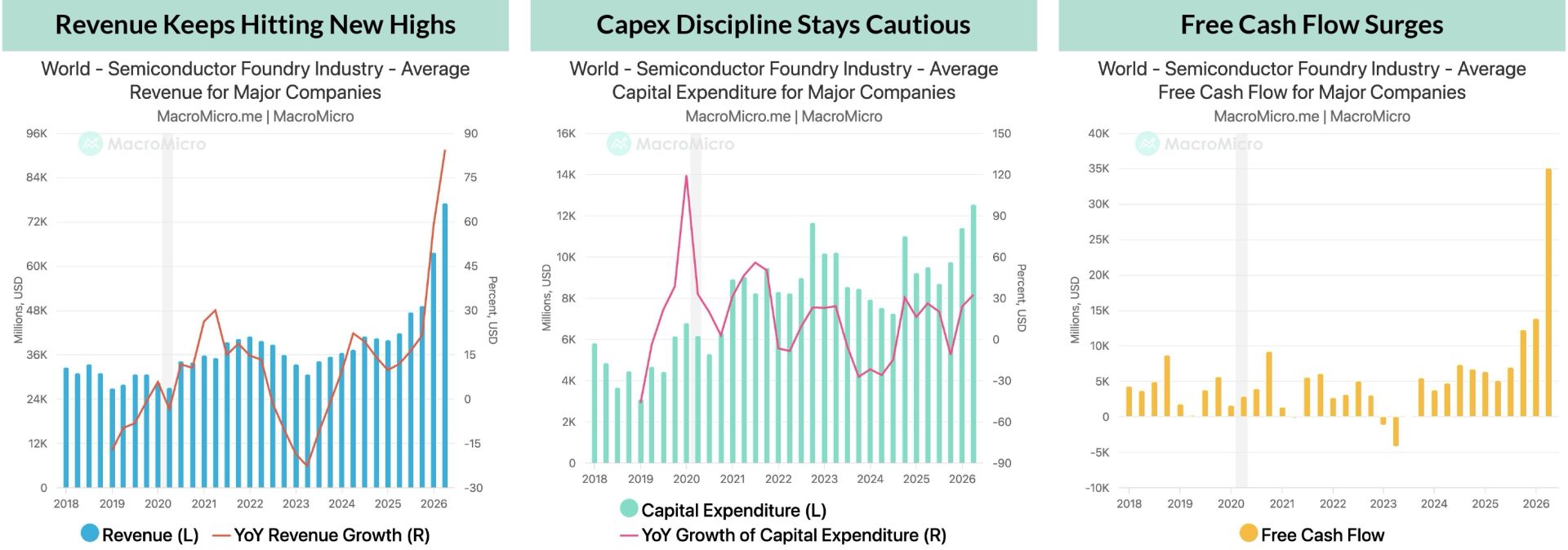
Pricing Power Is Moving Upstream, While Industry Concentration Enforces CapEx Discipline
- Revenue: Foundry revenue is currently hitting new highs in both absolute value and YoY growth, and global semiconductor sales also keep climbing. Beyond confirming strong demand, this is also the clearest evidence of limited supply and price hikes driven by shortages.
- Capital Expenditure: Foundries remain conservative and disciplined, expanding capacity cautiously rather than investing without restraint, avoiding a repeat of the 2022 overbooking episode.
- Cash Flow: The supply chain’s "pricing power" has moved upstream, and with disciplined investment, free cash flow has risen sharply since 2H25, as price increases convert further into cash and profit.
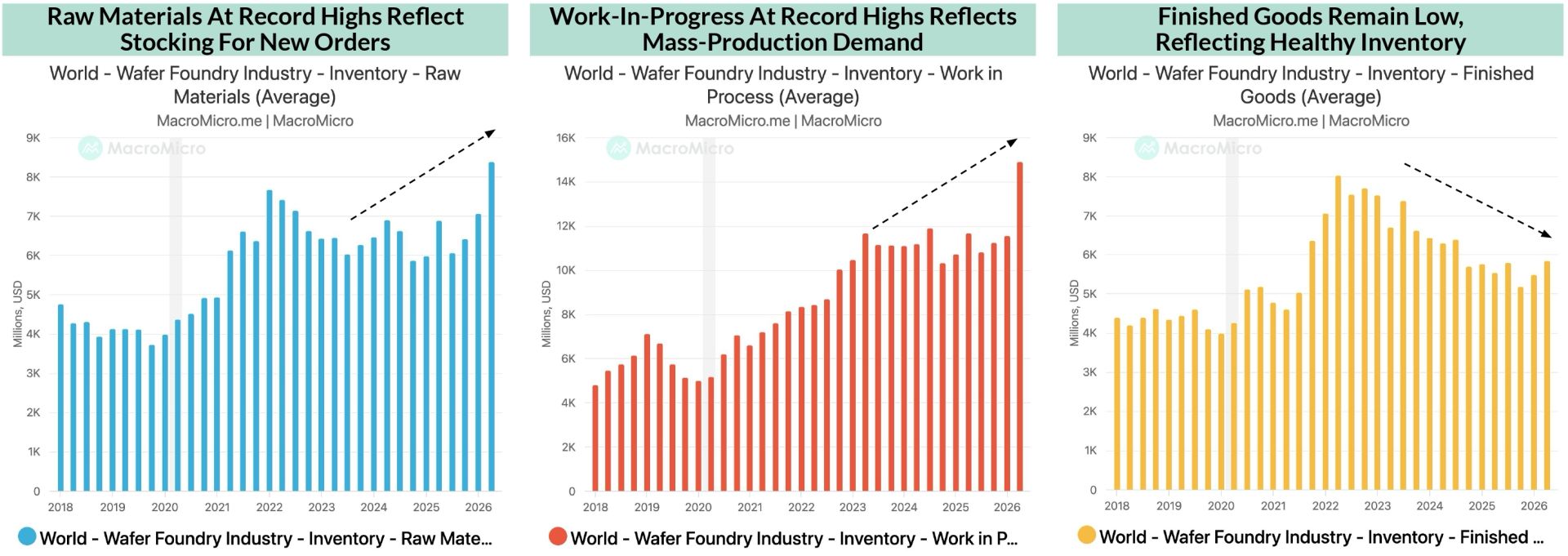
Breaking Down Foundry Inventory: Low Finished Goods Signal Strong Order Demand
- Raw materials: Average levels have climbed to record highs, reflecting customer demand for next-generation chip development and fully booked orders.
- Work-in-progress: Average levels have likewise climbed to record highs, reflecting that chips already in mass production are now being fabricated, a sign of strong demand.
- Finished goods: Average levels remain low, reflecting smooth delivery once chips are completed, healthy inventory conditions, and continued conversion into revenue and profit.
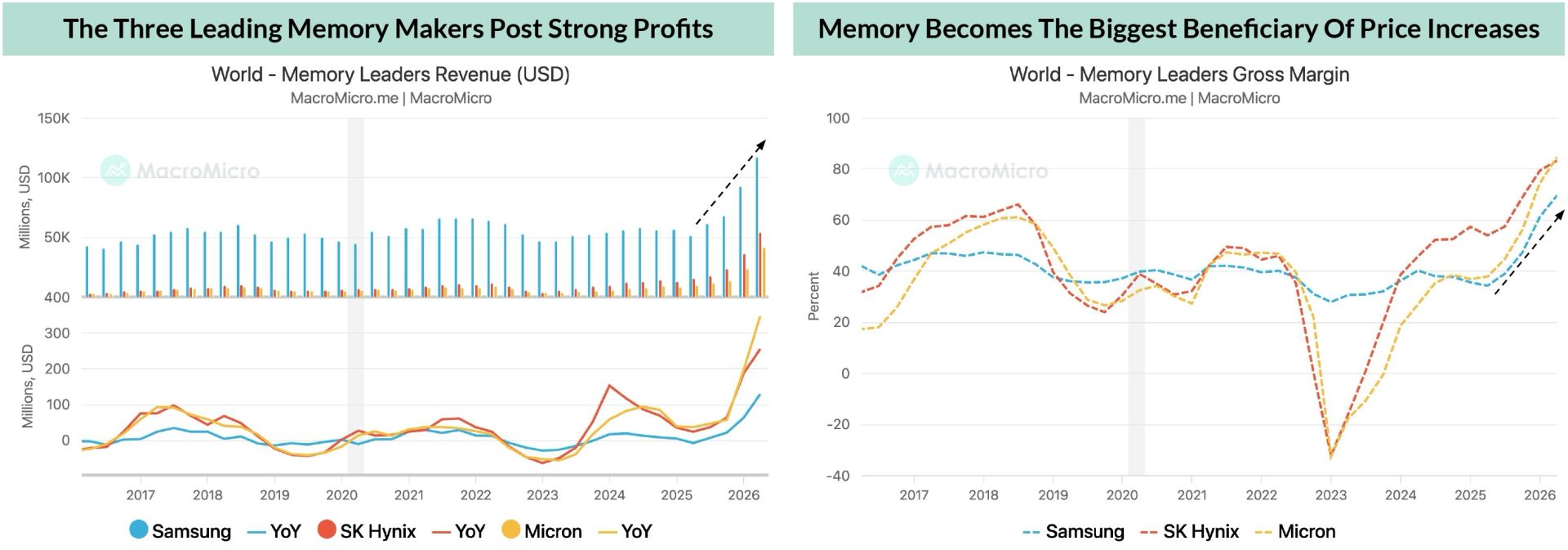
2. Memory Enters a Super Cycle: Leading Players Post Record Revenue, Margins, & Profit
- Memory remains one of the tightest supply-demand segments in the AI supply chain. As major memory makers keep shifting capacity toward higher-end products such as HBM and DDR5, while gradually winding down supply of mature products like end-of-life DDR4, both new and old generations of memory are seeing supply tighten and prices rise together, pushing the entire industry into a new super cycle.
- Since 2H25, the leading memory makers have seen explosive results, with revenue hitting record highs in both absolute value and YoY growth, and gross margins reaching a striking 80%, which, as with foundry, likewise reflects pricing power shifting upstream.
Leading Players Sign "Long-Term Agreements" for the First Time to Secure Future Cash Flow
- As quoted prices surge, the three leading memory makers have begun signing long-term agreements to lock in future customer demand and avoid falling back into the boom-and-bust cycles of the past.
- Most of these long-term agreements run for 5 years, with pricing varying by each company’s capacity plans and customer demand. The agreements also center around: pricing, purchase volume, and financial guarantees.
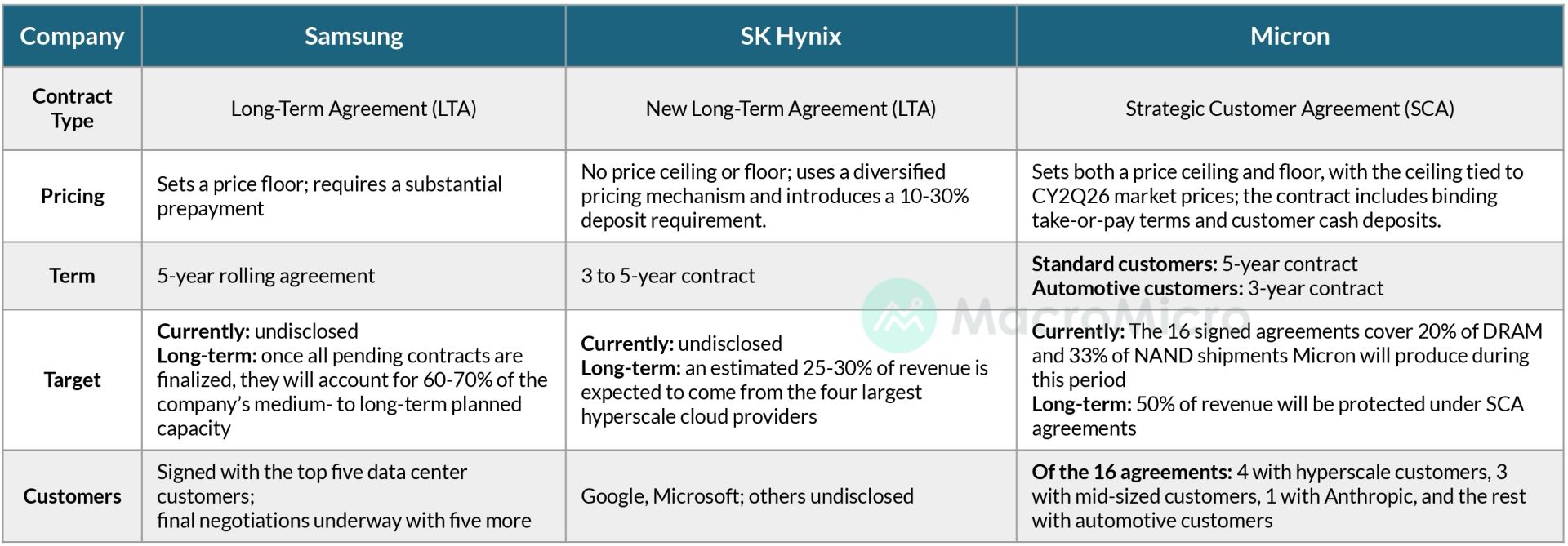
Note: Samsung’s "rolling basis" contract is renegotiated annually. If both parties reach agreement, an additional year is added at the end of the contract, so the remaining contract term is always maintained at approximately 5 years.
From Compute-Oriented to Memory-Oriented: Fast Enough Is No Longer Enough, You Also Need Enough Capacity
Already a subscriber? Click here to log in.
Full Access to Our Services

Comprehensive data at your service
with key indicators for investment insights

Exclusive flash reports
on key events and data

Create your own charts and analysis
including performance backtesting

Hub of professionals to engage
in meaningful discussions and insights
 Get answers from MM AI.
-
Which segments of the AI supply chain possess the most resilient moats and technological monopolies?
💡Foundries and memory segments possess the most resilient moats and technological monopolies within the AI supply chain, acting as the largest current bottlenecks. These industries demonstrate sharply growing revenue and gross margins, alongside high industry concentration, reflecting their strong pricing power and critical role in AI chip production, particularly with advanced process capacities being scarce and leading memory makers experiencing explosive results.
-
Why do foundries like TSMC exhibit strong pricing power in the AI supply chain?
💡Foundries like TSMC exhibit strong pricing power in the AI supply chain because of the scarcity of advanced process capacity, critical for AI chips, which translates into price-increase dividends for foundry and advanced packaging. TSMC's revenue guidance for 3Q26 of USD 44.6 to 45.8 billion and raised full-year 2026 USD revenue growth guidance to "just over 40%" underscore this, as strong AI demand consistently moves upstream, driving up revenue and cash flow, while disciplined capital expenditure avoids oversupply.
-
How is memory evolving into a super cycle with leading players achieving record revenues and margins?
💡Memory is evolving into a super cycle, with leading players achieving record revenues and margins, driven by a structural upgrade across the industry. Major memory makers are shifting capacity toward higher-end products like HBM and DDR5, while phasing out mature products like DDR4, leading to tightening supply and rising prices across both new and old generations. Since 2H25, this shift has resulted in explosive results, with gross margins reaching a striking 80% for leading players, reflecting a significant upstream shift in pricing power and the signing of long-term agreements to secure future cash flow.
-
What role does heterogeneous integration play in driving demand for advanced packaging and ABF substrates?
💡Heterogeneous integration plays a crucial role in driving demand for advanced packaging and ABF substrates by enabling the integration of multiple separate dies into a single package, overcoming the limits of traditional single-die designs. This trend increases signal input/output contacts, thereby enlarging substrate size and requiring higher layer counts and more advanced packaging, sharply boosting ABF demand. The need to combine diverse chiplets also increases overall package size and bump count, necessitating more ABF layers and raising technical complexity, yield bottlenecks, and the importance of ABF substrates.
-
How are thermal management solutions adapting to the increasing power of high-end AI chips?
💡Thermal management solutions are adapting to the increasing power of high-end AI chips by shifting from traditional air cooling, which is nearing its limits for chips surpassing 1kW TDP, to advanced liquid cooling, which is becoming the standard for high-end AI infrastructure. Liquid cooling penetration in AI chips is projected to exceed 50% this year and nearly 60% by 2027. The industry is also transforming into a provider of complete liquid cooling systems (CDU/manifold/rack) and moving towards "package-level cooling" and "silicon-wafer-level" architectures by co-designing with foundries.
-
What technological advancements are driving the evolution of optical communications in AI infrastructure?
💡Technological advancements are driving the evolution of optical communications in AI infrastructure by moving from traditional pluggable optical modules towards NPO and CPO, and eventually to Optical I/O. This core trend aims to bring the optical engine (OE) closer to the xPU/ASIC, thereby shortening electrical signal transmission distance, reducing power consumption and latency, and boosting transmission bandwidth to overcome data transmission bottlenecks. Packaging technology is advancing in parallel through 2.5D and 3D heterogeneous integration, combining electronic ICs (EIC) and photonic ICs (PIC) more closely to improve transmission efficiency and bandwidth density.
-
Why do assembly manufacturers face high risks and profit pressure within the AI supply chain?
💡Assembly manufacturers face high risks and profit pressure within the AI supply chain because, as the furthest downstream link, they must absorb rising costs for chips, server components, and racks due to upstream price increases. Intense industry competition and relatively low technological barriers prevent them from easily passing these costs onto customers. Additionally, component mismatches, where some parts are available but others are missing, delay full-system shipments, creating inventory buildup and cash flow strain, all of which squeeze gross margins despite sustained demand.
-
What long-term factors will convert AI supply chain capacity into actual productivity?
💡Long-term factors that will convert AI supply chain capacity into actual productivity center on the effective monetization and clear visibility of AI's business model. This involves whether the growing backlog of remaining performance obligations (RPO) can successfully replace capital expenditure by tech giants and Neoclouds, which is projected to exceed USD 800 billion in 2026. The increasing global token usage and the entry of AI agents into enterprise workflows are crucial indicators that AI applications are formally beginning to generate productivity.
-
How will AI applications and agent adoption impact future economic growth and demand?
💡AI applications and agent adoption will significantly impact future economic growth and demand by formally converting AI's capabilities into tangible productivity. The surging global token usage and the integration of AI agents into enterprise workflows indicate a transition from large-scale AI training to widespread inference and practical application. This expansion of AI into daily operations and business processes is expected to drive demand for computing power, hardware, and infrastructure, ultimately fueling economic growth by enhancing efficiency and creating new opportunities across various industries.
-
What is the projected capital expenditure by tech giants and Neoclouds in the AI compute supply layer for 2026?
💡The projected capital expenditure by tech giants and Neoclouds in the AI compute supply layer for 2026 is set to exceed USD 800 billion. This substantial investment underscores the increasing demand for AI infrastructure and reflects the industry's commitment to expanding computing capabilities as AI development progresses from large-scale training to widespread inference and the era of AI Agents. Additionally, off-balance-sheet financing continues to expand, further supporting these capital-intensive initiatives.
