Our MacroMicro Q1 2026 Economic Outlook delivered a sweeping view of the global economy as it enters 2026, from fading tariff headwinds and an AI-driven semiconductor supercycle to the diverging fortunes of the US, China, and Europe—and the macro implications of an active US-Iran conflict that has put oil markets and Fed policy back under the spotlight.. With MacroMicro's own Vivianna, Vice Research Director, at the helm, this latest session highlights a resilient global economy anchored by a historic semiconductor boom, driving massive capital investments and fundamentally reshaping supply chains.
1. Geopolitical and Tariff Risks Remain Contained, Averting Stagflation
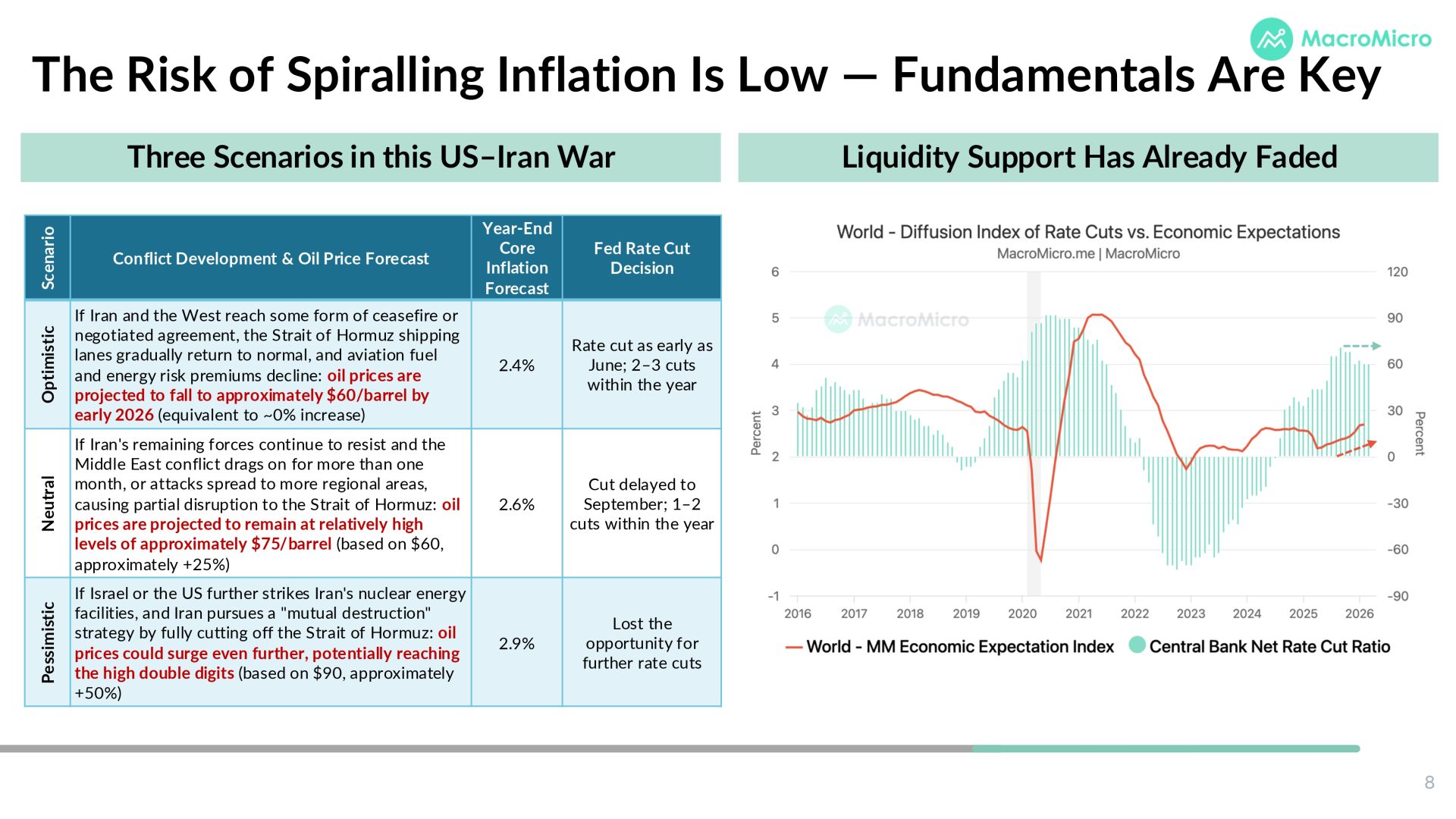
Initial fears of a prolonged trade war have largely subsided. US effective tariff rates have declined following the Supreme Court's blocking of reciprocal tariffs, and inflation peaked at a manageable 3% before retreating. On the geopolitical front, US-Iran tensions remain a key variable, but the macroeconomic risk is structurally lower than the 2022 Russia-Ukraine shock for three reasons: global oil markets are now running a surplus bolstered by US shale and OPEC+ capacity expansion; real interest rates remain above neutral, giving the Fed room to absorb shocks without aggressive intervention; and sustained AI-driven productivity growth provides a demand buffer that simply didn't exist four years ago.
In summary, US–Iran tensions are less likely to escalate into a prolonged conflict and are expected to have a more limited economic impact relative to 2022. The Fed is therefore more likely to delay rate cuts rather than cancel them altogether.
However, a more severe scenario must also be considered. If disruptions in the Strait of Hormuz push oil prices above $100 for more than a quarter, the Fed may have little to no room to cut rates and could even be forced to consider renewed tightening.
2. Global Divergence: US Wealth Effects vs. China's Structural Drag
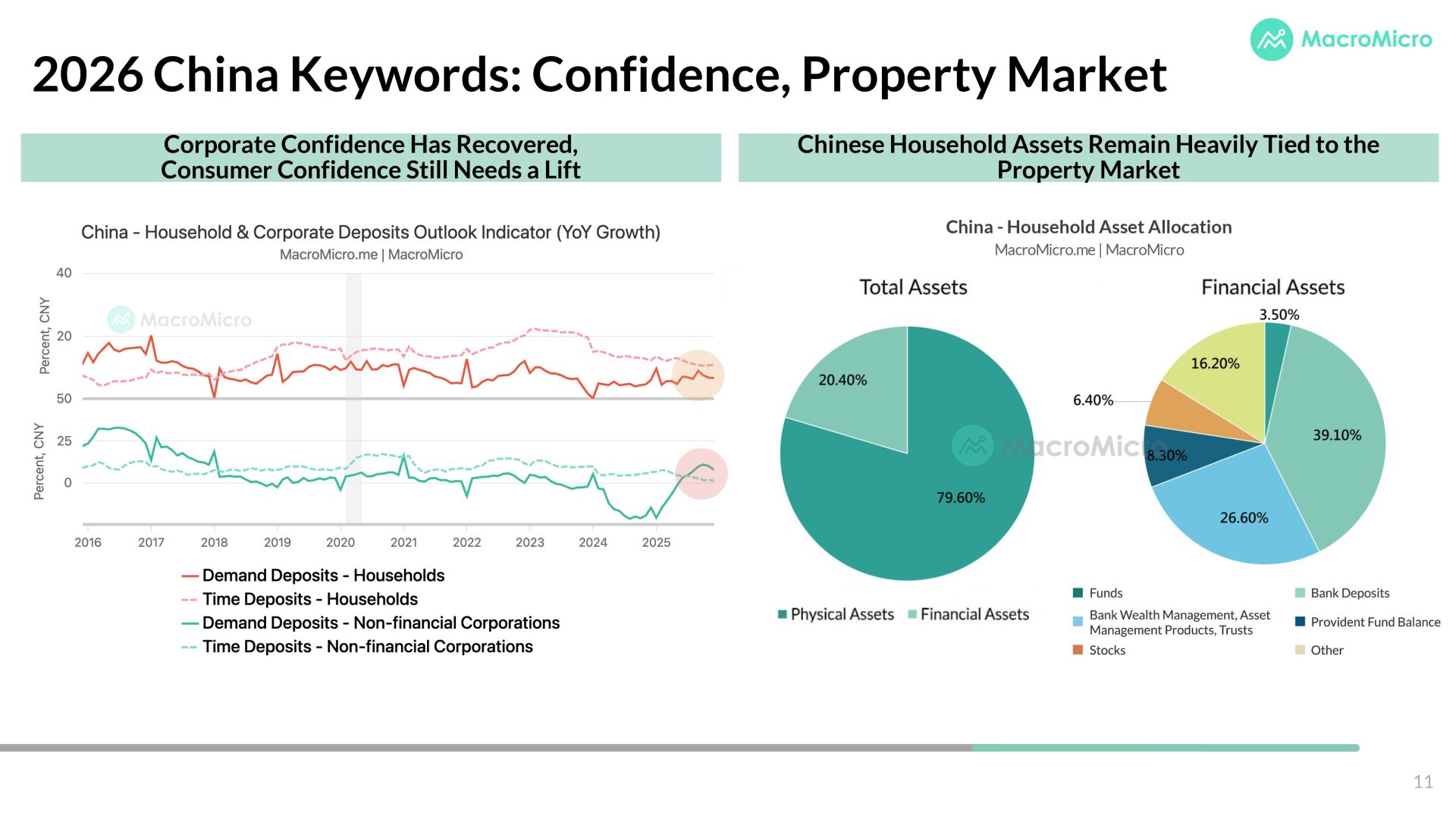
Economic momentum is sharply diverging across major global markets. In the US, a combination of expanding fiscal stimulus and robust stock market performance has created a powerful wealth effect for high-income earners, keeping consumption afloat as the narrative shifts to "Make America Affordable Again." Conversely, China faces a structural hurdle; while corporate confidence and investment are recovering due to policy support, household sentiment severely lags. Because roughly 80% of Chinese household wealth is tied to the struggling real estate market, consumer spending will remain constrained until property values stabilize.
3. AI Advances to "Stage 3" Broad Monetization Amidst Healthy Competition
We are actively transitioning from the initial hardware breakthrough phase to widespread software monetization (Stage 3) of the AI cycle. Rather than a monolithic monopoly, the AI landscape is diversifying, the combined market share of the top three LLMs has dropped from roughly 80% to 50% over the past year. This intensifying competition is...
🎥 MM Max Annual subscribers can now stream the full Q1 MEO replay — plus unlock the US–Iran Conflict Dashboard (14 charts) for free.
Already a subscriber? Click here to log in.
Full Access to Our Services

Comprehensive data at your service
with key indicators for investment insights

Exclusive flash reports
on key events and data

Create your own charts and analysis
including performance backtesting

Hub of professionals to engage
in meaningful discussions and insights
 Get answers from MM AI.
-
What is the macroeconomic risk of the US-Iran conflict compared to the 2022 Russia-Ukraine shock?
💡The macroeconomic risk of the US-Iran conflict is structurally lower than the 2022 Russia-Ukraine shock due to a global oil market surplus, real interest rates above neutral, and sustained AI-driven productivity growth providing a demand buffer.
-
What factors contribute to the structurally lower macroeconomic risk from US-Iran tensions?
💡Factors contributing to the structurally lower macroeconomic risk from US-Iran tensions include a global oil market running a surplus, bolstered by US shale and OPEC+ capacity expansion, real interest rates remaining above neutral, giving the Fed room to absorb shocks without aggressive intervention, and sustained AI-driven productivity growth providing a demand buffer that did not exist four years ago.
-
How do US wealth effects contrast with China's structural economic drag?
💡US wealth effects, driven by expanding fiscal stimulus and robust stock market performance, create a powerful wealth effect for high-income earners, keeping consumption afloat. Conversely, China faces a structural economic drag where household sentiment lags due to approximately 80% of household wealth being tied to the struggling real estate market, constraining consumer spending.
-
What impedes Chinese household consumption, despite corporate recovery?
💡Chinese household consumption is impeded by the fact that roughly 80% of household wealth is tied to the struggling real estate market, meaning consumer spending will remain constrained until property values stabilize, despite a recovery in corporate confidence and investment due to policy support.
-
What defines the 'Stage 3' monetization phase of the AI cycle?
💡The 'Stage 3' monetization phase of the AI cycle is defined by the active transition from initial hardware breakthroughs to widespread software monetization, characterized by a diversifying AI landscape and intensifying competition rather than a monolithic monopoly.
-
How has competition among large language models evolved recently?
💡Competition among large language models has evolved with increased diversification, as the combined market share of the top three LLMs has dropped from approximately 80% to 50% over the past year, indicating a dynamic and healthy innovation cycle.
-
How does AI demand affect the consumer electronics sector and memory prices?
💡AI demand significantly affects the consumer electronics sector and memory prices by absorbing manufacturing capacity and driving memory prices higher due to skyrocketing demand for AI compute, creating a bifurcated market.
-
Which types of consumer electronics manufacturers face challenges due to AI's 'crowding out' effect?
💡Mid-to-low-tier consumer electronics manufacturers face challenges due to AI's 'crowding out' effect, experiencing constrained component access, limited ability to pass through costs, and in some cases, forced specification downgrades that erode their competitive position.
-
What drives the semiconductor supercycle despite mixed results in end-consumer markets?
💡The semiconductor supercycle is driven by the structural, insatiable demand for AI infrastructure, which guarantees the sector remains structurally under-supplied and highly profitable, despite mixed results in end-consumer markets and a 'shallow U-shaped' recovery in the automotive sector.
-
What is MacroMicro's Q1 2026 Economic Outlook's view on global economic resilience?
💡MacroMicro's Q1 2026 Economic Outlook views the global economy as resilient, anchored by a historic semiconductor boom that drives massive capital investments and fundamentally reshapes supply chains, alongside receding trade tensions and rising fiscal stimulus.
