What You Should Know
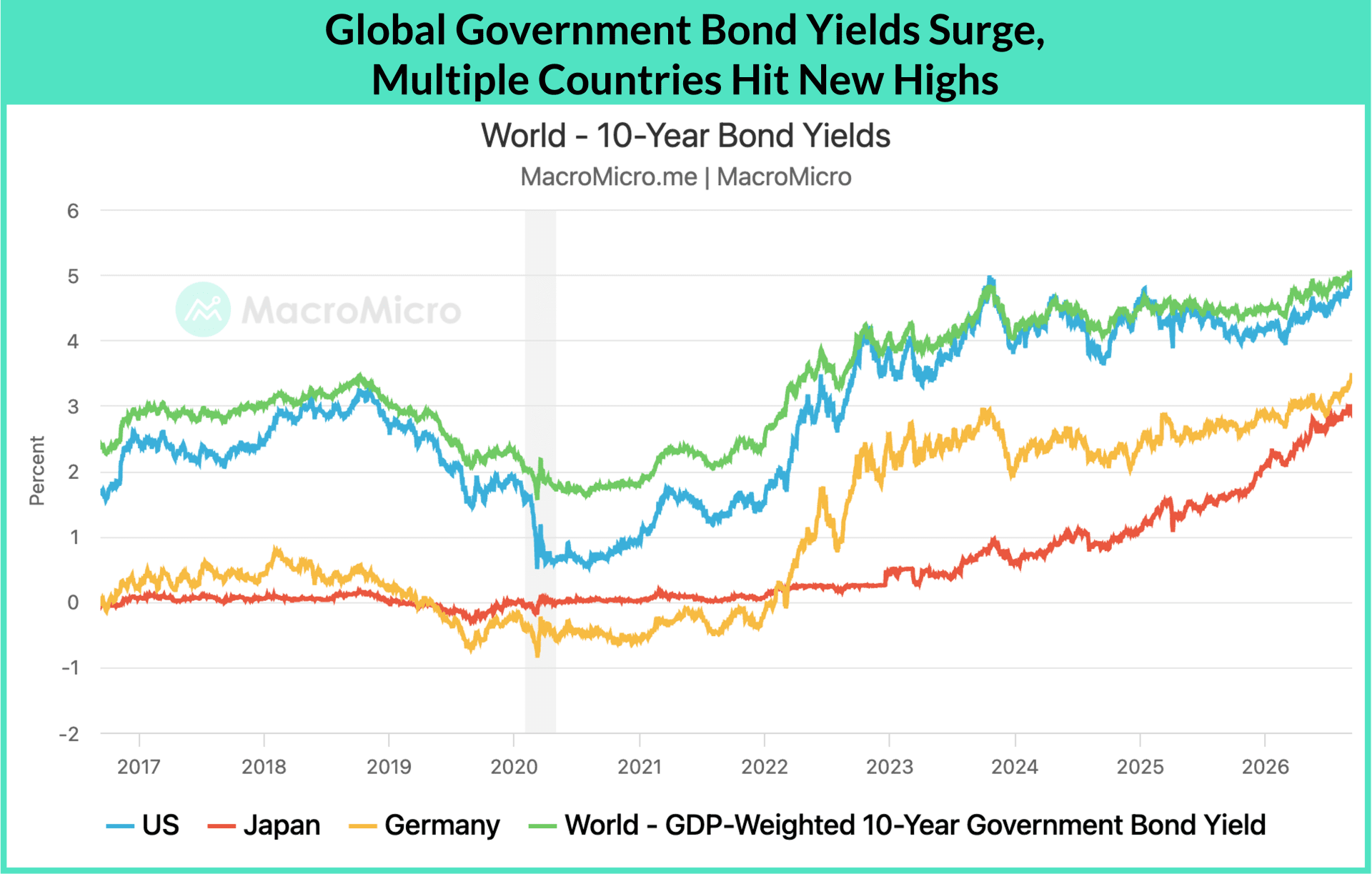
Government bond yields across major developed economies are simultaneously hitting new highs. The US 10-year Treasury yield has climbed above 4.8%, while the 30-year yield has reached its highest level since June 2007. Germany's 30-year yield has surged to 3.79%, the highest since the European debt crisis in 2011. Japan's 10-year yield has hit 3% for the first time since September 1996, while its 30-year yield has climbed to 4.14%, a record high since the maturity was first introduced in 1999.
The surge in global government bond yields reflects two forces taking hold at the same time. First, structural deficits are becoming normalized, with fiscal deficits shifting from exceptional crisis-era measures to persistent fiscal expansion. Second, geopolitical shocks are pushing up costs and driving central banks back toward rate hikes. Our previous article focused on US Treasuries. This time, we broaden the lens to the global market: first breaking down the scale and nature of fiscal expansion across major economies, then examining the actions of the two major central banks that resumed rate hikes in September, the ECB and the BOJ, before reviewing the tools available to governments and, finally, considering how economies can address their debt burdens over the long term through the productivity gains brought by AI.
Key Takeaways
- Why are yields surging? Expanded defense spending and subsidies have turned current debt accumulation from a one-off phenomenon into persistent structural deficits. At the same time, geopolitical shocks have pushed the ECB and BOJ back onto a rate-hiking path, jointly driving government bond yields higher.
- How are governments responding? Governments are shortening debt maturities by issuing more short-term bonds, improving secondary-market liquidity, developing retail investors as a new source of demand, while central banks provide defensive mechanisms such as repo facilities.
- Assessing the long-term solution: The key to long-term stability in bond markets is whether the debt-to-GDP ratio can decline through productivity gains driven by AI. We estimate the "growth gap" each economy needs to close to stabilize its debt burden and compare the feasibility of using AI-driven productivity gains to close these gaps.
- Government bond investment: We assess the investment value of government bond markets across major economies.
I. Two Drivers Behind the Global Bond Selloff: Weaker Fiscal Cycles & an Earlier End to the Rate-Cutting Cycle
The surge in global government bond yields is being driven by two major forces: the normalization of structural deficits, and geopolitical shocks that are forcing the ECB and BOJ back toward rate hikes.
Weaker Fiscal Cycles: Fiscal Expansion Shifts From Crisis Response to Structural Spending
The OECD's latest Global Debt Report 2026 shows that outstanding sovereign debt in developed economies reached a record $61 trillion in 2025, while annual net borrowing requirements are expected to rise to nearly $4 trillion in 2026, the second-highest level on record. This new round of fiscal expansion is not driven solely by population aging and the snowballing cost of interest payments. Two new spending channels have emerged: defense rearmament and household subsidies. Both have shifted from one-off special budgets introduced in response to geopolitical risks to recurring items in annual government budgets.
- US: In July 2025, the One Big Beautiful Bill Act (OBBBA) made the 2017 tax cuts permanent while adding to defense and border spending. The CBO estimates that this will increase deficits by $4.7 trillion over 2026–35. Tariffs, which had originally served as a fiscal revenue patch, were dealt a major blow in February 2026 when the Supreme Court ruled that tariffs imposed under IEEPA exceeded the administration's authority, requiring collected tariffs to be refunded. Although the White House subsequently shifted to Sections 122 and 301 of the Trade Act, the tariff refunds nevertheless...
Already a subscriber? Click here to log in.
Full Access to Our Services

Comprehensive data at your service
with key indicators for investment insights

Exclusive flash reports
on key events and data

Create your own charts and analysis
including performance backtesting

Hub of professionals to engage
in meaningful discussions and insights
 Get answers from MM AI.
-
How do structural deficits contribute to the current rise in government bond yields?
💡Structural deficits contribute to the current rise in government bond yields by normalizing fiscal expansion, shifting from exceptional crisis-era measures to persistent fiscal spending, particularly in defense rearmament and household subsidies. This increased government borrowing supply, as highlighted by the OECD's projection of $61 trillion in sovereign debt by 2025 and annual net borrowing requirements of nearly $4 trillion by 2026, places upward pressure on yields.
-
How does the fiscal expansion in recent years differ from historical patterns regarding monetary policy?
💡The fiscal expansion in recent years differs from historical patterns due to the decoupling of fiscal and monetary policy. Historically, fiscal expansion during recessions was often accompanied by monetary loosening and central bank bond purchases, preventing significant interest rate increases. However, recent expansion occurs while the ECB and BOJ are shrinking balance sheets and resuming rate hikes, increasing debt issuance without corresponding central bank absorption.
-
What factors led the European Central Bank (ECB) to raise rates by 25 basis points in September?
💡The European Central Bank (ECB) raised rates by 25 basis points in September due to a triple shock in the summer of 2026: extreme heat, drought, and the Middle East crisis. These events constrained hydropower and nuclear power, forcing increased natural gas-fired generation, which pushed Dutch TTF gas prices up. Additionally, unresolved Middle East conflict drove Brent crude above $100 per barrel, causing eurozone HICP to rebound to 3.3% in August.
-
What are the key reasons behind the Bank of Japan's (BOJ) expected rate hike?
💡The key reasons behind the Bank of Japan's (BOJ) expected rate hike include endogenous inflation dynamics and AI pushing inflation higher, with wage increases exceeding 5% for the third consecutive year and underlying inflation moving toward 2%. Additionally, the damage from excessive yen depreciation, which pushed the yen to 164 in August, now outweighs the cost of rate hikes, and financial conditions remain accommodative despite previous hikes, justifying further tightening.
-
How is the US intervention influencing Japan's monetary policy decisions and yen stability?
💡US intervention is significantly influencing Japan's monetary policy decisions and yen stability, with Washington concerned Japan might sell US Treasuries to fund yen intervention, exacerbating supply and liquidity pressures in the Treasury market. Japan's foreign securities holdings fell by $87.8 billion at the end of August, suggesting Treasury sales for intervention. This has led to rare coordinated US-Japan FX intervention and public statements from US Treasury Secretary Scott Bessent advocating BOJ rate hikes.
-
What is the most common approach governments are using to address high borrowing costs?
💡The most common approach governments are using to address high borrowing costs is to shorten debt maturities by issuing more short-term debt, with maturities of one year or less. By the end of 2025, these bonds accounted for a record 48% of total government bond issuance in developed economies, with the US having the highest share at nearly 57%.
-
How are governments attempting to improve liquidity in the bond market?
💡Governments are attempting to improve liquidity in the bond market by focusing on 'ease of trading, flexible replenishment, and efficient fund turnover.' Specific measures include extending trading hours, increasing issuance of popular bonds and flexibly reopening less popular ones, providing short-term borrowing and lending services for bonds and cash, and using advance buybacks or bond exchanges to spread out future debt repayment pressure. Most countries also utilize investment banks for underwriting syndicates.
-
What strategies is Japan employing to mobilize retail investors for its government bonds?
💡Japan is employing two main strategies to mobilize retail investors for its government bonds: encouraging the Government Pension Investment Fund (GPIF) to increase its allocation to Japanese government bonds from 25% to potentially 30% or 35%, which could channel ¥15 trillion to ¥29 trillion. Additionally, Japan plans to introduce tax incentives, such as including government bond interest and capital gains in NISA's tax-exempt scope and offering inheritance tax exemptions, to turn retail investors into stable, long-term holders.
-
How do central banks like the Federal Reserve provide a final layer of insurance for bond markets?
💡Central banks like the Federal Reserve provide a final layer of insurance for bond markets through mechanisms such as removing the aggregate cap on its Standing Repo Facility (SRF) in 2025 and introducing the Reserve Management Purchases (RMP) program. The FIMA Repo Facility allows foreign central banks, including the BOJ, to borrow US dollars against US Treasuries without selling them directly, helping stabilize the yen and preventing disorderly conditions in the Treasury market.
-
What long-term solution is proposed to address the fundamental problem of debt accumulation?
💡The long-term solution proposed to address the fundamental problem of debt accumulation is raising the real GDP growth rate (g) to dilute the debt burden through the denominator, specifically by leveraging AI to boost economic growth. This approach aims to ensure the economic growth rate exceeds the financing rate, allowing the debt-to-GDP ratio to decline, thereby strengthening fiscal health and market confidence in government credit.
