The AI Race Is No Longer Zero-Sum: Why Intensifying Competition May Be Extending the Infrastructure Supercycle
What You Should Know
Recent reports suggesting that OpenAI had missed internal revenue and user growth targets briefly reignited concerns surrounding the sustainability of the AI investment cycle. According to reporting from The Wall Street Journal, internal discussions at OpenAI had raised concerns that future computing obligations could become difficult to fund if growth slowed materially.
However, market sentiment reversed sharply following Q1 earnings releases from major technology companies. Google, Amazon, Microsoft, and Meta all continued raising AI-related capital expenditure guidance, reinforcing the view that hyperscalers remain committed to long-term infrastructure expansion.
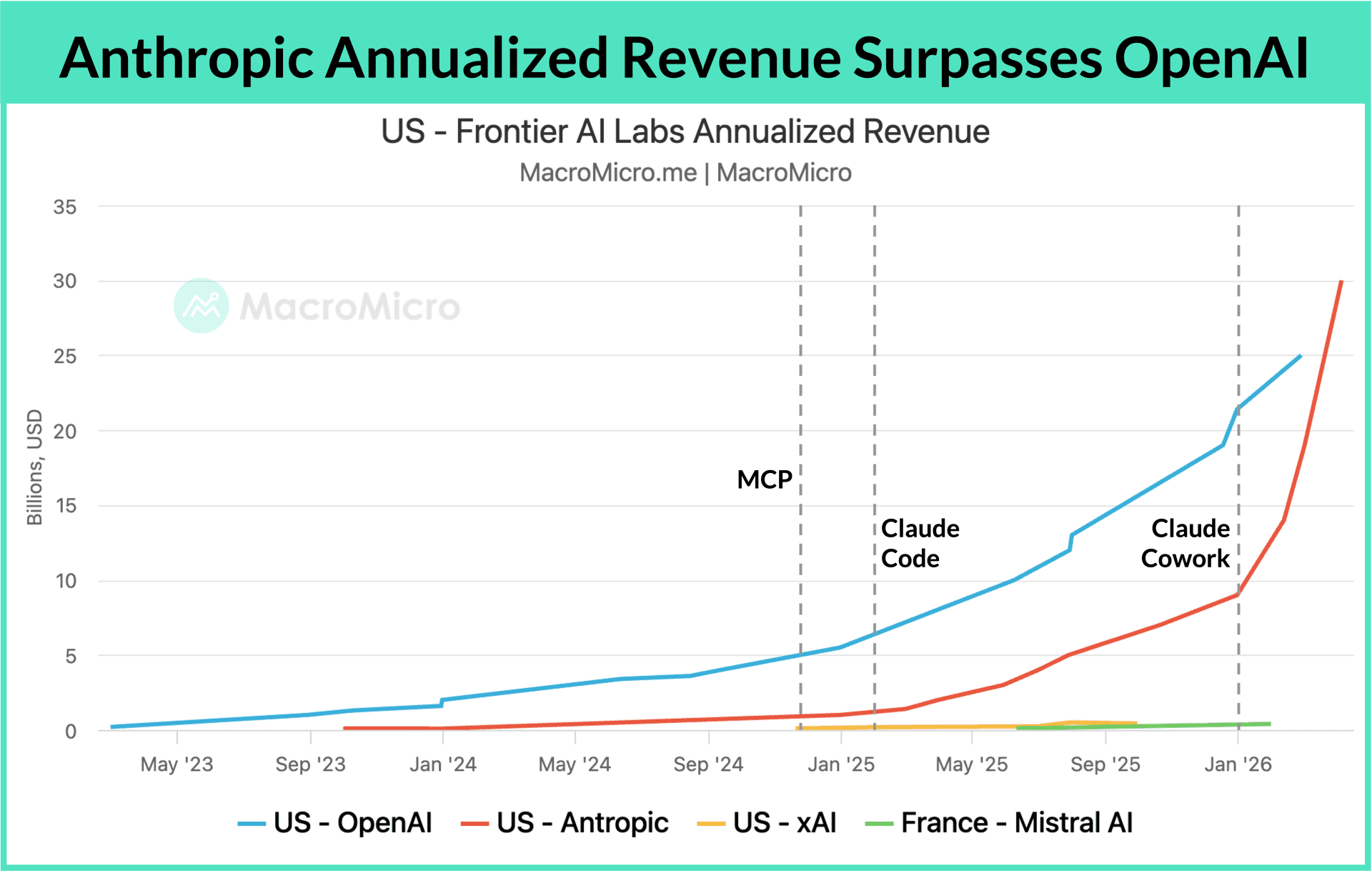
At the same time, competition among frontier LLM developers continues intensifying. According to multiple industry estimates, Anthropic’s annual recurring revenue (ARR) has now surpassed OpenAI’s on a gross accounting basis, with some projections suggesting ARR could already exceed $40 billion. While accounting methodologies differ materially between the two companies, Anthropic’s rise nonetheless highlights how rapidly the competitive landscape is evolving.
Importantly, this does not necessarily imply weakening demand for AI overall. Instead, the industry increasingly resembles an expanding ecosystem in which competition itself continues driving broader adoption, larger infrastructure investment, and accelerating commercialization across the entire stack.
Key Highlights
- Despite renewed concerns surrounding OpenAI’s revenue trajectory, hyperscalers continue aggressively expanding AI capital expenditure, with combined 2026 spending expectations now surpassing $700 billion. The market increasingly views AI infrastructure demand as structurally persistent rather than cyclical.
- Competition among frontier LLM developers is no longer simply a battle for market share. Anthropic’s rapid rise alongside OpenAI and Google DeepMind reflects an AI market that is still expanding in absolute size, particularly across enterprise adoption and AI agent deployment.
- At the cloud and hardware layers, hyperscalers are transitioning from a “build first, monetize later” phase toward one increasingly supported by backlog visibility, enterprise commitments, and improving AI monetization metrics.
- Meanwhile, GPUs and custom ASICs are entering a complementary expansion cycle rather than a zero-sum competitive dynamic, continuing to drive demand across semiconductors, servers, networking, power infrastructure, and data centers.
I. The AI Ecosystem Is Expanding Across Every Layer
The AI ecosystem can broadly be divided into three layers: upstream hardware infrastructure, midstream compute suppliers, and downstream applications.
At the upstream layer, competition centers around NVIDIA-led GPU clusters and the growing adoption of custom ASIC architectures developed by hyperscalers such as Google, Amazon, and Meta. The primary battlegrounds are performance efficiency, inference cost, and long-term control over supply chains.
In the midstream layer, competition is unfolding between traditional Cloud Service Providers (CSPs) and emerging “NeoCloud” platforms specializing in AI compute rental. Traditional CSPs benefit from scale, capital access, and integrated ecosystems, while NeoCloud providers differentiate through specialized GPU infrastructure tailored toward AI training and inference workloads.
At the downstream layer, the LLM race has increasingly consolidated around OpenAI, Anthropic, and Google DeepMind. Yet despite intensifying competition, the current AI cycle should not be viewed as a purely zero-sum market. Instead, aggressive competition is simultaneously accelerating technological advancement, lowering deployment costs, and expanding real-world adoption.
A useful historical analogy is the browser wars of the 1990s. At its peak, Netscape controlled roughly 90% of the browser market before being displaced by Microsoft through aggressive operating-system bundling and pricing strategies. Yet despite Netscape’s collapse, the internet economy itself continued expanding exponentially. The browser battle accelerated internet adoption rather than suppressing it. Similarly, leadership within frontier AI models may continue changing over time, while the broader ecosystem simultaneously grows larger. In fact, rapidly shifting competitive dynamics may itself reinforce...
Is the AI investment cycle beginning to evolve from speculative buildout into measurable commercialization? This in-depth report explores hyperscaler AI spending, OpenAI and Anthropic competition, cloud monetization trends, Neocloud risk dynamics, and the complementary expansion of GPUs and ASICs across the broader AI ecosystem. Unlock full access to this report, proprietary data insights, and our ongoing coverage of the global AI infrastructure and semiconductor cycle with MM Max. Subscribe Now»
Already a subscriber? Click here to log in.
Full Access to Our Services

Comprehensive data at your service
with key indicators for investment insights

Exclusive flash reports
on key events and data

Create your own charts and analysis
including performance backtesting

Hub of professionals to engage
in meaningful discussions and insights
 Get answers from MM AI.
-
How are major tech companies like Google and Amazon addressing AI infrastructure expansion?
💡Google, Amazon, Microsoft, and Meta are aggressively expanding AI infrastructure by raising AI-related capital expenditure guidance, with combined 2026 spending expectations surpassing $700 billion. They are shifting from a "build first, monetize later" phase to one supported by backlog visibility, enterprise commitments, and improved AI monetization metrics, demonstrating a persistent structural demand for AI infrastructure.
-
How is the intensifying competition among LLM developers like Anthropic and OpenAI affecting the AI market?
💡Intensifying competition among LLM developers, such as Anthropic surpassing OpenAI in annual recurring revenue (ARR) on a gross accounting basis with projections exceeding $40 billion, signifies a rapidly expanding AI market rather than a zero-sum game. This competition drives broader adoption, larger infrastructure investments, and accelerated commercialization across the entire AI ecosystem, particularly in enterprise adoption and AI agent deployment.
-
How are hyperscalers transitioning from a 'build first, monetize later' phase in AI infrastructure?
💡Hyperscalers are transitioning from a 'build first, monetize later' phase by supporting AI capital expenditures with backlog visibility, enterprise commitments, and improving AI monetization metrics. They are now seeing concrete revenue results from AI businesses, developing custom ASICs for hardware self-sufficiency, and diversifying towards broader model ecosystems with AI agents to achieve validated commercial business models, suggesting a shift to a 'commit first, deploy later' model.
-
How is AI beginning to deliver concrete revenue results for tech giants?
💡AI is delivering concrete revenue results for tech giants, with Google Cloud revenue surging 63% year-over-year, its backlog nearly doubling, and Amazon AWS achieving its fastest growth in 15 quarters, with AI services reaching an annualized revenue run-rate exceeding $15 billion. Microsoft's Azure grew 40%, with paid Copilot seats surpassing 20 million, indicating that pure AI revenue streams are appearing on earnings statements with specific forward guidance.
-
What is the AI Monetization Coverage Ratio, and how does it evaluate capital expenditure?
💡The AI Monetization Coverage Ratio evaluates capital expenditure by comparing expected future AI-related revenue and contractual obligations against current AI capital expenditure commitments. This ratio helps determine if the staggering CapEx scale projected by Cloud Service Providers (CSPs) is justified by revenue-generating AI infrastructure within the next one to two years. For an industry in the early stages of AI agent explosion, a ratio between 0.5 and 0.8 is considered highly acceptable, with Meta, Microsoft, Google, and Amazon currently exhibiting ratios of 1.8, 1.5, 1.1, and 0.7, respectively.
-
How do GPUs and ASICs complement each other in the AI hardware ecosystem?
💡GPUs and ASICs complement each other in the AI hardware ecosystem because they are fundamentally different chips with distinct advantages. GPUs are flexible, general-purpose computing tools ideal for AI model training, rapid iteration, and R&D due to their parallel computing strength and CUDA ecosystem. ASICs are specialized, highly efficient, and low-power hardware tailored for specific algorithms, making them ideal for large-scale deployment of finalized model architectures. CSPs utilize mixed deployments in resource-limited environments to maximize utility, with both benefiting as the total addressable market for AI expands.
-
What key inventory metrics indicate the health of the GPU cluster market?
💡Key inventory metrics for the GPU cluster market include monitoring the finished goods inventory and Days Sales of Inventory (DSI) directly on the balance sheets of companies like NVIDIA and AMD. A slight increase in DSI and a rise in Work-in-Process (WIP) alongside stabilized finished goods reflect mass production of new GPUs and stocking phases. A subsequent decline in finished goods, once server shipments scale up, will confirm robust and unhindered AI demand.
-
How do inventory metrics for ASIC clusters differ from those for GPUs?
💡Inventory metrics for ASIC clusters differ from GPUs as ASICs operate on a "self-developed, self-use" model by cloud giants, generating zero finished goods inventory for the end-user upon deployment. Therefore, tracking Work-in-Process (WIP) inventory of major IC design and foundry firms is crucial. A surge in WIP indicates massive new generation orders from CSPs, demonstrating high confidence in AI computing expansion, with current DSI for these firms declining or remaining at low levels as previously mass-produced products ship rapidly.
-
Why is the current AI cycle structurally different from previous technology cycles?
💡The current AI cycle is structurally different from previous technology cycles because the manufacturing cycle had not fully bottomed out before being pulled up by AI computing demand, indicating a transition into a new productivity cycle requiring structural upgrades across the global electronic supply chain in data centers, chips, servers, power, and cooling. This signifies a persistent, rather than cyclical, demand for AI infrastructure, making inventory tracking crucial to observe supply and demand dynamics.
-
How do free cash flow dynamics suggest an inflection point for AI revenue growth?
💡Free cash flow dynamics suggest an inflection point for AI revenue growth from 2026 through 2027, where AI-related revenue is projected to scale faster than infrastructure expenditure growth. Hyperscalers are expected to transition from a "spend first, monetize later" phase toward a "commit first, deploy later" model supported by enterprise contracts and backlog visibility, indicating a maturing monetization strategy that will generate sufficient revenue returns from current AI capital expenditure.

