CEO House View | AI Bubble and Liquidity Risks Brewing, But the Decisive Turning Point Is Not Yet Here!
Dear all,
Following the record highs set across global stock markets in October, performance in November saw a modest pullback. This month, the two most heated topics—an AI bubble and liquidity risks—continued to draw broad discussion. Our team maintains that the true inflection point for both has not yet arrived.
I. AI Bubble: Risks Not Yet at Critical Mass, The Real Test Comes in Q2 2026
My view on the AI bubble remains largely unchanged: yes, there is froth, but we are still far from the point of rupture. In the context of economic development and the ongoing productivity cycle, some degree of bubble is actually beneficial—it encourages concentrated corporate investment that ultimately drives greater efficiency—what we refer to today as the “AI perpetual motion machine.”
Data we track shows that enterprises continue to ramp up capital expenditures (CapEx) —heavily concentrated in AI. This is evident in the tech giants’ Q3 prints and guidance, which broadly beat expectations across cloud, advertising, and hardware. The Citi Earnings Revision Index remains on an upward trajectory. In semiconductor , the cycle has yet to show signs of turning, with YoY growth at 25% and absolute levels at fresh highs. On the macro front, MM’s MM’s Manufacturing Cycle Index has moved back above zero, while our recession probability has declined to just 30%.
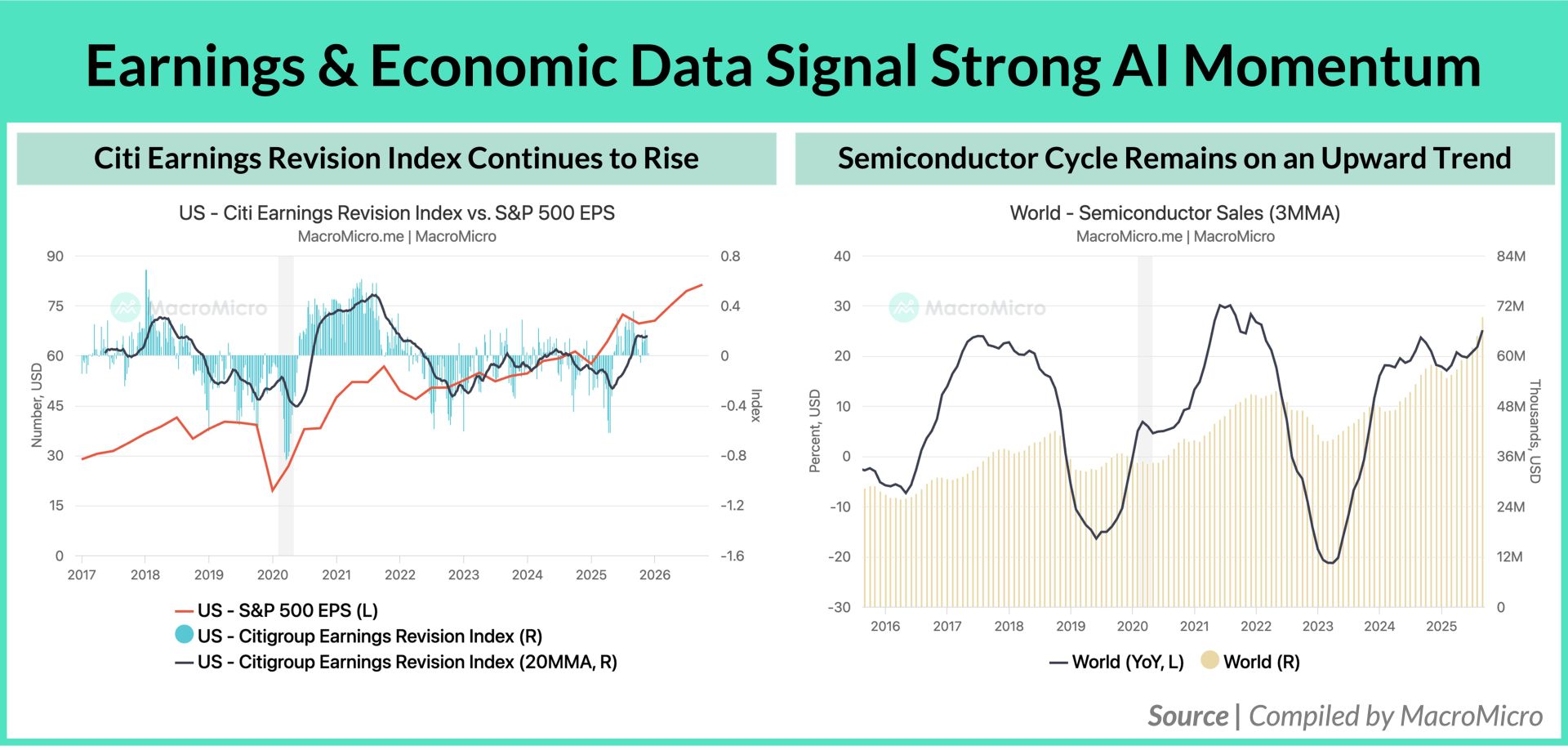
Structurally, today’s AI cycle is far healthier than the dot-com bubble— free cash flow is at record highs and leverage remains low across leading companies. Still, as we pointed out last month’s report, Q2 next year will likely become a more serious checkpoint for the market. Why? One reason is the elevated base that will naturally slow growth rates. The other lies in inventory dynamics.
NVIDIA’s days of inventory have recently begun to rise—a figure that often serves as a leading indicator for the broader product inventory cycle. Breaking it down further, the increase is primarily driven by work-in-process inventory. For now, this can be viewed positively: it reflects manufacturers building stock ahead of still-robust demand.
The real test will come when WIP begins converting into finished goods over the next one to two quarters...
This article is exclusive to subscribers. If you're not a subscriber yet, take advantage of our biggest deal of the year — save 50% on MM Max Annual and gain full access to all our charts, reports, including our 2026 market outlook, and more. Subscribe Now»

Already a subscriber? Click here to log in.
Full Access to Our Services

Comprehensive data at your service
with key indicators for investment insights

Exclusive flash reports
on key events and data

Create your own charts and analysis
including performance backtesting

Hub of professionals to engage
in meaningful discussions and insights

