Dear all,
In September, the three major risks flagged last month continued to unfold: global long-term bond yields climbed to new highs, while the Federal Reserve went a step further this month with a "preemptive rate hike." As a result, most equity markets pulled back, with the Dow Jones, European markets, and most Asian markets all retreating. In FX, the US Dollar Index rose +2%, while Asian currencies held up relatively well, with the Korean won and Japanese yen strengthening and the Taiwan dollar remaining flat.
What is truly worth noting is that, as repeatedly emphasized in our September House View, the r < g logic continued to play out. Markets with the strongest economic fundamentals, such as the Taiwan Weighted Index, Nasdaq, and SOX, rose +4.5%, +1.1%, and +4.9%, respectively. Despite the headwind from rate hikes, these markets still finished the month in positive territory.
I. Reframing the Fed's Path: Two Rate Hikes This Year, Wait & See Next Year
The Fed's latest rate hike went beyond my expectations in August, when I believed inflation data were temporarily under control. However, against the backdrop of the US-Iran conflict intensifying and oil prices breaking above $100, the Fed chose to act preemptively. Based on Warsh's comments at this meeting, my team and I have directly revised our rate-hike path to two hikes this year.
Nevertheless, we still view this as a preemptive rate hike. In particular, even though the Fed's dot plot indicated that further rate hikes could still be possible next year, we continue to believe that the Fed could shift to a wait-and-see stance next year. There are three reasons:
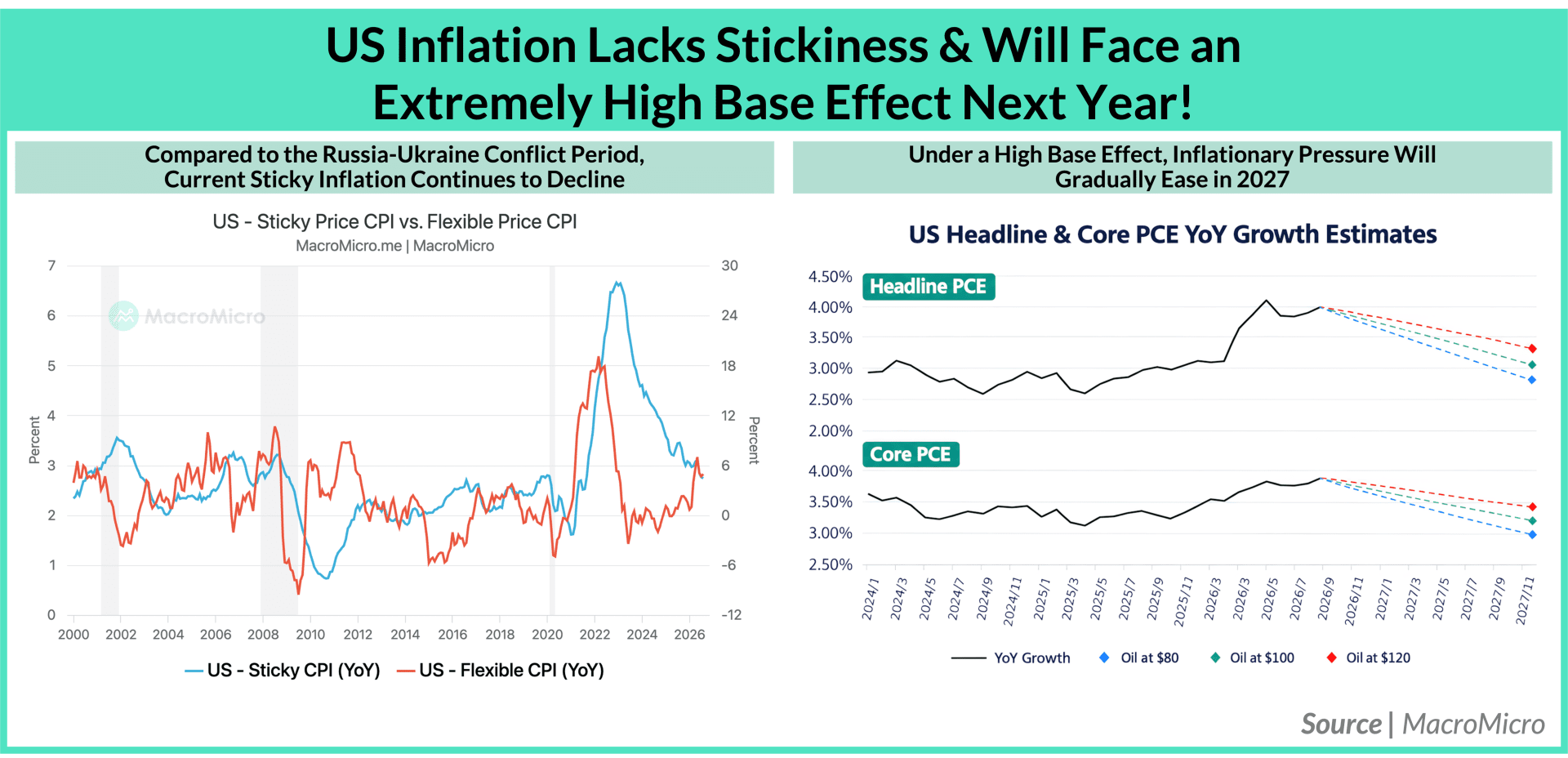
First, there is little sign of persistent inflation at present. Compared with the Russia-Ukraine war period, when both sticky and flexible inflation surged and the Fed raised rates ten consecutive times, sticky inflation is still declining this time around. This indicates that there is no broad-based price pressure, making the current situation fundamentally different from the previous cycle.
Second, supply and demand in the labor market remain balanced, while wage inflation continues to ease. The current employment supply-demand structure has not become imbalanced, while the longer-term trend in wage growth remains steadily downward. This means inflation lacks an endogenous, wage-driven source of momentum.
Finally, and most importantly, this year's high oil prices will become the biggest positive for next year. This may sound counterintuitive, but...
Already a subscriber? Click here to log in.
Full Access to Our Services

Comprehensive data at your service
with key indicators for investment insights

Exclusive flash reports
on key events and data

Create your own charts and analysis
including performance backtesting

Hub of professionals to engage
in meaningful discussions and insights
 Get answers from MM AI.
-
How many rate hikes does MacroMicro anticipate from the Fed this year?
💡MacroMicro anticipates two rate hikes from the Federal Reserve this year, adjusting its initial expectations due to intensifying geopolitical conflicts, specifically the US-Iran conflict, which caused oil prices to exceed $100, prompting the Fed to act preemptively.
-
Why does MacroMicro believe the Fed may adopt a wait-and-see stance next year?
💡MacroMicro believes the Fed may adopt a wait-and-see stance next year due to three primary factors: a lack of persistent inflation, with sticky inflation declining unlike the Russia-Ukraine war period; balanced labor market supply and demand alongside easing wage inflation; and the high oil prices of this year creating a high base effect, which will naturally diminish the impact of energy prices on overall inflation in 2027, even if oil prices remain elevated.
-
What are the key differences between current inflation and the Russia-Ukraine war period?
💡The key differences between current inflation and the Russia-Ukraine war period are that currently, sticky inflation is declining, indicating an absence of broad-based price pressure. In contrast, during the Russia-Ukraine war, both sticky and flexible inflation surged, leading the Fed to implement ten consecutive rate hikes, a situation fundamentally different from the present.
-
How are labor market dynamics and wage inflation influencing the Fed's policy outlook?
💡Labor market dynamics and wage inflation are influencing the Fed's policy outlook positively, as the employment supply-demand structure remains balanced and the longer-term trend in wage growth continues its steady downward trajectory. This suggests that inflation lacks an endogenous, wage-driven source of momentum, supporting a potentially less aggressive future Fed policy.
-
How will high oil prices from this year impact inflation expectations for next year?
💡High oil prices from this year will become the biggest positive for next year, as they will establish an exceptionally high oil-price base. This high base effect means that even if oil prices remain elevated at $90 to $100 next year due to geopolitical events, their impact on overall inflation will naturally fade, with inflation expected to decline across all scenarios in 2027.
-
When does MacroMicro expect the period of greatest financial market pressure to occur?
💡MacroMicro expects the period of greatest financial market pressure to be the second half of this year, as the market has already absorbed the impact of the September rate hike. Heading into Q4, even with another potential rate hike, the market and the Fed's focus are anticipated to shift towards easing inflationary pressure next year.
-
Why did the Taiwan Weighted Index and Philadelphia Semiconductor Index hit new highs?
💡The Taiwan Weighted Index and Philadelphia Semiconductor Index hit new highs in September, despite rate hikes, primarily due to the 'r < g' effect, where strong growth (g) in markets with robust economic fundamentals, particularly those benefiting from the AI-driven productivity cycle, is sufficient to absorb the pressure from rising interest rates (r).
-
What evidence supports a broad-based economic expansion in the US?
💡Evidence supporting a broad-based economic expansion in the US includes continued increases in nonfarm payrolls and declining initial jobless claims, retail sales growth reaching 6% YoY with positive growth across all industries in August, and strong investment, with non-defense capital goods orders rising to 14% YoY and a low inventory-to-sales ratio for businesses.
-
What is MacroMicro's current portfolio positioning regarding equities, bonds, and specific sectors?
💡MacroMicro's current portfolio positioning maintains a preference for equities over bonds, specifically avoiding long-duration bonds. This strategy is supported by solid fundamentals and the validation of the 'equities over bonds' allocation thesis despite increased market volatility.
-
Which specific market segments remain attractive for holding, according to MacroMicro?
💡Specific market segments remaining attractive for holding, according to MacroMicro, include AI supply-chain companies, financials, and domestic-demand sectors. This preference is driven by the broadening AI trend and solid underlying fundamentals.

