Dear all,
Markets have been volatile this month. Most global equity markets declined and bond yields retreated after climbing to highs. Oil rose while gold fell. The overall price action cannot be explained simply by “inflation driving rate hikes and putting pressure on markets,” since Treasury yields would not have pulled back in that case. Nor does it fully reflect a deterioration in fundamentals, which should have sent gold sharply higher. Instead, it looks more like a stress test.
I. What Is the Market Stress-Testing? Three Key Concerns
This wave of selling was triggered by three successive developments.
First, inflation reignited. US CPI inflation rose to 3.7% YoY in September (from 3.4%), while PPI inflation climbed to 6.4% (from 5.6%), its highest level since 2022. Core CPI rose 0.3% MoM for the second consecutive month, exceeding expectations. Second, credit risks in AI financing came into focus. Neocloud provider CoreWeave plunged 25% in a single week, its five-year CDS spread surged above 1,100 basis points, and yields on its unsecured bonds briefly exceeded 15%, approaching distressed-debt territory. The resulting anxiety also weighed on Oracle and SpaceX. Third, concerns emerged over end-market monetization. Anthropic reported record quarterly revenue of $16.8 billion, but its projected quarterly growth rate is expected to slow from 145.2% to 44.8%, prompting a downward revision to its IPO valuation. The market's dominant narrative has shifted from AI growth to a repricing of financing and credit risks.
Related Reading: Is a 5% Treasury Yield Pulling Capital Away? The AI Rally Faces Its Stress Test
II. Our Assessment: Interpreting Inflation, Credit Risks & Fundamentals
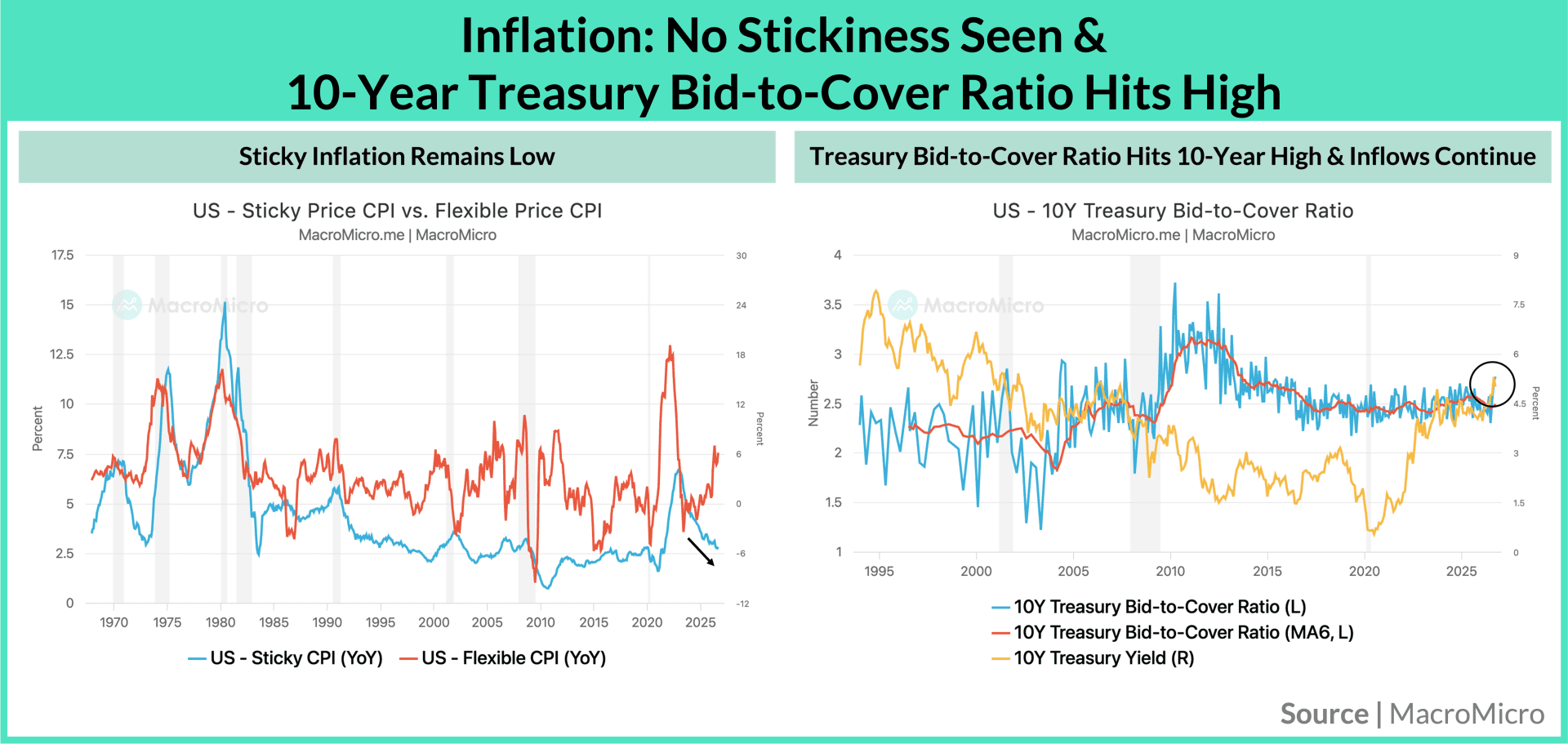
Inflation: The shock is real, but inflation remains flexible rather than entrenched. We warned in previous monthly reports that if the US-Iran conflict persisted beyond mid-August, we would inevitably see unfavorable CPI and PPI data in September and October. A closer look, however, suggests that the latest inflationary pressure still comes primarily from more flexible components. The sticky inflation measure in CPI, which I monitor closely, remains subdued. This is the biggest difference from the Russia-Ukraine shock and the Fed's successive rate hikes. In addition, the share of CPI components rising more than 3% YoY actually declined from the previous month (48% vs. 51%), while the rebound in rents has yet to show signs of persistence. As a result, any pullback driven by a moderation in inflation should be viewed as an opportunity rather than a risk.
Notably, the Fed has also shifted to a wait-and-see stance. The 10-year Treasury yield retreated after breaking above 5%, while the bid-to-cover ratio at Treasury auctions reached its highest level since 2014. This suggests that 5% yields are not only drawing capital away from other assets but are also beginning to attract buyers themselves. It is a sign that the worst of the selling pressure in the bond market may be passing. We maintain that the Fed still has room to assess conditions as they evolve. Another 25-basis-point rate hike remains possible by year-end, but inflationary pressure should peak in Q4 this year and ease next year as base effects rise.
AI Credit & Financing: As for AI financing, I still view the current developments as company-specific events rather than signs of a systemic retreat. In several previous AI reports, we warned that midstream CSPs and neocloud providers would face the greatest cash flow pressure as AI computing capacity expanded. That pressure is now becoming increasingly visible. Following Google and Tesla last quarter, Meta's free cash flow also turned negative this quarter, reaching -$2.12 billion, while Google's deficit widened to -$9.1 billion from -$5.85 billion. Each instance has triggered market volatility. Yet even when companies face similar cash flow pressures, their underlying financial strength can differ dramatically.
Neocloud providers such as CoreWeave and Nebius, along with Oracle, which is aggressively expanding its AI computing capacity, face substantially greater financing pressure than the major hyperscalers. Take CoreWeave as an example: in...
Already a subscriber? Click here to log in.
Full Access to Our Services

Comprehensive data at your service
with key indicators for investment insights

Exclusive flash reports
on key events and data

Create your own charts and analysis
including performance backtesting

Hub of professionals to engage
in meaningful discussions and insights
 Get answers from MM AI.
-
What triggered the recent market selling wave and increased volatility?
💡The recent market selling wave and increased volatility were triggered by three developments: reignited inflation with US CPI rising to 3.7% YoY in September and PPI climbing to 6.4%, emerging credit risks in AI financing as CoreWeave's five-year CDS spread surged above 1,100 basis points, and concerns over end-market monetization due to Anthropic's projected quarterly growth rate slowing from 145.2% to 44.8%.
-
Does MacroMicro believe current inflation is flexible or entrenched?
💡MacroMicro believes current inflation remains flexible rather than entrenched, despite the recent shock of CPI rising to 3.7% YoY in September. This assessment is based on the subdued sticky inflation measure in CPI, the decline in the share of CPI components rising more than 3% YoY (48% vs. 51%), and the lack of persistent rebound in rents, differentiating it from previous inflationary shocks.
-
What is the significance of the 10-year Treasury yield retreat above 5%?
💡The retreat of the 10-year Treasury yield after breaking above 5% is significant because it suggests that 5% yields are not only attracting capital away from other assets but are also beginning to draw buyers, as evidenced by the bid-to-cover ratio at Treasury auctions reaching its highest level since 2014. This indicates that the worst of the bond market's selling pressure may be passing.
-
Are current AI financing issues systemic or company-specific?
💡Current AI financing issues are viewed as company-specific events rather than signs of a systemic retreat. While midstream CSPs and neocloud providers like CoreWeave face significant cash flow pressure, evidenced by CoreWeave's operating cash flow of $3.66 billion against $14.1 billion in capital expenditures, major hyperscalers often possess robust financial foundations, such as Meta's $31.8 billion in operating cash flow and over $80 billion in cash, mitigating systemic risk concerns.
-
What does the option-adjusted spread on investment-grade bonds indicate?
💡The option-adjusted spread (OAS) on investment-grade corporate bonds remaining at just around 0.9%, near historical lows, indicates that the market is repricing the credit risk of individual companies rather than withdrawing from credit markets across the board. This suggests that broader credit markets for financially sound entities are stable, with risks concentrated in highly leveraged firms like those with CCC-rated bonds, where yields have climbed to around 18%.
-
Are semiconductor fundamentals intact despite recent stock pullbacks?
💡Semiconductor fundamentals remain strong despite recent stock pullbacks. TSMC's Q3 revenue rose 50.9% YoY to NT$1.494 trillion, with a gross margin of 66.4%, and the company raised its earnings guidance and AI CAGR forecast. Additionally, inventory days are declining, confirmed by ASML and Micron, and Taiwan's export orders surged to a record $114 billion, indicating continued strong demand and investment translation into shipments.
-
Why did Anthropic's revenue growth slow, and what does it imply?
💡Anthropic's revenue growth slowed primarily due to pricing strategies amidst intensifying competition among AI models, rather than weakening demand. This implies that while enterprise AI adoption continues to advance and token usage reaches new highs, the end-market competition has entered a transitional phase, shifting value toward the upper and middle parts of the supply chain rather than signaling a decline in overall AI demand.
-
Which parts of the AI supply chain should continue to benefit?
💡The upper and middle parts of the AI supply chain, particularly chips, semiconductor equipment, and power-related businesses, should continue to benefit from elevated cash flows and upward earnings revisions. This is because value is shifting towards these segments due to intense competition in the end-market, despite overall AI demand remaining strong and expanding significantly with the launch of consumer-facing AI agents.
-
How should investors distinguish genuine risks from misleading narratives?
💡Investors should distinguish genuine risks from misleading narratives by focusing on company-specific financial strength, cash flow conversion ability, and financing conditions. Misleading narratives include persistent high inflation driving bond yields, which is not expected to last, and rising yields universally causing market blowups, which depends on specific country fundamentals like nominal GDP growth. AI risks are concentrated in companies with weak balance sheets and debt reliance, not a systemic bubble, as strong financial foundations protect firms like Microsoft and TSMC.
-
What is MacroMicro's recommended portfolio positioning for year-end?
💡MacroMicro's recommended portfolio positioning for year-end is equities over bonds, avoiding long-duration bonds, and focusing on the upper and middle parts of the AI supply chain, specifically chips, semiconductor equipment, and power. Diversification remains essential further downstream, while the balance between equities and bonds for next year is an open question as inflationary pressures subside and AI investment bases rise.

