What You Need to Know
Global equity markets broadly weakened over the past week, with technology and semiconductor stocks facing particularly heavy selling pressure. A series of developments, including a rebound in US inflation data in September, a sharp widening in cloud computing provider CoreWeave's CDS spreads, and slower revenue growth at Anthropic, has refocused market attention on funding pressures and questions over investment returns in the AI industry.
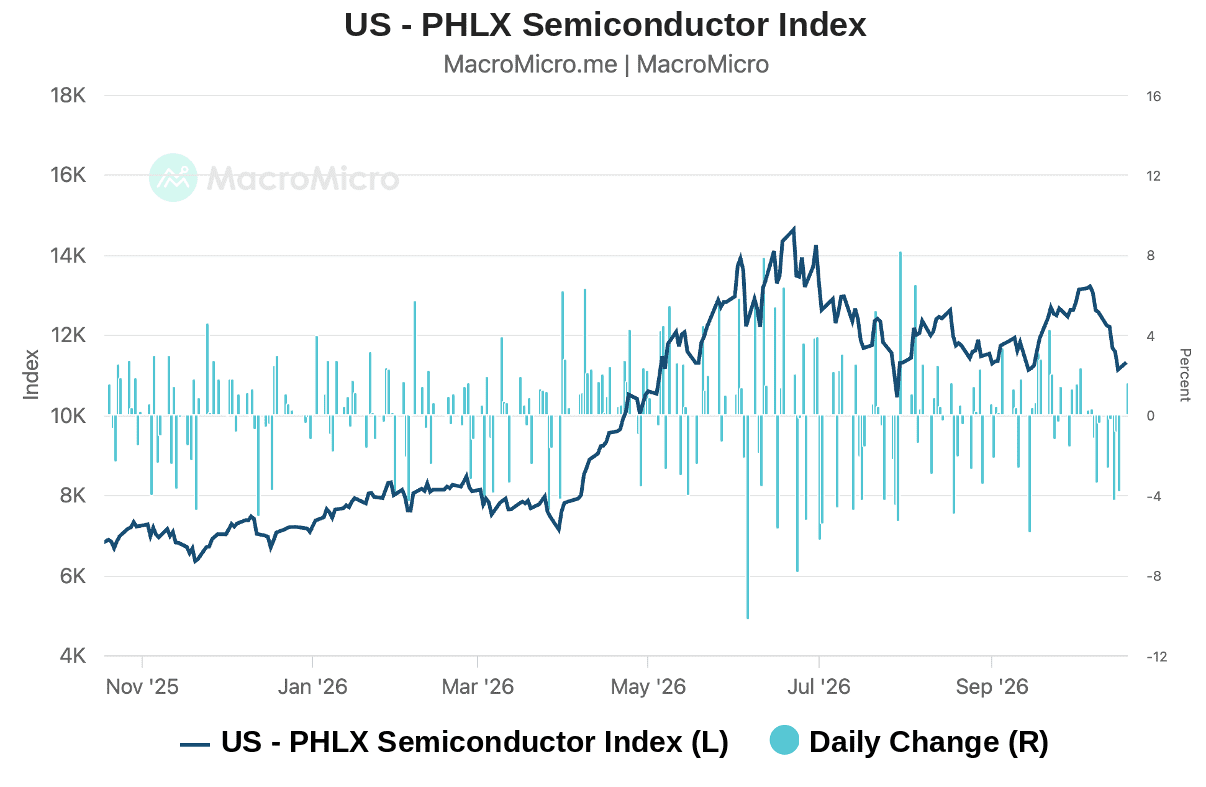
The Philadelphia Semiconductor Index (SOX) recorded eight consecutive daily declines, an unusual streak that marked its longest losing run since 2008. From its October 6 peak through last Friday, the index had fallen more than 15%. Entering this week, however, the SOX finally rebounded 1.6% on Monday, supported by TSMC's strong earnings, which reinforced confidence in the semiconductor industry's fundamentals. The Nasdaq and S&P 500 also gained 1.1% and 0.4%, respectively.
Despite the rebound, concerns over AI funding have yet to dissipate. This report examines three key sources of concern: inflation, CoreWeave, and Anthropic, offering our observations and assessment of each.
Key Takeaways:
- Inflation surprises to the upside: September CPI and PPI beat expectations again, with CPI rising to 3.7% YoY (prior: 3.4%) and PPI to 6.4% (prior: 5.6%), the highest since 2022. Yet yields fell rather than rose. Is the bond market pulling money out of equities?
- CoreWeave CDS spikes: Shares of neocloud provider CoreWeave plunged 25% in a single week, while CDS pricing implied a five-year default probability exceeding 60%. Is this an isolated case, or the first domino in a broader retreat from AI financing?
- Anthropic's revenue growth slows: Anthropic's quarterly revenue growth fell sharply from 145% to 45%, prompting a downward revision to its IPO valuation. Does the abrupt slowdown signal a monetization ceiling for AI, or the beginning of a price war?
I. What Is the Market Selling Off On?
1. Oil Swings Push September Inflation Above Expectations
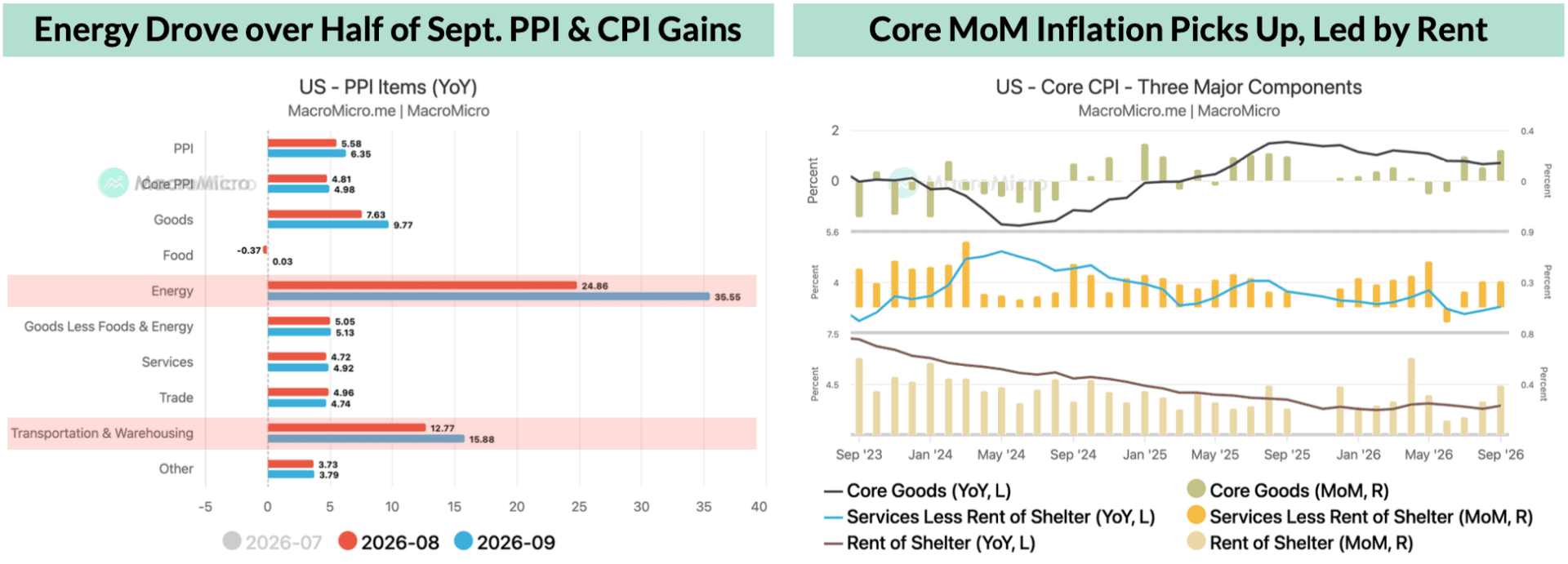
- The latest September CPI and PPI data both came in above expectations. CPI inflation rose to 3.7% YoY (previously 3.4%), while PPI inflation climbed to 6.4% (previously 5.6%), its highest level since 2022. Energy was the main driver of inflation this time around. In both the PPI and CPI reports, gasoline alone accounted for more than half of the increase.
- Beyond energy, monthly inflation across the three major components of core CPI also picked up in September, keeping monthly core CPI inflation at 0.3% (unchanged from the previous month) for a second consecutive month above market expectations.
2. CoreWeave CDS Spikes, Reviving AI Financing Fears
- As of October 16, neocloud provider CoreWeave had plunged 25% in a single week. Its five-year credit default swap (CDS) spread surged past 1,100 basis points, implying a five-year default probability of more than 60%. Yields on its unsecured bonds maturing in 2031–2032 briefly exceeded 15%, approaching distressed-debt territory.
- The resulting panic also dragged down highly leveraged technology stocks such as Oracle and SpaceX, indicating that the market's dominant narrative is...
Already a subscriber? Click here to log in.
Full Access to Our Services

Comprehensive data at your service
with key indicators for investment insights

Exclusive flash reports
on key events and data

Create your own charts and analysis
including performance backtesting

Hub of professionals to engage
in meaningful discussions and insights
 Get answers from MM AI.
-
What key factors caused global equity markets to weaken recently, particularly in technology and semiconductor stocks?
💡Global equity markets weakened due to a rebound in US inflation data in September, a sharp widening in cloud computing provider CoreWeave's Credit Default Swap (CDS) spreads, and slower revenue growth at Anthropic. These factors refocused market attention on funding pressures and questions about investment returns in the AI industry, leading to heavy selling pressure in technology and semiconductor stocks.
-
How did US inflation data in September, CoreWeave's CDS spreads, and Anthropic's revenue growth impact AI industry funding concerns?
💡The US inflation data for September, with CPI rising to 3.7% year-over-year and PPI to 6.4%, highlighted funding pressures in the AI industry. CoreWeave's CDS spreads surging past 1,100 basis points, implying a five-year default probability exceeding 60%, raised fears about broader AI financing risks. Anthropic's sharp slowdown in quarterly revenue growth from 145% to 45% prompted a downward revision to its IPO valuation, further fueling concerns over AI investment returns and potential monetization ceilings.
-
How did CoreWeave's CDS spread surge and its bond yields impact market sentiment regarding AI financing risks?
💡CoreWeave's five-year Credit Default Swap (CDS) spread surged past 1,100 basis points, implying a five-year default probability exceeding 60%, and its unsecured bond yields briefly exceeded 15%. This severely impacted market sentiment, causing shares of the neocloud provider to plunge 25% in a single week and dragging down other highly leveraged technology stocks, shifting the market narrative towards a repricing of AI financing and credit risks.
-
Despite strong financial metrics, why did Anthropic's Q3 revenue growth slowdown alarm investors and lead to valuation revisions?
💡Anthropic's Q3 revenue growth slowed sharply from 145% to 45%, alarming investors and leading to a downward revision of its valuation, despite strong results in other financial metrics such as its second consecutive profitable quarter and 85% adjusted gross margin. This slowdown raised concerns among investors about a potential monetization ceiling for AI or the onset of a price war within the industry, leading to caution despite overall positive financial health indicators.
-
What are MacroMicro's three reasons for not being entirely bearish on the current inflation trend?
💡MacroMicro is not entirely bearish on the current inflation trend for three reasons: the breadth of CPI inflation, with the share of components increasing above 3% declining from 51% to 48%; the differing components responsible for core inflation surprises, with education and communication cooling to 0.2% from 1.6%; and the unlikelihood of sustained rental inflation given the recovery in US rental vacancy rates and restrained home price growth.
-
What financial indicators suggest CoreWeave's financial position has become less resilient, eroding its profits despite revenue growth?
💡CoreWeave's financial statements indicate less resilience due to its heavy reliance on external financing, with operating cash flow of $3.66 billion against cash capital expenditure of $14.1 billion in H1 2026, necessitating $11.53 billion in net funding through additional borrowing. Despite 113% YoY Q2 revenue growth to $2.58 billion, net interest expense reached $640 million, leaving only $130 million in operating profit after depreciation, suggesting high leverage is eroding profitability.
-
How do large cloud service providers (CSPs) compare financially to neocloud companies like CoreWeave?
💡Large cloud service providers (CSPs) are in a significantly stronger financial position than neocloud companies like CoreWeave. Neocloud providers exhibit an average capital expenditure-to-revenue ratio as high as 180% and have recorded negative average free cash flow for nine consecutive quarters, making them more vulnerable to financing freezes. Major CSPs, despite potential negative cash flow, possess robust fundraising and monetization capabilities within their complete cloud ecosystems, indicating materially weaker financial health for neoclouds.
-
Does Anthropic's revenue slowdown indicate stalled AI returns, or is it a result of fierce model competition?
💡Anthropic's revenue slowdown is more indicative of fierce model competition rather than stalled AI returns. The primary driver is pricing pressure from rivals like OpenAI, which cut prices by approximately 80%, prompting Anthropic to lower its own token prices. Overall token usage continues to climb, suggesting that AI demand has not slowed, but competition is intensifying for market share and pricing.
-
What impact could the launch of consumer-facing AI agents have on future token usage and revenue growth?
💡The launch of consumer-facing AI agents in Q3 could significantly multiply demand for computing capacity because these agents operate continuously without requiring constant user instructions. Goldman Sachs estimates AI agent token usage will grow 24-fold by 2030, potentially offsetting the impact of falling prices from competitive models and accelerating revenue growth once again through increased volume.
-
At which stage of the dot-com bubble's four phases is the current AI industry, according to MacroMicro?
💡According to MacroMicro, the current AI industry is at the transition between Stage 2 and Stage 3 of the dot-com bubble's four phases. This signifies a period where early capital expenditures begin to yield returns, prompting companies to accelerate spending through financing and leverage (Stage 2), but also where leverage expansion may outpace recovery speed, leading to deteriorating financial statements for some companies while others with financial flexibility achieve massive returns (Stage 3).

