CEO House View | Geopolitics Forces an Early Valuation Reset—The Market’s Inflection Point Is Taking Shape
Dear all,
In the introduction of our March CEO House View, we pointed out that oil prices would become the key factor influencing liquidity conditions and portfolio positioning. We warned that if WTI crude oil prices breached $70 per barrel, it could lead to “a delay in Fed rate cuts, a higher probability of a broader market pullback, and the need to reduce position sizes.”
Subsequently, as the US-Israel-Iran conflict escalated, commodities reacted sharply. Oil prices surged rapidly, with WTI crude soaring by 35.9%, while gold dropped by -13.7% under the impact of climbing real interest rates. As the US-Iran war continues to rage, this month has seen an indiscriminate sell-off across equities, foreign exchange, bonds, and gold. Risk capital has fled en masse, bringing the valuation correction forward earlier than expected.
I. Current Market Reaction Remains Limited to Valuation Correction, Not Yet Reflecting Fundamental Deterioration
From a global macro perspective, most economies reported data in February that showed no clear signs of deterioration. Overall, economic conditions have continued the improvement trend observed since late last year.
Since February, across 13F filings, large trader commitments (COT), and ETF fund flows, we have observed a concentrated migration of capital into the energy sector. At the same time, certain inflation indicators have begun to stir. The crucial "Prices Index" within the ISM Manufacturing sub-indices released on March 2 surged from 59 to 70.5, with almost all purchasing managers reporting price increases.
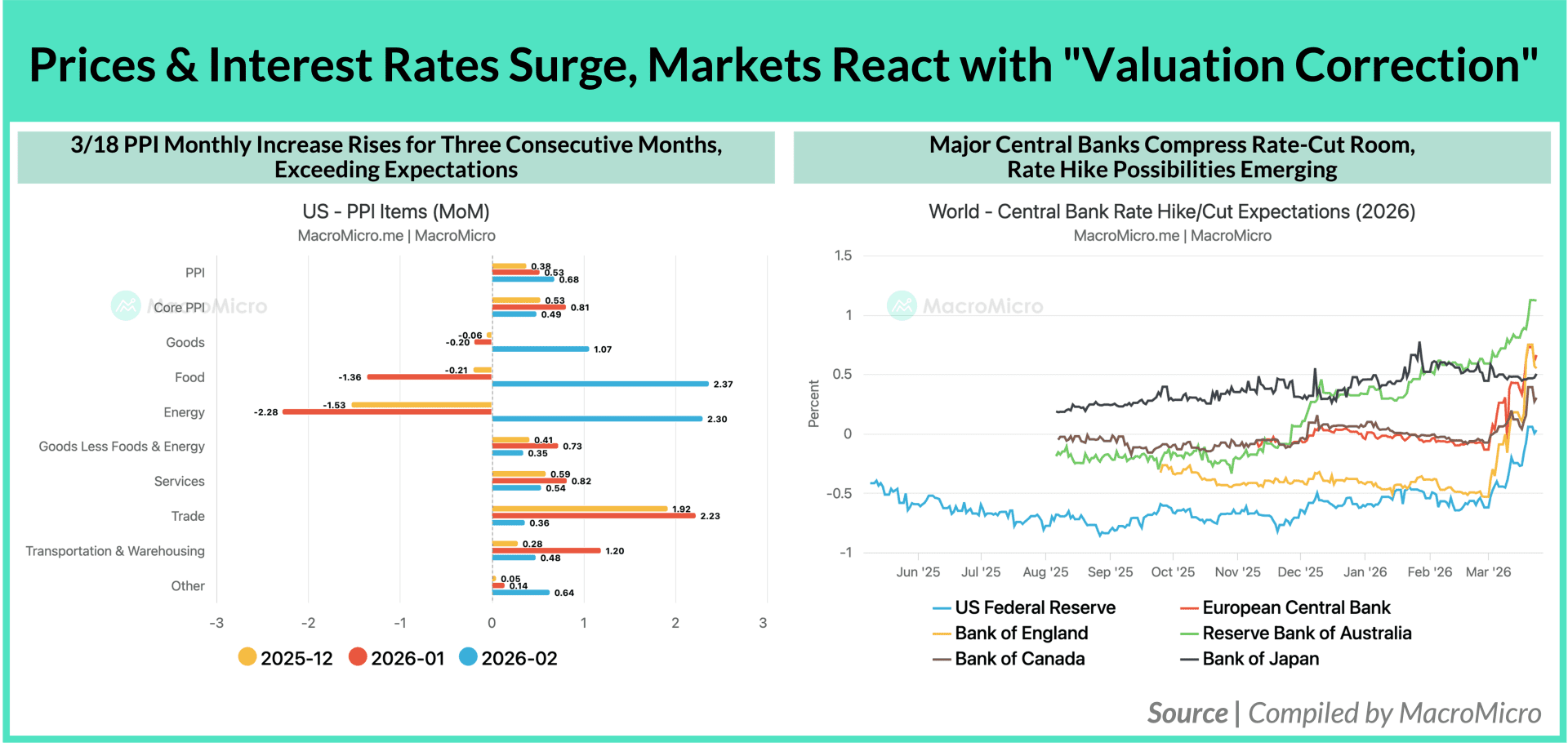
On March 18, just ahead of the Federal Reserve meeting, the PPI recorded its third consecutive month-over-month increase, dragging US stocks down. Notably, the aforementioned data largely did not fully capture the impacts following the outbreak of the US-Israel-Iran conflict, further deepening market anxieties over mounting inflationary pressures ahead.
Shifts in inflation expectations have also rapidly transmitted to the interest rate market. Although the Federal Reserve has repeatedly emphasized a “wait-and-see” stance and high uncertainty, markets have already significantly scaled back expectations for rate cuts this year. In fact, expectations are even beginning to reflect potential...
II. Will We See a "Davis Double Whammy"? Completing the Inflation > Rates > Economic Fundamentals Correction Cycle?
As for whether this situation will evolve into a “Davis Double Whammy”, where both valuations and fundamentals are revised...
This article is exclusive to subscribers. Track every US–Iran shockwave. Redeem your MM Max trial code to unlock the full report — limited time only.

Already a subscriber? Click here to log in.
Full Access to Our Services

Comprehensive data at your service
with key indicators for investment insights

Exclusive flash reports
on key events and data

Create your own charts and analysis
including performance backtesting

Hub of professionals to engage
in meaningful discussions and insights
 Get answers from MM AI.
-
How did oil prices influence liquidity and portfolio positioning?
💡Oil prices became the key factor influencing liquidity conditions and portfolio positioning, with MacroMicro's CEO warning that WTI crude oil prices breaching $70 per barrel could lead to a delay in Fed rate cuts, a higher probability of a broader market pullback, and the need to reduce position sizes.
-
Why is the current market reaction considered a valuation correction, not fundamental deterioration?
💡The current market reaction is considered a valuation correction, not fundamental deterioration, because global macro data in February showed no clear signs of deterioration, and economic conditions continued their improvement trend. Markets are still framing this shock as a "short-term event," with the IEA swiftly releasing strategic reserves to contain the actual supply gap at approximately 3%–5% for about one quarter, preventing downward revisions of corporate earnings at the fundamental level.
-
What specific inflation indicators showed signs of stirring in February and March?
💡Specific inflation indicators that showed signs of stirring in February and March include a surge in the "Prices Index" within the ISM Manufacturing sub-indices from 59 to 70.5 on March 2, with almost all purchasing managers reporting price increases. Additionally, the PPI recorded its third consecutive month-over-month increase on March 18, just ahead of the Federal Reserve meeting, further deepening market anxieties over mounting inflationary pressures.
-
How did inflation expectations transmit to the interest rate market, affecting rate cut forecasts?
💡Inflation expectations rapidly transmitted to the interest rate market, causing markets to significantly scale back expectations for rate cuts this year. Expectations are even beginning to reflect potential tightening pivots from central banks in Europe, the UK, and Canada, despite the Federal Reserve's repeated emphasis on a “wait-and-see” stance and high uncertainty.
-
What is the key difference in downside protection between the current situation and the Russia-Ukraine war?
💡The key difference in downside protection between the current situation and the Russia-Ukraine war lies in two factors: the current AI cycle is propelling productivity, which, coupled with already restrictive interest rates, reduces the urgency for aggressive rate hikes. Additionally, Donald Trump's stance, influenced by the midterm elections, pressures him to suppress inflation and prevent risks from spreading.
-
What two key reasons provide downside protection during the current market environment?
💡Two key reasons provide downside protection during the current market environment: first, the ongoing AI cycle is propelling productivity, and existing restrictive interest rates reduce the urgency for aggressive rate hikes. Second, Donald Trump's stance ahead of this year's midterm elections will pressure him to suppress inflation and prevent risks from spreading.
-
How do oil prices above $100 per barrel impact consumption momentum and corporate inventories?
💡When oil prices rise above $100 per barrel, they begin transmitting to the demand side, transforming into a "demand-side shock." This impacts consumption momentum, causing it to fall significantly below the historical average, as observed in 2008, 2012, and 2022. For corporate inventories, ISM subcomponents show that if firms expect input prices to rise persistently for more than one quarter, inventories typically increase while new orders decline.
-
Which inflation metrics should investors monitor to assess the market's reaction to rising prices?
💡Investors should monitor the University of Michigan (UMich) inflation expectations, specifically whether the 1-year and 5-year inflation expectation revisions begin to climb from their current low levels, indicating market sentiment for short-term impact. Additionally, the CPI is a primary focal point, especially the critical April 10 CPI release for March data.
-
What is the projected CPI growth for March, and why is the April 10 CPI release critical?
💡The projected CPI growth for March is expected to break above 3% in one swoop, compared to February's 2.41%, largely due to energy prices surging over 30%. The April 10 CPI release is critical as it will effectively test the market's reaction to these rising prices and a higher inflation figure.
-
How do nonfarm payroll reports need to perform to indicate economic resilience after the conflict?
💡Nonfarm payroll reports need to maintain a certain degree of resilience, specifically remaining in positive territory (above 0), to indicate that the US-Israel-Iran conflict has not infected broader economic fundamentals. This performance will be crucial following the February report, which was largely attributed to labor strikes.
