Dear all,
With the Lunar New Year holiday now behind us, MacroMicro wishes everyone a happy new year, smooth investing, and strong momentum throughout the Year of the Horse!
In February, the three major US equity indices broadly pulled back. The Dow Jones, Nasdaq, and S&P 500 declined by -1.8%, -2.7%, and -0.8%, respectively. The Nasdaq underperformed in particular, weighed down by weakness in software stocks.
In contrast, European equities, Southeast Asian markets, emerging markets, and Asian equities tied to the AI supply chain generally advanced. South Korea’s KOSPI, benefiting from strong demand expectations in the memory sector, stood out with a sharp gain of +23.4%.
In fixed income markets, bond prices posted modest gains overall. In commodities, crude oil and gold rose by +9.0% and +3.5%, respectively, reflecting persistent geopolitical tensions between the US and Iran.
Taken together, global markets are currently exhibiting a healthy rotation of capital. Recently released 13F institutional holdings further show that large financial institutions are actively diversifying allocations across multiple sectors, with a focus on technology, energy, and mining-related industries.
I. Fundamentals: Global Growth Improving Steadily, With No Visible Cracks or Systemic Risks
In February, economic data released across most major economies showed no material signs of deterioration, and the overall outlook continued the improvement seen since late last year.
Taking Taiwan as an example, January exports hit a new record high of $65 billion USD, reflecting sustained momentum in the electronics sector. At the same time, both manufacturing and services PMIs showed improving six-month outlooks, indicating that Taiwan’s economic structure is gradually transitioning from a long-standing pattern of “external strength, domestic weakness” toward one of “external strength with moderate domestic recovery.”
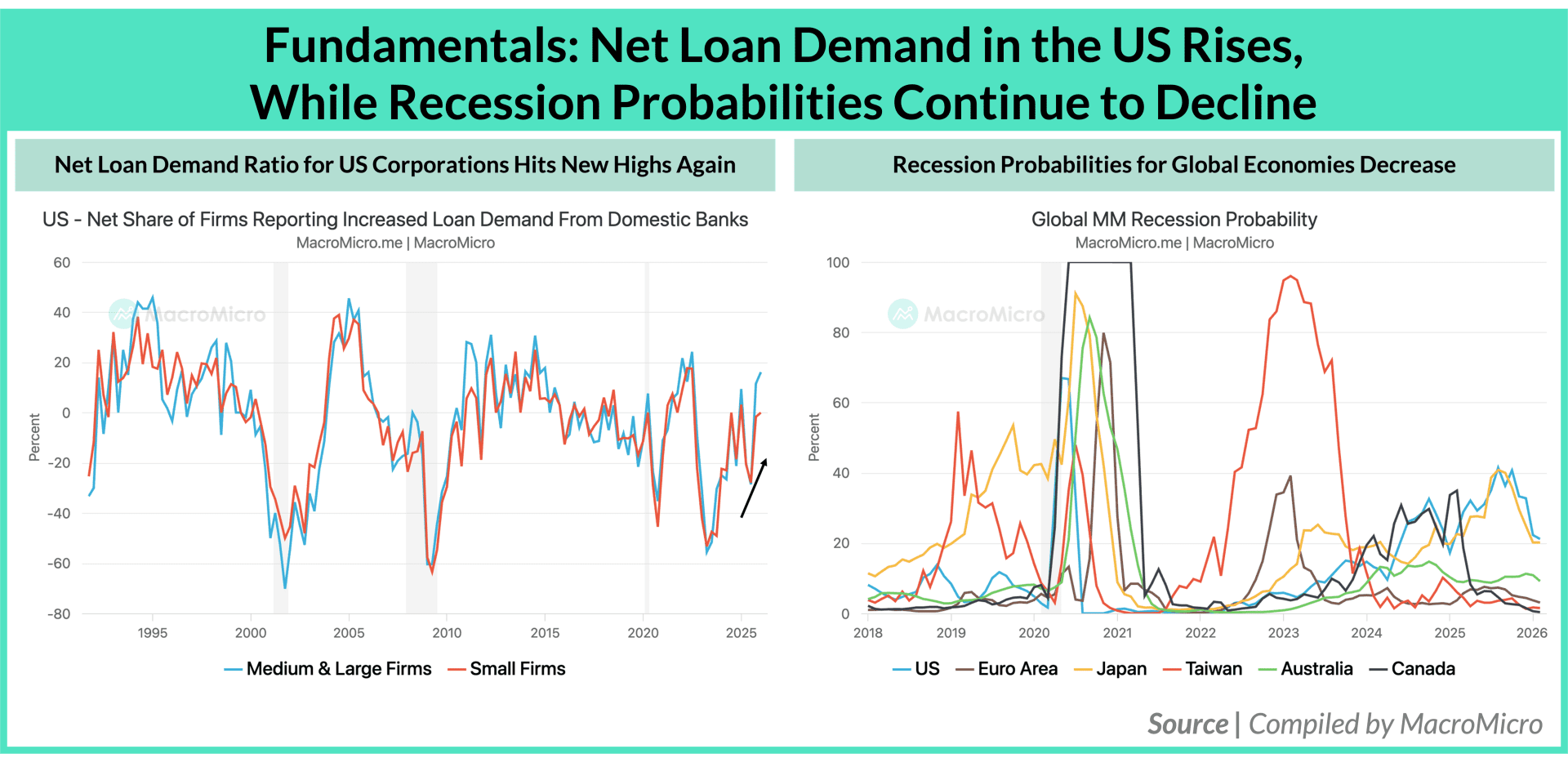
In the United States, the labor market remains resilient. Initial jobless claims are holding at low levels, and January nonfarm payrolls increased by 130,000. In addition, the Federal Reserve’s measure of the net percentage of firms reporting increased demand for domestic bank loans has climbed to a near three-year high, signaling a rebound in US corporate financing activity and capital expenditure intentions. Together, investment and consumption are showing signs of a...
II. Liquidity: Strengthening Growth & Rising Energy Prices Prompt a Surprise Shift in Fed Rhetoric
One of the more notable developments in February was the divergence of views within the Federal Reserve, as revealed in the latest meeting minutes, along with an unexpected shift in tone from Milan...
This article is exclusive to subscribers. If you're not a subscriber yet, subscribe to MM Max today and gain full access to all our charts, reports, including our full 2026 MacroMicro Economic Outlook series via our Full-Year Intelligence Live Pass, and more. Subscribe Now»

Already a subscriber? Click here to log in.
Full Access to Our Services

Comprehensive data at your service
with key indicators for investment insights

Exclusive flash reports
on key events and data

Create your own charts and analysis
including performance backtesting

Hub of professionals to engage
in meaningful discussions and insights
 Get answers from MM AI.
-
Which global markets showed strong performance in February, benefiting from the AI supply chain?
💡European equities, Southeast Asian markets, emerging markets, and Asian equities tied to the AI supply chain generally advanced in February. South Korea's KOSPI, in particular, gained +16.5% due to strong demand expectations in the memory sector, highlighting the robust performance of AI-related segments across these regions.
-
What key indicators suggest a recovery in US corporate financing and capital expenditure?
💡Key indicators suggesting a recovery in US corporate financing and capital expenditure include initial jobless claims holding at low levels, January nonfarm payrolls increasing by 130,000, and the Federal Reserve’s measure of the net percentage of firms reporting increased demand for domestic bank loans climbing to a near three-year high. These factors signal a gradual and moderate recovery in both investment and consumption.
-
How did global economic expectation indices change in February compared to January forecasts?
💡Global economic expectation indices showed a significant improvement in February compared to January forecasts, with two-thirds of economies revising their growth forecasts upward. Concurrently, recession probabilities across major economies, including the US, Europe, Japan, Australia, and Taiwan, continued to decline, underscoring broad-based economic repair.
-
What notable divergence of views appeared within the Federal Reserve's latest meeting minutes?
💡A notable divergence of views appeared within the Federal Reserve's latest meeting minutes, with several officials supporting a “two-sided” description for future policy decisions. This indicates the possibility that if inflation remains persistently above target, policy could respond in either direction, explicitly mentioning that raising the federal funds target range could be an appropriate option.
-
What unexpected shift in tone did Milan exhibit regarding potential rate cuts?
💡Milan, a close ally of Trump, exhibited an unexpected shift in tone by remarking in a February interview that the labor market is more resilient than expected, walking back his earlier stance favoring aggressive easing. He suggested that rate cuts this year could be reduced from 150 basis points to 100 basis points, signaling a move toward a more cautious policy stance.
-
When is the earliest plausible timing for the Federal Reserve to resume rate cuts?
💡The earliest plausible timing for the Federal Reserve to resume rate cuts is June, with September as the latest, ultimately contingent on oil prices. The Fed’s recent messaging has effectively ruled out rate cuts in the first half of the year, consistent with an outlook for easing to resume only after the new Fed chair takes office.
-
What factors are driving the recent increase in crude oil prices, according to MacroMicro?
💡According to MacroMicro, the recent increase in crude oil prices is driven by fundamental improvements, in addition to geopolitical risks such as US–Iran tensions. The EIA’s latest data, showing an unusual negative year-over-year growth in US crude oil inventories, signals a meaningful recovery in demand as a primary driver for this rotation.
-
How should equity exposure be adjusted if WTI crude oil prices remain below $65 per barrel?
💡If WTI crude oil prices remain below $65 per barrel, the probability of a June rate cut increases, and equity exposure can be moderately raised. In this scenario, the broader market is likely to advance safely and forcefully, with healthy sector rotation and a high probability of success.
-
What are the implications for rate cuts and equity exposure if WTI crude oil prices exceed $70 per barrel?
💡If WTI crude oil prices exceed $70 per barrel, rate cuts could be pushed back to September. In this scenario, equity exposure should be reduced on rallies, as the likelihood of a broader market pullback increases. This indicates a more constrained liquidity environment.
-
What is the expected performance of the bond market in Q2, and what about gold positions?
💡The bond market performance in Q2 is expected to be subdued, while gold positions should be maintained. Additional gold allocations are recommended opportunistically during periods of volatility, suggesting a cautious approach for fixed income and a hedge strategy for gold.
