The US midterm elections were held on Tuesday, November 3, with all 435 House seats and one-third of the Senate, or 35 seats, up for election. As of November 5, Democrats had secured at least 54 Senate seats and were projected to win 249 House seats, securing majorities in both chambers. The outcome quickly rattled markets: on Thursday, fears that Democratic governors and local ballot measures would slow the data center buildout triggered a sharp selloff in AI and chip stocks. With Democrats successfully reclaiming control of Congress, how might US policy direction change? And what new variables could emerge for AI, a development closely watched by global markets? This article takes an in-depth look at both questions.
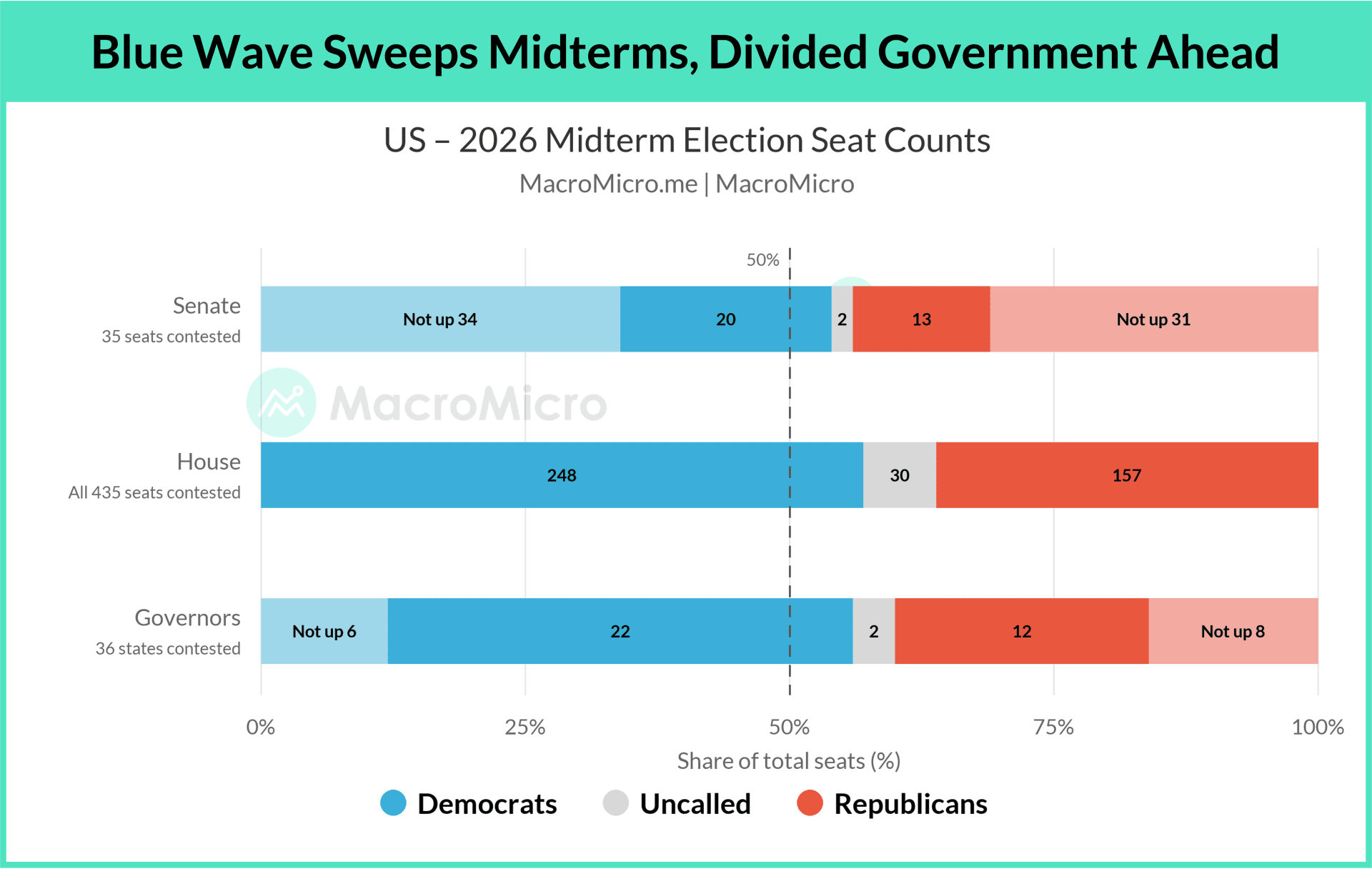
Key Takeaways:
- Democrats Sweep Both Chambers: Democrats won both the House and Senate in the midterm elections, shifting control of Congress. Will Trump's tariff, foreign policy, and fiscal agendas change as a result?
- Texas Turns Blue: Texas, home to the largest data center capacity in the US, saw both its governorship and federal Senate seat flip to Democrats. With the political winds shifting, could AI data center construction face delays?
- Historical Midterm Analysis: Congress changes hands and divided government takes shape. How do markets perform in the year following midterm elections? We backtest 14 midterm elections since 1970 to find out.
I. Democrats Sweep Both Chambers: What Changes, & What Doesn't?
With Democrats sweeping both chambers of Congress, the US will enter a period of "Divided Government," in which the president and the congressional majority belong to different political parties, creating a system of checks and balances between the executive and legislative branches. Regardless of whether Democrats or Republicans seek to advance major legislation, they will face greater resistance.
-
For Republicans, the Trump administration's legislative agenda will be meaningfully constrained. With Democrats holding both chambers and control of the legislative agenda, any major Republican bill that lacks Democratic support will struggle to clear Congress.
-
For Democrats, however, controlling a congressional majority does not mean they can directly overturn Trump's policies. Even with control of both chambers, Democrats remain constrained by the Senate filibuster, under which most bills need 60 votes to advance to a vote. More importantly, Trump retains his veto, and overriding it requires a two-thirds majority in both chambers. Because Democrats fall short of these thresholds, they will find it difficult to force a major policy shift on their own.
We therefore expect that, as divided government takes shape, Democrats will remain bound by legislative thresholds despite controlling both chambers, and major policy initiatives are likely to stall in bipartisan negotiations. History shows that when the domestic agenda is blocked, presidents tend to turn to foreign affairs to deliver results. After the Bush administration's midterm losses in 2006, for example, it pivoted to active diplomatic engagement with North Korea; in 2015, the Obama administration reached the Iran nuclear deal while Republicans controlled Congress.
Note: The filibuster refers to a tactic in which a legislative minority uses procedural rules, such as extended debate or delay, to prevent a bill from coming to a vote. It is most common in the US Senate, where the majority typically needs 60 votes to pass a cloture motion to end debate and proceed to a vote. With Republicans at 44 seats and Democrats at 54, neither party currently reaches that threshold.
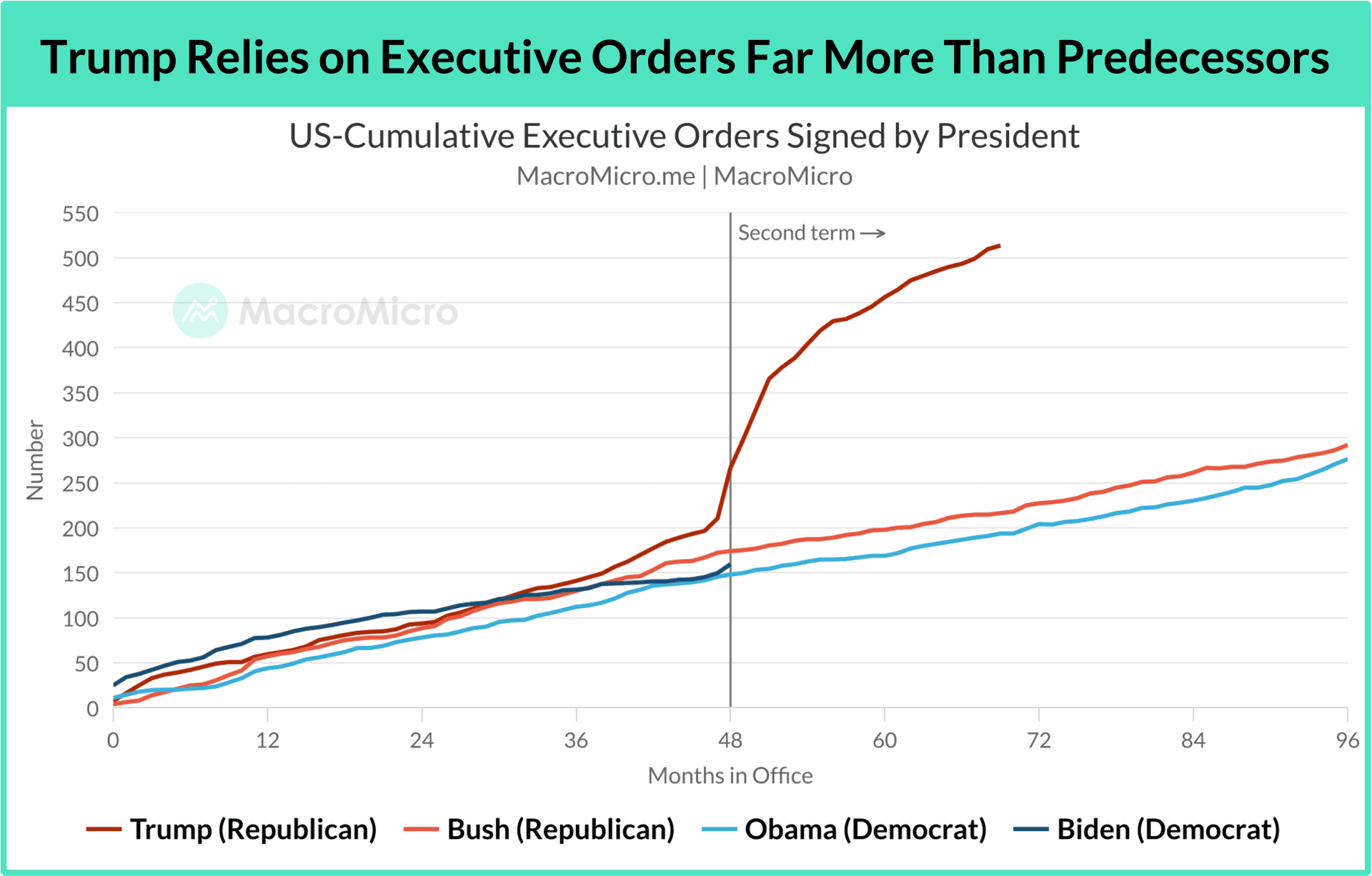
We do not expect this time to be any different. Given that Trump already favors executive orders to sidestep congressional checks, the change in Congress is unlikely to materially alter the policy direction he has set on issues such as US-Iran relations and tariffs. However, with the odds of partisan gridlock rising, we highlight three areas worth watching:
1. Government Shutdown Talks Return at Year-End
First, with Democrats winning a majority in the midterms, Congress can be expected to face greater resistance on both legislation and annual budget negotiations during the "lame duck session" (the transition period from the post-election weeks in November until the new Congress is sworn in on January 3). The first hurdle is the continuing resolution (CR) that expires on December 11.
Because Democrats will take control of Congress next year, when they will be better positioned to advance their own priorities, they have little incentive to cooperate with Republicans on legislation before the new Congress is seated. When the CR expires in mid-December, Democrats will most likely pass only another short-term CR and push full-year budget negotiations to the new Congress next year. Even so, without a 60-vote supermajority in the Senate, Democrats will still...
Already a subscriber? Click here to log in.
Full Access to Our Services

Comprehensive data at your service
with key indicators for investment insights

Exclusive flash reports
on key events and data

Create your own charts and analysis
including performance backtesting

Hub of professionals to engage
in meaningful discussions and insights
 Get answers from MM AI.
-
How will Democrats controlling both US congressional chambers impact Trump's policy agenda?
💡Democrats controlling both US congressional chambers will meaningfully constrain the Trump administration's legislative agenda, as any major Republican bill lacking Democratic support will struggle to pass. Despite holding majorities, Democrats cannot easily overturn Trump's policies due to the Senate filibuster requiring 60 votes for most bills and the presidential veto, which needs a two-thirds majority in both chambers to override. This dynamic will likely lead to partisan gridlock, with major policy initiatives stalling in bipartisan negotiations, causing the president to potentially pivot towards foreign affairs to deliver results, as seen in previous administrations.
-
What are the potential consequences for AI data center expansion after Texas's political shift?
💡Texas's political shift, with Democrats winning the governorship and a federal Senate seat, could significantly raise costs and extend review times for new AI data center projects in the state, which accounts for over a quarter of planned US data center capacity. Governor-elect Hinojosa is expected to move towards strict legislation, potentially codifying union hiring, local veto power, a ban on NDAs to allow disclosure of water and power use, no increase in household bills, and the removal of subsidies as legal prerequisites for approving new projects. This shift, combined with tightening local and federal regulations, could stall data center buildouts and impact AI compute supply from 2027 onward, affecting nearly half of new US capacity slated for 2028.
-
How do financial markets historically perform in the year following US midterm elections?
💡Historically, financial markets tend to be volatile and lackluster in the year before a midterm election, but perform positively afterward. Across 14 midterms since 1970, the median S&P 500 return in the 12 months post-election was +13.59%, with a 100% win rate. This trend is attributed to political uncertainty fading post-election, encouraging investment in risk assets, and the checks and balances of a divided government, which can prevent controversial legislation and spiraling fiscal deficits, thereby reassuring markets. Under a Republican president and divided government, specifically, the median S&P 500 return in the 12 months after the election was +12.69%, also with a 100% win rate.
-
How might a Democratic Congress affect US defense spending and power infrastructure regulation?
💡A Democratic Congress is expected to scrutinize military spending closely, pushing back on Republican plans for a major defense buildup. Markets anticipate cuts to proposed defense budgets, such as the Trump administration's US$1.5 trillion FY2027 defense budget, potentially reducing military procurement and conventional weapons contracts, which would weigh on defense stocks. For power infrastructure, Democrats take a stricter stance on environmental and electricity regulation, likely requiring energy-intensive data centers to bear grid upgrade costs and tightening permitting standards. This has historically led to selling pressure on power infrastructure names despite strong earnings, as evidenced by underperformance correlating with increased probability of a Democratic sweep.
-
Which sectors, like healthcare, are expected to benefit from Democratic budget allocation priorities?
💡Healthcare is expected to clearly benefit from Democratic budget allocation priorities. Markets anticipate the new Congress will shift budget priorities toward public healthcare and the social safety net, including continued efforts to preserve Medicaid funding and extend ACA premium subsidies. This policy stance is projected to significantly improve earnings visibility for insurers and healthcare providers, directly lifting the sector. Conversely, defense spending may face pressure and underperform due to expected budget cuts, while power infrastructure could face tighter regulation and increased costs for grid upgrades. Software and banks are considered neutral, driven more by earnings and broader AI trends.
-
How will Democrats' control of Congress impact the 'who pays' debate for AI data center grid costs?
💡Democrats' control of Congress is likely to shift the 'who pays' debate for AI data center grid costs towards stricter federal legislation. Currently, federal rules rely on voluntary commitments, like the Ratepayer Protection Pledge where big tech committed to paying for grid upgrades, but it is not legally binding. The previous Ratepayer Protection Act, which only required states to 'consider' these costs, was blocked by Democrats as too weak. With Democrats now controlling both chambers, Congress may advance a stricter version, such as Senator Heinrich's proposal, requiring large power users to pay for grid interconnection costs, thereby increasing capex and cash flow pressure on big tech and prompting more careful assessment of AI investments.
-
What new local regulations are emerging in key states like Texas regarding data center development?
💡New local regulations are emerging in key states, intensifying disputes over water, power, and tax breaks for data centers. In Texas, where Democrats flipped the governorship and a US Senate seat, Governor-elect Hinojosa is expected to move from an executive freeze towards 'strict legislation,' codifying union hiring, local veto power, a ban on NDAs for disclosure of water and power use, preventing household bill increases, and removing subsidies as legal prerequisites for new projects. Other states are also tightening regulations; New York State ordered a pause on permits for projects above 50 MW, and California passed legislation requiring operators to pay for grid buildout and disclose water use, reflecting a strong voter preference for greater limits on data center development across 46 of 47 local ballot measures.
-
What is the near-term and long-term impact of data center regulations on 2027 and 2028 capacity?
💡The near-term impact of data center regulations on 2027 capacity is limited, affecting only about 2.3 GW or 6% of the estimated 38 GW of new capacity, primarily because current restrictions target new applications, and 22 GW of 2027 capacity is already in construction. However, the long-term impact on 2028 capacity faces greater uncertainty. Of the estimated 62.2 GW for 2028, most has not broken ground, and approximately 30 GW is concentrated in states like Texas, Georgia, New Mexico, and Ohio, where new governors favor a pause or tougher reviews. This political shift means 2028 buildout timelines may face significant delays and increased costs due as operators are required to pay for grid upgrades and tax incentives are revisited.
-
What investment opportunities arise from the increasing demand for independent power and clean energy solutions for data centers?
💡The increasing demand for independent power and clean energy solutions for data centers presents significant investment opportunities. Facing grid interconnection queues and permitting limits, big tech will accelerate deployment of behind-the-meter (BTM) power using distributed sources like gas turbines, reciprocating engines, and solid oxide fuel cells (SOFC), paired with large-scale battery energy storage systems (BESS) and rack-level battery backup units (BBU). Additionally, with greater Democratic emphasis on decarbonization, 'renewables plus storage' and small modular reactors (SMR) are expected to gain policy support, creating new growth opportunities for industries providing energy independence and low-carbon benefits.
-
What historical market trends follow midterm elections under a Republican president and divided government?
💡Historical market trends following midterm elections under a Republican president and divided government show positive returns for the S&P 500. Across 7 such instances since 1970, the median S&P 500 return in the 12 months post-election was +12.69%, with a 100% win rate, indicating that divided government has not negatively impacted stocks. In bonds, the median 10-year Treasury yield fell by 32.5 basis points over the same period, reflecting price increases, primarily due to congressional constraints on fiscal expansion. The US dollar showed a median return of +1.45%, suggesting a range-bound performance, while gold rose 12.77%, maintaining its long-term uptrend.
[Black Friday Is LIVE] Max AI Annual: 12 months + 2 bonus months. Save 40%+ with full MM AI access, unlimited charts, and 8+ exclusive 2027 outlook reports. Get the Offer