What You Need to Know
Global semiconductor stocks have recently come under pressure as concerns about the outlook for the AI industry have resurfaced. Against this backdrop, TSMC, one of the most critical upstream players in the global AI supply chain, held its Q3 2026 earnings call on October 15, drawing considerable market attention to its financial performance and forward guidance.
At this earnings call, TSMC once again raised its full-year revenue growth forecast to 44%, up from its previous guidance of "slightly above 40%," demonstrating continued momentum in robust AI demand. Although gross margin edged lower due to the ramp-up of 2nm mass production and overseas capacity expansion, the company maintained its 2026 capital expenditure plan of US$60 billion to US$64 billion. It also expects capital expenditure in 2026–2028 to be significantly higher than in the preceding three years.
In this article, we take an in-depth look at TSMC's operating performance this quarter, assess its financial growth drivers for 2027, and examine the positioning of the global semiconductor supply chain.
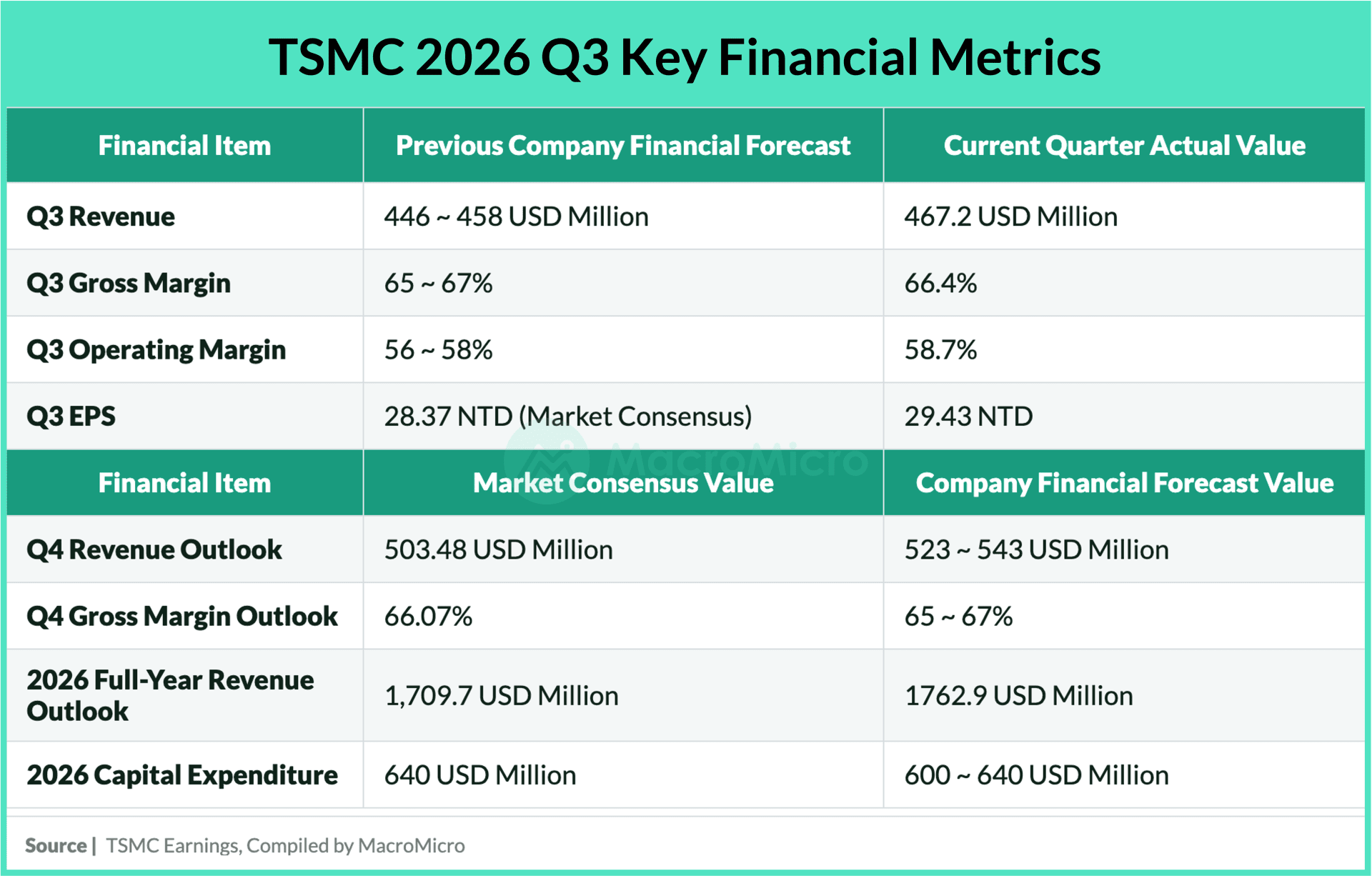
Key Takeaways
- TSMC's Q3 2026 revenue reached NT$1.49 trillion, up 17.62% QoQ (previously 12.01%) and 50.95% YoY (previously 36.05%), with growth continuing to accelerate and results exceeding market expectations. Revenue in US dollar terms reached US$46.72 billion, up 41.2% YoY (previously 33.7%), surpassing the upper end of the company's guidance from the previous quarter. The main growth drivers were strong HPC demand, a higher revenue contribution from N3, and the start of N2 mass production.
- For Q4, TSMC expects revenue of US$52.3 billion to US$54.3 billion, representing 58% YoY growth and exceeding market expectations. The company also raised its full-year 2026 revenue growth forecast in US dollar terms from "slightly above 40%" to "approximately 44%."
- AI CAGR is expected to exceed previous estimates, while capital expenditure will continue to expand, underscoring TSMC's view that its earnings potential has "no ceiling."
- TSMC's inventory days declined as expected, supported by preparations for substantial N2 shipments in the second half of this year and next year. With demand for next-generation AI chips and custom-designed chips also accelerating, the company is converting inventory into revenue!
I. TSMC's Q3 2026 Operating Performance & Revenue Outlook
Below are the key takeaways from TSMC's latest financial results, compiled by us at MacroMicro.
TSMC's Q3 2026 revenue reached NT$1.49 trillion, up 17.62% QoQ (previously 12.01%) and 50.95% YoY (previously 36.05%). Revenue in US dollar terms reached US$46.72 billion, up 41.2% YoY (previously 33.7%), exceeding the upper end of the company's guidance from the previous quarter (US$45.8 billion). The main growth drivers were strong HPC demand, a higher revenue contribution from N3, and the start of N2 mass production.
Gross margin and operating margin declined to 66.4% (previously 67.7%) and 58.7% (previously 60.3%), respectively, in line with guidance. Diluted EPS came in at NT$29.4 (previously NT$27.25), exceeding market expectations of NT$28.4. The dilutive impact of N2 is beginning to show up in the financial results, but management emphasized that productivity improvements and product mix optimization would partially offset this effect, allowing the company to maintain strong profitability.
- By technology platform, HPC remained TSMC's primary growth engine, with its share of revenue climbing to a record 68% (previously 66%). HPC revenue grew 22% QoQ, following 20% growth in the previous quarter. Smartphone revenue accounted for a slightly smaller share of 21% (previously 22%), although revenue still grew 10% QoQ. Automotive revenue remained unchanged at 4% of the total, while IoT declined from 5% to 4%. Revenue from these two segments grew 23% and 5% QoQ, respectively. Consumer electronics and other businesses maintained their respective revenue shares of 1% and 2%, while revenue declined 12% and 10% QoQ, respectively.
- By process node, revenue from advanced technologies (N7 and more advanced nodes) increased further to 79% of the total (previously 77%), continuing to improve the overall product mix. N2's revenue contribution rose rapidly to 8% (previously 3%), while N3 benefited from strong customer demand and the continued conversion of N5 capacity, lifting its share to 33% (previously 30%). By contrast, the shares of N5 and N7 declined to 28% (previously 33%) and 10% (previously 11%), respectively. The company also emphasized that it would continue...
Already a subscriber? Click here to log in.
Full Access to Our Services

Comprehensive data at your service
with key indicators for investment insights

Exclusive flash reports
on key events and data

Create your own charts and analysis
including performance backtesting

Hub of professionals to engage
in meaningful discussions and insights
 Get answers from MM AI.
-
What were TSMC's key financial highlights in Q3 2026, including revenue growth and earnings per share?
💡TSMC's Q3 2026 revenue reached NT$1.49 trillion, marking a 17.62% QoQ increase and a 50.95% YoY surge, with US dollar revenue reaching US$46.72 billion, up 41.2% YoY and exceeding company guidance. Diluted EPS was NT$29.4, surpassing market expectations of NT$28.4, driven by strong HPC demand, increased N3 revenue contribution, and the initiation of N2 mass production. Gross margin and operating margin saw slight declines to 66.4% and 58.7% respectively, aligning with guidance, as the dilutive impact of N2 began to show in financial results.
-
How will N2 mass production impact TSMC's gross margin, and what mitigation strategies are in place?
💡N2 mass production is expected to dilute TSMC's gross margin by 3–4 percentage points, with the projected Q4 gross margin midpoint at 66%, representing a 1.7 percentage point QoQ decline from Q2. However, management emphasized that the dilutive impact would be partially offset by productivity improvements and optimization across process nodes. These mitigation strategies aim to maintain strong profitability despite the initial costs associated with ramping up N2 production, ensuring the company's continued financial strength.
-
What is the projected revenue growth and EPS for TSMC in 2027, considering AI demand and N2 production?
💡For 2027, TSMC projects revenue growth of 30–40% in US dollar terms, with a gross margin of 66–67%, and an estimated EPS of NT$154.24. These forecasts take into account strong AI demand, the anticipated margin dilution from N2 mass production, continued capital expenditure, and the introduction of A14 into production. The company anticipates sustained high demand for advanced technologies to fuel this significant growth.
-
What is TSMC's updated CAGR forecast for AI accelerators from 2024 to 2029?
💡TSMC's updated CAGR forecast for narrowly defined AI accelerators from 2024 to 2029 is now expected to potentially exceed the original forecast of 55–59%, or the mid-to-high 50s. CEO C.C. Wei stated that demand is currently extremely strong with no signs of slowing, indicating a more robust growth trajectory for AI semiconductors than previously anticipated. The company's rigorous capacity planning, including on-site inspections of data centers, supports this upward revision.
-
How does TSMC assess AI demand and potential supply chain bottlenecks in its capacity planning?
💡TSMC assesses AI demand and potential supply chain bottlenecks through a rigorous and disciplined capacity planning process. The company considers CSPs' capital expenditure, data center construction progress, financial conditions, power availability, and the status of various components, even dispatching teams to the US to inspect data center construction and power availability firsthand. Following this comprehensive assessment, TSMC concluded that "AI demand remains far greater than supply," and is intensively expanding capacity to narrow the gap.
-
Why does TSMC believe its earnings potential has 'no ceiling' despite rising capital expenditure and inflation?
💡TSMC believes its earnings potential has "no ceiling" due to the long-term AI megatrend, which drives substantial demand for its advanced technologies. Despite rising capital expenditure and inflation in equipment, materials, and labor costs, the company's core strategy is to help customers succeed through technological leadership and capture the value it creates in return. CEO C.C. Wei emphasized that while substantial growth will not happen overnight, the underlying demand and TSMC's strategic positioning ensure continuous growth opportunities.
-
Why is TSMC not at a disadvantage by adopting High-NA EUV technology later than competitors?
💡TSMC is not at a disadvantage by adopting High-NA EUV technology later than competitors because its criteria for introducing new equipment into mass production are based on offering the best technology, reasonable cost, and the highest level of maturity. While High-NA EUV is a promising technology, TSMC expects it to reach sufficient technological and cost maturity only by 2030 and is working with ASML to establish a 12-inch mask ecosystem by 2031. CEO C.C. Wei remains highly confident that TSMC's manufacturing expertise will continue to provide customers with the most advanced and cost-effective options.
-
How did TSMC's inventory days change in Q3 2026, and what does this indicate about demand?
💡TSMC's inventory days declined to 72.9 days in Q3 2026, down from 76.5 days, indicating robust demand for advanced process technologies. This reduction suggests that TSMC is effectively converting its accumulated inventory into actual shipments, after building it in advance for substantial N2 shipments in the second half of this year and next year. The accelerating demand for next-generation AI chips and customized ASICs has contributed to this improvement, validating the strong market conditions.
-
How does TSMC's gross margin divergence from inventory days indicate its competitive advantages?
💡TSMC's gross margin continues to diverge from its inventory days, with gross margin rising much faster than inventory days, which indicates its strong competitive advantages. This trend signifies that TSMC is improving inventory turnover efficiency while simultaneously maintaining robust profitability and pricing power. This divergence highlights the company's ability to command premium prices and manage its inventory effectively, even amidst increasing demand for advanced technologies.
-
What are MacroMicro's revised EPS estimates for TSMC for the current and next year?
💡MacroMicro has raised its EPS estimates for TSMC for the current year to NT$112.5 and for the next year to NT$154.2. These upward revisions are based on TSMC's stronger-than-expected Q3 earnings call, positive operating outlook, robust long-term AI demand, and expanding capital expenditure plans. MacroMicro believes that the recent pullback in semiconductor stocks due to inflation and interest rate concerns may present attractive investment opportunities for TSMC.

