What You Should Know
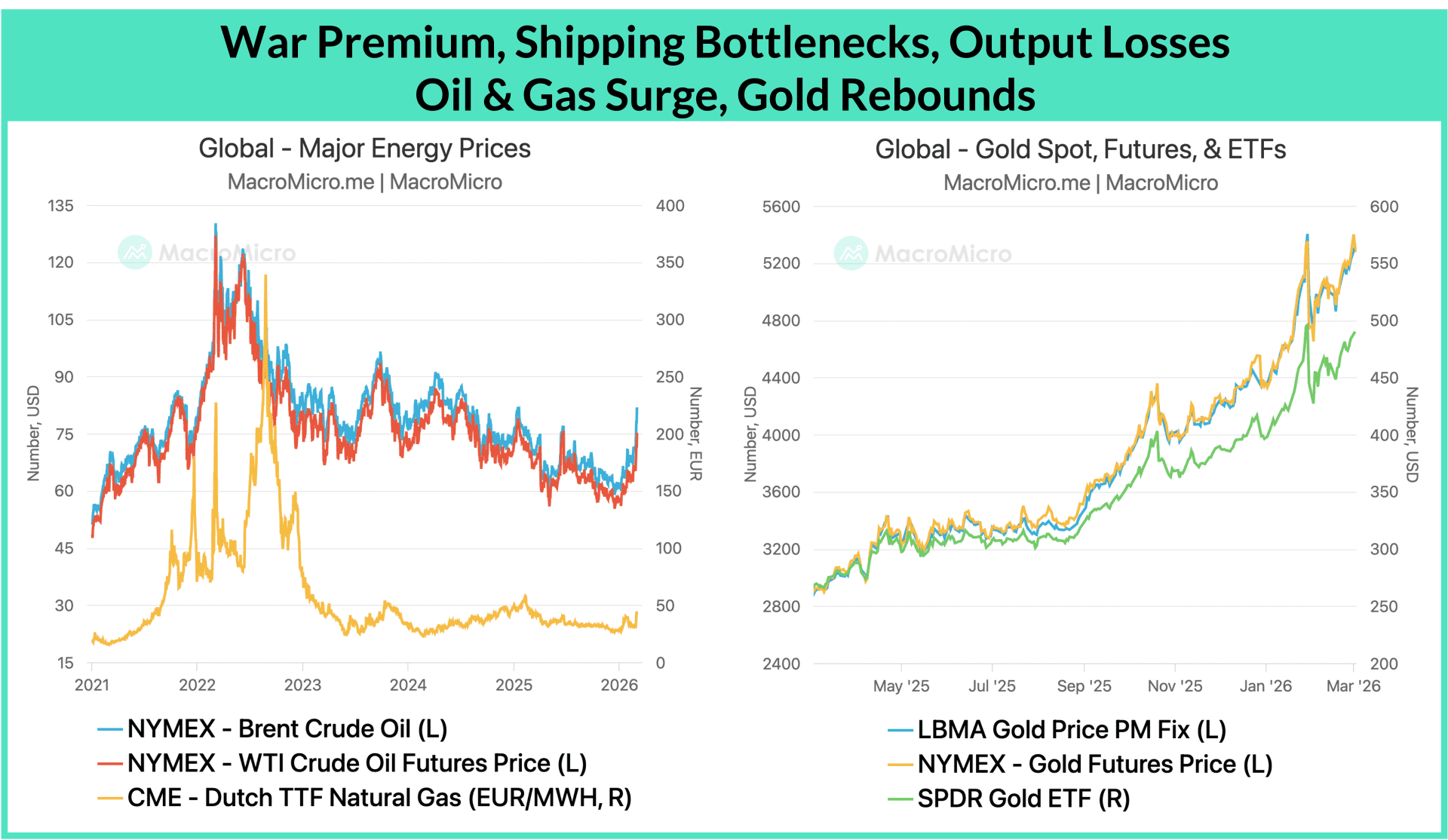
The US–Israel coalition has launched a joint military campaign, “Operation Epic Fury” (US) and “Operation Lion’s Roar” (Israel), targeting the core of Iran’s ruling regime. The geopolitical landscape in the Middle East has shifted abruptly. Oil, natural gas, and gold have all surged, while the world’s critical energy artery, the Strait of Hormuz, is effectively under blockade conditions.
With oil prices returning to the $70+ range, we provide a comprehensive analysis of US strategic logic, the possible trajectories of Iran’s regime, oil price scenarios, and how markets are pricing the risks.
Key Takeaways:
- What happened: A full-scale US–Israel–Iran conflict has erupted in the Middle East; crude oil, natural gas, and gold have surged.
- Why did this escalate so quickly? Trump’s strategic framework: containing Iran, stabilizing the region, and reinforcing global hegemony.
- Iran’s regime transition paths: Four potential developments amid a power vacuum.
- Oil market implications: Rising shipping risks in the Strait of Hormuz; early signs of slowing maritime trade flows.
- Peace vs. Prolonged Conflict vs. Survival Mode: Three scenario projections for the Middle East realignment, with oil prices at the center of capital flows.
I. What Happened: Full-Scale Middle East War Sends Oil, Gas, & Gold Soaring
On February 28, the United States and Israel launched joint military operations—“Operation Epic Fury” (US) and “Operation Lion’s Roar” (Israel)—conducting airstrikes on Iran's political and military leadership, resulting in the deaths of Supreme Leader Khamenei, the Defense Minister, the Chief of Staff, and about 40 other officials. Additionally, the US-Israeli coalition struck approximately 500 strategic targets across Iran, including locations such as Isfahan (air force base/uranium conversion facility), Bushehr (site of an operational nuclear power plant), the western military strongholds of Kermanshah and Khorramabad, as well as the deep-water port of Chabahar on Iran's southeastern coast along the Gulf of Oman.
Iran subsequently launched several waves of retaliatory attacks, not only firing multiple rounds of ballistic missiles and drones at Israel but also expanding the scope to surrounding countries, including Bahrain, Iraq, Jordan, Kuwait, Oman, Qatar, Saudi Arabia, and the UAE—eight nations in total—primarily targeting US military bases, indicating signs that the Middle East situation is shifting toward expanded conflict. Since entering March, energy infrastructure and maritime shipping have not escaped the impact: Saudi Aramco's Ras Tanura refinery, with a daily capacity of 550,000 barrels, was attacked by drones; Qatar's liquefied natural gas (LNG) production faces interruptions; Iraq has shut down production at the Shaikan oil field in the Kurdish region; Iran's Islamic Revolutionary Guard Corps (IRGC) attacked oil tankers near the Persian Gulf, and Yemen's Houthi militants announced...
This in-depth analysis of the US-Israel-Iran conflict, the Strait of Hormuz disruptions, surging oil/gas/gold prices, and potential regime shifts in Tehran is exclusive to MM Max subscribers. Unlock full access to this report, interactive charts, and our ongoing coverage of this fast-evolving geopolitical energy crisis. Subscribe Now»
Already a subscriber? Click here to log in.
Full Access to Our Services

Comprehensive data at your service
with key indicators for investment insights

Exclusive flash reports
on key events and data

Create your own charts and analysis
including performance backtesting

Hub of professionals to engage
in meaningful discussions and insights
 Get answers from MM AI.
-
What were the immediate market reactions in crude oil, natural gas, and gold prices to the Middle East conflict?
💡Following the Middle East conflict, Brent crude futures surged 13% to over $82, reaching the highest price since early 2025. European TTF natural gas futures increased by over 70% in two trading days due to LNG supply disruptions. Gold spot prices rebounded to $5,400 per ounce, nearing the historical high from late January, as safe-haven sentiment renewed, while global equities generally faced pressure except for the energy sector.
-
How did Trump's 'Peace Through Strength' strategy redefine US core interests in the Persian Gulf?
💡Trump's 'Peace Through Strength' strategy, outlined in the 'US 2025 National Security Strategy,' redefined US core interests in the Persian Gulf by emphasizing that Persian Gulf energy supplies must not fall into enemy hands, the Strait of Hormuz must remain open, and the Red Sea must allow free passage, preventing it from becoming a base for terrorism. This framework prioritizes physically removing Iran's ability to threaten waterways by destroying its missile industry and naval facilities, aiming to replace a long-term 'military standoff' with 'regime collapse' by publicly calling on the Iranian people to overthrow the government.
-
What are the four potential scenarios for Iran's regime transition after Supreme Leader Khamenei's death?
💡Following Supreme Leader Khamenei's death, Iran's regime transition has four potential scenarios: 'Regime unchanged' (high probability), maintaining the existing theocratic system with an 88-member Assembly of Experts electing a new Supreme Leader, but failing to resolve domestic and Western conflicts. 'Long-term transition' (medium-high probability) involves 'collective rule' by a provisional guidance committee or a figurehead Supreme Leader, with real power held by Ali Larijani and IRGC generals, maintaining regime legitimacy. A 'Military coup' (low probability) by the IRGC, which controls 30-50% of Iran's national economic output, is less likely as elite leaders would protect vested interests. 'Regime collapse' (medium-low probability) entails the theocratic regime collapsing under Trump's encouragement, leading to internal revolution and the potential return of secular opposition or the exiled royal family, supported by the US to establish a pro-Western democratic regime.
-
How does the Strait of Hormuz serve as a critical chokepoint for global oil and LNG trade?
💡The Strait of Hormuz is a critical chokepoint for global energy trade, situated between Oman and Iran, connecting the Persian Gulf, Gulf of Oman, and Arabian Sea. The International Energy Agency (IEA) estimates that one-quarter of global seaborne oil trade and one-fifth of LNG trade passes through this strait. Additionally, Kpler data indicates that Europe relies on the strait for 25-30% of its aviation fuel, and India for up to 85% of its liquefied petroleum gas (LPG) imports and exports, underscoring its indispensable role in international energy flows.
-
What impact has the conflict had on shipping traffic and insurance rates in the Strait of Hormuz?
💡Since February 28, the conflict has significantly impacted shipping traffic and insurance rates in the Strait of Hormuz, with Bloomberg and Marine Traffic data showing a sharp decline in transiting vessels and hundreds waiting near Fujairah and offshore Dubai. Marine insurance and tanker rates have reached recent highs. Major shipping companies like Maersk, MSC, and Hapag-Lloyd have rerouted vessels via the Cape of Good Hope, while Japanese and Taiwanese carriers suspended Persian Gulf operations due to Iranian retaliatory attacks on commercial vessels and IRGC interference with satellite navigation systems, leading to increased caution among operators.
-
How did OPEC+ respond to the escalating conflict, and what were the limitations of its decision?
💡OPEC+ responded to the escalating conflict by holding a ministerial meeting on March 1, deciding to gradually phase out the 1.65 million barrels per day voluntary production cut announced in April 2023, agreeing to raise production targets by 206,000 barrels starting in April. However, this decision faced limitations: the timing constraint meant the additional supply would not be released until April, too late for the immediate market squeeze; logistical constraints affected countries like Iraq and Kuwait that lack alternative pipeline infrastructure; and the scale constraint rendered the 206,000 barrels per day increase negligible compared to the roughly 16 million barrels per day transiting the Strait of Hormuz.
-
What are the three market scenarios (Peace, Delay, Survival) for oil prices amid the Middle East realignment?
💡The three market scenarios for oil prices amid the Middle East realignment are: 'Optimistic (Peace Mode),' where Iran and the West reach a ceasefire, the Strait of Hormuz normalizes, geopolitical premiums dissipate, and oil prices ease to the $60s. 'Neutral (Delay Mode),' where Iranian forces counterattack, warfare drags on, the Strait is obstructed but not fully blockaded, and oil prices oscillate at high $70s levels with high volatility until negotiations clarify. 'Pessimistic (Survival Mode),' an extreme tail risk, involves strikes on Iran's core energy facilities, Iran adopting a 'mutual destruction' strategy, fully cutting off the strait, and oil prices facing uncontrolled upside pressure, while OPEC+ production losses could equate to 10% of global output.
-
What is the 'Long-term' strategic logic behind the US military stance concerning US-China rivalry?
💡The 'Long-term' strategic logic behind the US military stance concerning US-China rivalry is to disrupt China's Middle East strategy by dismantling non-Western strategic alliances and hostile proxies. Beijing's 'China-Iran Comprehensive Cooperation Plan' in 2021 involved $400 billion in investments for discounted oil, aiming to establish an energy backup against the 'Malacca Dilemma' and promote a 'petro-yuan' system to challenge US dollar hegemony. The US seeks to sever China's energy and geopolitical influence, redirecting strategic resources to the Indo-Pacific region, thus underscoring the broader US-China hegemony competition.
-
How do rising oil prices, specifically above $70, affect the Federal Reserve's monetary policy and rate cut expectations?
💡Rising oil prices, specifically above $70, affect the Federal Reserve's monetary policy and rate cut expectations by compressing the Fed's easing space in the first half of the year, due to the WTI oil price base in the first half of 2025 averaging $68. This increase contributes to inflation expectations, potentially delaying expected rate cut timing to September. If the situation shifts to an optimistic negotiation scenario, a mid-year (June) rate cut probability rises, allowing for stock additions; conversely, a strait blockade or significant production damage leading to decoupled inflation expectations would necessitate vigilance for a reversal of the easing cycle and repricing of market risks.
-
What are the implications for Asian buyers like China and India due to Middle East maritime disruptions?
💡Asian buyers like China and India will be forced to premium-bid in the spot market or purchase Brent futures on ICE to lock in costs due to Middle East maritime disruptions. Short-term maritime route disruptions and export blockages may lead to storage capacity limits for producers, potentially forcing countries like Iraq and Kuwait to cut production. This exacerbates oil market supply pressures, especially as Iran's daily crude production of 3.3 million barrels and exports of 1.6 million barrels, mainly from Kharg Island, are suppressed by the conflict, contributing to a rise in 'unplanned outages.'
