What You Should Know
Gold returned 65% in 2025, marking the highest annual gain since 1979. Entering 2026, global markets faced successive geopolitical disruptions in Venezuela, Iran, and Greenland, alongside Trump's interference with Federal Reserve independence. "Safe-haven plus FOMO" sentiment drove gold formally above $5,000 per ounce, while silver, propelled by physical supply gaps and Shanghai-New York arbitrage mechanism failures, experienced near-parabolic momentum, with New York silver futures briefly touching a record high of $121 per ounce.
Within less than a week, precious metals markets reversed violently through their most extreme volatility on record. Silver plunged 30% in a single day, gold fell 13%, with the two metals evaporating over $6 trillion in market value within 48 hours (equivalent to four times Bitcoin's market capitalization), representing the largest single-day precious metals crash in modern history.
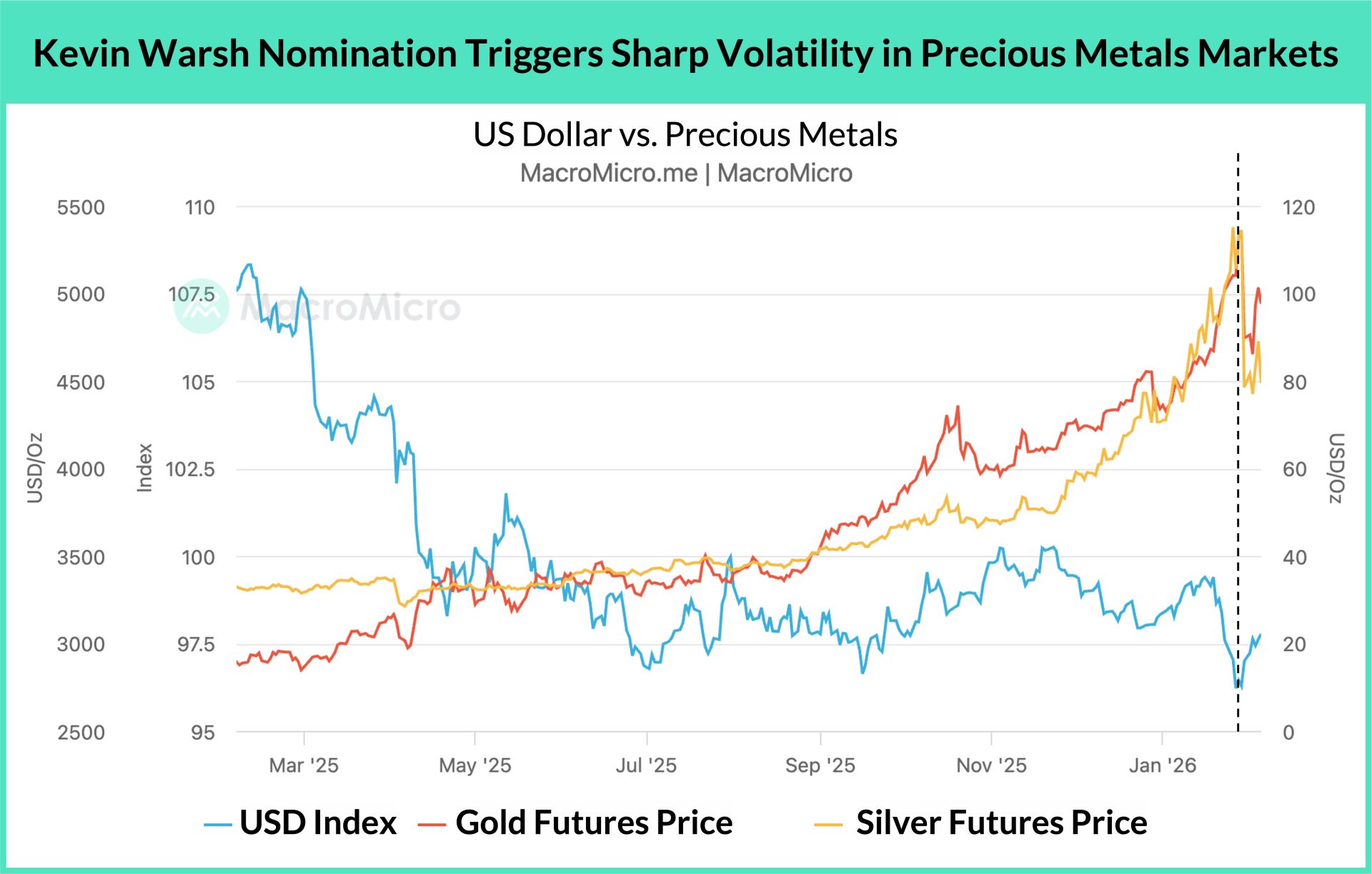
This violent precious metals volatility stemmed from three domino events: regulatory crackdown (CME consecutively raising margin requirements), policy expectation reversal (Trump nominating Kevin Warsh), and ultimately triggering a liquidity stampede (coinciding with thin liquidity during contract rollover, forcing mechanical position closures by market makers). Historical experience shows regulatory intervention often catalyzes silver price collapses. During the 1980s Hunt Brothers incident, CME implemented "Silver Rule 7," permitting only position closures while prohibiting new positions, issuing $100 million in margin calls that ultimately triggered silver's collapse. In 2011, CME raised silver margins five consecutive times within roughly two weeks (nine trading days).
Tightening Meets Its Limits
Trump's January 30 announcement nominating Kevin Warsh as next Fed chair triggered immediate market reactions. The dollar index recovered above 97, while precious metals collapsed.
Warsh's Tightening Talk
Market instinct often labels Warsh as "the hawkish official who resigned in 2011 opposing QE2," sparking fears of tighter monetary policy. However, his recent statements reveal a more nuanced position. He advocates...
This article is exclusive to subscribers. If you're not a subscriber yet, subscribe to MM Max today and gain full access to all our charts, reports, and more. Subscribe Now»

Already a subscriber? Click here to log in.
Full Access to Our Services

Comprehensive data at your service
with key indicators for investment insights

Exclusive flash reports
on key events and data

Create your own charts and analysis
including performance backtesting

Hub of professionals to engage
in meaningful discussions and insights
 Get answers from MM AI.
-
What caused gold's 65% return in 2025, reaching its highest annual gain since 1979?
💡Gold's 65% return in 2025, the highest annual gain since 1979, was driven by a "safe-haven plus FOMO" sentiment. This surge occurred amidst global market disruptions from geopolitical events in Venezuela, Iran, and Greenland, alongside Trump's interference with Federal Reserve independence, pushing gold above $5,000 per ounce.
-
What geopolitical disruptions and policy interferences drove gold above $5,000 per ounce in 2026?
💡Geopolitical disruptions in Venezuela, Iran, and Greenland, coupled with Trump's interference with Federal Reserve independence, drove gold above $5,000 per ounce in 2026. This environment fostered a "safe-haven plus FOMO" sentiment among investors, contributing to the significant price increase.
-
How did CME's regulatory actions, such as raising margin requirements, contribute to the silver price collapse?
💡CME's regulatory actions, specifically consecutively raising margin requirements, significantly contributed to the silver price collapse by exacerbating liquidity issues and forcing mechanical position closures. This intervention created a liquidity stampede, particularly during contract rollover with thin liquidity, which historically has catalyzed silver price collapses, similar to the 1980s Hunt Brothers incident and 2011 events where margins were raised five consecutive times.
-
What is Kevin Warsh's nuanced stance on monetary policy, combining balance sheet reduction with rate cuts?
💡Kevin Warsh's nuanced monetary policy stance combines superficial hawkish and dovish elements; he advocates for shrinking the balance sheet in exchange for rate cuts. Warsh believes AI-driven productivity growth possesses disinflationary properties, eliminating the need for the Fed to suppress demand with high rates, and aims to rebuild fiscal discipline and restore Federal Reserve credibility by redirecting credit resources to the real economy.
-
Why is near-term quantitative tightening by the Federal Reserve considered unlikely despite hawkish rhetoric?
💡Near-term quantitative tightening by the Federal Reserve is considered unlikely despite hawkish rhetoric due to significant feasibility issues, primarily liquidity and fiscal constraints. The Fed recently resumed bond purchases to ease year-end liquidity tensions, making balance sheet reduction challenging without pushing overnight rates above target. Additionally, fiscal expansion preferred by the Trump administration contradicts balance sheet reduction, as the Fed has become a major Treasury buyer.
-
What liquidity and fiscal constraints hinder the Fed's ability to implement significant balance sheet reduction?
💡Two major factors hinder the Fed's ability to implement significant balance sheet reduction: liquidity constraints and fiscal constraints. Liquidity constraints are evident as the Fed recently resumed bond purchases, and further withdrawal would push overnight rates above the target corridor, particularly during the April tax season. Fiscal constraints stem from the Trump administration's preference for fiscal expansion, meaning Fed withdrawal would complicate fiscal operations given the weakened market appetite for Treasuries.
-
What is the 'interest rate ceiling' concept, and how does it limit central banks' monetary policy space?
💡The 'interest rate ceiling' concept refers to the invisible limit on central banks' ability to raise rates against inflation due to high global public debt structures, specifically to avoid debt default and unanchored inflation expectations. This constraint can lead central banks into a deadlock during severe recessions, where fiscally permissible rates fall below the "zero lower bound," preventing effective rate adjustments for either suppressing inflation or stimulating rescue.
-
How has the S&P 500's nominal growth masked a significant decline in real value when measured in gold terms?
💡The S&P 500's nominal returns, exceeding 135% since 2020, have masked a significant decline in real value when measured in gold terms, with a nearly 30% decrease. Similarly, holding US 10-year Treasuries produced approximately 33% lower real returns in gold terms. This indicates that nominal asset price growth largely stems from "monetary illusion" rather than genuine gains in real value or purchasing power, highlighting long-term fiat debasement.
-
What are the two likely scenarios for the future of the international monetary system beyond dollar dominance?
💡Two likely scenarios for the future of the international monetary system beyond dollar dominance are the continued dominance of the dollar, where gold persists as a hedge against declining fiat purchasing power and its portfolio allocation value rises; and the emergence of a multipolar currency system, where new orders take shape through multilateral mechanisms like mBridge, with countries increasingly incorporating "gold reserve quantities" as national-level credit backing.
-
How will gold continue to play a core role in both extended dollar hegemony and a multipolar currency system?
💡Gold will continue to play a core role in both extended dollar hegemony and a multipolar currency system by acting as a hedge against declining fiat purchasing power. In a dollar-dominant scenario, its portfolio allocation value will rise. In a multipolar system, countries may increasingly incorporate "gold reserve quantities" as national-level credit backing to avoid disproportionate influence from single nations, ensuring gold's strategic importance.
