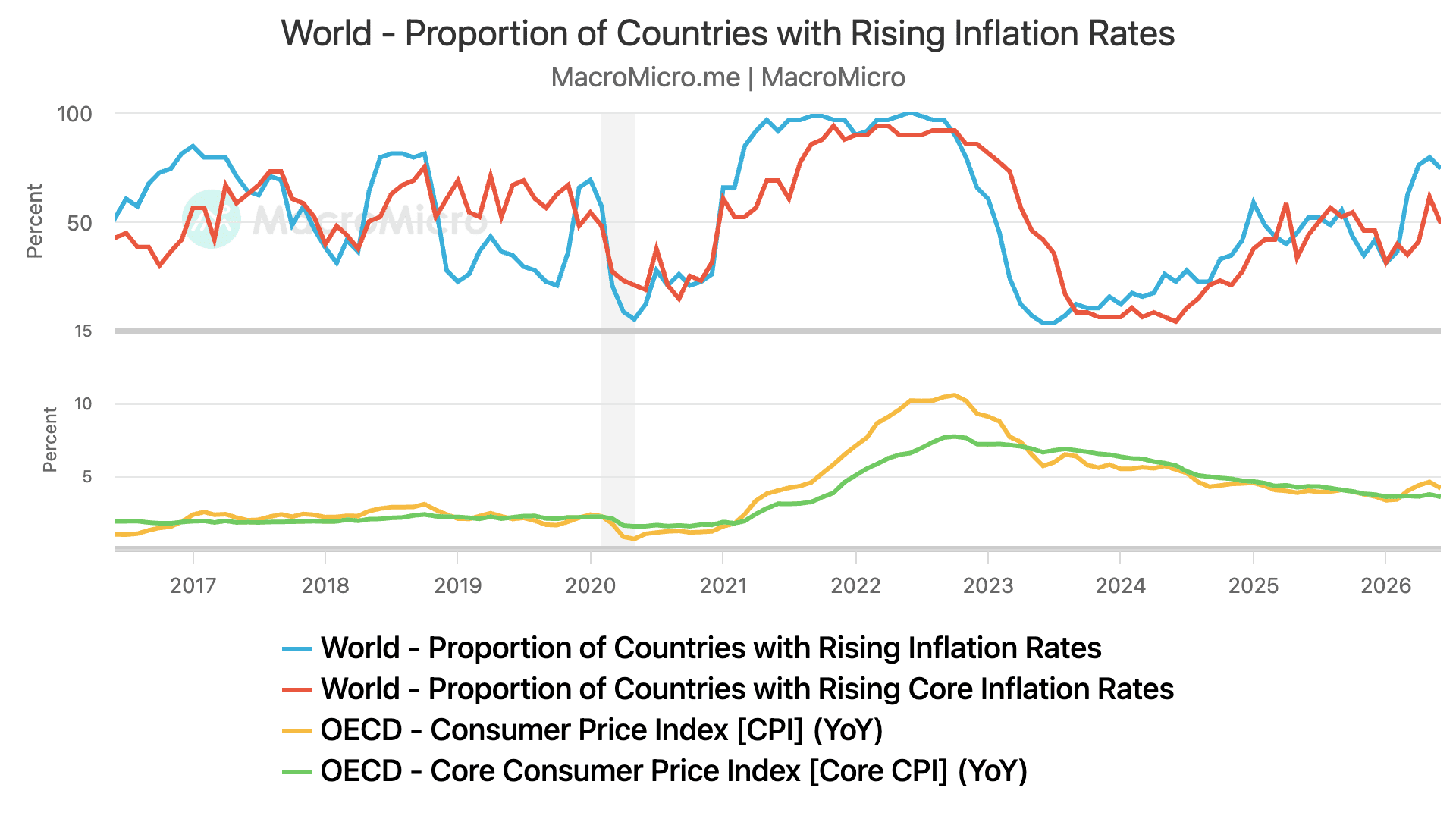
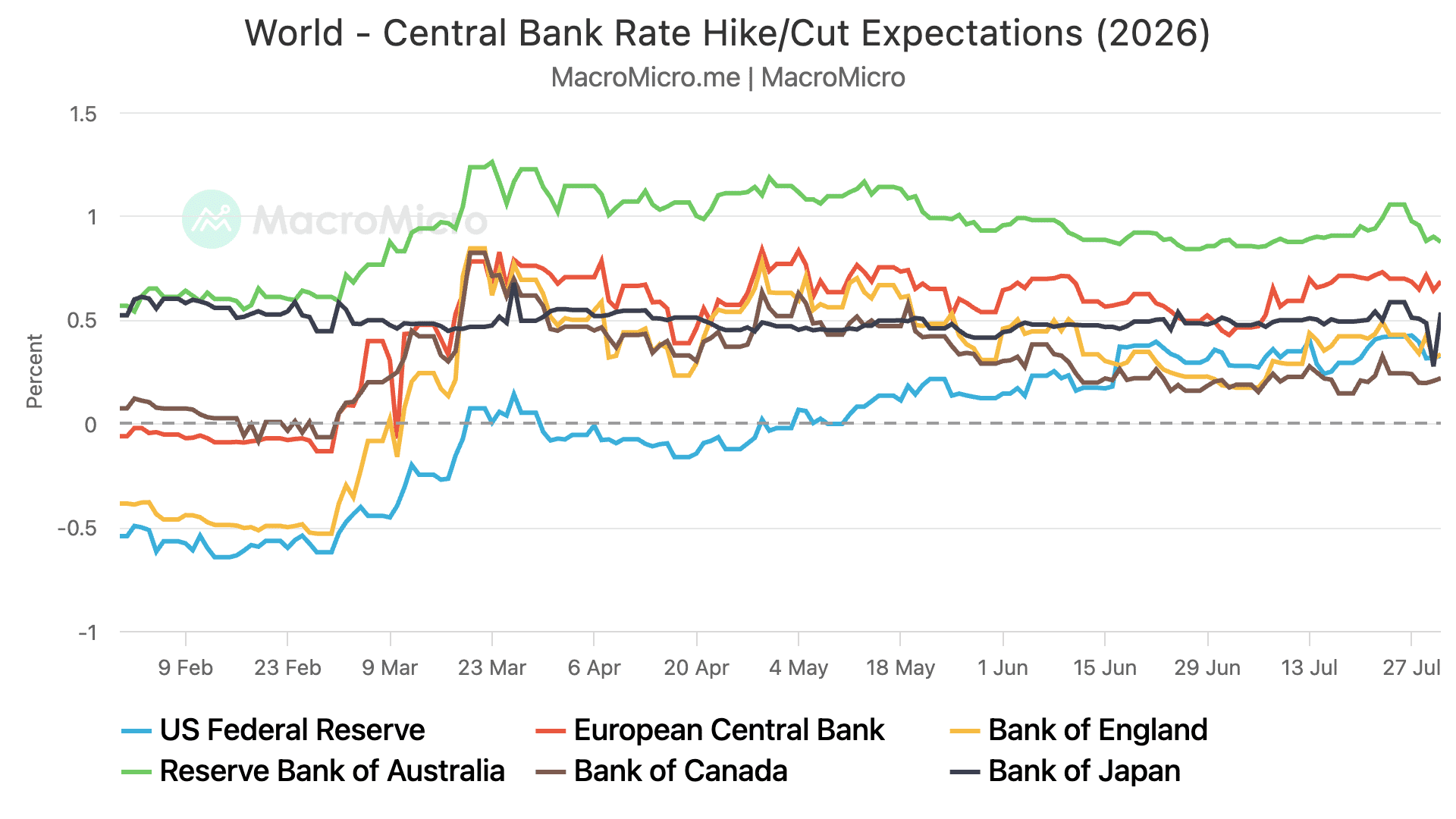
As we move into the second half of 2026, with the shock of the U.S.–Iran conflict, central banks around the world are broadly facing inflationary pressure, and some have already moved first with rate hikes in the first half of the year. Will this put pressure on global markets? Following our review of global central bank policy progress at the end of last year, we once again consolidates the policy paths of 12 major central banks across developed and emerging markets, helping you grasp each central bank's policy pace and its next move!
Key points of this article:
- About 30% of central banks are now hiking. Will more follow? And how long will this cycle last?
- Key commentary on the monetary policy direction of the 12 major central banks and what to watch next, covering the Fed, the ECB, the BOE, the BOJ, and the central banks of Canada, Australia, China, South Korea, Taiwan, India, Brazil and Russia.
For the latest real-time central bank information, please see our website ➨ Central Bank.
▌U.S. Federal Reserve (Fed): Internal divisions notably deepening; the Fed stays on the sidelines over whether to hike in Q3
Since the start of 2026, the Fed has kept its target range unchanged at 3.50–3.75%. Since Warsh took over as Chair, forward guidance has been abandoned in order to avoid revealing the Fed's underlying leanings in any concrete way; nevertheless, judging from individual members' remarks and the three dissenting votes at the latest July meeting, internal divisions have already deepened.
At present, we still believe inflation remains stable with no second round of increases, and against a backdrop where financial markets have priced in an equity correction on their own and real rates have risen — which is itself starting to suppress inflation — the Fed has been bought more time. We therefore continue to see a higher probability that it stands pat this year. On the other hand, FedWatch shows the market expects one 25bp hike this year. Core inflation over the next several prints is worth watching closely: as New York Fed President Williams put it, a monthly increase of 0.2% is relatively safe, while a clear overshoot would cause us to change our view.
On the balance sheet, since Reserve Management Purchases (RMPs) were launched last December, the pace has gradually slowed from the elevated USD 40 billion per month seen ahead of tax season to USD 10 billion per month. According to the Treasury's latest announcement, the Q4 TGA target balance will fall back from USD 950 billion to USD 850 billion; with the liquidity that this releases, we think RMPs could be paused in Q3. That said, the statement reiterated a policy of maintaining ample reserves, so expectations of aggressive balance sheet reduction have already faded and we see no significant cause for concern.
▌European Central Bank (ECB): Energy prices rebound, prompting the ECB to begin precautionary hikes
Headline euro area HICP rose from 2.8% year-on-year in June to 2.9% in July, while core HICP also unexpectedly rebounded to 2.5% (from 2.4%), driven mainly by energy prices accelerating sharply to 10.0% year-on-year (from 8.5%) and services picking up to 3.3% (from 3.2%). European electricity and natural gas futures prices have already exceeded their March highs. Having begun precautionary rate hikes in June this year, the ECB then decided at its July meeting to keep the deposit facility rate unchanged at 2.25% while waiting to see how the conflict develops. If the war in the Middle East drags on, we expect the ECB to have at most one more 25bp hike before year-end.
▌Bank of England (BOE): With the new government expanding fiscal policy, the BOE is acting more cautiously
The BOE voted 6:3 at its July meeting to keep the Bank Rate unchanged at 3.75%, standing pat for a fifth consecutive time, but internal policy divisions have widened markedly, with three members voting for an immediate 25bp hike on concerns that a renewed Middle East conflict would send energy and commodity prices soaring. The latest data show...
Already a subscriber? Click here to log in.
Full Access to Our Services

Comprehensive data at your service
with key indicators for investment insights

Exclusive flash reports
on key events and data

Create your own charts and analysis
including performance backtesting

Hub of professionals to engage
in meaningful discussions and insights
 Get answers from MM AI.
-
What is MacroMicro's projection for the Fed's interest rate policy for the remainder of 2026?
💡MacroMicro projects a higher probability that the Fed will stand pat for the remainder of 2026, believing inflation remains stable without a second-round increase, and that financial markets' equity correction and rising real rates are already suppressing inflation, providing the Fed more time.
-
How many rate hikes does MacroMicro anticipate from the Bank of Japan (BOJ) in the second half of 2026?
💡MacroMicro anticipates just one 25bp hike to 1.25% from the Bank of Japan (BOJ) in the second half of 2026, despite projections of inflation rebounding significantly above 2%, as domestic fiscal pressure continues to constrain the pace of normalization.
-
What is the probability of a Reserve Requirement Ratio (RRR) cut by the PBOC in the second half of 2026?
💡There is a fairly high probability of a Reserve Requirement Ratio (RRR) cut by the PBOC in the second half of 2026, with room for 25–50bps of reduction, due to weaker-than-expected economic data and accelerated fiscal releases, though interest rate cuts will be more cautious to maintain renminbi stability.
-
What is the Central Bank of Brazil's (BCB) current stance on its easing cycle?
💡The Central Bank of Brazil (BCB) is continuing its easing cycle, having already lowered its policy rate from 15% to 14.25% this year, but its pace of cuts is expected to become more cautious due to anticipated El Niño causing potential supply-side shocks to food and commodity prices.
