Investing with Manufacturing Cycles (Part II): How Manufacturing Cycles Can Guide Your Portfolio Strategy
In our last article on manufacturing cycles (read here), we introduced the concept of manufacturing cycles and the key indicators to watch. In this article, we focus on a topic of keen interest to investors: how to leverage one key manufacturing cycle indicator to invest in the global markets of stocks, currencies, bonds and commodities.
I. Reversals in Manufacturing Cycles Lead Global Equities by 6~12 Months
Manufacturing cycles are closely connected with broader economic activity, with each cycle typically spanning 3-4 years and going through phases of expansion, peak, and contraction. Let’s first dive into how these cycles coorelate with the global stock market, specifically the MSCI All Country World Index (ACWI).
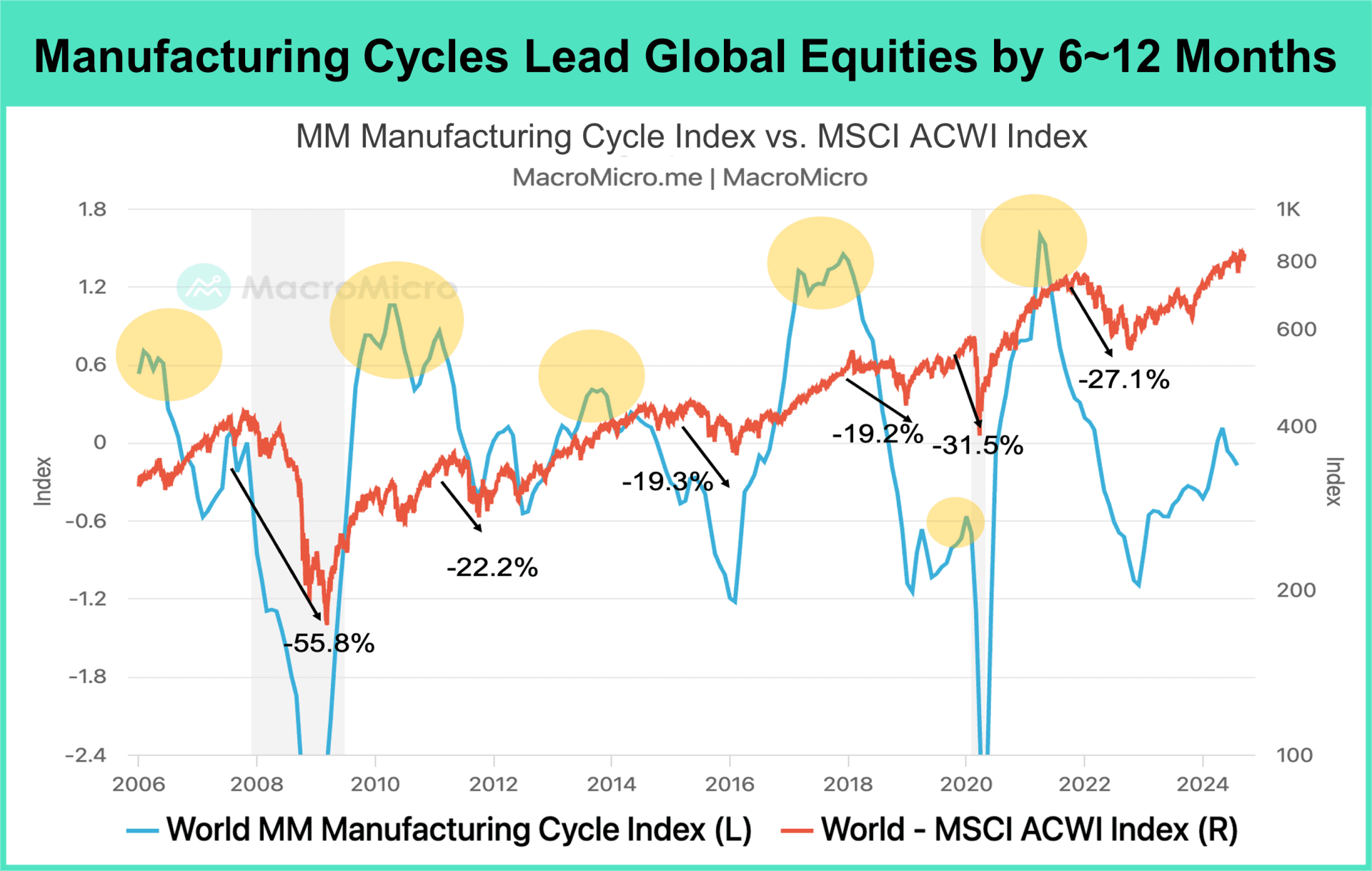
During the upswing phase of the manufacturing cycle, surging new orders prompt businesses to ramp up production, boosting profits and pushing stock markets higher. Subsequently, as new orders begin to decline, profit growth slows, and the manufacuturing sector begins to descend from a peak, marking a cyclical shift that is often accompanied with increased volatility in the equity market. When broader economic growth also visibly slows, businesses will scale back production in response to falling demand, accelerating the manufacturing downturn. During this phase, the MSCI ACWI is prone to sharp declines of more than 15%.
Historically, peaks in manufacturing cycles have preceded equity market peaks by 6~12 months. As illustrated in the chart below, the MSCI ACWI typically reverses course 6 months to a year after the manufacturing cycle hits its peak.
II. Master the Timing to Invest in Cyclical and Defensive Sectors
Shifts in manufacturing cycles can also inform stock selection, helping investors identify the best sectors to invest in and pinpoint the optimal timing for entry.
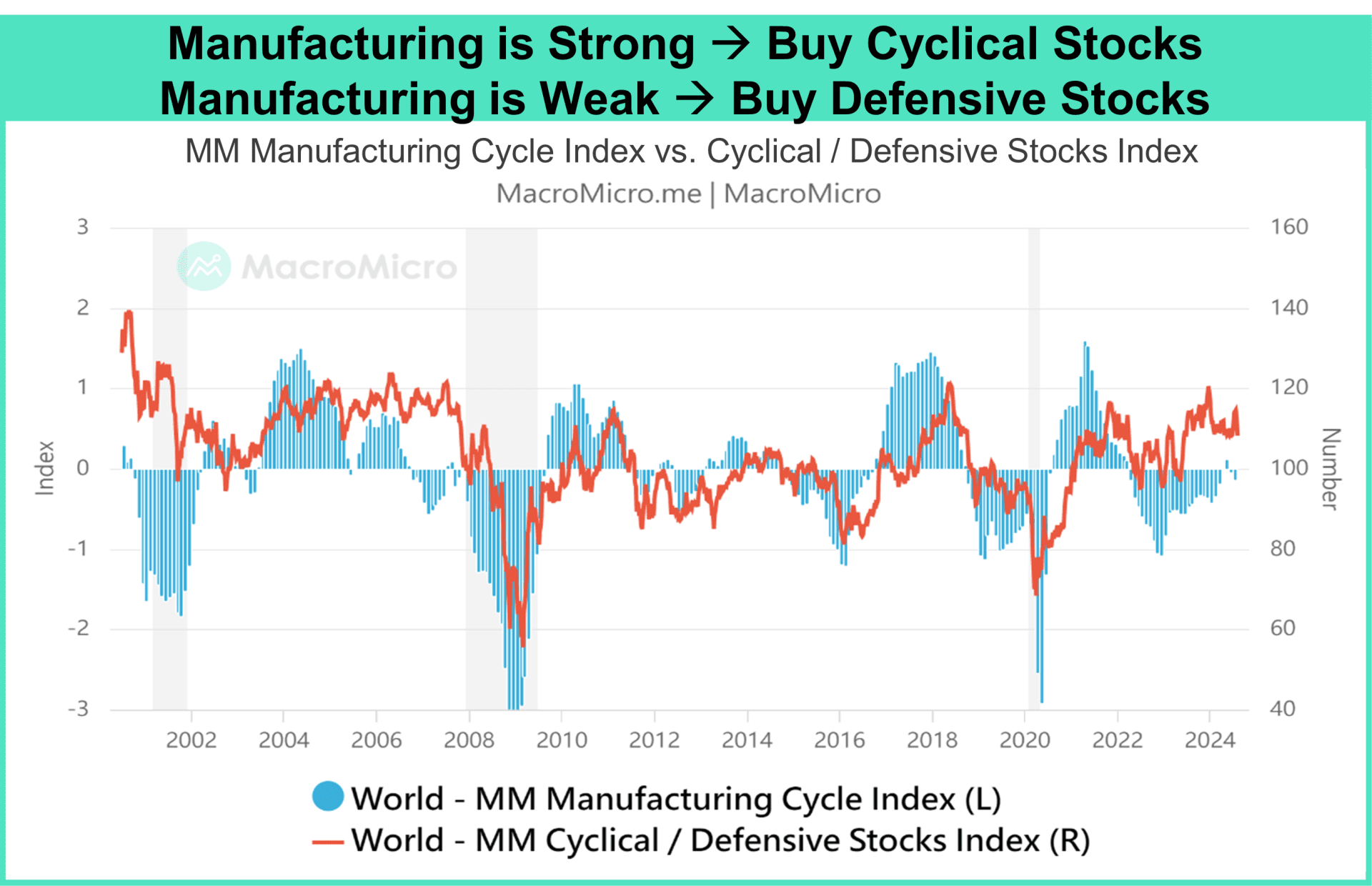
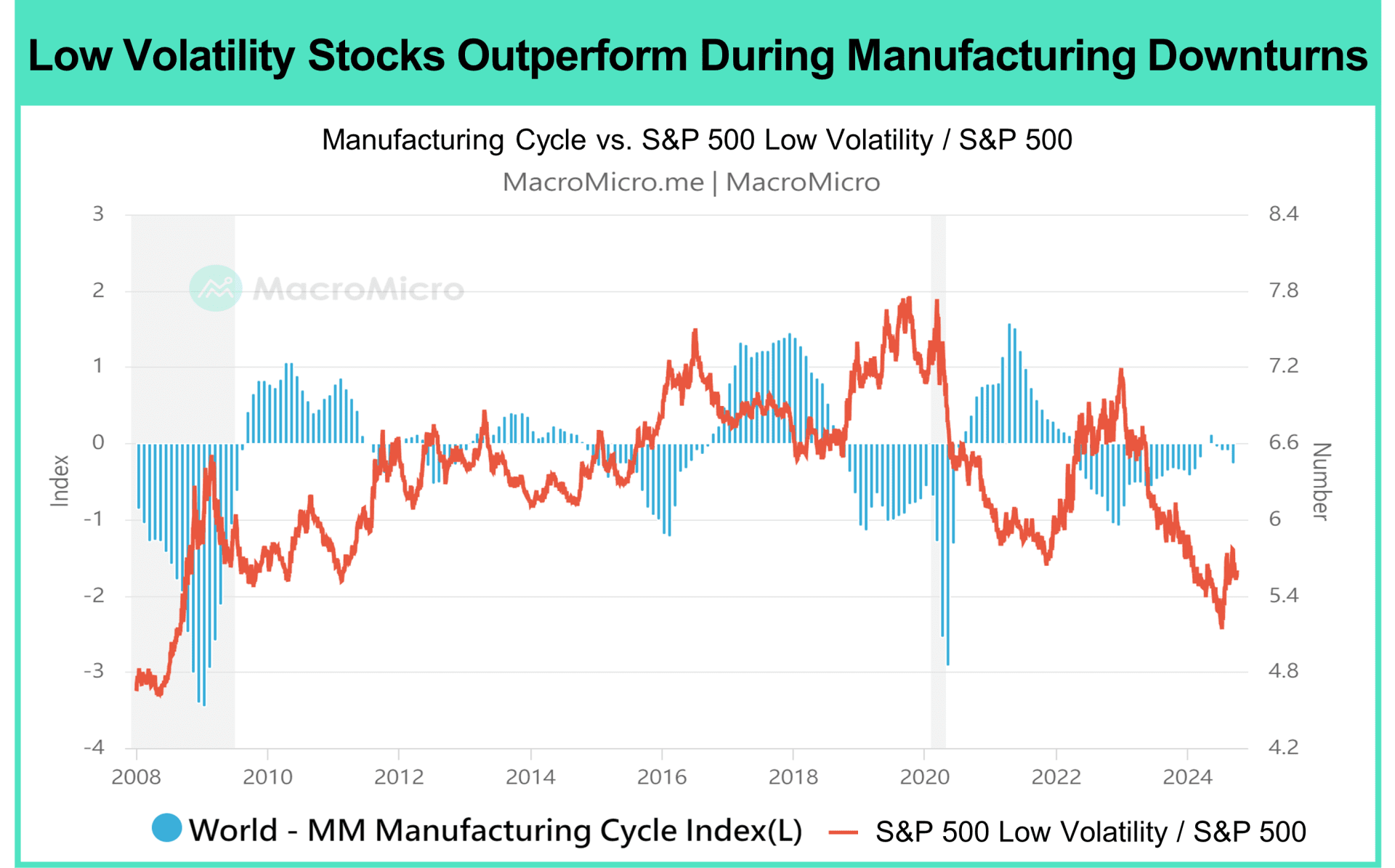
Stocks can generally be categorized into cyclical and defensive sectors. Cyclical sectors, such as real estate, consumer discretionary, industrials, financial services, and technology, closely track fluctuations in economic conditions. Defensive sectors, on the other hand, are less sensitive to economic fluctuations. Examples include utilities, consumer staples, and healthcare. There's also a third category, low-volatility stocks, which share similar characteristics with defensive stocks, exhibiting lower volatility and weaker correlations to the braoder market.
Defensive stocks and low-volatility stocks tend to hold up well during downturns in the manufacturing cycle, supported by relatively stable earnings as consumer demand in these sectors usually remains steady regardless of manufacturing activity. This resilience makes defensive and low-volatility stocks solid investment options during downturns. Conversely, when the economy is strong, consumers are more likely to spend on durable goods and luxury items and are also more willing to borrow, boosting cylical sectors like consumer discretionary and financials. As a result, cyclical sectors typically outperform during economic expansions.
III. Manufacturing Cycles Are Highly Correlated to Emerging Market Equity Performance
Manufacturing cycles also impact the performance of equities in both developed and emerging markets. In emerging markets like Southeast Asia, China, and Brazil, where the industrial sector plays a domoinant role and manufacturing makes up a large portion of the economy, stock markets are more sensitive to shifts in the manufacturing cycle. In contrast, developed economies, such as the U.S. and the UK, are more service-oriented, so equities in these markets are less influenced by manufacturing cycles.
Consequently, when the ...
Already a subscriber? Click here to log in.
Full Access to Our Services

Comprehensive data at your service
with key indicators for investment insights

Exclusive flash reports
on key events and data

Create your own charts and analysis
including performance backtesting

Hub of professionals to engage
in meaningful discussions and insights
