TSMC held its 2026 Q2 earnings conference on July 16. Not only did revenue once again exceed market expectations, but the company also significantly raised its full-year capital expenditure guidance to US$60-64 billion, up from the previous US$52-56 billion. Looking ahead, Chairman and CEO C.C. Wei further stated that 2026 revenue growth is now expected to exceed 40%, well above the company's previous guidance of more than 30%, once again highlighting the strength of AI demand and advanced process momentum.
Behind these impressive results, what key signals did TSMC deliver? Can AI demand remain this strong? Why was capital expenditure raised so aggressively? And what potential risks does the post-earnings ADR decline suggest investors should watch? This report provides a comprehensive analysis.
Key Takeaways:
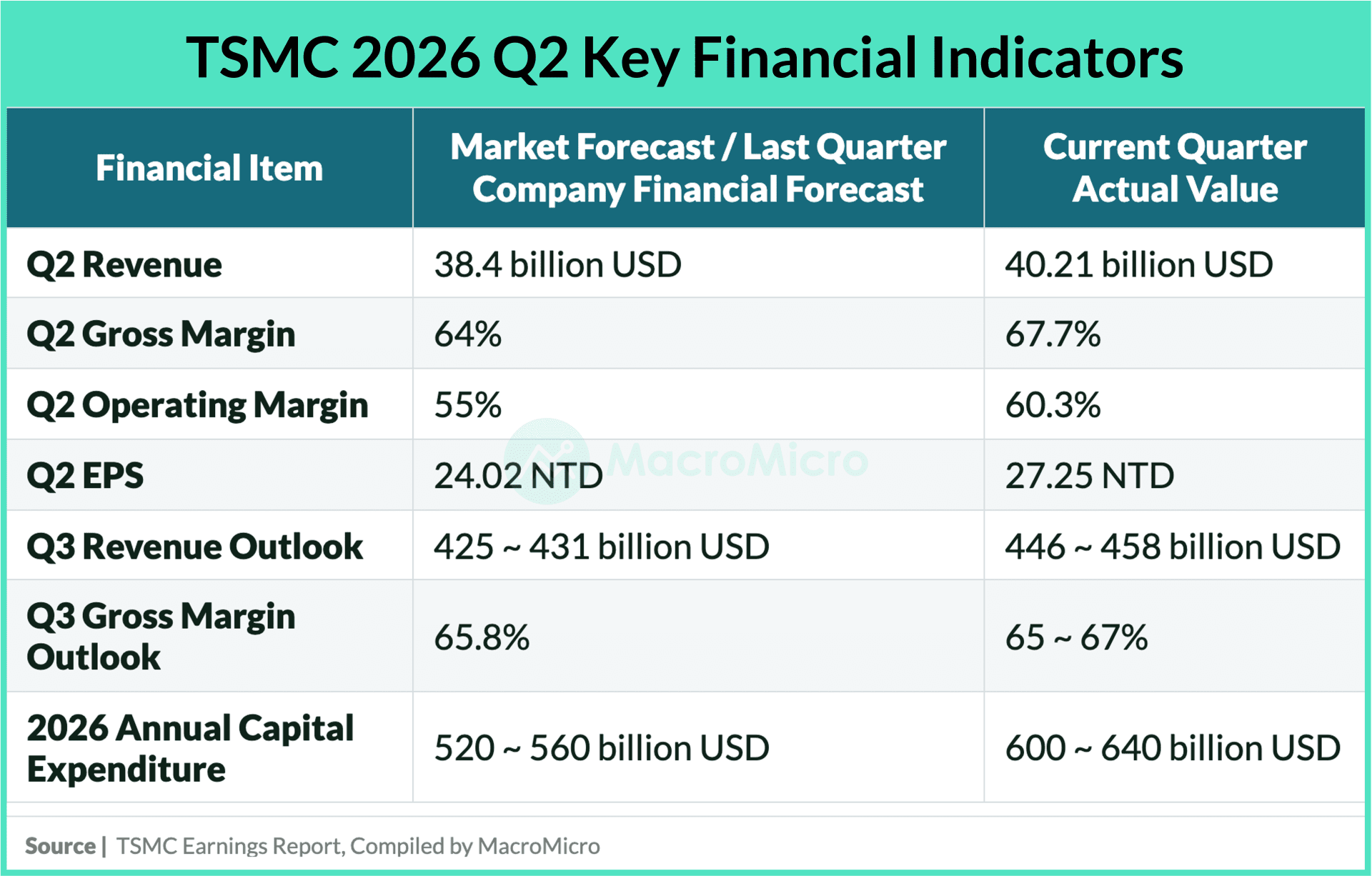
- TSMC reported NT$1.27 trillion in 2026 Q2 revenue, up 36% YoY (previously 35.1%), continuing to accelerate and exceeding market expectations. Growth was primarily driven by sustained HPC demand, while N2 also began contributing to revenue. Gross margin and operating margin increased to 67.7% (previously 66.2%) and 60.3% (previously 58.1%), both above company guidance, while diluted EPS reached NT$27.25 (previously NT$22.08).
- The key highlight from the earnings call was TSMC's decision to raise 2026 capital expenditure once again to US$60-64 billion, along with an additional US$100 billion investment in Arizona. The company also expects capital spending over the next three years to increase more significantly than over the previous three years, reflecting stronger-than-expected AI demand.
- Growing inventory uncertainty has increased the potential for market volatility. To prepare for N2 mass production in the second half of the year, TSMC accelerated inventory buildup, pushing days inventory outstanding to 76.5 days (previously 70.5 days). Investors should closely monitor shipment progress for Nvidia's Vera Rubin platform.
I. TSMC 2026 Q2 Operating Performance & Revenue Outlook
Below are our key takeaways from TSMC's latest earnings report:
TSMC reported NT$1.27 trillion in Q2 revenue, representing 12% QoQ growth (previously 8.6%) and 36% YoY growth (previously 35.1%), continuing its acceleration and outperforming market expectations. US dollar revenue reached US$40.2 billion, up 33.7% YoY (previously 40.6%), reaching the upper end of the company's previous quarterly guidance. The primary growth drivers remained robust HPC demand and the initial revenue contribution from N2.
Gross margin and operating margin rose to 67.7% (previously 66.2%) and 60.3% (previously 58.1%), respectively, both exceeding company guidance. Diluted EPS came in at NT$27.25 (previously NT$22.08), also surpassing the market consensus of NT$24.02. Although gross margin was partially diluted by overseas fabs, the company offset the impact through cost improvements and higher capacity utilization, allowing profitability to remain exceptionally strong.
- By technology platform, HPC remained the primary growth engine, accounting for 66% of revenue (previously 61%), reaching another record high for the second consecutive quarter with 20% QoQ growth (unchanged from the previous quarter). Smartphone revenue contribution declined to 22% (previously 26%), with revenue falling 4% QoQ (previously -11%). Automotive and consumer electronics revenue increased 15% and 5% QoQ, respectively, while maintaining revenue shares of 4% and 1%. IoT revenue grew 4% QoQ, accounting for 5% of total revenue.
- By process technology, advanced nodes (N7 and below) accounted for 77% of wafer revenue, with their contribution continuing to rise. N3 increased to 30% (previously 25%) as the company expanded N3 capacity in both Taiwan and overseas. N5 and N7 represented 33% (previously 36%) and 11% (previously 13%), respectively. Management noted that some N5 equipment...
TSMC's latest earnings reaffirm that AI demand remains stronger than expected, but rising inventories and unprecedented capital spending also introduce new questions for the semiconductor cycle. Read our in-depth analysis of production ramps, supply chain bottlenecks, and the indicators that will determine whether this upcycle can continue. Unlock full access to this report, proprietary macro data insights, and ongoing market coverage with MM Max. Subscribe Now»
Already a subscriber? Click here to log in.
Full Access to Our Services

Comprehensive data at your service
with key indicators for investment insights

Exclusive flash reports
on key events and data

Create your own charts and analysis
including performance backtesting

Hub of professionals to engage
in meaningful discussions and insights
 Get answers from MM AI.
-
What key factors drove TSMC's NT$1.27 trillion revenue increase in Q2 2026?
💡TSMC's Q2 2026 revenue of NT$1.27 trillion, a 36% YoY increase, was primarily driven by sustained strong High-Performance Computing (HPC) demand, which accounted for 66% of revenue, and the initial revenue contribution from N2 process technology. This performance exceeded market expectations, showcasing accelerated growth and robust demand in key technology areas.
-
How did TSMC's gross margin and operating margin perform in Q2 2026 compared to guidance?
💡TSMC's gross margin and operating margin in Q2 2026 both exceeded company guidance, reaching 67.7% and 60.3% respectively. These figures were higher than the previously guided 66.2% for gross margin and 58.1% for operating margin. The company managed to offset the partial dilution from overseas fabs through cost improvements and higher capacity utilization, maintaining exceptional profitability.
-
Which technology platform was the primary growth driver for TSMC's Q2 2026 revenue?
💡The primary growth driver for TSMC's Q2 2026 revenue was the High-Performance Computing (HPC) technology platform, which accounted for 66% of total revenue. HPC achieved a 20% quarter-over-quarter growth, marking a second consecutive record high and significantly contributing to the company's accelerated revenue increase and outperformance of market expectations.
-
How has TSMC revised its full-year 2026 US dollar revenue growth guidance?
💡TSMC has revised its full-year 2026 US dollar revenue growth guidance from "more than 30%" to "slightly above 40%". This upward revision reflects increased confidence in its earnings outlook, driven by accelerating AI demand and sustained momentum in advanced process technologies, leading to higher capital expenditure allocations.
-
What is the primary reason for TSMC raising its 2026 capital expenditure guidance to US$60-64 billion?
💡TSMC raised its 2026 capital expenditure guidance to US$60-64 billion primarily due to strong structural demand from 5G, AI, and High-Performance Computing (HPC) customers. This significant increase also reflects the company's confidence that capital spending over the next three years will grow more substantially than in the previous three, addressing stronger-than-expected AI demand and substantial supply-demand gaps.
-
How much additional investment is TSMC allocating to its Arizona operations?
💡TSMC is allocating an additional US$100 billion investment to its Arizona operations, bringing the total investment there to US$265 billion. This expanded investment aims to build multiple wafer fabs and advanced packaging facilities that will support N2 and even more advanced technologies, demonstrating the company's commitment to global manufacturing expansion.
-
How does TSMC's Chairman C.C. Wei describe the current demand for AI?
💡TSMC's Chairman C.C. Wei describes the current demand for AI as "Stronger, Stronger, and Stronger," emphasizing that AI demand continues to accelerate beyond previous expectations. This robust confidence in AI's growth trajectory led TSMC to raise its 2026 revenue growth outlook to slightly above 40%, directly linking it to significant growth opportunities.
-
Why did TSMC's inventory days increase to 76.5 days in Q2 2026?
💡TSMC's inventory days increased to 76.5 days in Q2 2026, up from 70.5 days, primarily due to the rapid production ramp for N2 technology in the second half of the year. Additionally, this accumulation reflects preemptive inventory preparation for shipments of next-generation AI chips, such as Nvidia's Vera Rubin platform, Google TPU v7/v8, and Amazon Trainium 3/Trainium 4.
-
What are the inventory trends for AI chip companies like Nvidia, and what role do Vera Rubin shipments play?
💡Inventory trends for AI chip companies remain constructive; Nvidia's inventory days declined to 103 days following the start of GB300 volume production. Shipments of the Vera Rubin platform in the second half of the year are expected to further reduce inventories across chip suppliers, highlighting continued strong demand and active deployment within the AI chip supply chain.
-
Which semiconductor market segments are experiencing strong demand, and which face pricing pressure?
💡The semiconductor market exhibits strong demand in AI and industrial sectors, with AI demand being "Stronger, Stronger, and Stronger," and industrial benefiting from AI spillover and inventory replenishment. Conversely, consumer electronics face clear pricing pressure and rising inventories due to surging memory prices and declining shipments of smartphones and PCs, while automotive demand is stabilizing but still awaits a meaningful recovery.
