What You Should Know
As 2025 officially closes, the US economy not only weathered the tariff storms but also delivered strong equity market performance amid the ongoing AI boom. The S&P 500 rose 16.4% for the year, marking the third consecutive year of double-digit gains, while the Philadelphia Semiconductor Index surged over 40%.
On the other hand, with the Federal Reserve entering a rate-cut cycle, US Treasuries rallied, while the US dollar showed relative weakness, falling nearly 10% over the year. This suggests that tariff policies have continued to dampen confidence in the US to some degree, adding uncertainty to global capital allocation moving forward.
Looking ahead to 2026: Can the US economy maintain resilience and allow equities to ride the AI trend higher? With global central banks halting rate cuts and the Fed remaining the primary driver of monetary easing, how will the dollar and US Treasuries perform? This article provides a comprehensive outlook on the US economy and asset markets.
Key Takeaways:
- Fundamentals: Two major factors are expected to support economic momentum, leading us to conservatively forecast US real GDP growth around 2% in 2026.
- Capital Markets: Monetary easing is expected to continue, with attention focused on two key Fed developments.
- Asset Overview: A full look at US equities, the dollar, and Treasuries.
I. Fundamentals: Consumption Resilience & Investment Support Point to ~2% Growth
First, the primary concern currently weighing on markets is the sluggish pace of job growth. Looking at the data, official nonfarm payrolls have recorded three months of declines since 2025, while ADP’s private payroll data over the past three months has hovered near zero, indicating stagnation in employment. Beyond the pressure from tariff volatility on small and medium enterprises in 2025, we believe accelerated AI adoption and automation have also suppressed labor demand.
Interestingly, despite weak employment growth, the US unemployment rate has only gradually risen to 4.6%. At first glance, the data appear contradictory, but in reality, declining labor demand has coincided with a contraction in labor supply—a structural shift we have highlighted throughout our monthly and flash reports. On one side, stricter immigration policies under the Trump administration have sharply slowed immigrant labor participation; on the other, a higher proportion of older workers with lower labor participation has further depressed the overall rate.
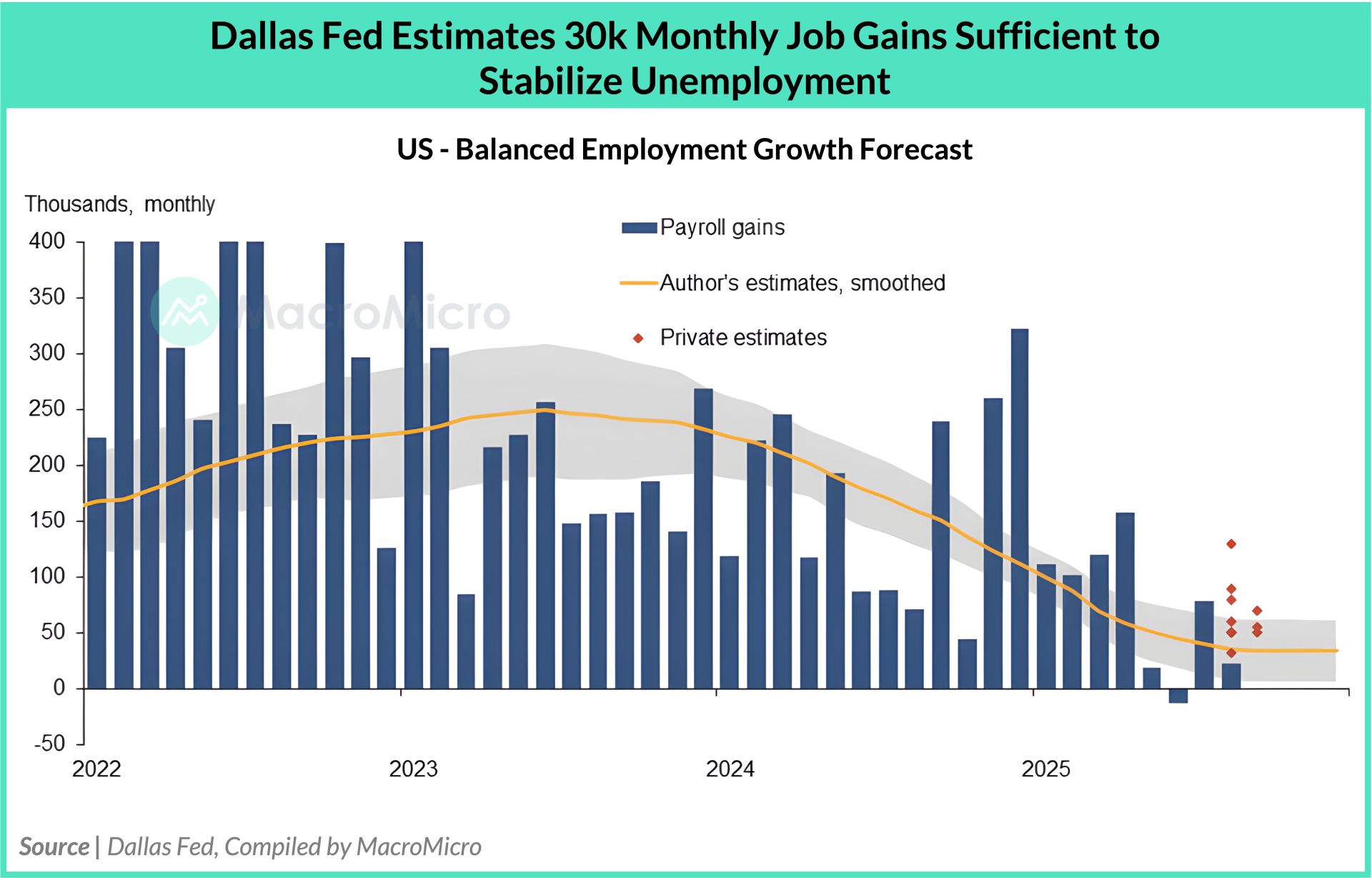
According to Dallas Fed estimates, with labor supply clearly slowing, the monthly job growth required to maintain a stable unemployment rate has dropped from roughly 250,000 at the 2023 peak to about 30,000 today. In other words, current low employment growth itself does not...
For economic output, low employment is also not problematic, as productivity has compensated for the slowdown in labor growth. St. Louis Fed data show that pre-pandemic (2015–2019) annualized productivity growth averaged...
This article is exclusive to subscribers. As we celebrate 10 years of MacroMicro, we're giving back. If you're not a subscriber yet, take advantage of this special anniversary gift — join MM Max Annual and gain full access to all our charts, reports, including the 2026 market outlook, and more. Subscribe Now»

Already a subscriber? Click here to log in.
Full Access to Our Services

Comprehensive data at your service
with key indicators for investment insights

Exclusive flash reports
on key events and data

Create your own charts and analysis
including performance backtesting

Hub of professionals to engage
in meaningful discussions and insights

