Executive Summary:
As Taylor Swift ends her Eras tour, Dr Ed starts his Roaring 2020s Tour to meet with our accounts. Last week in Texas, they shared their concerns about the “known unknowns,” as the new administration represents a significant policy regime change. On balance, Trump 2.0 should perpetuate our Roaring 2020s scenario. Fortunately, the US economy and financial markets are resilient and tend to outperform globally whomever occupies the White House, thanks to Americans’ indomitable entrepreneurial spirit. … Also: The labor market remains strong, notwithstanding the weakness of some less creditable indicators. … And: Consumers are still doing what they do best.
US Strategy: Dr Ed on Tour.
Taylor Swift’s “The Eras Tour” ended yesterday in Vancouver. The extraordinary singer started this sixth concert tour in Glendale, Arizona on March 17, 2023. The tour consisted of 149 shows spanning five continents. Two of my daughters enjoyed her show in Toronto last month.
My “Roaring 2020s Tour” started in Dallas, Texas last Tuesday morning. That afternoon, after a great Tex-Mex lunch with a few accounts, I traveled to Fort Worth to meet with more accounts. A car service took me to Austin that night for my gig there on Wednesday. It was on to San Antonio for a small group dinner that evening at Bistr09. Then I was off to Houston to stay at the Houstonian Hotel for a group breakfast on Thursday. Next I flew to San Diego to speak at the NIRI Senior Roundtable Annual Meeting on Friday morning.
I enjoyed my discussions with our accounts. They all are pleased with the bull market in stocks. They are also rooting for our Roaring 2020s scenario. But they are nervous that stocks aren’t cheap now that valuation multiples are near previous bull market peaks. Their main concern for the fundamentals is that President Donald Trump might start a trade war. Everyone is also wondering whether the new administration will succeed in reducing the size, regulatory powers, headcount, and budget deficits of the federal government. In addition, a few people noted that mass deportation of illegal migrants might hamper some industries that rely on these workers. Everyone is uneasy about making so many policy changes at the same time. That could have unintended negative consequences for the economy and the financial markets.
Debbie, Eric, Joe, Melissa, and I share these concerns and are focusing our team’s research efforts on these mostly “known unknowns.” Our current assessment is that on balance Trump 2.0 will support our Roaring 2020s scenario for the remainder of the decade. To be politically fair, our scenario has unfolded very well under the current administration’s mix of policies favoring business regulations, open borders, lots of deficit-financed spending, and onshoring incentives.
Our central investment thesis is that the economy and stock market are resilient; they have a long history of performing well notwithstanding Washington’s meddling and regardless of which party has the White House.
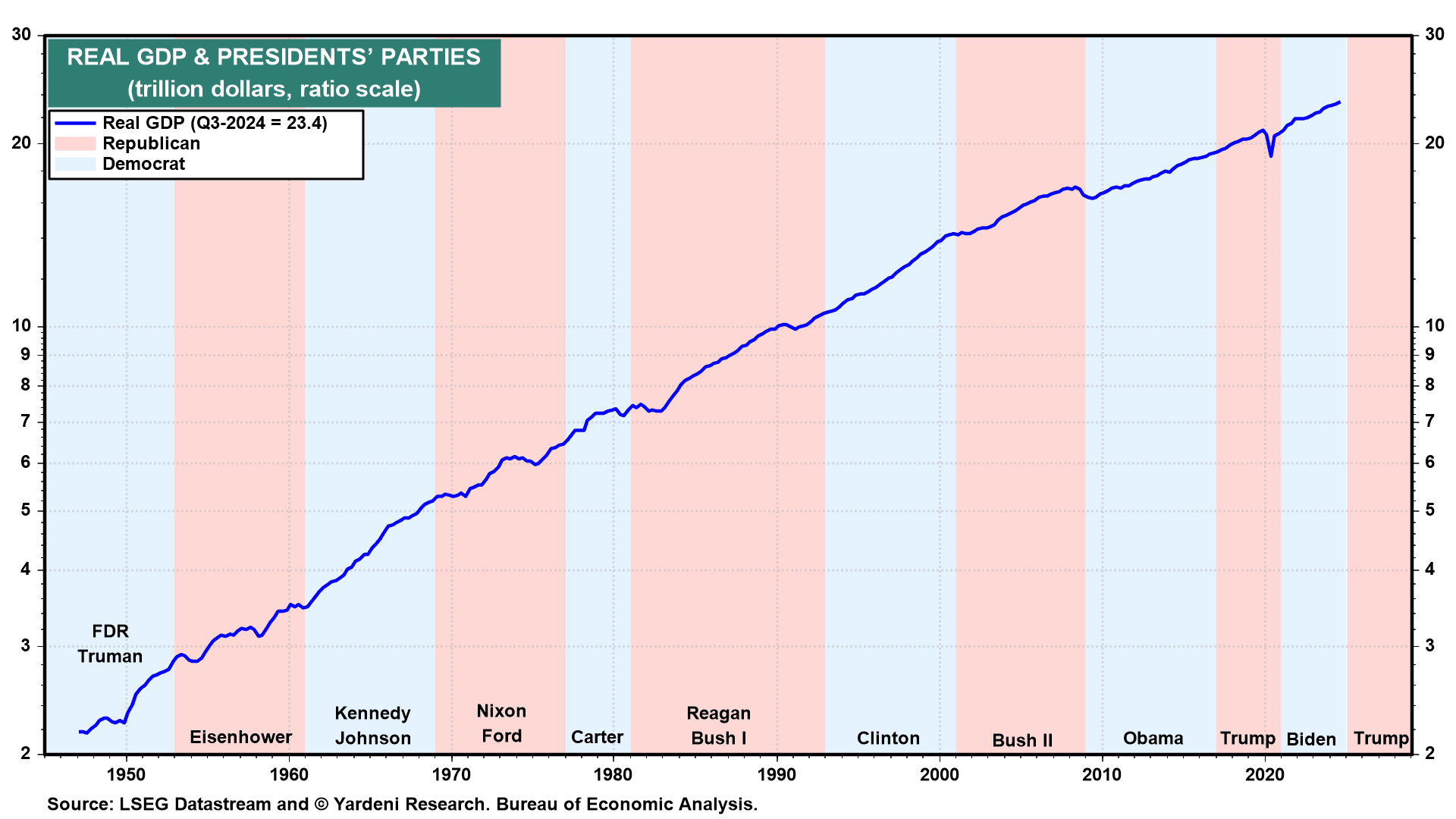
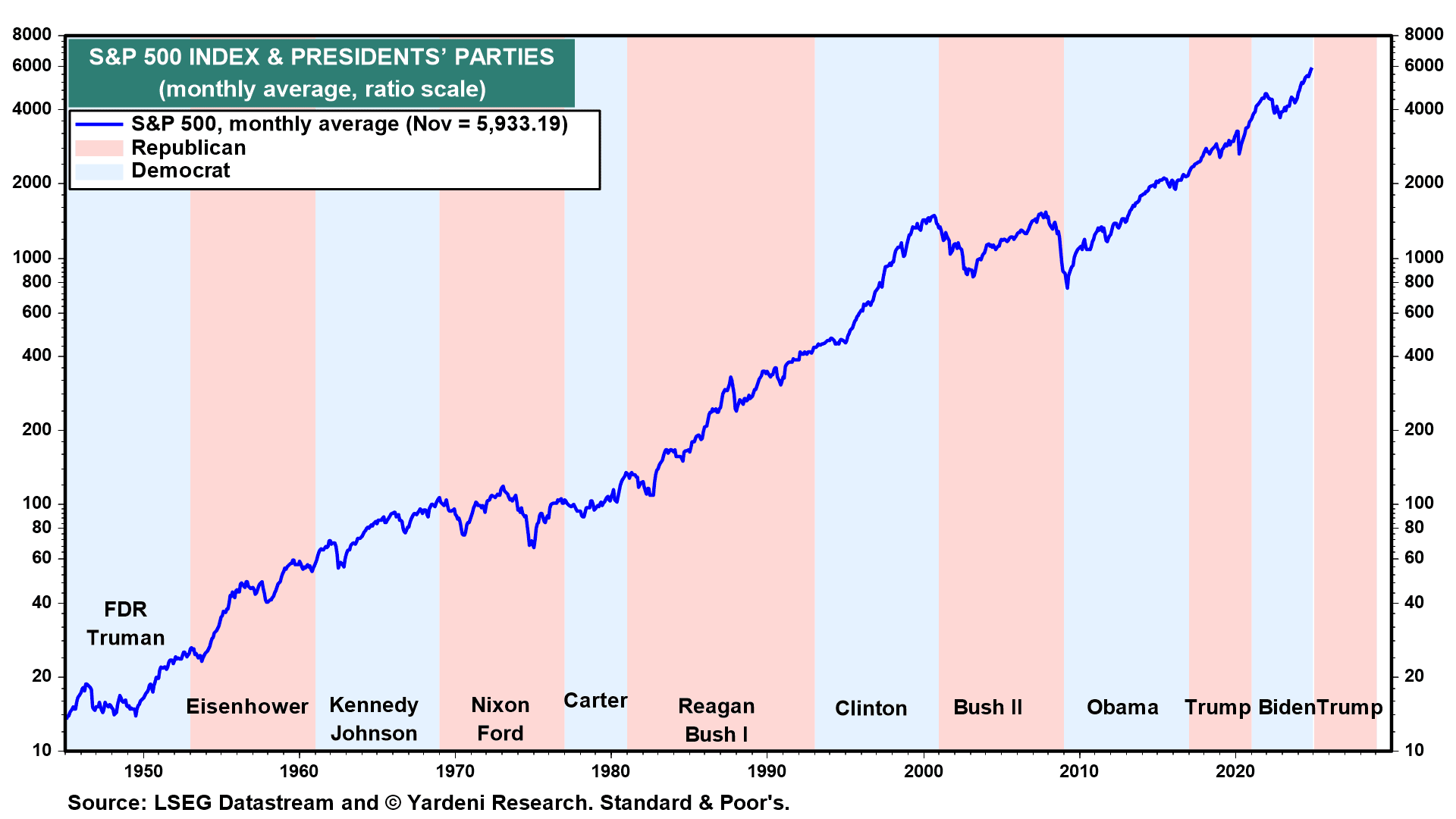
We the People of the United States make this country work, not the elected and unelected federal government officials in Washington. The US stands out among nations because it’s among the few that are prospering, and it’s doing so because entrepreneurial capitalism is flourishing. That’s what makes it exceptional.
European economies are stagnating under the regulatory regime of the European Union. Immigration has heightened a clash of civilizations within the region, exacerbating political partisanship. The region also has an increasingly geriatric profile. And Europe’s transition to clean energy has been costly and ineffective.
China began its shift toward a more market-oriented economy in 1978 under the leadership of Deng Xiaoping. The resultant economic boom started to fizzle in recent years as the Chinese Communist Party clamped down on capitalism, fearing that too many entrepreneurs were becoming too wealthy and powerful. A property depression and a rapidly aging population are also weighing on the country’s economy.America’s entrepreneurial spirit and comparative advantage is widely recognized in the realm of technological innovation, financed by a highly developed venture capital industry. That’s very evident in the US and global stock markets. The S&P 500 Information Technology and Communication Services sectors combined account for 40.1% of the S&P 500 market capitalization.
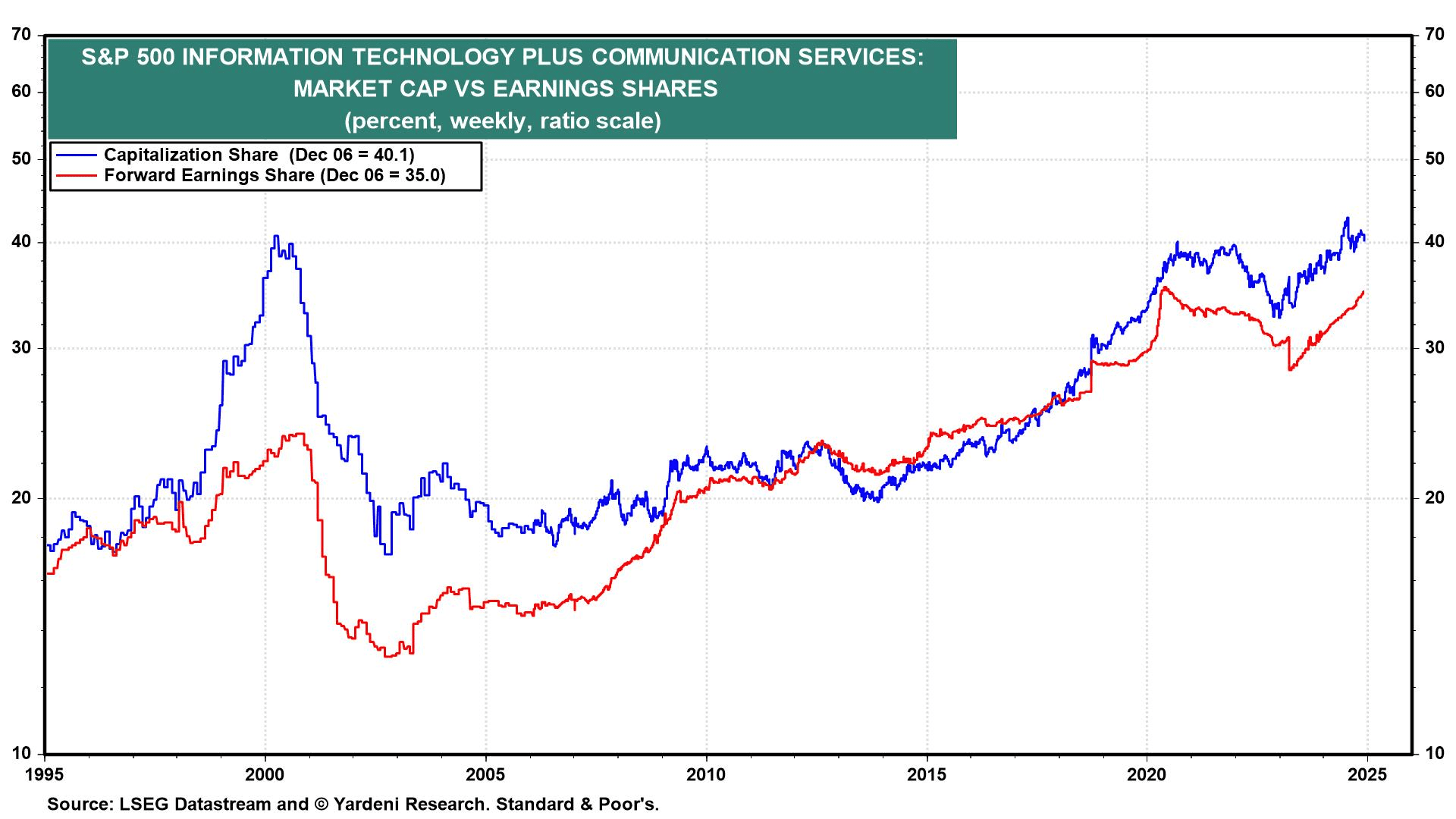
That’s the same market-cap weighting those two sectors represented just before the Tech Wreck of 2000. However, this time, such a large proportion of the broad index’s market cap is more justified because the sectors together account for 35.0% of the earnings share of the S&P 500 compared to 24.0% back then.
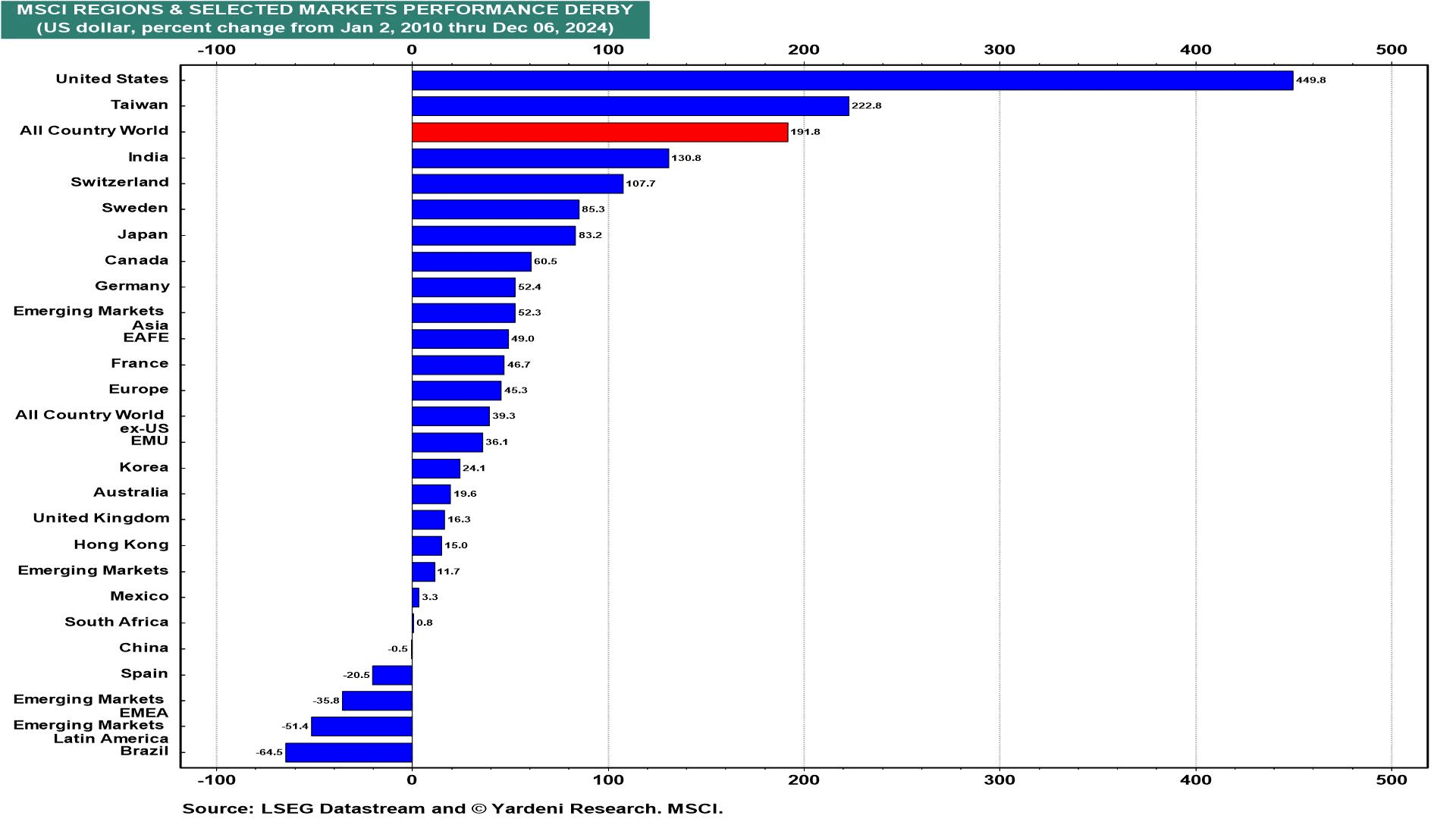
This is one of the main reasons why the US MSCI stock price index has dramatically outperformed the All Country World ex-US stock price index since 2010.
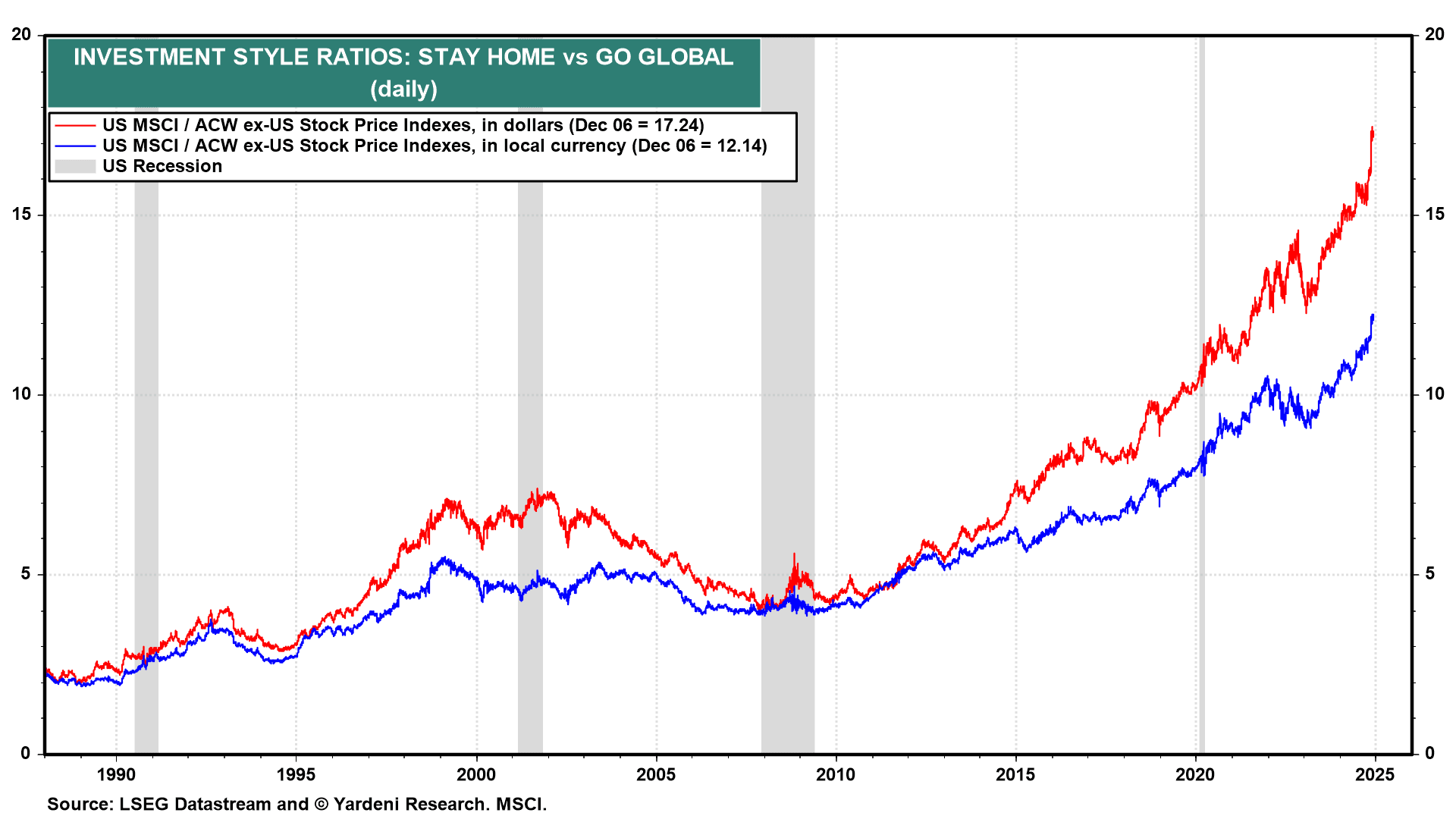
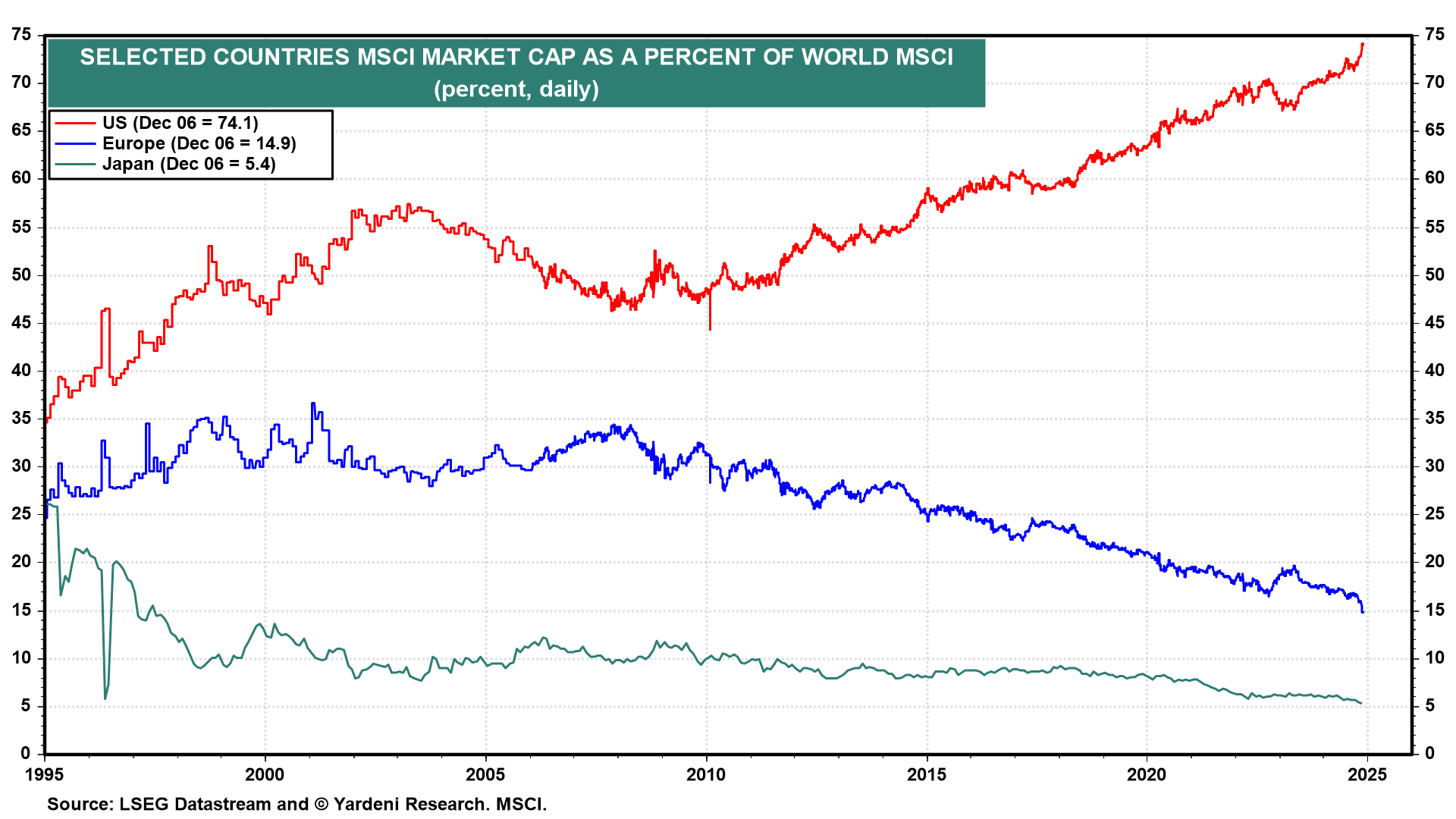
Furthermore, the US MSCI now accounts for a staggering 74% of the market capitalization of the All Country World MSCI.
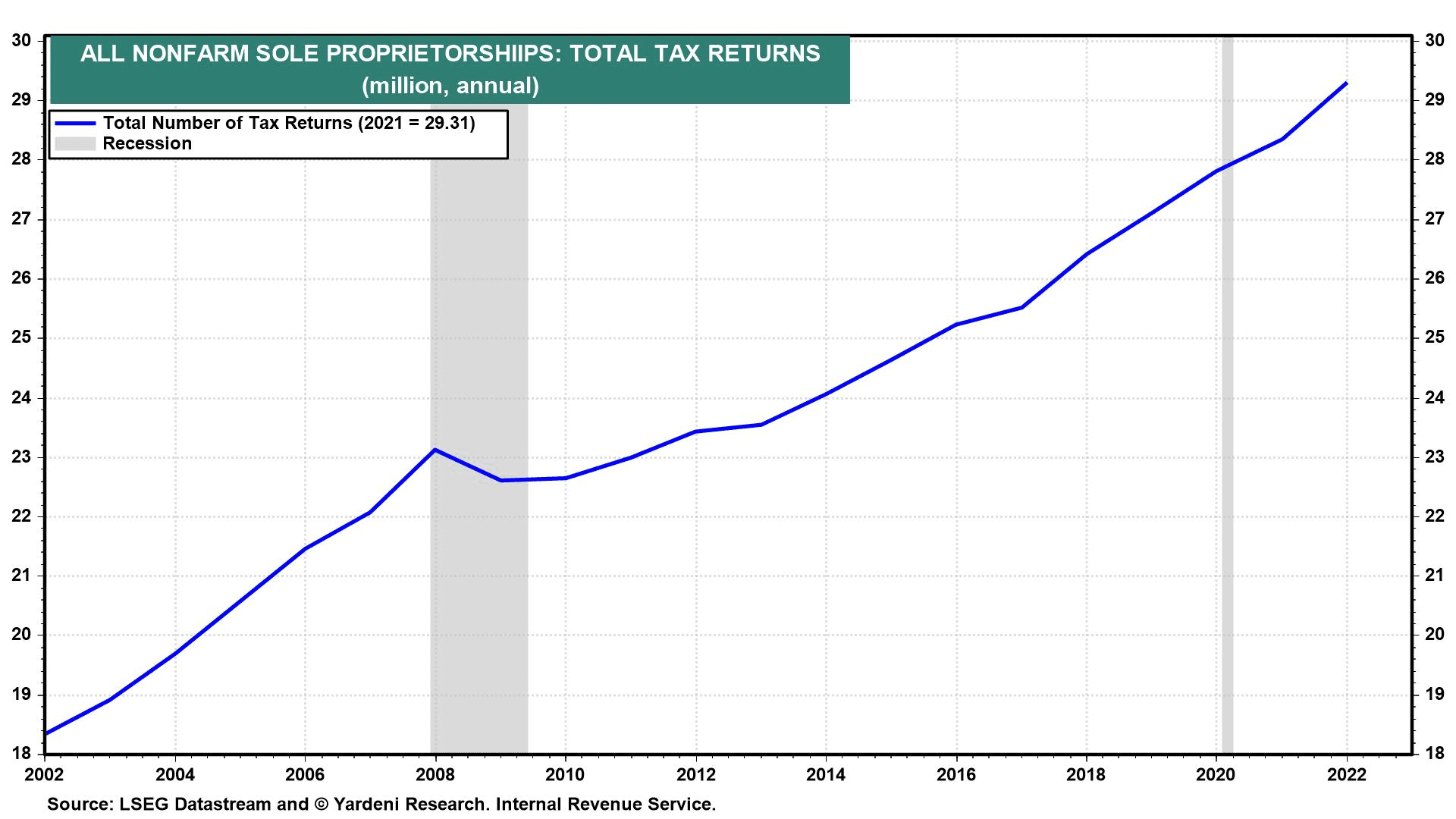
Less well known about America’s entrepreneurial juices is that there are over 30 million nonfarm sole proprietorships in America.
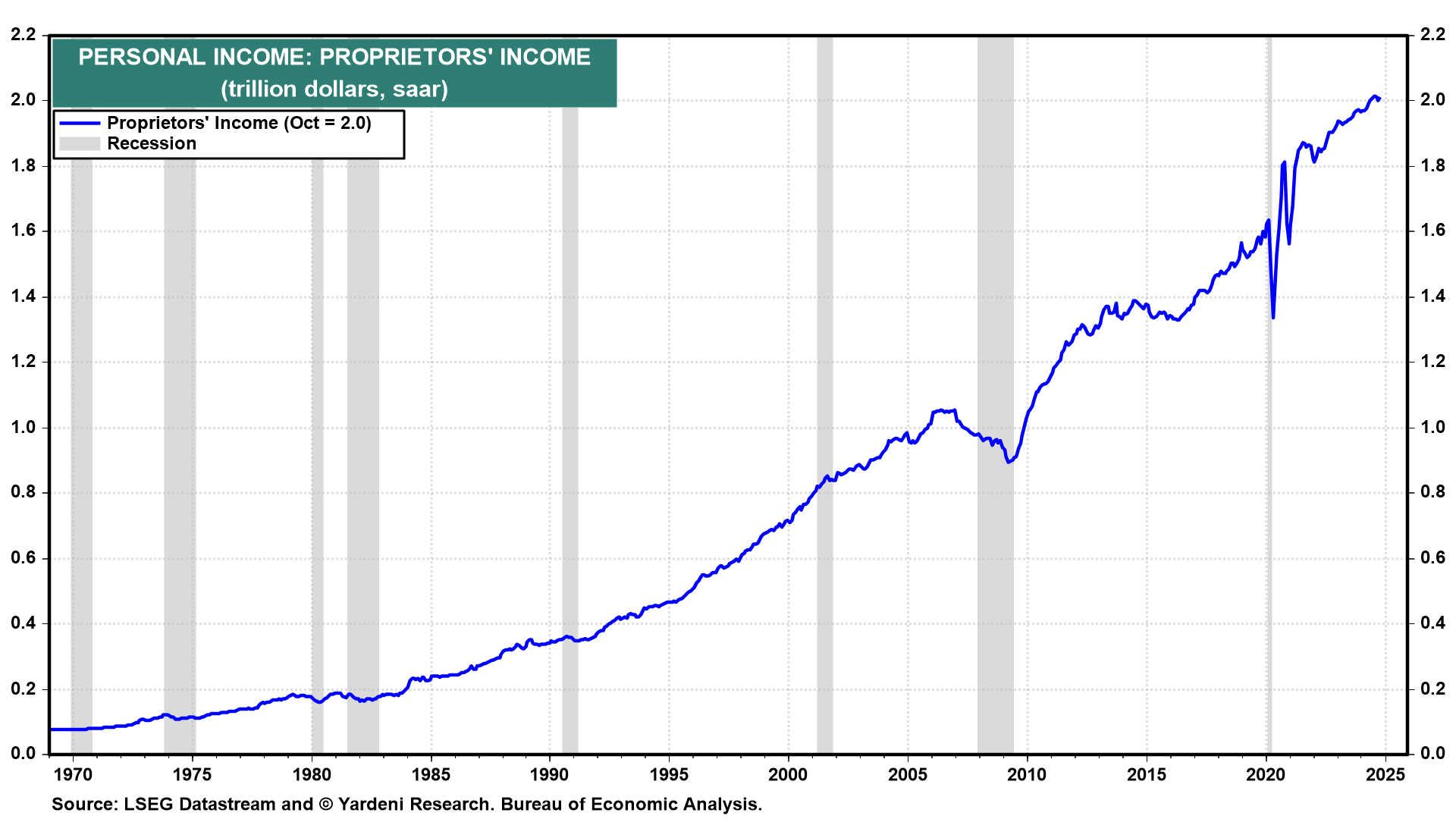
Proprietors’ income in personal income totaled $2.0 trillion (saar) during October.
Furthermore, the pace of new business applications has been hovering just above 5.0 million on a 12-month-sum basis since the pandemic.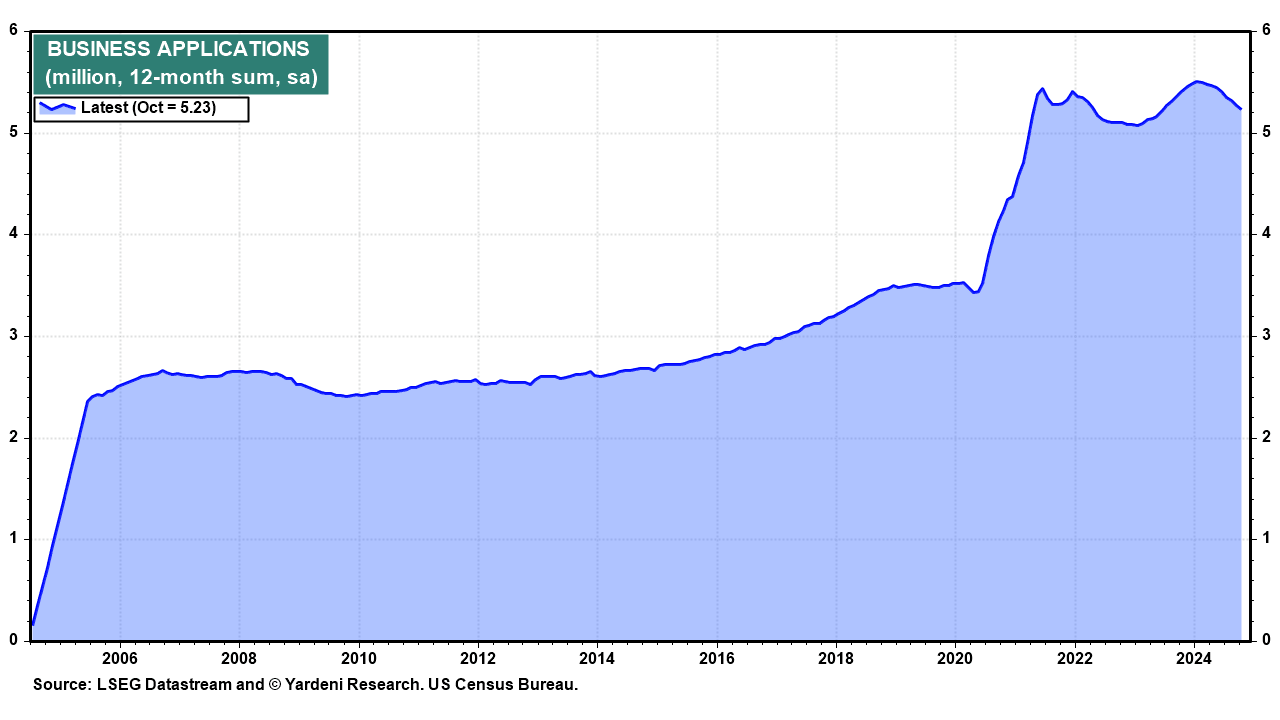
That’s up from around 3.3 million before the pandemic.
US Economy I: Labor Market Looks Good to Us.
We’ve said it before, half in jest: Any data series that does not support our story must be bad data or it will be revised to show we were right after all.
Over the past two months, the household measure of employment is down 723,0000, while the payroll measure of jobs is up 263,000. Ignore the former. It makes no sense. The rapid pace of business applications certainly must create plenty of jobs. That’s why we believe the payroll jobs survey’s data are more representative of the state of the labor market than that of the household employment survey. Consider the following:
(1) The former is up 518,000 over the past three months and 2.27 million over the past 12 months.
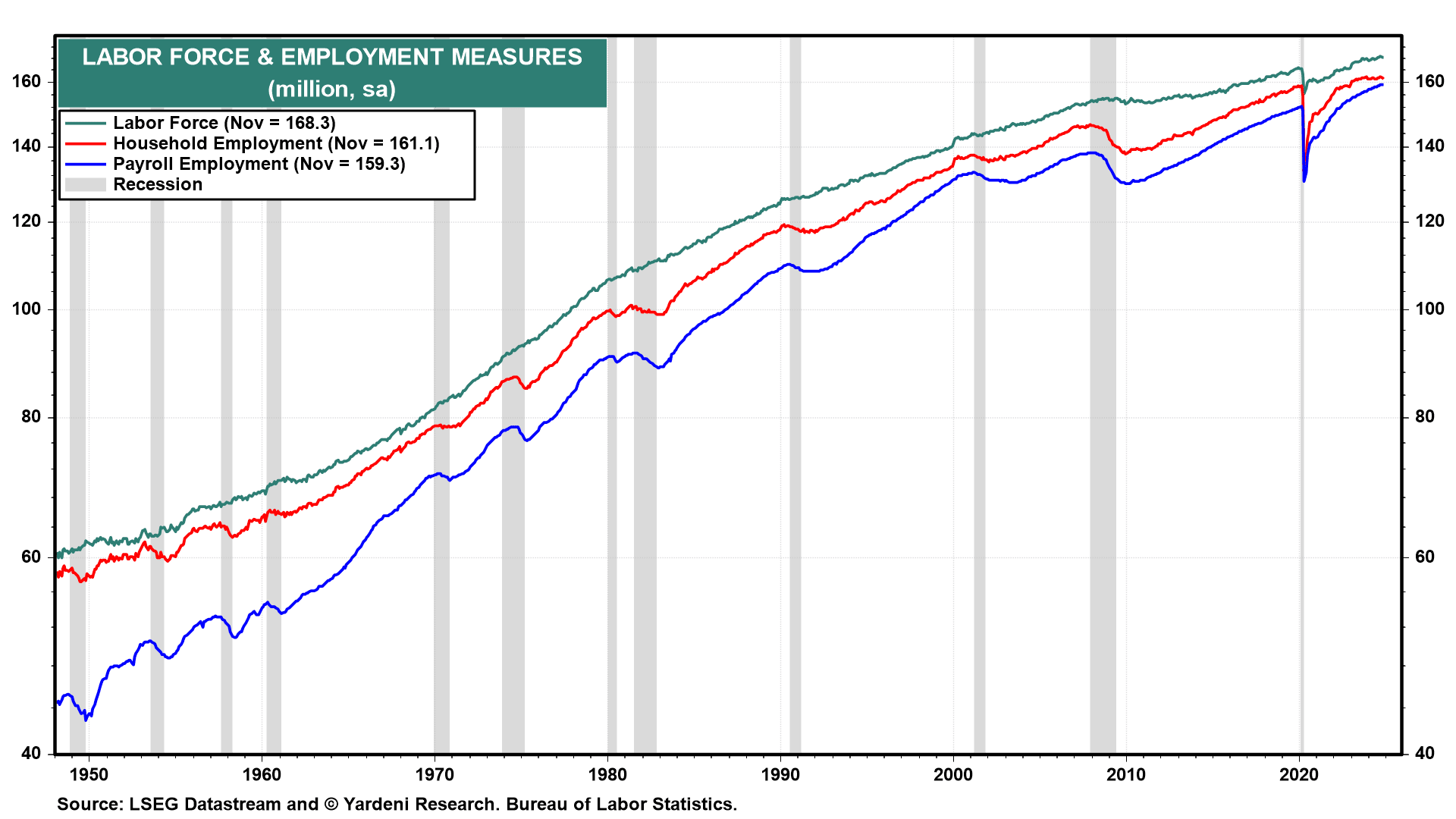
The latter is down 293,000 over the past three months and down 725,000 over the past 12 months. The number of jobs has been growing at a solid rate, while the number of people employed has been basically unchanged over the past 12 months. The ratio of the two has been increasing for a long time, and especially faster since the pandemic.
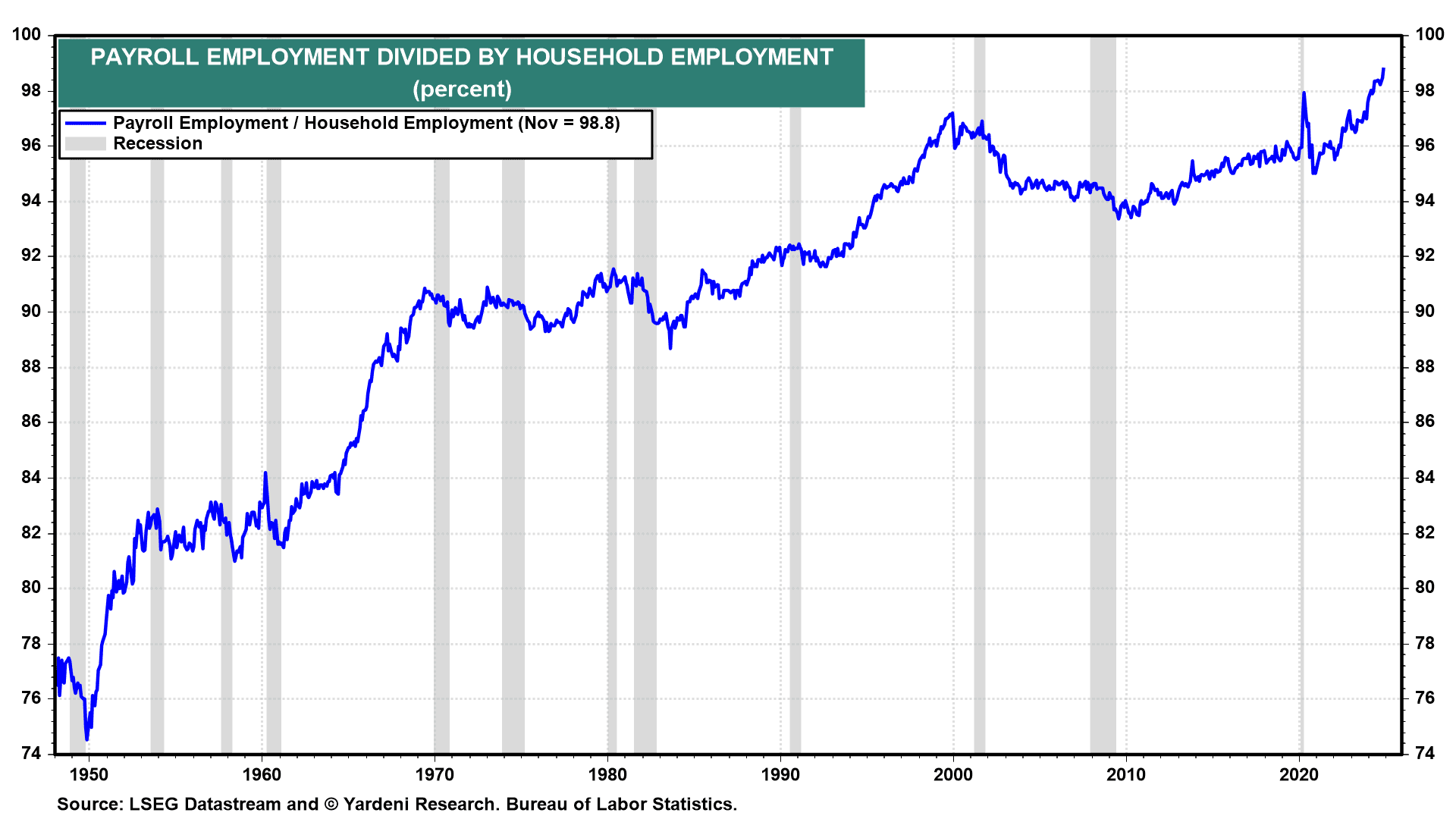
(2) The household survey includes among the employed agricultural workers, self-employed workers whose businesses are unincorporated, unpaid family workers, and private household workers. These groups are excluded from the establishment survey. It’s likely that more of the self-employed are incorporating as sole proprietorships; they then would be included in payroll but not household employment. The response rates to the employment surveys have been falling. More respondents to the household survey may not be responding to phone calls because they are flooded with robocalls.
(3) With the exception of the household employment survey data, November’s employment report looked fine to us. Our Earned Income Proxy (EIP) for private-industry wages and salaries in personal income rose 0.8% as aggregate hours worked and average hourly earnings each rose 0.4%.
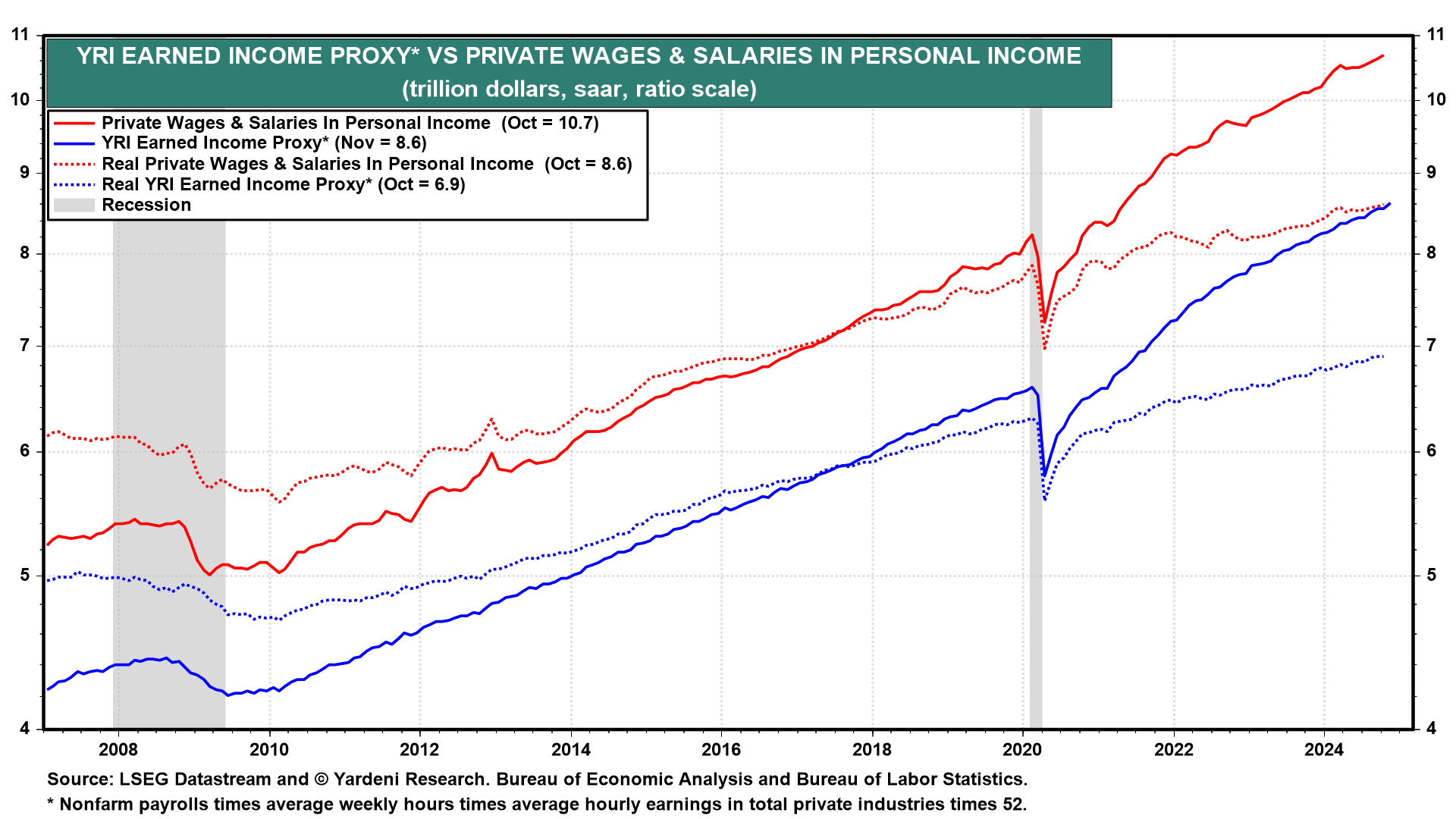
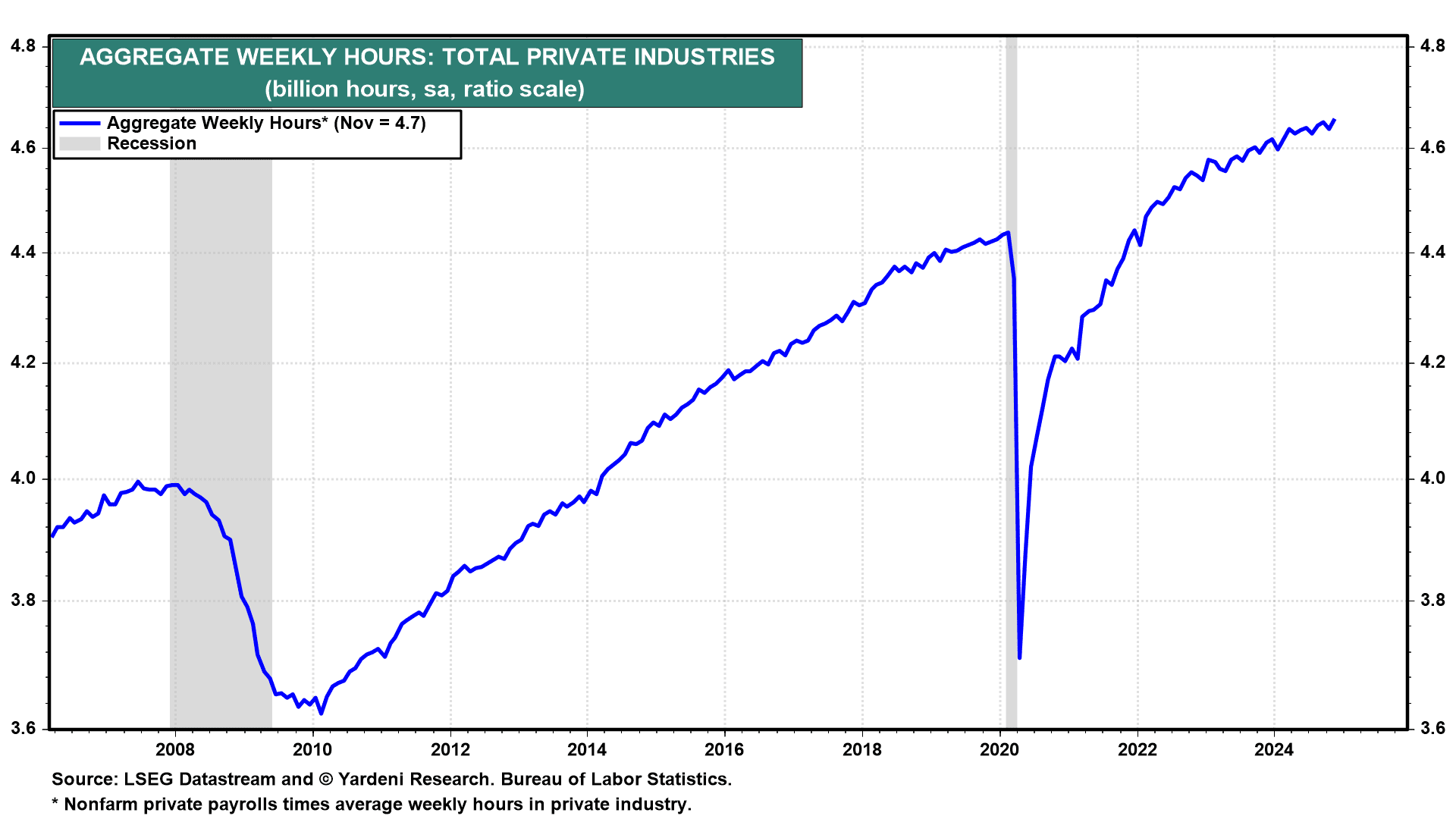
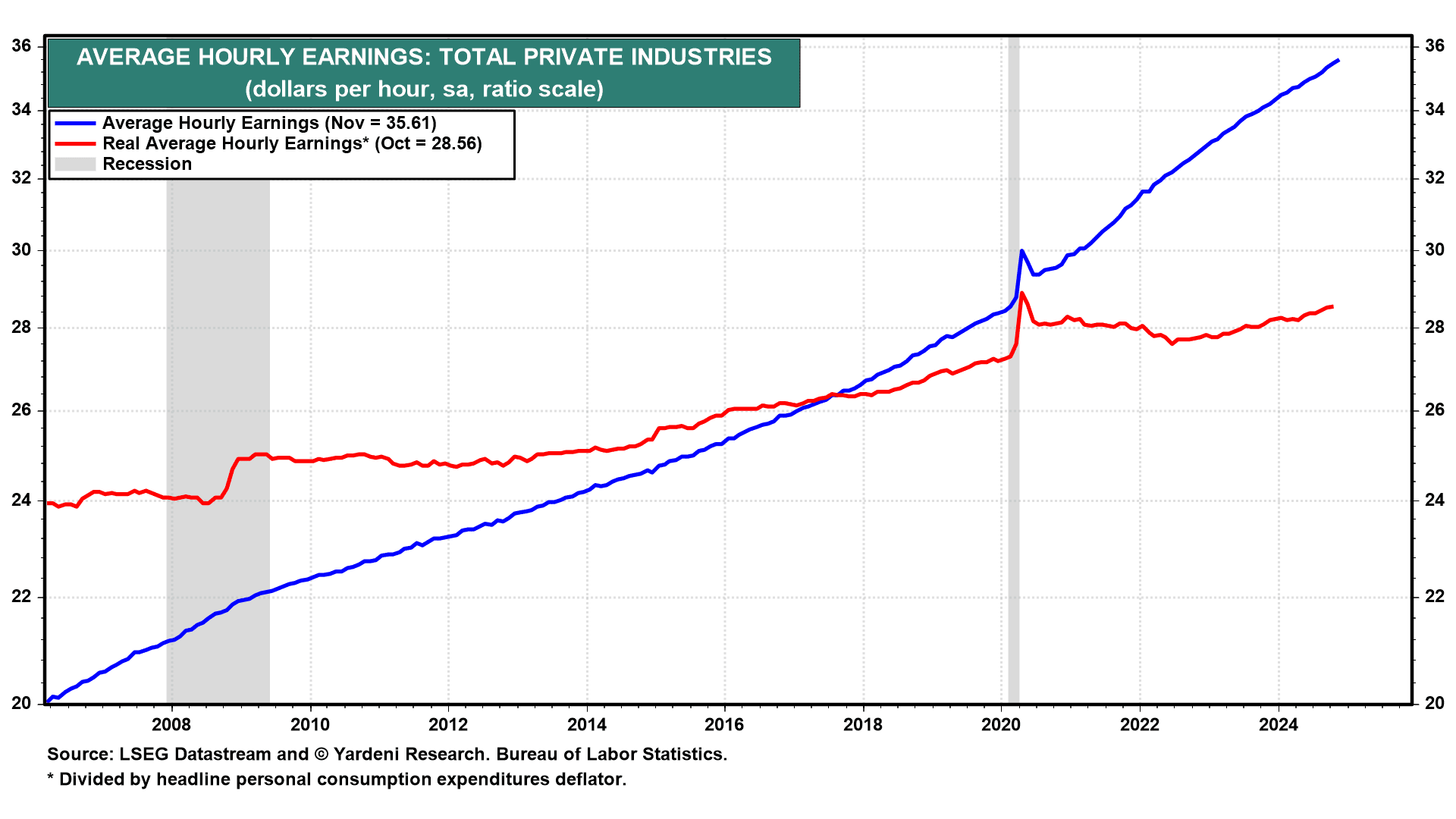
Those increases put all three at record highs! The strength in our EIP augurs well for the holiday shopping season.
(4) Employment gains were relatively widespread by industry last month.
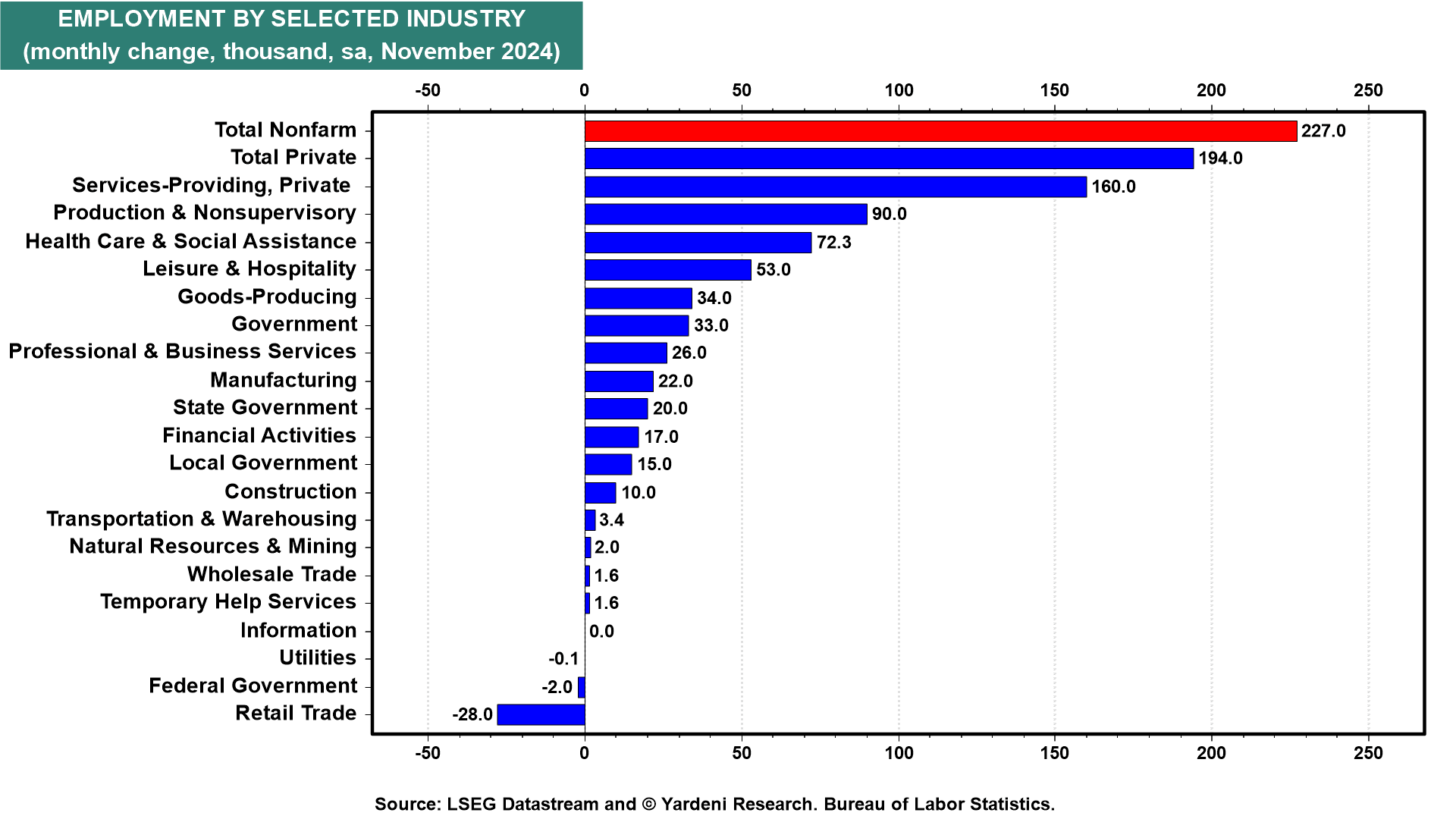
The only major decline was in retail trade with a decrease of 28,000. That might have been attributable to the late Thanksgiving this year. It fell on November 28.
Payroll employment rose to a record high in construction, educational services, financial activities, health care & social services, leisure & hospitality, professional scientific & technical services, state & local government, and wholesale trade.
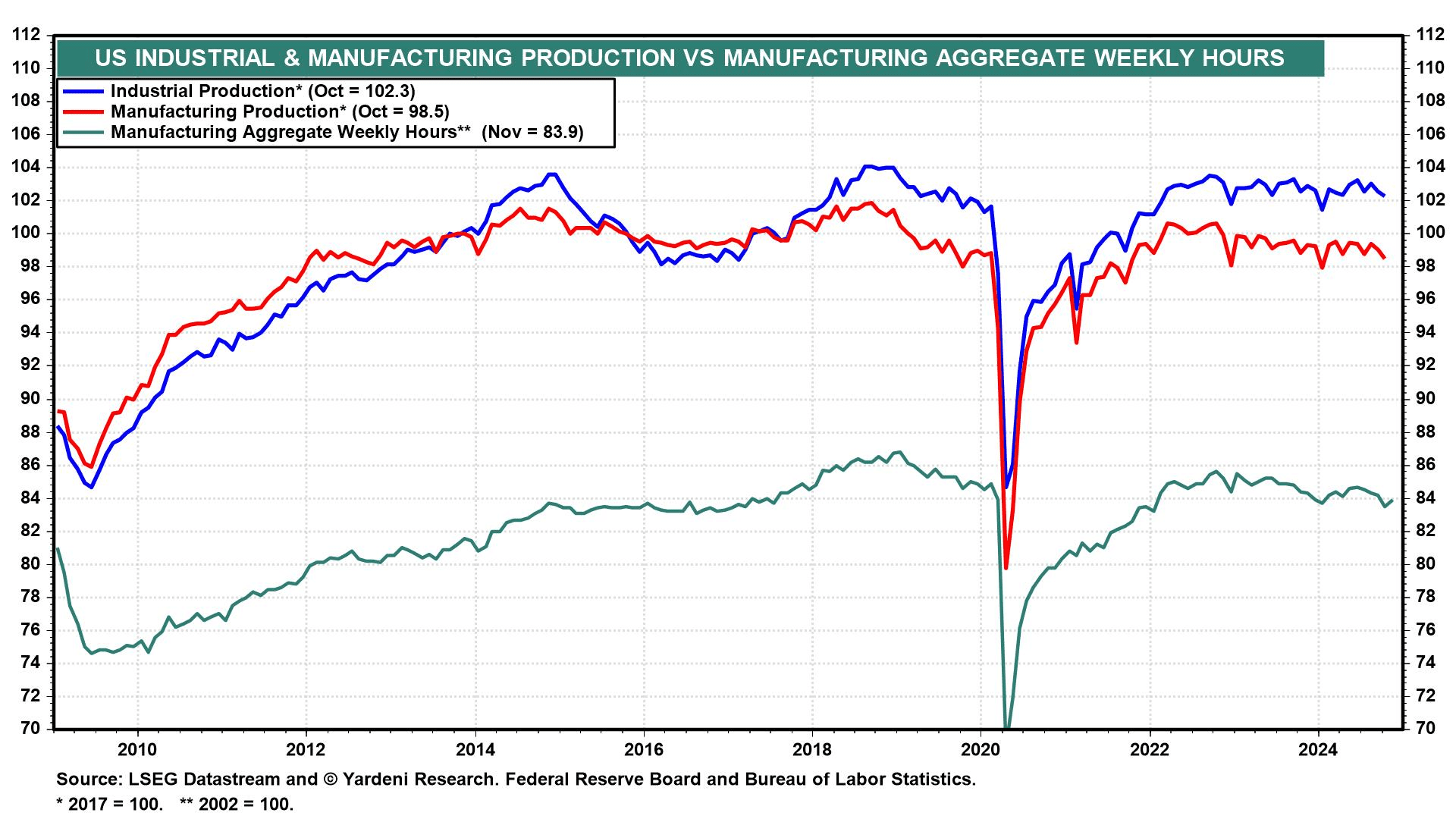
Aggregate weekly hours rose in manufacturing, suggesting that industrial production rose during November.
(5) The labor force declined by 413,000 during October and November and is up by only 159,000 over the past 12 months. The y/y growth rates of the 12-month averages of the working-age population and the labor force both were down to just 0.7% during November.
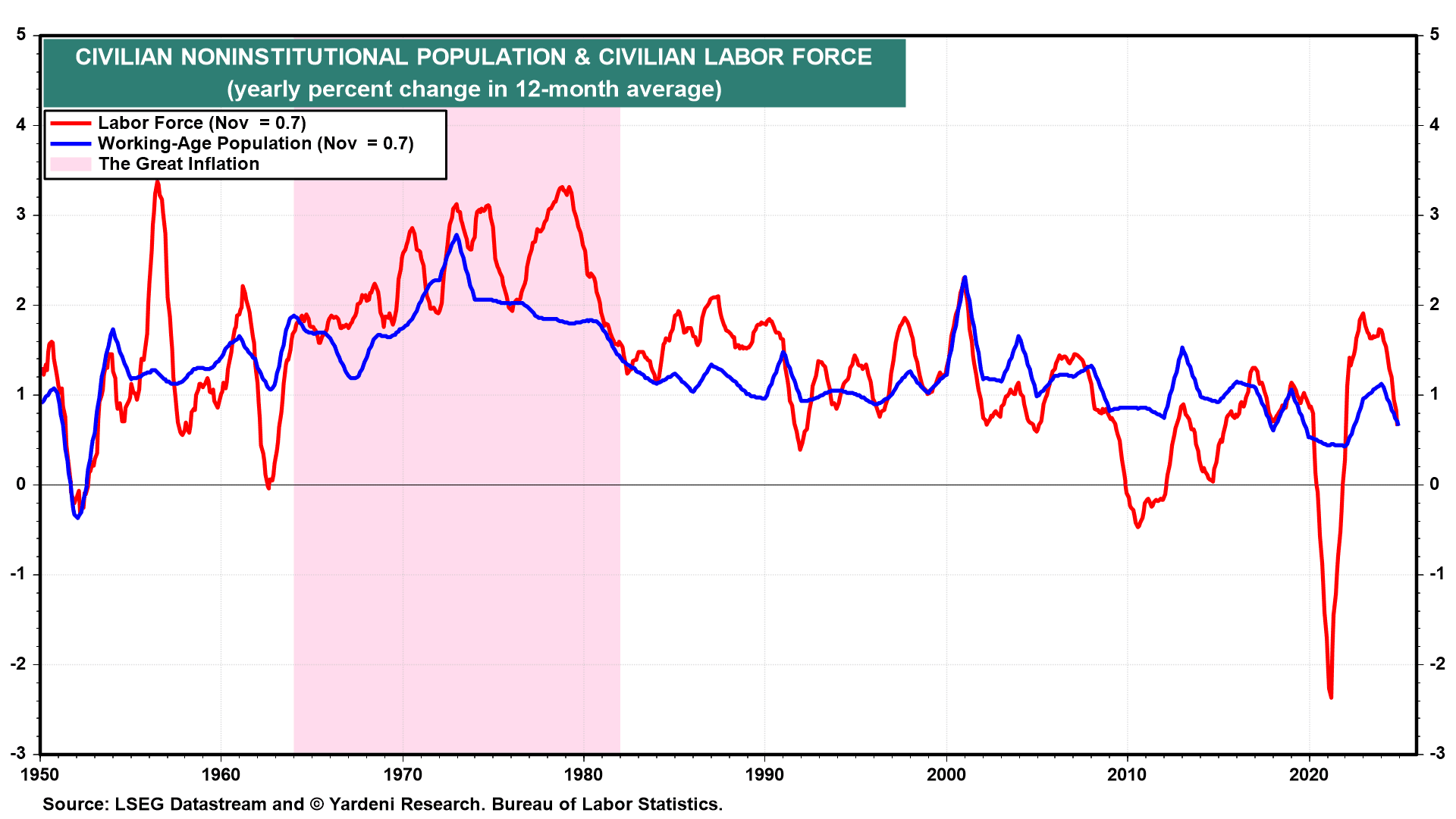
That slowdown is partly attributable to Baby Boomers, who started turning 65 years old in 2011 and have been increasingly retiring.
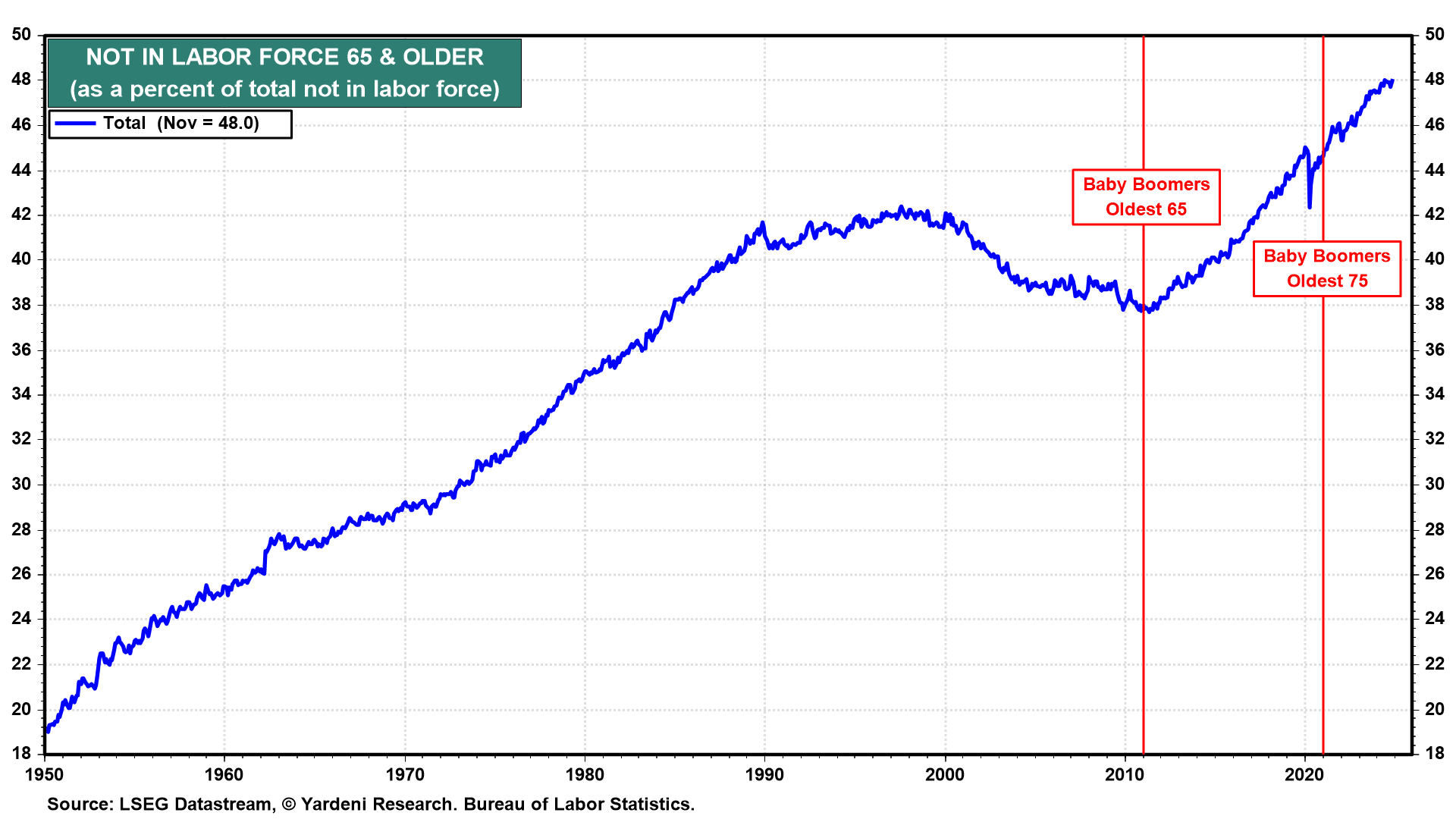
We believe that business managers are successfully increasing the productivity of their younger workers as the Baby Boomers drop out of the labor force.
US Economy II: Consumers Still Consuming.
The latest estimate by the Atlanta Fed’s GDPNow tracking model shows Q4’s real GDP rising by 3.3% (saar), bolstered by a 3.4% increase in real consumer spending.
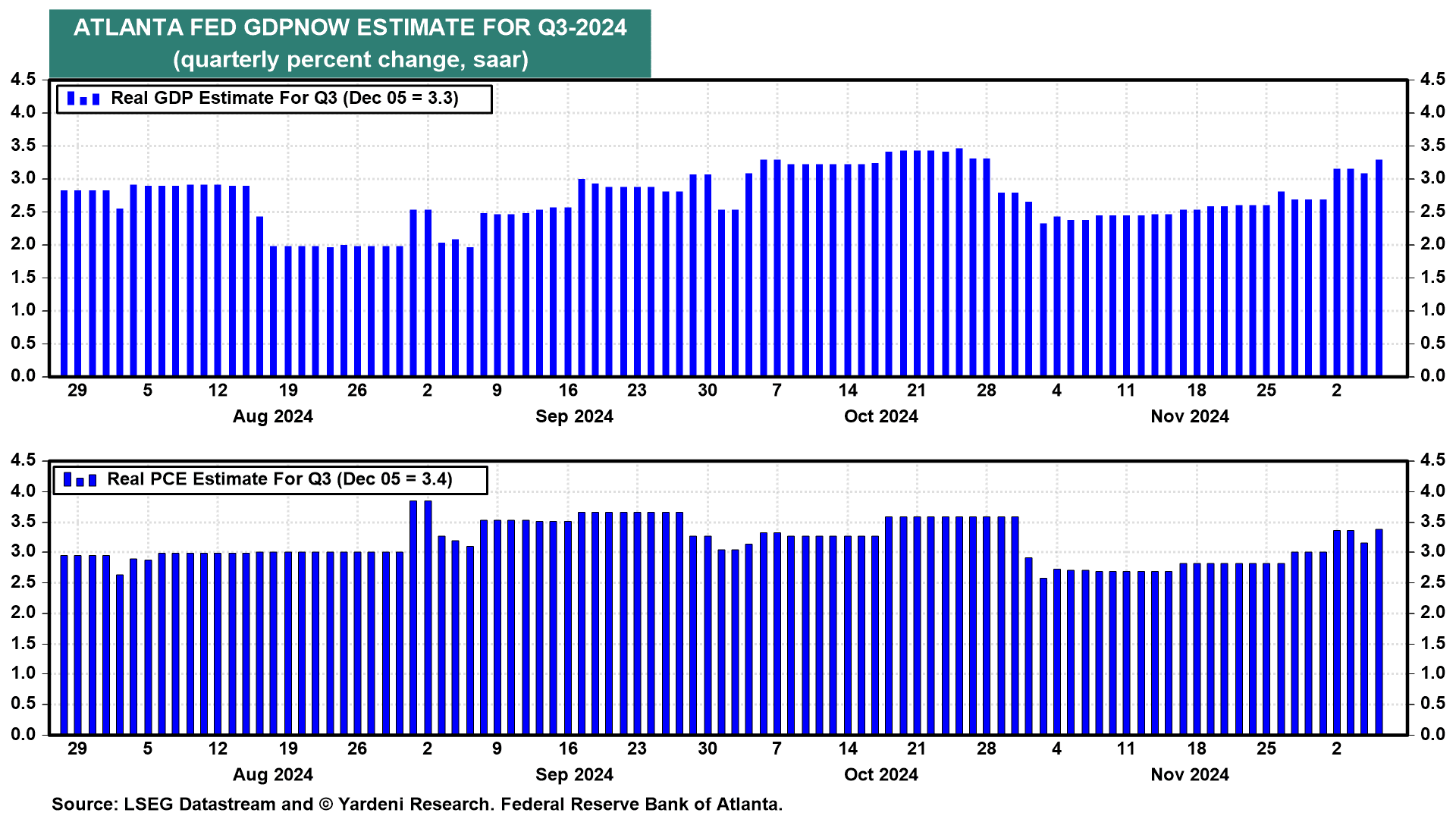
Friday’s employment report should boost both estimates when the GDPNow’s update is released on Monday.
During November, retail motor vehicle sales rose to 16.5 million units (saar), the best pace since May 2021.
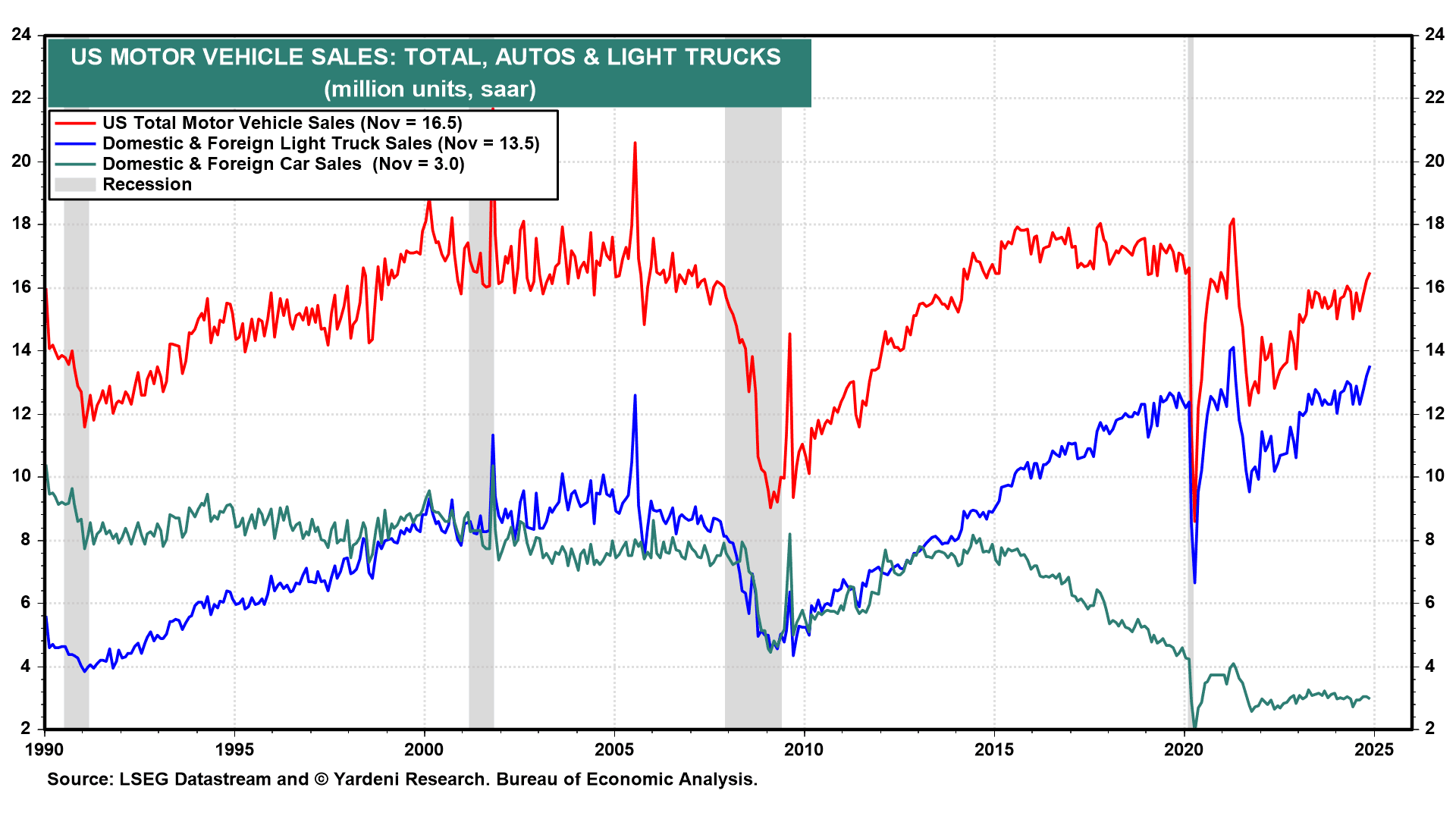
That was led by a big increase in light truck sales, which now account for a whopping 82.1% of retail motor vehicle sales. This is consistent with our view that consumers are still consuming with gusto and economic growth may be accelerating.
Memo to Fed: Don’t do it again. You’ll regret it if you do.
Executive Summary:
As Taylor Swift ends her Eras tour, Dr Ed starts his Roaring 2020s Tour to meet with our accounts. Last week in Texas, they shared their concerns about the “known unknowns,” as the new administration represents a significant policy regime change. On balance, Trump 2.0 should perpetuate our Roaring 2020s scenario. Fortunately, the US economy and financial markets are resilient and tend to outperform globally whomever occupies the White House, thanks to Americans’ indomitable entrepreneurial spirit. … Also: The labor market remains strong, notwithstanding the weakness of some less creditable indicators. … And: Consumers are still doing what they do best.
US Strategy: Dr Ed on Tour.
Taylor Swift’s “The Eras Tour” ended yesterday in Vancouver. The extraordinary singer started this sixth concert tour in Glendale, Arizona on March 17, 2023. The tour consisted of 149 shows spanning five continents. Two of my daughters enjoyed her show in Toronto last month.
My “Roaring 2020s Tour” started in Dallas, Texas last Tuesday morning. That afternoon, after a great Tex-Mex lunch with a few accounts, I traveled to Fort Worth to meet with more accounts. A car service took me to Austin that night for my gig there on Wednesday. It was on to San Antonio for a small group dinner that evening at Bistr09. Then I was off to Houston to stay at the Houstonian Hotel for a group breakfast on Thursday. Next I flew to San Diego to speak at the NIRI Senior Roundtable Annual Meeting on Friday morning.
I enjoyed my discussions with our accounts. They all are pleased with the bull market in stocks. They are also rooting for our Roaring 2020s scenario. But they are nervous that stocks aren’t cheap now that valuation multiples are near previous bull market peaks. Their main concern for the fundamentals is that President Donald Trump might start a trade war. Everyone is also wondering whether the new administration will succeed in reducing the size, regulatory powers, headcount, and budget deficits of the federal government. In addition, a few people noted that mass deportation of illegal migrants might hamper some industries that rely on these workers. Everyone is uneasy about making so many policy changes at the same time. That could have unintended negative consequences for the economy and the financial markets.
Debbie, Eric, Joe, Melissa, and I share these concerns and are focusing our team’s research efforts on these mostly “known unknowns.” Our current assessment is that on balance Trump 2.0 will support our Roaring 2020s scenario for the remainder of the decade. To be politically fair, our scenario has unfolded very well under the current administration’s mix of policies favoring business regulations, open borders, lots of deficit-financed spending, and onshoring incentives.
Our central investment thesis is that the economy and stock market are resilient; they have a long history of performing well notwithstanding Washington’s meddling and regardless of which party has the White House.
We the People of the United States make this country work, not the elected and unelected federal government officials in Washington. The US stands out among nations because it’s among the few that are prospering, and it’s doing so because entrepreneurial capitalism is flourishing. That’s what makes it exceptional.
European economies are stagnating under the regulatory regime of the European Union. Immigration has heightened a clash of civilizations within the region, exacerbating political partisanship. The region also has an increasingly geriatric profile. And Europe’s transition to clean energy has been costly and ineffective.
China began its shift toward a more market-oriented economy in 1978 under the leadership of Deng Xiaoping. The resultant economic boom started to fizzle in recent years as the Chinese Communist Party clamped down on capitalism, fearing that too many entrepreneurs were becoming too wealthy and powerful. A property depression and a rapidly aging population are also weighing on the country’s economy.America’s entrepreneurial spirit and comparative advantage is widely recognized in the realm of technological innovation, financed by a highly developed venture capital industry. That’s very evident in the US and global stock markets. The S&P 500 Information Technology and Communication Services sectors combined account for 40.1% of the S&P 500 market capitalization.
That’s the same market-cap weighting those two sectors represented just before the Tech Wreck of 2000. However, this time, such a large proportion of the broad index’s market cap is more justified because the sectors together account for 35.0% of the earnings share of the S&P 500 compared to 24.0% back then.
This is one of the main reasons why the US MSCI stock price index has dramatically outperformed the All Country World ex-US stock price index since 2010.
Furthermore, the US MSCI now accounts for a staggering 74% of the market capitalization of the All Country World MSCI.
Less well known about America’s entrepreneurial juices is that there are over 30 million nonfarm sole proprietorships in America.
Proprietors’ income in personal income totaled $2.0 trillion (saar) during October.
Furthermore, the pace of new business applications has been hovering just above 5.0 million on a 12-month-sum basis since the pandemic.
That’s up from around 3.3 million before the pandemic.
US Economy I: Labor Market Looks Good to Us.
We’ve said it before, half in jest: Any data series that does not support our story must be bad data or it will be revised to show we were right after all.
Over the past two months, the household measure of employment is down 723,0000, while the payroll measure of jobs is up 263,000. Ignore the former. It makes no sense. The rapid pace of business applications certainly must create plenty of jobs. That’s why we believe the payroll jobs survey’s data are more representative of the state of the labor market than that of the household employment survey. Consider the following:
(1) The former is up 518,000 over the past three months and 2.27 million over the past 12 months.
The latter is down 293,000 over the past three months and down 725,000 over the past 12 months. The number of jobs has been growing at a solid rate, while the number of people employed has been basically unchanged over the past 12 months. The ratio of the two has been increasing for a long time, and especially faster since the pandemic.
(2) The household survey includes among the employed agricultural workers, self-employed workers whose businesses are unincorporated, unpaid family workers, and private household workers. These groups are excluded from the establishment survey. It’s likely that more of the self-employed are incorporating as sole proprietorships; they then would be included in payroll but not household employment. The response rates to the employment surveys have been falling. More respondents to the household survey may not be responding to phone calls because they are flooded with robocalls.
(3) With the exception of the household employment survey data, November’s employment report looked fine to us. Our Earned Income Proxy (EIP) for private-industry wages and salaries in personal income rose 0.8% as aggregate hours worked and average hourly earnings each rose 0.4%.
Those increases put all three at record highs! The strength in our EIP augurs well for the holiday shopping season.
(4) Employment gains were relatively widespread by industry last month.
The only major decline was in retail trade with a decrease of 28,000. That might have been attributable to the late Thanksgiving this year. It fell on November 28.
Payroll employment rose to a record high in construction, educational services, financial activities, health care & social services, leisure & hospitality, professional scientific & technical services, state & local government, and wholesale trade.
Aggregate weekly hours rose in manufacturing, suggesting that industrial production rose during November.
(5) The labor force declined by 413,000 during October and November and is up by only 159,000 over the past 12 months. The y/y growth rates of the 12-month averages of the working-age population and the labor force both were down to just 0.7% during November.
That slowdown is partly attributable to Baby Boomers, who started turning 65 years old in 2011 and have been increasingly retiring.
We believe that business managers are successfully increasing the productivity of their younger workers as the Baby Boomers drop out of the labor force.
US Economy II: Consumers Still Consuming.
The latest estimate by the Atlanta Fed’s GDPNow tracking model shows Q4’s real GDP rising by 3.3% (saar), bolstered by a 3.4% increase in real consumer spending.
Friday’s employment report should boost both estimates when the GDPNow’s update is released on Monday.
During November, retail motor vehicle sales rose to 16.5 million units (saar), the best pace since May 2021.
That was led by a big increase in light truck sales, which now account for a whopping 82.1% of retail motor vehicle sales. This is consistent with our view that consumers are still consuming with gusto and economic growth may be accelerating.
Memo to Fed: Don’t do it again. You’ll regret it if you do.

