Executive Summary:
In a scant three months, FOMC members moved from a unanimous hold to a unanimous hike, raising the federal funds rate by 25bps and suggesting more of the same to come. President Trump, preferring rates be slashed, blamed everyone on the FOMC except Fed Chair Kevin Warsh. Today, Ed and Elias examine what motivated the September decision and Warsh’s role in it. He had argued all summer that conditions were ripe for a rate hike: The economy was resilient, with a full-employment labor market and financial conditions not restrictive, while inflation was a problem. By September, the Committee at large concurred. … We expect one or two more rate hikes this year. … Also: Check out our chart collection.
Fed I: Walking the Talk
At its September 15-16 meeting, the Federal Open Market Committee (FOMC) raised the federal funds rate (FFR) by 25bps to 3.75%-4.00%.
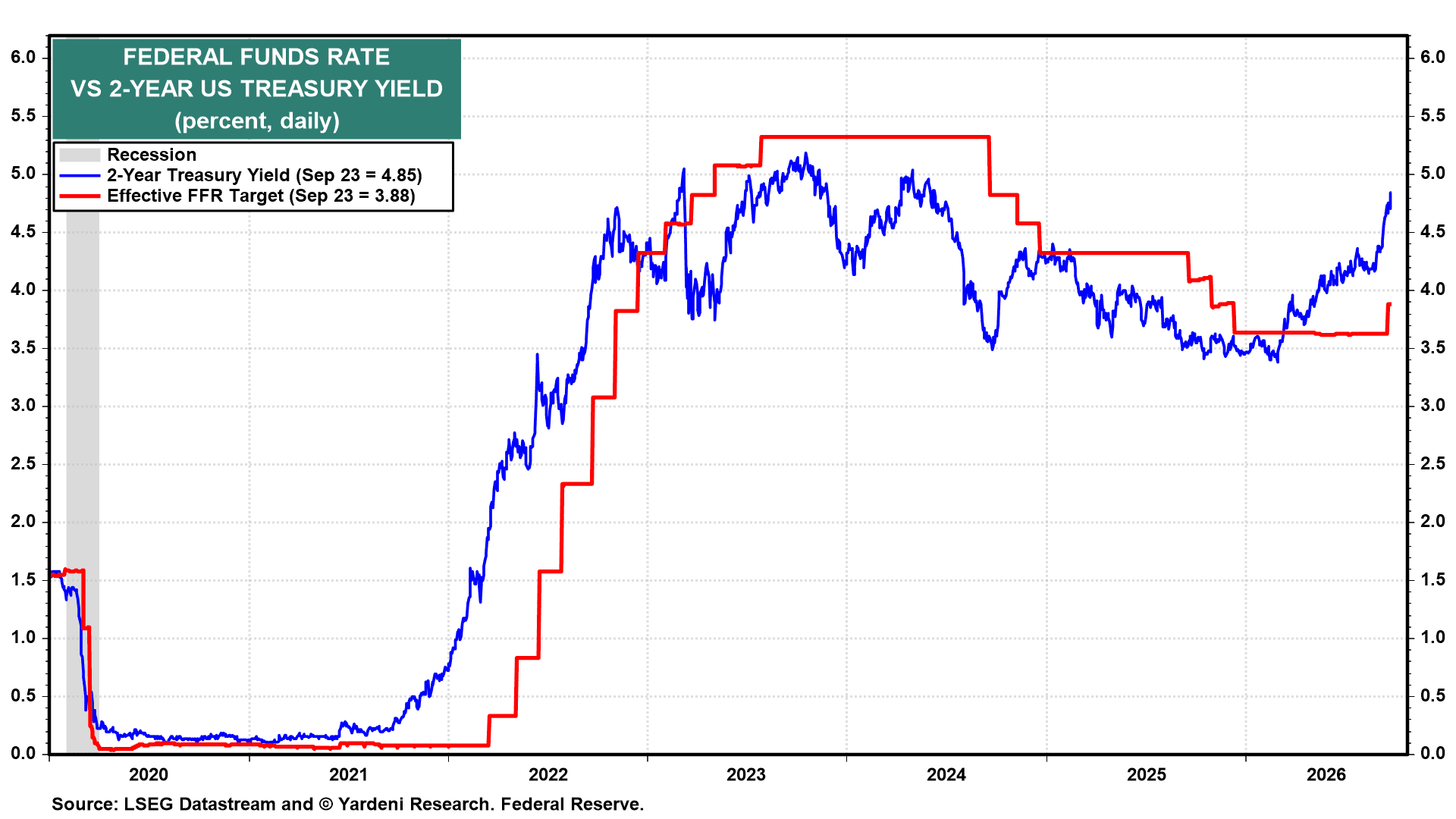 ▌View Related Live Charts: US - Federal Fund Interest Rates
The vote was unanimous. The unanimity was months in the making. At the June 16-17 meeting, Kevin Warsh’s first FOMC meeting as Fed chair, the Committee unanimously held rates steady. At the July 28-29 meeting, it did so again, but three officials dissented in favor of a hike. By September’s meeting, all 12 voters supported a 25bps increase.
What swept FOMC members from a unanimous hold to a unanimous hike in just three months? And what role did Warsh play?
President Trump offered one interpretation. He said that Warsh had “a very tough board” and that he had told Warsh before the meeting, “You might as well vote with the board because it’s not going to matter.” Trump criticized the rate increase, preferring a dramatic slash of rates, but blamed the rest of the FOMC rather than Warsh.
That raises an important question: Was Warsh dovish all along and ultimately pulled toward a hike by a hawkish Committee, or was he hawkish from the start and the Committee gradually moved in his direction? Let’s review:
(1) Talking tough. Warsh used his first FOMC meeting as Fed chair in June to reestablish the Fed’s inflation-fighting credibility. While the Committee unanimously voted to leave the FFR unchanged, Warsh stressed that...
 Get answers from MM AI.
-
What factors led the FOMC to unanimously raise the federal funds rate in September?
💡The FOMC unanimously raised the federal funds rate in September due to a strengthened economy, a robust labor market, and intensified inflation risks. Real final sales to private domestic purchasers accelerated to 4.2% in Q2, with the Atlanta Fed's GDPNow model tracking Q3 real GDP at 5.1%. Payrolls rose by 162,000 in August, and the unemployment rate remained at 4.1%. August CPI and PPI reports showed headline CPI at 3.4% y/y and core CPI at 2.4% y/y, intensifying concerns that inflation was not returning to the Fed's 2.0% target sustainably, thereby strengthening the case for a rate hike.
-
How did Fed Chair Kevin Warsh influence the FOMC's shift towards a rate hike?
💡Fed Chair Kevin Warsh significantly influenced the FOMC's shift towards a rate hike by consistently emphasizing the need to reestablish the Fed's inflation-fighting credibility since June. He stressed that inflation had been above the Fed's 2.0% y/y target for over five years and asserted that inflation is primarily determined by monetary policy. His persistent hawkish stance, coupled with a resilient economy and strong labor market, gradually moved the Committee in his direction, leading to a unanimous 25bps hike by September, even though he initially voted to hold rates steady while advocating for tighter policy.
-
What was Warsh's stance on inflation and economic conditions prior to the September hike?
💡Prior to the September hike, Warsh consistently held a hawkish stance on inflation and a positive outlook on economic conditions. He described the economy as showing "impressive resilience" with solid growth, a stable and full-employment labor market, and strong business investment. Warsh repeatedly stressed that inflation, which had been above the Fed's 2.0% y/y target for over five years, was a significant problem and primarily determined by monetary policy. He also questioned how restrictive policy actually was, arguing that financial conditions were not significantly impeding economic activity.
-
How did the Committee's assessment of economic risks evolve between June and September?
💡The Committee's assessment of economic risks evolved significantly between June and September, aligning more with Warsh's hawkish views. In June, 14 participants saw downside risks to growth, which decreased to five by June and to none by September. Similarly, 16 participants saw upside risks to unemployment in March, falling to seven in June and to none in September. Conversely, the number of participants seeing upside risks to headline PCED inflation remained high, with 17 participants in September, indicating a growing consensus that economic growth was robust and inflation was the primary concern, necessitating a rate hike.
-
What key economic data strengthened the case for a rate hike by the September meeting?
💡Key economic data strengthening the case for a rate hike by September included an accelerating economy, a robust labor market, and persistent inflation. Real final sales to private domestic purchasers accelerated from 2.0% in Q1 to 4.2% in Q2, with the Atlanta Fed’s GDPNow model tracking Q3 real GDP at 5.1%. Nonfarm payrolls rose by 162,000 in August, and the unemployment rate remained at 4.1%, while initial jobless claims fell to 196,000. Inflation reports showed headline CPI at 3.4% y/y and core CPI at 2.4% y/y in August, indicating inflation was well above the Fed's 2.0% target.
-
What indicators demonstrate the continued strength of the US labor market?
💡The continued strength of the US labor market is demonstrated by several indicators. Payrolls rose by 162,000 in August, with the three-month average at a robust 71,000, and the unemployment rate remained low at 4.1%. Layoffs data is also encouraging, with initial claims falling to 196,000 during the week of September 12, and their four-week average at 203,250. Continuing claims declined to 1.73 million, while temporary-help employment's year-over-year growth turned positive in August for the first time since October 2022, all pointing to a robust labor market operating at full employment.
-
What shocks are identified as responsible for the recent acceleration in inflation?
💡Three primary shocks are identified as responsible for the recent acceleration in inflation: the AI investment boom, US tariffs, and higher energy prices. The AI investment boom contributes to increased demand and potentially higher costs in technology-related sectors. US tariffs can lead to higher import prices that are passed on to consumers. Higher energy prices, driven by factors such as the conflict in the Middle East, Ukrainian strikes on Russian refineries, and sanctions, directly impact transportation and production costs, leading to broader inflationary pressures across the economy.
-
Why does the FOMC not consider current interest rates as restrictive?
💡The FOMC does not consider current interest rates as restrictive, as indicated by Fed Chair Kevin Warsh's statement that he would be "hard-pressed to describe broad financial conditions as restrictive." He characterized the September hike as removing "a dose of accommodation," suggesting the policy was becoming less accommodative rather than clearly restrictive. This interpretation is reinforced by the Committee's assessment of an accelerating economy and their fading concern about downside risks to growth, implying that the current rate level has not yet significantly constrained economic activity or inflation.
-
What recent wage growth data suggests potential for a wage-price spiral?
💡Recent wage growth data suggests potential for a wage-price spiral, with several indicators pointing to accelerating wage gains. Labor demand has exceeded labor supply for four consecutive months. The Atlanta Fed's Wage Growth Tracker accelerated to 4.1% year-over-year in August, marking its fastest pace in a year. Additionally, wage growth for job switchers rose to 5.0%, the fastest since May 2024. These trends indicate increasing pressure on labor costs, and if they accelerate further, they could contribute to a persistent inflation shock by driving a wage-price spiral, prompting the Fed to tighten policy further.
-
What are the Federal Reserve's projections for additional rate increases this year?
💡The Federal Reserve's projections, according to the Summary of Economic Projections (SEP) dot plot, indicate that the median participant expects one more 25bps rate hike this year. Beyond that, the median projection suggests no further rate changes in 2027. Fed Chair Kevin Warsh also emphasized that the September rate hike was just the beginning of demonstrating the Fed's commitment to restoring price stability, implying further tightening may be necessary. Analysts anticipate one or two more rate hikes this year, contingent on incoming inflation data, even with the October meeting's proximity to midterm elections.
