What You Should Know
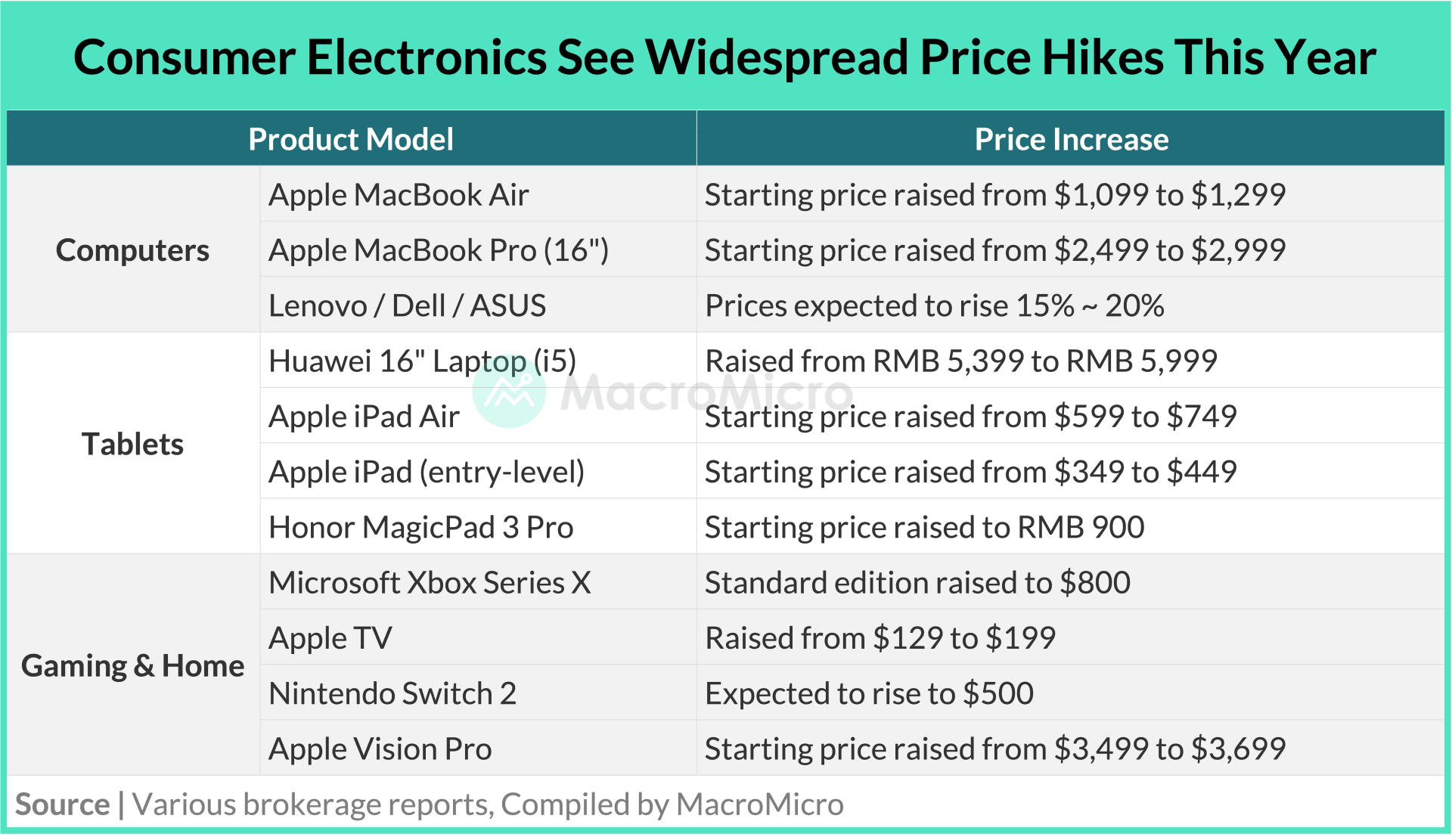
Apple made the unusual decision last week to raise prices, driven by the sharp increase in memory prices that has placed significant cost pressure on the company. Since the beginning of the year, many Chinese smartphone brands, along with Dell's product lineup in the US, have already implemented price hikes, indicating that the capacity displacement effects caused by AI are now spreading across the broader electronics industry.
In this report, we explain what is happening in the memory market, whether consumer demand is at risk of weakening, and whether the broader economy could ultimately face demand destruction.
Key Takeaways
- Consumer electronics revenue continues to grow overall, as higher average selling prices (ASPs) have offset weaker shipment volumes.
- Pricing power across the supply chain has reversed, shifting from a demand-driven buyer's market to a supply-driven seller's market.
- In the short to medium term, the economy remains supported by robust investment. Over the longer term, however, investors should monitor whether excessive investment eventually leads to inventory corrections.
Last week, The Wall Street Journal interviewed Apple's soon-to-depart CEO, Tim Cook. During the interview, Cook publicly stated that memory manufacturers are passing on substantial cost increases, prompting Apple to officially raise prices on its website by between $100 and $500, representing roughly 10% to 30% increases. Apple has even discussed with the US government the possibility of using memory chips supplied by China's ChangXin Memory Technologies (CXMT).
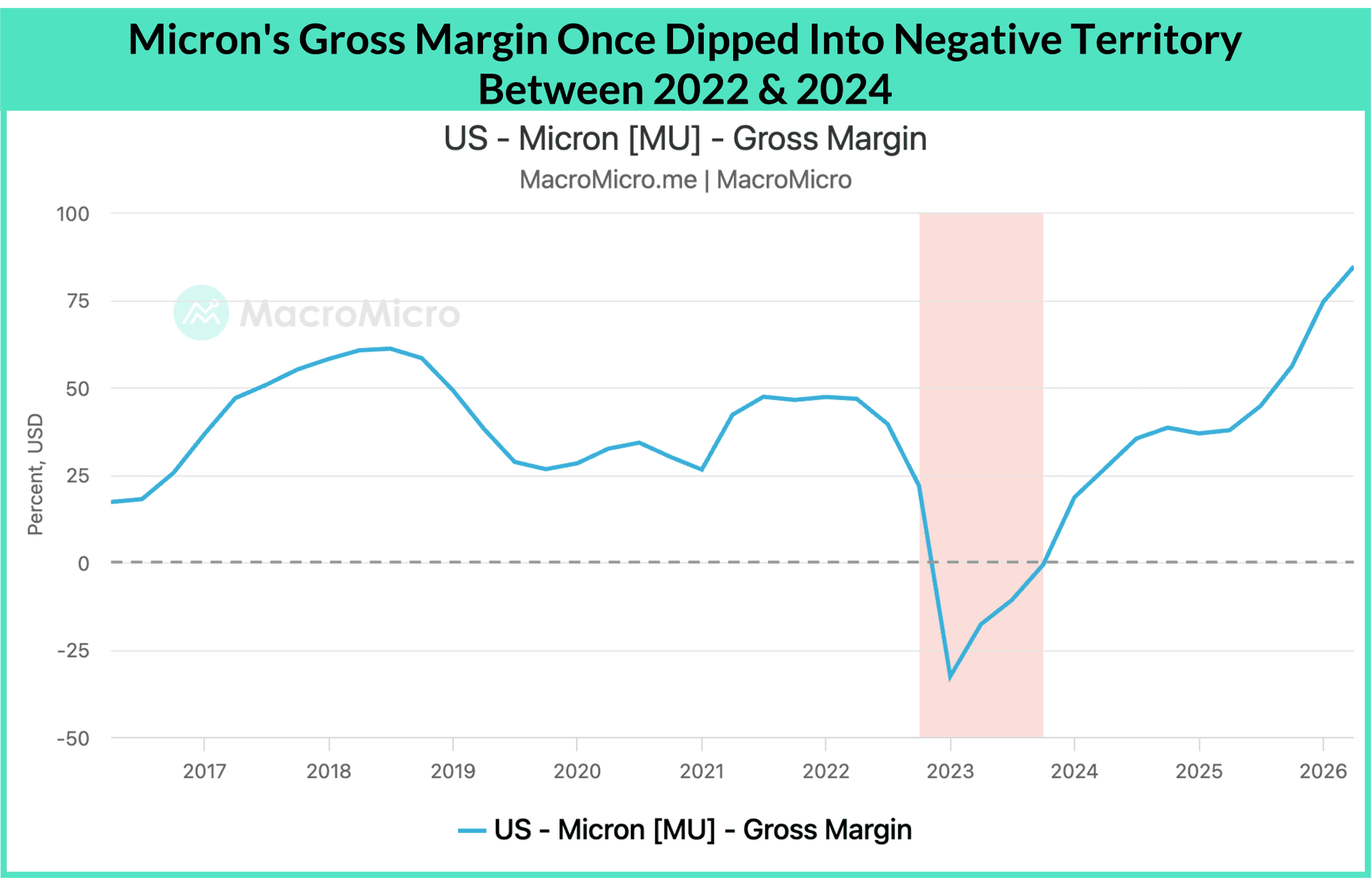
In response, The Wall Street Journal also interviewed Micron Chief Business Officer Sumit Sadana, who pushed back forcefully. Sadana noted that during the severe downturn in the memory market between 2022 and 2024, Micron's gross margin fell into negative territory, yet "certain customers" continued using their overwhelming bargaining power to demand even lower prices. This was a clear allusion to Apple Apple havind had squeezed suppliers so aggressively that the memory industry drastically reduced capital expenditures and capacity investment throughout 2023, ultimately contributing to today's severe supply-demand imbalance.
Micron's CEO added: "For the past decade, Apple bought our chips for $5, put them inside a metal box, sold it to consumers for $99, and then laughed at us for wanting to raise the price to $7. Today we sell the chip for $50, and Apple simply passes that on by charging consumers $250."
Historically, multiple industries have experienced supercycles driven by supply shortages, including memory and passive components, yet Apple has largely remained unaffected. This AI-driven transformation is different. Apple has gone as far as requesting permission to source memory from CXMT, while Micron has, for the first time, publicly stood its ground. Why has supplier pricing power become so dominant this cycle, and what impact will higher end-user prices have on the broader economy?
I. Pricing Power Has Reversed: The Shift from a Buyer's Market to a Seller's Market
Apple's long-standing buyer's market strategy is gradually losing effectiveness as AI-driven capacity constraints ripple through the supply chain. Micron's public response reflects this structural shift. The following three questions explain the chain reaction triggered by soaring memory prices.
Q. What Is Happening in the Memory Market?
Rising memory prices have become a well-known reality. During its Q2 2026 earnings call, Micron reported that DRAM prices increased by approximately 60% quarter-on-quarter, while NAND prices surged by around 80% quarter-on-quarter. However, the price hikes over the past year are not solely driven by High Bandwidth Memory (HBM); rather, they represent a comprehensive increase in memory quotes. The memory industry is being redefined, simultaneously exhibiting characteristics of high customization, exponential...
How will surging memory prices reshape the consumer electronics industry and the broader economy? This report examines Apple's unusual price hikes, the AI-driven shift in supply chain pricing power, the structural transformation of the memory market, and what rising hardware costs could mean for consumer demand, corporate margins, and long-term economic growth. Unlock full access to this report, proprietary macro data insights, and ongoing market coverage with MM Max. Subscribe Now»
Already a subscriber? Click here to log in.
Full Access to Our Services

Comprehensive data at your service
with key indicators for investment insights

Exclusive flash reports
on key events and data

Create your own charts and analysis
including performance backtesting

Hub of professionals to engage
in meaningful discussions and insights
 Get answers from MM AI.
-
How are rising memory prices impacting the broader electronics industry supply chain?
💡Rising memory prices are causing a profound impact on the broader electronics industry supply chain by shifting pricing power from a demand-driven buyer's market to a supply-driven seller's market. This is evident as memory manufacturers, such as Micron, have seen DRAM prices increase by approximately 60% quarter-on-quarter and NAND prices surge by around 80% quarter-on-quarter, compelling downstream consumer electronics brands like Apple to raise their product prices, demonstrating a clear transmission of upstream cost pressures to final consumer products.
-
What key factors characterize the current memory market supercycle?
💡The current memory market supercycle is characterized by high customization, exponential demand growth, and rapid technological iteration, breaking from traditional cyclical patterns. This supercycle is driven by AI, leading to a comprehensive increase in memory quotes, not solely HBM. The industry's dynamics now involve fierce competition for production capacity, long-term supply agreements, and upfront cash deposits, fundamentally altering the economic landscape for memory manufacturers.
-
How did generative AI and agentic AI influence demand for HBM and standard DRAM?
💡Generative AI from 2023 to 2025 initially drove up High Bandwidth Memory (HBM) consumption due to AI training demands, prompting major memory manufacturers to shift production capacity towards HBM, DDR5, and LPDDR5, leading to tightened global DRAM supply and rising prices. Subsequently, with the advent of agentic AI in 2026, standard DRAM (DDR and LPDDR) demand surged due to increased CPU usage for external tools, longer context processing, and multi-step tasks, while its capacity was simultaneously crowded out by HBM production, causing its price increases to surpass those of HBM.
-
How do Strategic Customer Agreements transform the economics for memory manufacturers like Micron?
💡Strategic Customer Agreements (SCAs) fundamentally transform the economics for memory manufacturers like Micron by guaranteeing substantial future revenue and securing production capacity with upfront payments. Micron, for instance, signed 16 SCAs, 14 of which guarantee approximately $100 billion in minimum revenue through the end of 2030, and the company expects gross margins to remain well above previous cycle peaks. These agreements ensure that memory manufacturers enjoy customers actively competing for and locking in supply, eliminating the long-held negotiating advantage of consumer electronics brands.
-
Which segments of the electronics supply chain benefit most from higher memory prices?
💡First-tier foundries and the broader memory industry, situated at the absolute upstream of the electronics supply chain, benefit most from higher memory prices, experiencing significant surges in average gross margins. This reflects a severe supply-demand imbalance, allowing upstream manufacturers to capitalize on strong AI demand and capacity crowding-out effects. Second-tier foundries have also seen modest recovery in gross margins due to tightening supply and rising prices.
-
How do higher average selling prices (ASPs) affect consumer electronics revenue projections?
💡Higher average selling prices (ASPs) are projected to increase overall consumer electronics revenue in 2026, even amidst declining shipment volumes, by compensating for lower unit sales. Specifically, forecasts for the smartphone market suggest revenue will rise as resilient consumer demand for high-end devices allows brands to implement price increases, despite a softening in demand for entry-level and mid-range models. This indicates that consumers are willing to pay premiums for high-end products, mitigating the impact of reduced volumes.
-
How is consumer demand for high-end versus mid-to-low-end smartphones changing?
💡Consumer demand for high-end smartphones remains resilient, leading to a widening gap with mid-to-low-end models. While consumers are willing to purchase premium devices at higher price points, demand for entry-level and mid-range devices is softening. This trend is reflected in overall smartphone market revenue forecasts for 2026, where rising average selling prices (ASPs) are expected to offset declining shipment volumes, primarily driven by continued strong demand for high-end devices.
-
What are the long-term risks associated with the economy's increasing reliance on AI investment?
💡The long-term risks associated with the economy's increasing reliance on AI investment include the potential for excessive leveraging up, which historically preceded asset price collapses and rapid economic downturns, such as the Dot-com Bubble and the Global Financial Crisis. While current AI investments are driving productivity gains, the economy faces risks if the manufacturing sector transitions from active to passive inventory replenishment, leading to a deleveraging phase characterized by stagnant investment, which would warrant significant caution.
-
How does the shift from a buyer's to a seller's market affect consumer electronics brands?
💡The shift from a buyer's to a seller's market severely erodes the pricing power of consumer electronics brands like Apple. Historically dominant through tactics like leveraging largest buyer status, fostering supplier competition, extending payment terms, and mandating annual price reductions, these brands now face memory manufacturers with newfound pricing power, who secure long-term agreements and demand cash deposits. Consequently, consumer electronics brands are left competing for remaining production capacity, forcing them to raise prices and seek compelling edge AI experiences to drive future sales.
-
What will ultimately sustain long-term economic growth according to MacroMicro's analysis?
💡According to MacroMicro's analysis, long-term economic growth will ultimately depend on AI investments generating real commercial returns, driving stronger consumer demand, and creating a self-reinforcing cycle of productivity, income growth, and consumption. While short-to-medium-term growth is supported by AI infrastructure investment, sustained expansion requires these investments to translate into tangible benefits for consumers, encouraging a new device replacement cycle driven by compelling edge AI experiences.
