What You Should Know
Last week, markets saw notable volatility. As tech earnings season picked up, investor focus shifted back to corporate guidance and growth visibility. AMD's outlook came under intense scrutiny, while new AI tools from Google and Anthropic raised concerns that software companies' competitive moats could be eroding. This sparked a pullback in both software and broader tech stocks, with the Nasdaq falling 1.84% for the week.
Key Questions:
- Is AI weakening the competitive edge of software companies?
- Could end-user demand for AI be slowing, and does that warrant more caution?
The SaaS Shakeout Has Begun—& AI Is Driving It
Technology sector weakness extends beyond semiconductor margins and capacity constraints. Software stocks experienced severe selloffs since October 2025, with the S&P 500 Software & Services Index dropping 25% from peak levels. Unity collapsed 43%, AppLovin fell 37%, Intuit declined 29.2%, and ServiceNow lost 24.7%. The sector underperformed broader market indices by substantial margins.
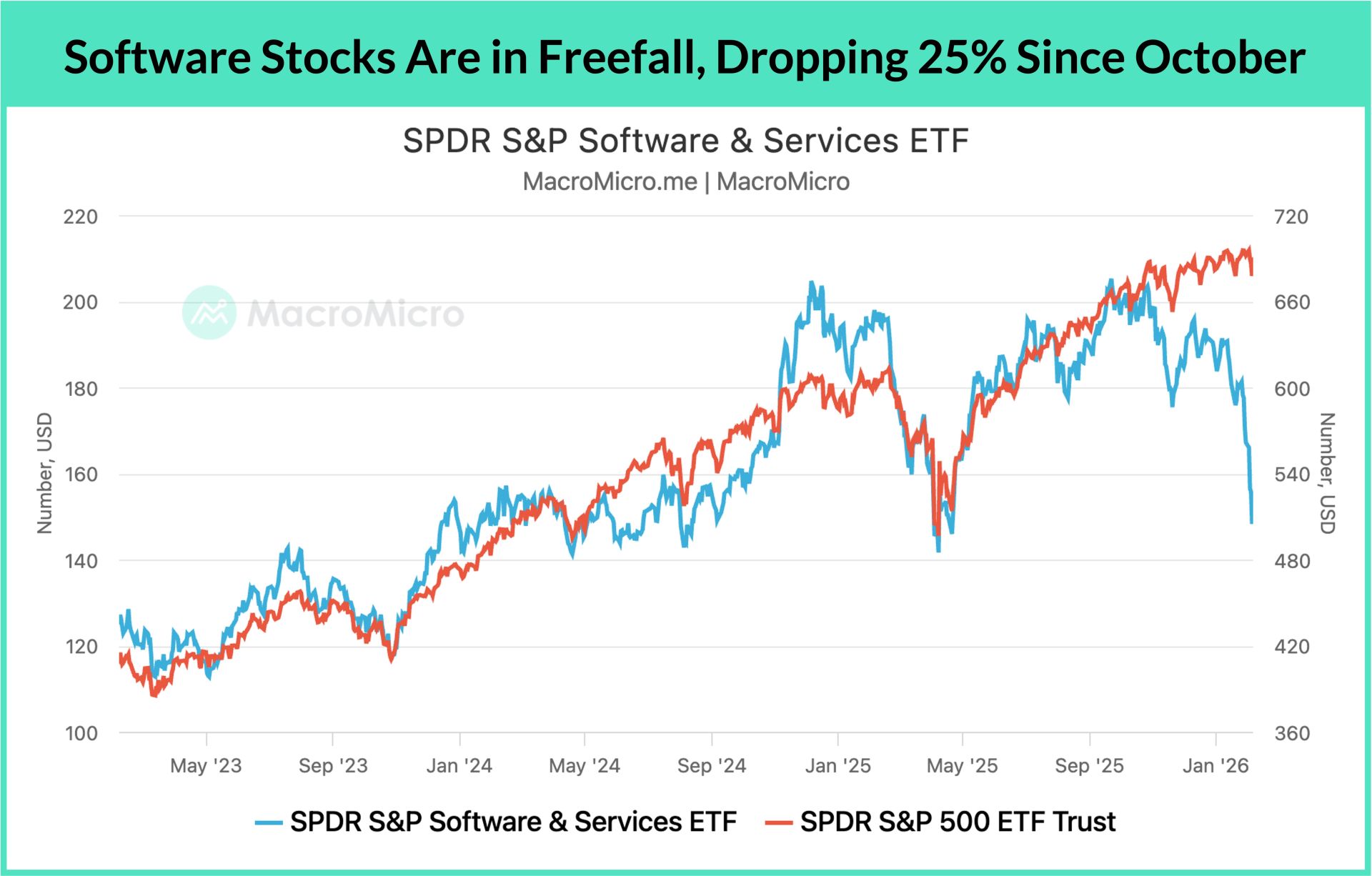
Two catalyzing events accelerated the rout. Google opened testing for Project Genie, which generates interactive 3D virtual worlds from simple text descriptions, directly threatening Unity's game engine business model. Anthropic launched Claude Cowork Legal Plugin, enabling AI to execute document review, compliance tracking, and contract drafting. The $100 monthly subscription undercuts traditional legal software pricing structures by thousands of dollars, challenging Thomson Reuters, RELX, and LegalZoom core revenue streams.
These developments fundamentally altered market narratives. The prevailing view positioned AI as a SaaS industry catalyst, expanding addressable markets and enhancing productivity. Recent demonstrations shifted sentiment toward viewing AI as a...
This article is exclusive to subscribers. If you're not a subscriber yet, subscribe to MM Max today and gain full access to all our charts, reports, and more. Subscribe Now»

Already a subscriber? Click here to log in.
Full Access to Our Services

Comprehensive data at your service
with key indicators for investment insights

Exclusive flash reports
on key events and data

Create your own charts and analysis
including performance backtesting

Hub of professionals to engage
in meaningful discussions and insights
 Get answers from MM AI.
-
Which software companies are most vulnerable to AI-driven commoditization?
💡Software companies most vulnerable to AI-driven commoditization are those with weaker competitive moats, characterized by shallow workflows, low switching costs, or offering primarily feature-based tools. These functional tools risk becoming interchangeable and facing intense pricing pressure as AI models improve. Examples of companies already experiencing significant sell-offs include Unity, which collapsed 43%, AppLovin, which fell 37%, Intuit, declining 29.2%, and ServiceNow, which lost 24.7% since October 2025, largely due to AI advancements directly challenging their core offerings.
-
What is the MacroMicro three-phase 'Productivity Cycle' for AI development?
💡The MacroMicro three-phase 'Productivity Cycle' for AI development includes Phase 1: Infrastructure build-out, focused on hardware demand like GPUs and data centers; Phase 2: Software & platform build-up, where cloud providers integrate compute and models, shifting focus to hyperscaler CapEx and cloud growth; and Phase 3: Application & monetization, where AI enters core business processes, with key metrics being AI agent adoption, edge AI penetration, and enterprise ROI. The industry is currently in a "monetization scrutiny phase," transitioning from Phase 2 to Phase 3, with increasing emphasis on profitability and efficiency.
-
How are rising memory and component prices affecting consumer electronics?
💡Rising memory and component prices are forcing consumer electronics manufacturers to re-evaluate their Bill of Materials (BOM), potentially leading to price increases or specification downgrades, especially in mid- to low-end products. DRAM and NAND contract prices have jumped 30-50% per quarter, with forecasts suggesting annual cost increases of 80-100%. This structural divergence means leading brands with strong pricing power can pass on costs, while lower-tier brands risk marginalization. This shift contributes to a "low volume, high price" market for AI-enabled devices, with profits concentrating among strong players.
-
Why did AMD's Q1 2026 guidance disappoint investors despite revenue beats?
💡AMD's Q1 2026 guidance disappointed investors despite its Q4 2025 revenue of $10.27 billion beating guidance, primarily because the forecast revenue of $9.5-10.1 billion implied only ~32% year-over-year growth and a 5% sequential decline. This fell short of market expectations for accelerating AI-related revenue, contrasting sharply with more optimistic outlooks from competitors like TSMC and Broadcom. The guidance suggested AMD might be falling behind in the AI chip growth curve, triggering a ~17% stock plunge and a valuation reset.
-
What is driving the massive CapEx spending by cloud giants in 2026?
💡The massive CapEx spending by cloud giants in 2026 is driven by unprecedented demand for Generative AI (GenAI) infrastructure. Amazon is investing in AWS data centers and proprietary chips like Trainium/Graviton due to AI demand outstripping capacity. Alphabet is allocating 60% of its CapEx to servers for its "AI Factories" to support 50% Google Cloud growth. Microsoft's aggressive spend on GPUs underpins 39% Azure growth and a $625 billion backlog, all indicating a supply-constrained market rather than an overinvestment bubble.
-
Is the current 'AI bubble' narrative overblown, according to MacroMicro's analysis?
💡According to MacroMicro's analysis, the current 'AI bubble' narrative is overblown. The strong underlying demand for AI continues to outpace supply, suggesting the AI cycle remains firmly in place despite near-term price volatility and market focus on monetization and supply gaps. This robust fundamental demand, coupled with healthy inventory levels across the AI hardware supply chain, indicates that fears of an impending bubble burst are likely overstated.
-
What is the most critical metric for assessing risks in the AI super-cycle?
💡The most critical metric for assessing risks in the AI super-cycle is inventory levels. Currently, inventory across the AI hardware supply chain remains healthy, with no red flags. Monitoring inventory is crucial because a sudden supply-demand reversal poses the primary risk to the cycle. Stable or trending-down inventory levels indicate that fundamental demand continues to outpace supply, reassuring investors that fears of an "AI bubble" may be overstated.
-
How do AI agent platforms change the software value chain and pricing power?
💡AI agent platforms fundamentally change the software value chain and pricing power by consolidating control over workflows and user entry points around these platforms. This integration means individual software tools will serve as callable capabilities for task execution within these agent-driven systems, effectively weakening their standalone pricing power. The shift echoes Satya Nadella’s "Agents are the new Apps" concept, where AI agents become the primary interface for completing tasks by connecting to best-in-class tools, rather than users interacting with single-function applications directly.
-
What role does inventory play in evaluating the health of the AI hardware supply chain?
💡Inventory plays a critical role in evaluating the health of the AI hardware supply chain as it is the most crucial metric for assessing risks in the AI super-cycle. Currently, inventory levels across the AI hardware supply chain, from TSMC to Micron to major PC and phone brands, have returned to healthier levels and continue to trend down. This indicates that the inventory correction is largely over, and strong underlying demand continues to outpace supply, suggesting that fears of an "AI bubble" are likely overstated and fundamentals remain robust.
