What You Should Know
TSMC held its earnings call on April 16. In the week leading up to the call, the stock had already reflected market optimism, rising 6.6% cumulatively. As the core global supplier of AI chips, TSMC once again delivered outstanding results. Management also provided updated guidance on key areas of market focus, including AI demand strength, progress in advanced nodes (such as 3nm and 2nm), and capital expenditure plans. This report breaks down the key takeaways from the earnings call and shares our view on the current semiconductor cycle.
Key Highlights
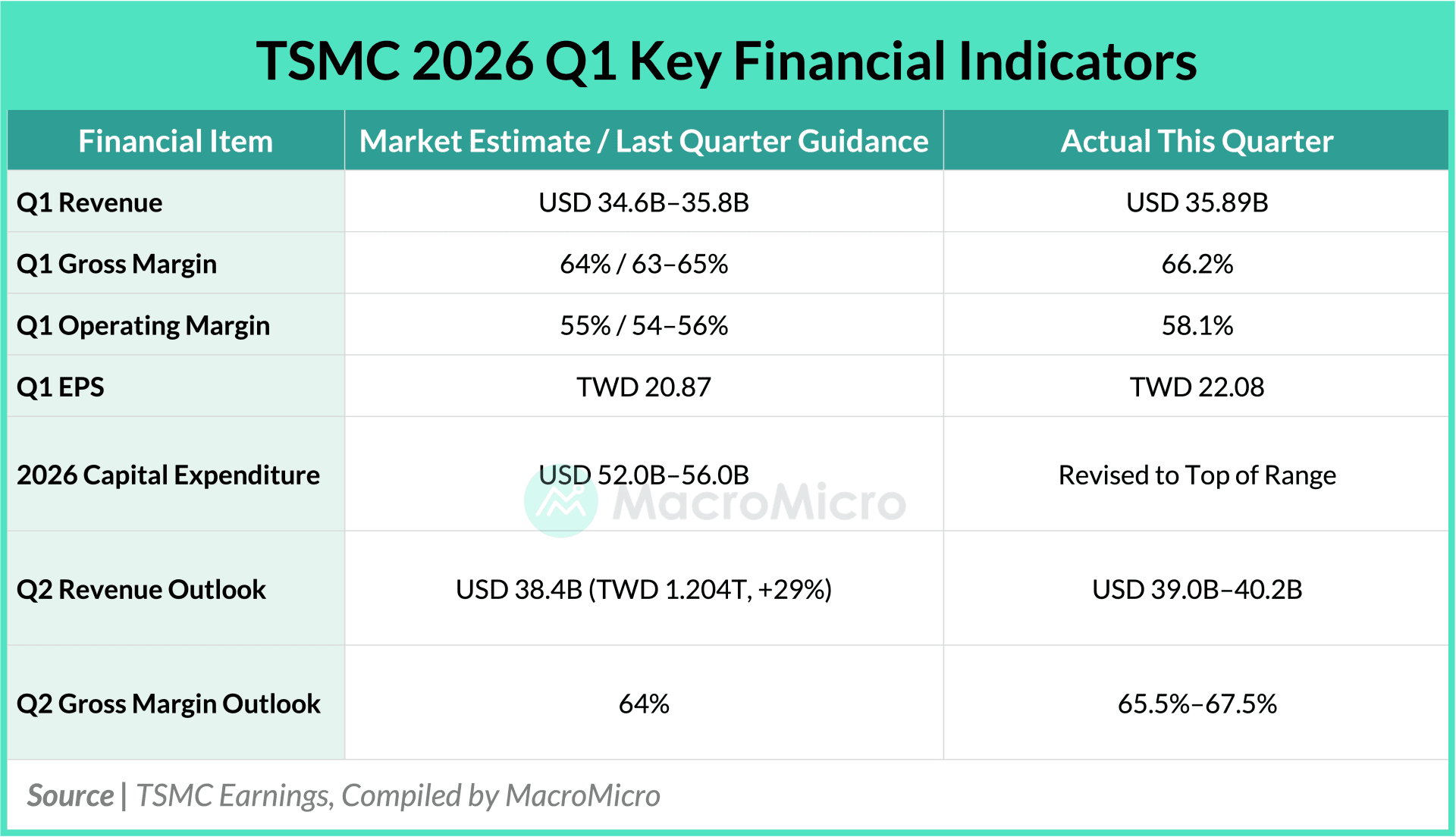
- TSMC reported 1Q26 revenue of TWD 1.13 trillion, up 35.1% YoY, significantly exceeding market expectations. Growth was driven by strong HPC demand and price increases for advanced nodes implemented earlier this year. Gross margin and operating margin rose to 66.2% (vs. 62.3%) and 58.1% (vs. 54%), respectively, while diluted EPS reached TWD 22.08, all well above expectations.
- A key focus of the call was the evolution of AI demand toward “Agentic AI.” This led TSMC to revise upward its long-term CAGR for AI accelerator revenue from 50% to 56%–59%, while also guiding capital expenditure toward the high end of its range.
- Inventory days rose slightly, reflecting proactive inventory buildup and a shift in product mix toward higher-margin products. The AI supply chain remains tight, with demand expanding from GPUs and HBM into CPUs and power management ICs. With capex expansion, demand is now further extending into semiconductor equipment.
I. TSMC Q1 2026 Operational Performance & Revenue Outlook
Results Once Again Beat Expectations
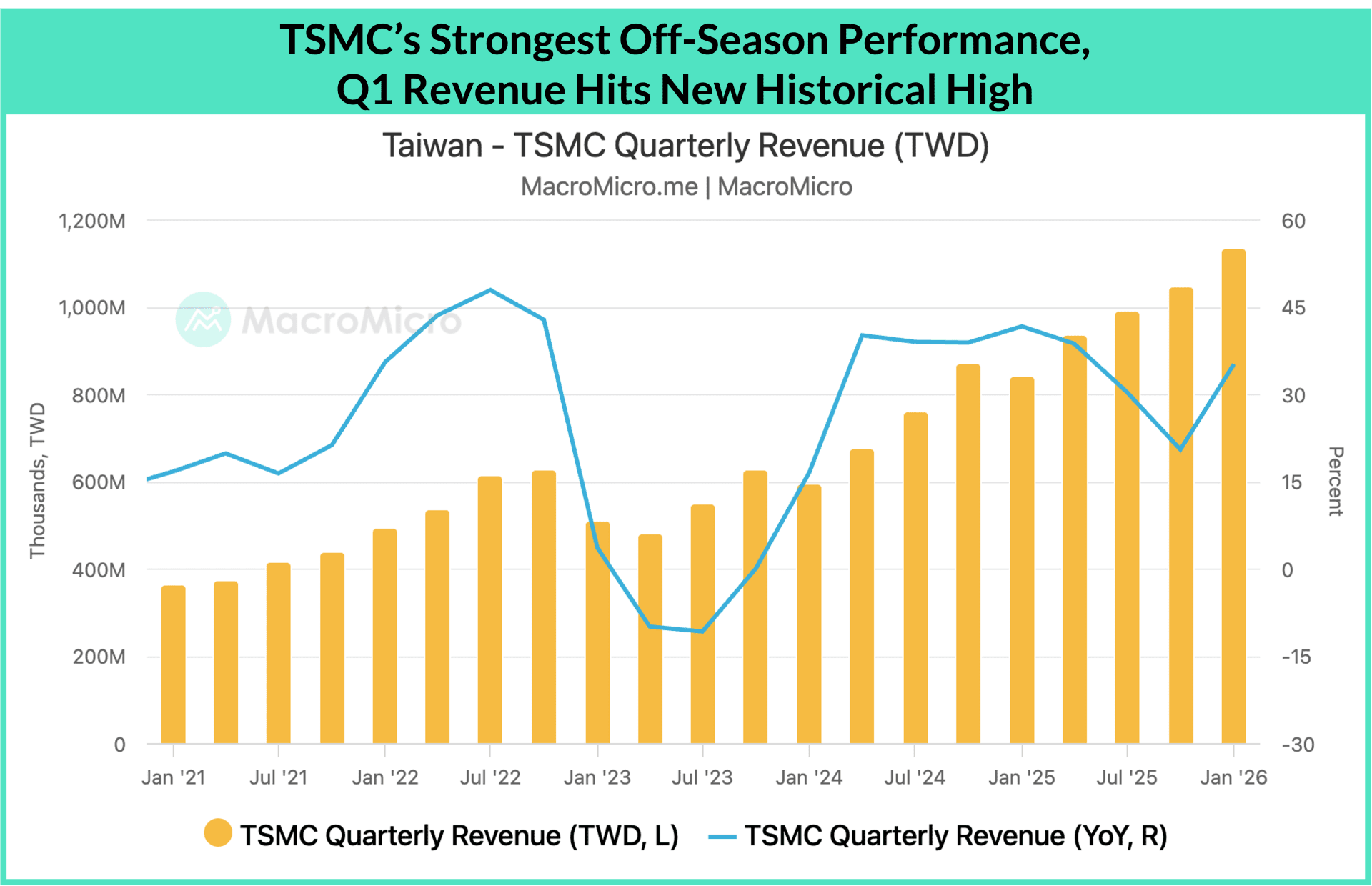
TSMC's Q1 2026 revenue reached 1.13 trillion NTD, representing a quarter-over-quarter increase of 8.6% (compared to the previous 5.6%) and a year-over-year increase of 35.1% (compared to the previous 20.4%). Revenue in US dollars reached 35.89 billion USD, a year-over-year increase of 40.6% (compared to the previous 25.5%), beating market expectations of 34.6 to 35.8 billion USD. In addition to benefiting from strong HPC demand, this was also driven by the price hikes for advanced nodes earlier in the year. The gross margin and operating margin rose to 66.2% (from 62.3%) and 58.1% (from 54%), respectively, both far exceeding the financial guidance of 63% to 65% and 54% to 56%. Diluted EPS was 22.08 NTD (from 19.5 NTD), significantly outperforming the market expectation of 20.87 NTD.
-
From a technology platform perspective, the revenue support from HPC increased significantly, accounting for a record high of 61% (from 55%) with a stellar quarter-over-quarter growth rate of 20% (from 4%). Meanwhile, the smartphone segment's share declined to 26% (from 32%) due to seasonality, reflecting a quarter-over-quarter decrease of 11% (from an 11% increase). Automotive electronics and consumer electronics accounted for 4% (from 5%) and 1% (from 1%) respectively. The former saw a quarter-over-quarter decrease of 7% (from a 1% decrease), while the latter saw a quarter-over-quarter increase of 28% (from a 22% decrease), indicating slowing automotive demand and a recovery in consumer electronics inventory restocking.
-
Looking at process nodes, advanced nodes (N10 and below) stably maintained a share of over 70%, coming in at 74%. The N3 share pulled back to 25% (from 28%), reflecting the off-season demand for smartphones. The N4/N5 share remained stable at 36% (from 35%). Going forward, we will continue to see AI customers successively transitioning to the...
Is the AI megatrend just getting started? This in-depth analysis of TSMC’s rare capacity expansion, the upgrade to Agentic AI demand, updated long-term growth forecasts, and the broadening semiconductor recovery is exclusive to MM Max subscribers. Unlock full access to this report, proprietary data insights, and our continuing coverage of the AI supply chain and semiconductor cycle. Subscribe Now»
Already a subscriber? Click here to log in.
Full Access to Our Services

Comprehensive data at your service
with key indicators for investment insights

Exclusive flash reports
on key events and data

Create your own charts and analysis
including performance backtesting

Hub of professionals to engage
in meaningful discussions and insights
 Get answers from MM AI.
-
How did TSMC's 1Q26 revenue and EPS compare to market expectations?
💡TSMC's 1Q26 revenue reached TWD 1.13 trillion, up 35.1% YoY, significantly exceeding market expectations, and in USD terms, it was $35.89 billion, surpassing market estimates of $34.6 to $35.8 billion. Diluted EPS also significantly outperformed expectations at TWD 22.08, compared to a market expectation of TWD 20.87.
-
What factors drove TSMC's strong Q1 2026 financial performance?
💡TSMC's strong Q1 2026 financial performance was primarily driven by robust High-Performance Computing (HPC) demand and price increases implemented for advanced nodes earlier in the year. This resulted in gross margin and operating margin rising to 66.2% and 58.1% respectively, both well above financial guidance.
-
What is TSMC's revenue forecast for Q2 and the full year 2026?
💡TSMC projects Q2 2026 revenue to be between $39.0 and $40.2 billion USD, indicating a year-over-year growth of 29.7% to 33.7%, which is far above the market expectation of $38.4 billion USD. For the full year 2026, the company revised its revenue growth forecast upward from 30% to "over 30%".
-
How is Agentic AI demand influencing TSMC's capital expenditure plans?
💡Agentic AI demand is significantly influencing TSMC's capital expenditure plans, leading the company to guide its capital expenditure toward the high end of its $52.0 to $56.0 billion USD range. This reflects strong confidence in long-term AI trends, with future Capex expected to be significantly higher than the past three years.
-
What is TSMC's strategy for increasing N3 advanced node capacity?
💡TSMC's strategy for increasing N3 advanced node capacity involves actively adding capacity, a departure from its historical approach. This includes converting some N5 equipment to support N3 in Taiwan and planning to introduce N3 technology to its second fab in Arizona, US, and its fab in Japan, with volume production expected in the second half of 2027 and 2028, respectively.
-
What is the current status of CoWoS advanced packaging capacity?
💡CoWoS advanced packaging capacity is currently extremely tight, prompting TSMC to strive to increase its own capacity and collaborate closely with Outsourced Semiconductor Assembly and Test (OSAT) partners. For next-generation CoWoS technology, a pilot line has been established, with formal production expected in the next few years.
-
What is the impact of geopolitical conflicts on TSMC's operations and supply chain?
💡TSMC stated that geopolitical conflicts, specifically the Middle East conflict, will not materially impact short-term operations due to government support and diversified supply chain collaboration. The company maintains diversified sourcing channels for specialty chemicals and gases, and Taiwan's natural gas reserves can last until May, with TSMC actively expanding backup power mechanisms.
-
How does TSMC's current inventory reflect its product mix and pricing power?
💡TSMC's current inventory, stabilizing at 70.5 days, reflects a healthy product mix shifting towards high-value, high-performance chips, as indicated by a 15% quarter-over-quarter growth in gross profit far outpacing an 8% sequential increase in inventory. This demonstrates the company's strong pricing power and robust demand for advanced nodes and CoWoS.
-
How is AI demand expanding beyond GPUs into other semiconductor components?
💡AI demand is expanding beyond GPUs into a more diverse range of semiconductor components, now encompassing CPUs, power management ICs (PMICs), and cooling solutions. This broader demand is driven by the needs of industrial automation, energy infrastructure, and AI data center power management, as well as the increasing hardware requirements for "Agentic AI" in high-performance CPUs.
-
How do Taiwan's Q1 export data align with NVIDIA's GB300 production schedule?
💡Taiwan's Q1 export data align perfectly with NVIDIA's GB300 production schedule, showing a significant alleviation of inventory concerns. Despite being the traditional off-season, export value reached $195.7 billion USD, a 51.1% year-over-year increase, with electronic components growing 42.7% and ICT products growing 102% year-over-year, indicating strong shipments of AI servers and components.

