US Earnings: Is Software Back, and Is the Pricing-Up Narrative Over? A Guide to Understanding Capital Rotation
What You Should Know
According to FactSet, as of Friday, August 7, 88% of S&P 500 constituents had reported their Q2 earnings, with 86% of companies posting EPS above expectations. These figures are both above the five-year average of 78% and the 10-year average of 76%, while the magnitude of the earnings surprise reached as high as 29.2%. Following the record set in Q1, Q2 has continued to set a new all-time high since FactSet began tracking this indicator in 2008. Behind the strong overall results, how did individual sectors perform? Which groups were responsible for the upside surprises this time around? And how should investors adjust their positioning going forward? This article provides a comprehensive analysis.
Key Takeaways
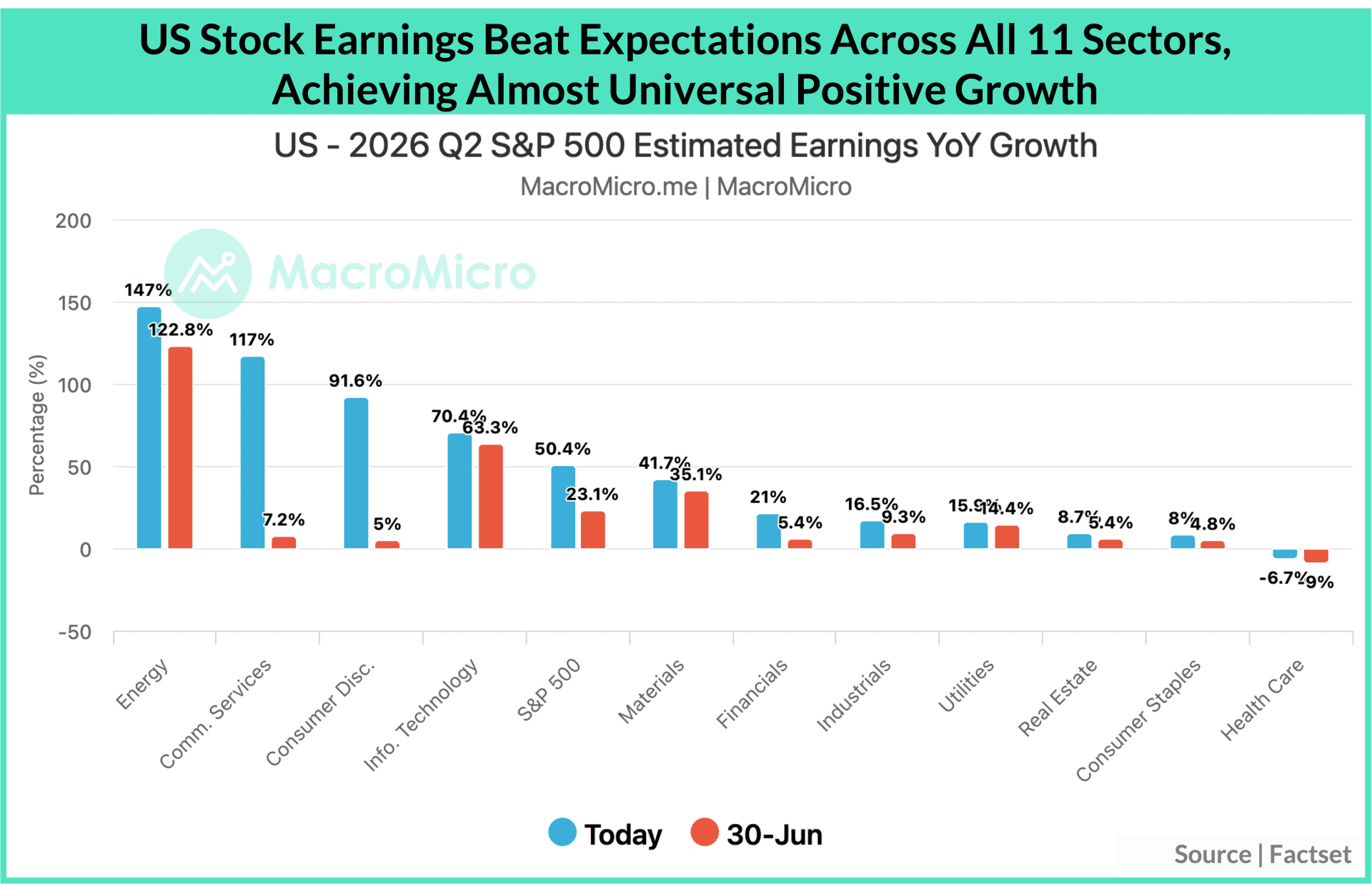
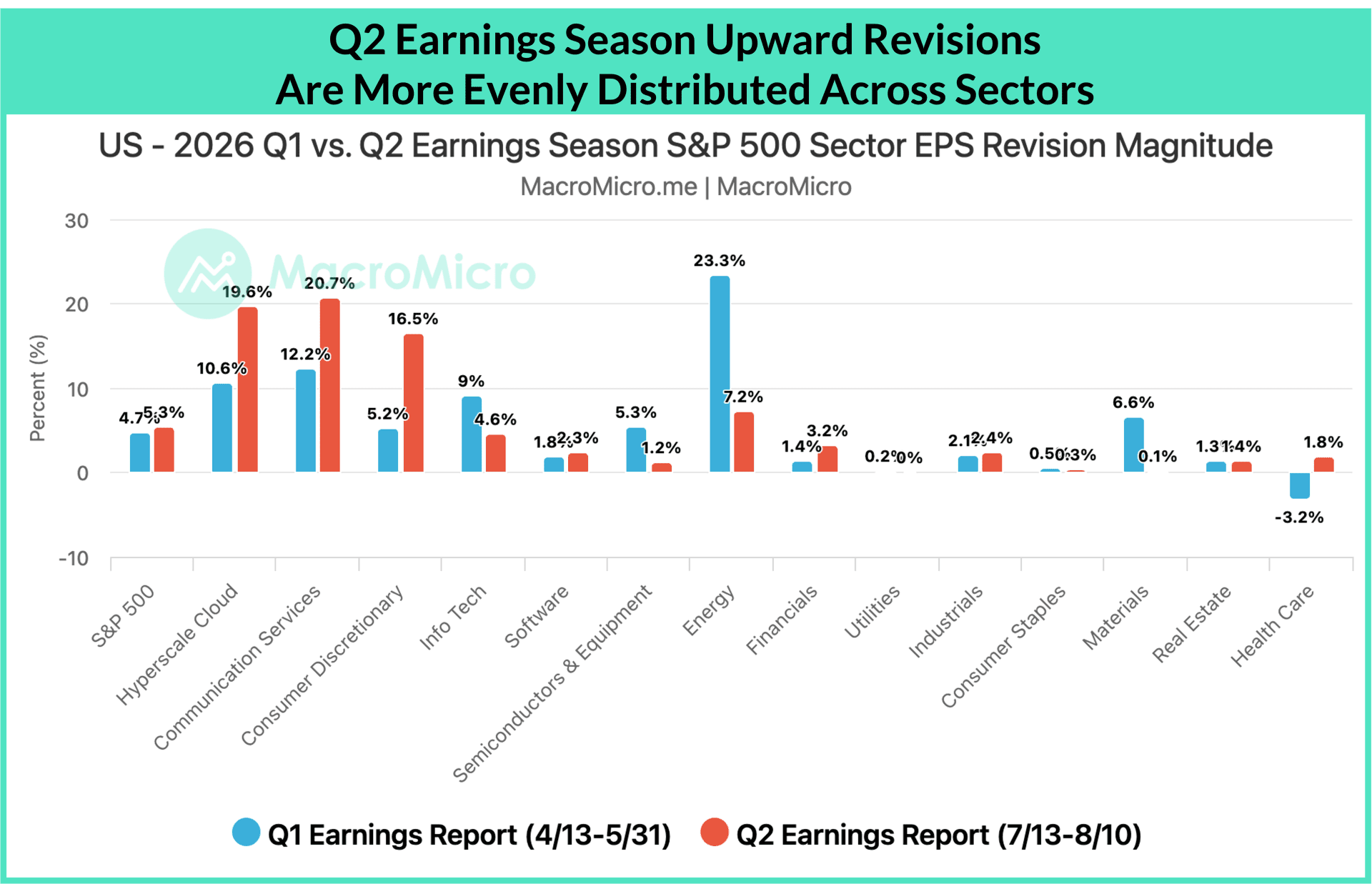
- US earnings overview: This earnings season, revenue and earnings growth reached 15.0% and 50.4% YoY, respectively, both marking their strongest growth since 2021. Across the 11 major sectors, 10 delivered positive earnings growth, with as many as eight recording double-digit growth. Upward earnings revisions were also more evenly distributed across sectors, indicating that earnings momentum is spreading to a broader range of industries.
- Positioning strategy: The economy remains in an expansion phase, a key characteristic of which is that earnings growth gradually spreads from a small number of leading companies to the broader economy. Market capital also rotates more frequently across sectors. We also examine the recent shift in the core narrative across the upstream, midstream, and downstream AI value chain, as well as the corresponding sector allocation implications.
I. Q2 Earnings Set Another Record for Upward Revisions as Earnings Momentum Broadens
Nearly 90% of S&P 500 companies have now reported their Q2 2026 earnings. Revenue and earnings growth reached 15.0% and 50.4% YoY, respectively, both marking their strongest growth since 2021. Even excluding the combined $151.4 billion in other income reported by Alphabet and Amazon, primarily gains from equity investments in private companies, overall earnings growth remained a solid 32%, indicating that US equities continue to have a sound fundamental backdrop. Across the 11 major sectors, 10 delivered positive earnings growth, with as many as eight posting double-digit growth. Energy, Communication Services, Consumer Discretionary, and Information Technology were the primary growth engines this quarter.
Looking more closely at the magnitude of Earnings Surprises compared with the previous earnings season, Q2 performance from the hyperscalers was even stronger than in Q1. Semiconductor earnings surprises, by contrast, narrowed from the previous quarter, while software has exceeded expectations for two consecutive quarters. Outside technology, Energy continued to make a significant contribution to upward revisions in index earnings, while Financials also outperformed expectations. Below, we examine the technology and non-technology sectors separately:
 Note: Earnings Surprise refers to the difference between a company's actual earnings per share (EPS) and the market consensus estimate. When the surprise is negative, it simply means that "actual earnings fell short of the market's original high expectations." It does not mean that the company's earnings deteriorated or that it posted a loss, as operating performance may still be higher than in the previous quarter or the same period last year.
Technology: CSP Giants Demonstrate AI Monetization, While Software Earnings Disprove the SaaS Apocalypse Narrative
In this earnings season, Communication Services and Information Technology, which are most directly linked to the development of AI technology, continued to rank among the strongest performers. Communication Services posted earnings growth of as much as 117.0%, second only to Energy, while Information Technology followed closely at 70.4%. In addition, one of the major contributors to the upside earnings surprise this season was Amazon. As a result, the Consumer Discretionary sector, where Amazon is classified, also recorded an impressive 91.6% earnings growth rate.
Breaking down the AI supply chain, the upstream hardware layer is undoubtedly...
From record-breaking earnings growth to a broadening rotation beyond the Magnificent 7, US equities are entering a phase where earnings momentum is spreading across sectors. Explore how the AI investment cycle is shifting from supply bottlenecks and pricing power toward technological leadership, monetization, and software, and what these changes mean for portfolio positioning. Unlock full access to this report, proprietary macro data insights, and ongoing market coverage with MM Max. Subscribe Now»
Already a subscriber? Click here to log in.
Full Access to Our Services

Comprehensive data at your service
with key indicators for investment insights

Exclusive flash reports
on key events and data

Create your own charts and analysis
including performance backtesting

Hub of professionals to engage
in meaningful discussions and insights
 Get answers from MM AI.
-
How did S&P 500 companies perform in Q2 earnings compared to expectations?
💡S&P 500 companies demonstrated exceptional performance in Q2 earnings, with 86% of companies reporting EPS above expectations, significantly surpassing the five-year average of 78% and the 10-year average of 76%. The magnitude of this earnings surprise reached a remarkable 29.2%, marking a new all-time high since FactSet began tracking this indicator in 2008. This broad-based outperformance signals a robust fundamental backdrop for US equities, as nearly 90% of constituents have reported strong results, reflecting a widespread positive trend across industries.
-
How did technology sector earnings, including CSPs and software, perform in Q2?
💡Technology sector earnings, particularly for Communication Services and Information Technology, performed exceptionally well in Q2, with Communication Services achieving 117.0% earnings growth and Information Technology following at 70.4%. CSP giants like Amazon AWS, Microsoft Intelligent Cloud, and Google Cloud reported revenue growth of 37%, 32%, and 82%, respectively, demonstrating AI monetization entering a harvest phase. Software companies also defied the "SaaS apocalypse" narrative, with Palantir's revenue reaching a record $1.94 billion, up 93% YoY, and Cloudflare reporting a more than 1,700% increase in daily AI Agent requests, indicating strong performance driven by AI demand.
-
What impact is model profitability compression having on the downstream software value?
💡Model profitability compression in the downstream software value, driven by intense pricing competition from Chinese open-source models like Moonshot AI's Kimi K3 and DeepSeek V4 Flash, is forcing frontier labs to implement defensive price cuts. While this compresses the intelligence premium in tokens and impacts the model layer's profit structure in the short term, it is ultimately beneficial for extending the productivity cycle and accelerating mature technological adoption. This compression shifts the focus to the application layer, which is demonstrating stronger performance, as evidenced by robust software company earnings, validating that lower model prices can unlock broader demand and new applications.
-
How does the Jevons Paradox explain increased AI demand despite lower model prices?
💡The Jevons Paradox explains increased AI demand despite lower model prices by demonstrating that when the cost of a resource (like "intelligence" per token) decreases, its overall consumption can increase significantly, unlocking much larger and broader latent demand and entirely new applications. The DeepSeek moment in early 2025, with lower model prices, led to continuous new highs in token usage on third-party platforms like OpenRouter, proving that reduced prices do not signal an end to demand but rather stimulate its expansion. This paradox suggests that cheaper AI intelligence can transform into a "General Purpose Technology," driving long-term economic growth by redefining efficiency.
-
Which investment strategies are recommended for an expansionary economic environment?
💡For an expansionary economic environment, recommended investment strategies emphasize diversification and flexible sector positioning due to broadening earnings growth and increased sector rotation. While technology remains a core allocation, investors should focus on technological leadership, monetization speed, and ecosystem integration capabilities within AI, rather than just pricing-up beneficiaries. The portfolio should balance offensive sectors, which benefit when risk appetite rises, with defensive allocations, which demonstrate resilience during cautious market sentiment. This approach moves beyond betting on single narratives, ensuring a more balanced and adaptable strategy amid market volatility and spreading earnings momentum.
-
How has the market's capital rotation affected sector performance beyond the M7?
💡The market's capital rotation has led to improving earnings for the other 493 S&P 500 companies, significantly broadening earnings growth beyond the M7-dominated performance of the past two to three years. This shift is evident even as the Philadelphia Semiconductor Index fell by nearly 30% in less than two months, with the S&P 500 reaching new highs, indicating capital has rotated from previously strong areas like semiconductors and hardware into other sectors. This trend aligns with an expansionary economy where earnings growth spreads from leading companies to the broader market, diversifying performance across industries.
-
What is the updated guidance for S&P 500 EPS in Q3 2026?
💡As of August 7, 2026, the updated guidance for S&P 500 EPS in Q3 2026 is largely positive, with approximately 67% of the 75 companies that provided guidance issuing positive outlooks. This figure significantly exceeds the five-year average of 42% and the 10-year average of 40%. This widespread optimism in corporate outlooks indicates confidence in continued earnings momentum and aligns with the broader trend of expanding earnings growth across various sectors, suggesting a robust outlook for the upcoming quarter.
-
Which specific companies demonstrated strong AI monetization in their Q2 results?
💡Several specific companies demonstrated strong AI monetization in their Q2 results. Amazon AWS, Microsoft Intelligent Cloud, and Google Cloud reported robust revenue growth of 37%, 32%, and 82%, respectively, indicating that AI infrastructure investments are entering a harvest phase. SpaceX announced its AI division's adjusted EBITDA turned positive at $1.1 billion. In software, Palantir's Q2 revenue hit a record $1.94 billion, up 93% YoY, and Cloudflare noted a more than 1,700% increase in daily AI Agent requests, showcasing tangible AI-driven revenue and cash flow conversion.
-
How did oil prices in Q2 2026 affect the Energy sector's earnings growth?
💡Oil prices in Q2 2026 significantly boosted the Energy sector's earnings growth, reaching 147.0% year-over-year. The average oil price rose 45% to $92.55 per barrel compared to $63.68 in the same period last year, primarily driven by the US-Iran conflict. This surge in oil prices directly supported substantial growth in the refining and oil and gas exploration industries, making Energy a primary growth engine for the S&P 500 in Q2.
-
What role did investment banking fees play in the Financials sector's Q2 performance?
💡Investment banking fees played a crucial role in the Financials sector's Q2 performance, contributing to its 21.0% earnings growth and 11.7% revenue growth. Strong financing demand, largely driven by AI development, fueled a wide range of activities including large M&A transactions, IPOs, and equity and debt underwriting. Specifically, investment banking fees at Goldman Sachs and J.P. Morgan increased by 55% and 30% year-over-year, respectively, reflecting robust activity and demonstrating the sector's benefit from capital market engagements tied to technological advancements.
