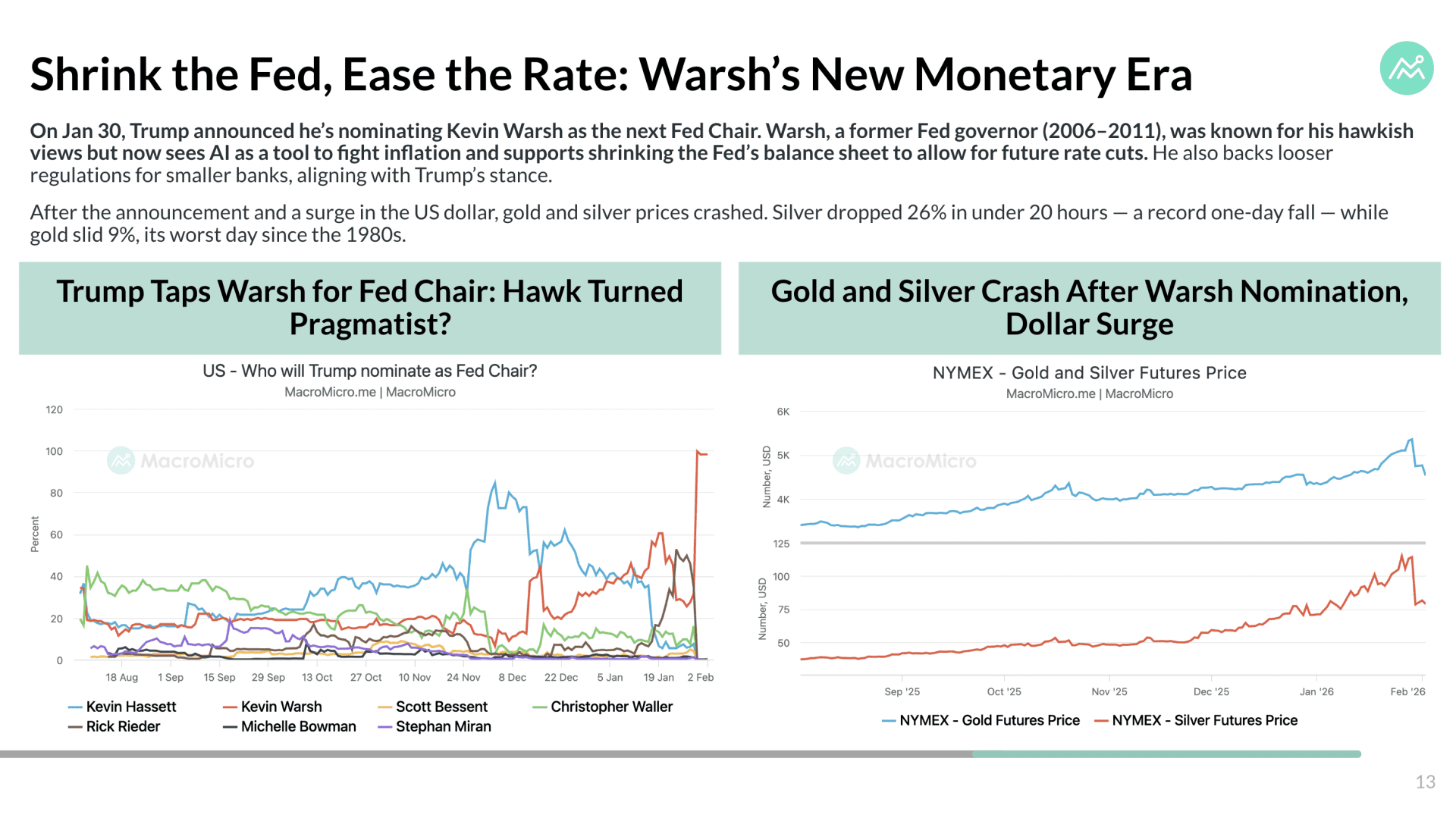
Trump’s nomination of Kevin Warsh as Fed Chair on Jan 30 triggered a historic plunge in precious metals. Silver dropped 26% in under 20 hours; gold saw its worst day since the 1980s — driven by Warsh’s hawkish image, AI-driven disinflation talk, a surging dollar, and leveraged unwinding. Will Warsh really change U.S. monetary policy? Is this a lasting reversal for gold and silver? This week’s WEFC takes a closer look.
1. The Warsh Shock: Precious Metals Reset
President Trump’s nomination of Kevin Warsh as Fed Chair on January 30 triggered a historic crash in precious metals as markets reacted to his hawkish reputation and plans for AI-driven disinflation. Silver plummeted 26% in under 20 hours and gold suffered its worst daily drop since the 1980s, fueled by a surging US dollar and leveraged liquidations. Despite this shock, we view the sell-off as a short-term correction within a long-term bull market, supported by persistent fiscal deficits and anticipated rate cuts later in 2026.
2. January 2026 FOMC Meeting: Key Takeaways
The Federal Reserve held interest rates steady at 3.50%–3.75% in a 10-2 vote at its January meeting. While governors Miran and Waller favored a cut, the majority pivoted to a 'data-dependent' pause following three consecutive reductions.
The FOMC upgraded its outlook to "solid" growth, noting that the unemployment rate has stabilized at 4.4%. While core PCE remains elevated at 3.0% due to temporary tariff shocks, the Fed expects inflation to peak by mid-year. To ensure stability, the Fed continues purchasing $40B/month in T-bills, maintaining reserves above $3T. Markets now anticipate a hold through H1, with potential easing in late 2026.
3. Hardware vs. Software: The AI Monetization Gap Widens
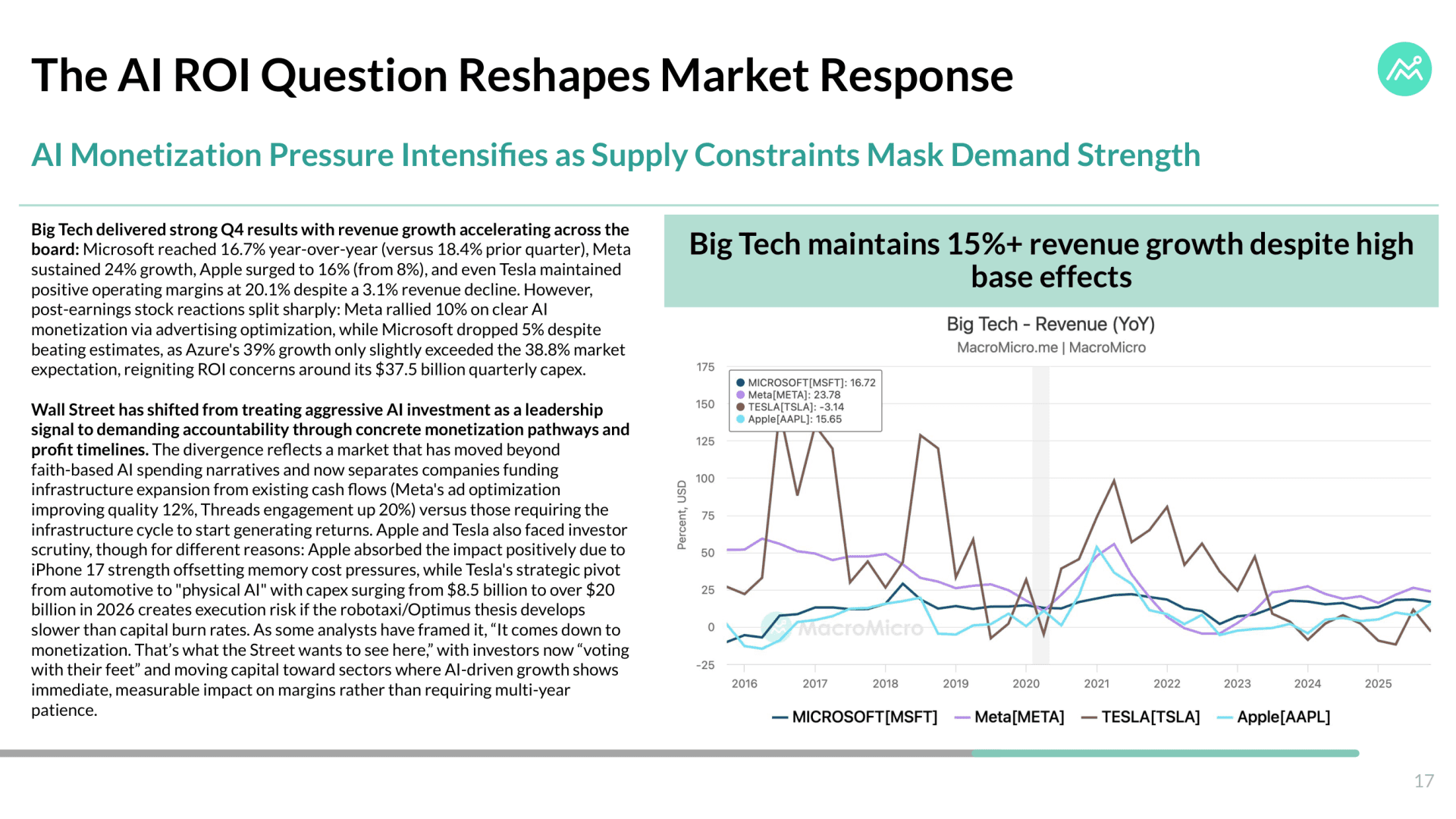
The tech sector is facing a structural divergence as AI Agents disrupt traditional SaaS "per-seat" pricing models, shifting value toward infrastructure and systems of record. While both hardware and software sectors have increased capital intensity to 20%, hardware companies are sustaining 20% revenue growth compared to just 10% in software. This has triggered an aggressive capital rotation into semiconductors and memory, while software valuations have tumbled to six-month lows as investors favor tangible returns over unproven software monetization.
About Weekly Economic and Financial Commentary (WEFC)
The MacroMicro WEFC cuts through the noise, delivering rigorous analysis and in-depth insights on the most critical market-moving events. These topics cover equities, foreign exchange, bonds, commodities, global central banks, international political economy, and more.
At the core of WEFC is a concise Chart Pack, enabling you to grasp market trends at a glance.
Already a subscriber? Click here to log in.
Full Access to Our Services

Comprehensive data at your service
with key indicators for investment insights

Exclusive flash reports
on key events and data

Create your own charts and analysis
including performance backtesting

Hub of professionals to engage
in meaningful discussions and insights
 Get answers from MM AI.
-
What caused the historic plunge in precious metals on January 30, 2026?
💡The historic plunge in precious metals on January 30, 2026, was caused by President Trump’s nomination of Kevin Warsh as Fed Chair, driven by market reactions to Warsh's hawkish image, discussions about AI-driven disinflation, a surging US dollar, and leveraged unwinding. This event led to silver dropping 26% in under 20 hours and gold experiencing its worst day since the 1980s.
-
What sustained the long-term bull market for gold and silver despite the Warsh shock?
💡The long-term bull market for gold and silver was sustained despite the Warsh shock by persistent fiscal deficits and the anticipation of future interest rate cuts later in 2026. These macroeconomic factors are expected to provide ongoing support for precious metals, indicating that the recent sell-off was a temporary correction rather than a fundamental reversal.
-
What was the outcome of the January 2026 FOMC meeting regarding interest rates?
💡The January 2026 FOMC meeting resulted in the Federal Reserve holding interest rates steady at 3.50%–3.75%, following a 10-2 vote. The majority pivoted to a 'data-dependent' pause after three consecutive reductions, with governors Miran and Waller being the only members to favor a rate cut.
-
When do markets anticipate potential interest rate easing from the Fed?
💡Markets now anticipate potential interest rate easing from the Fed in late 2026, following a projected hold through the first half of the year. This expectation stems from the Fed's pivot to a 'data-dependent' pause after three consecutive reductions and its assessment of inflation peaking by mid-year.
-
What is the key divergence between hardware and software sectors in capital intensity and revenue growth?
💡The key divergence between hardware and software sectors is seen in capital intensity and revenue growth. Both sectors have increased capital intensity to 20%, but hardware companies are sustaining 20% revenue growth, double the 10% seen in software. This indicates that hardware is translating increased capital investment into stronger top-line performance.
