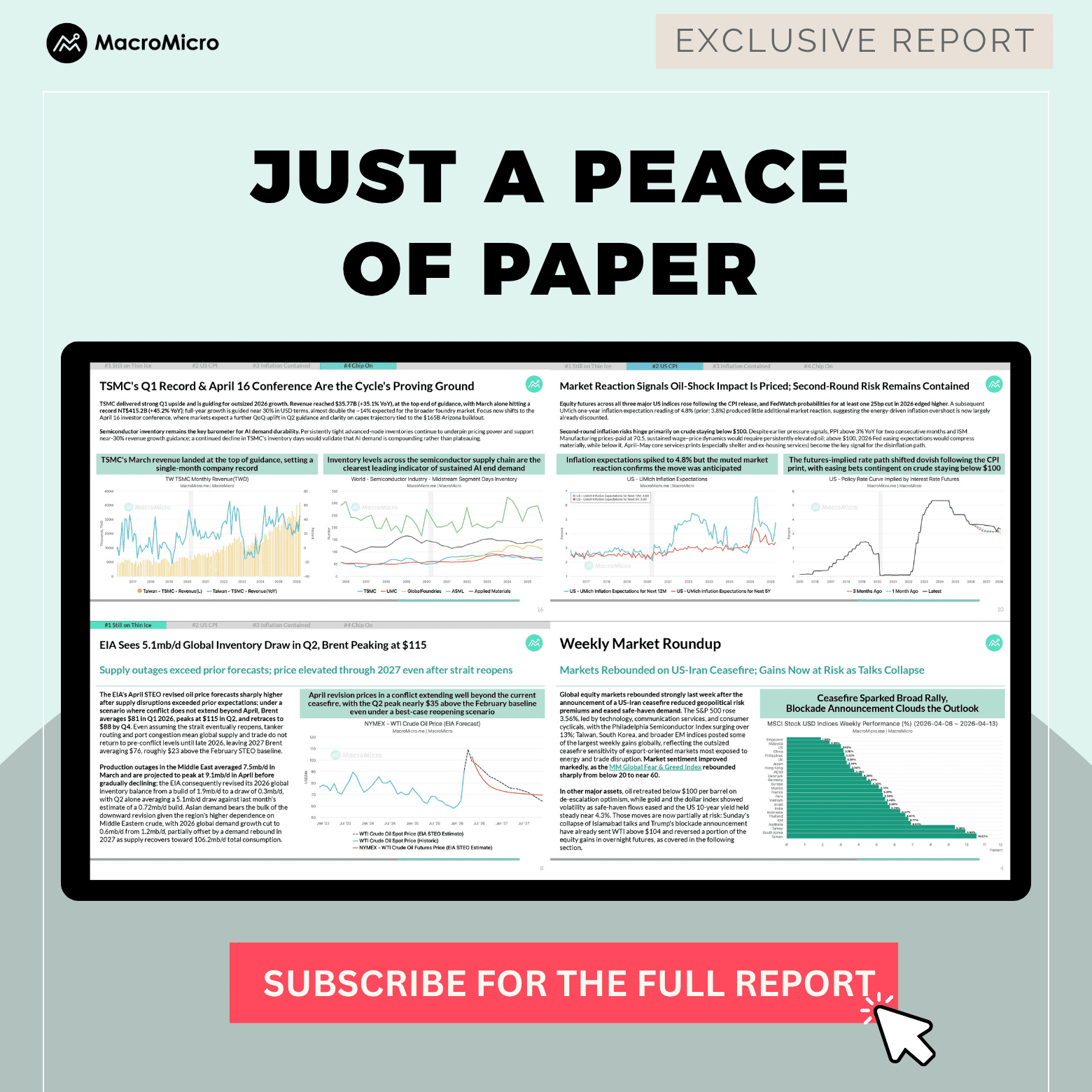
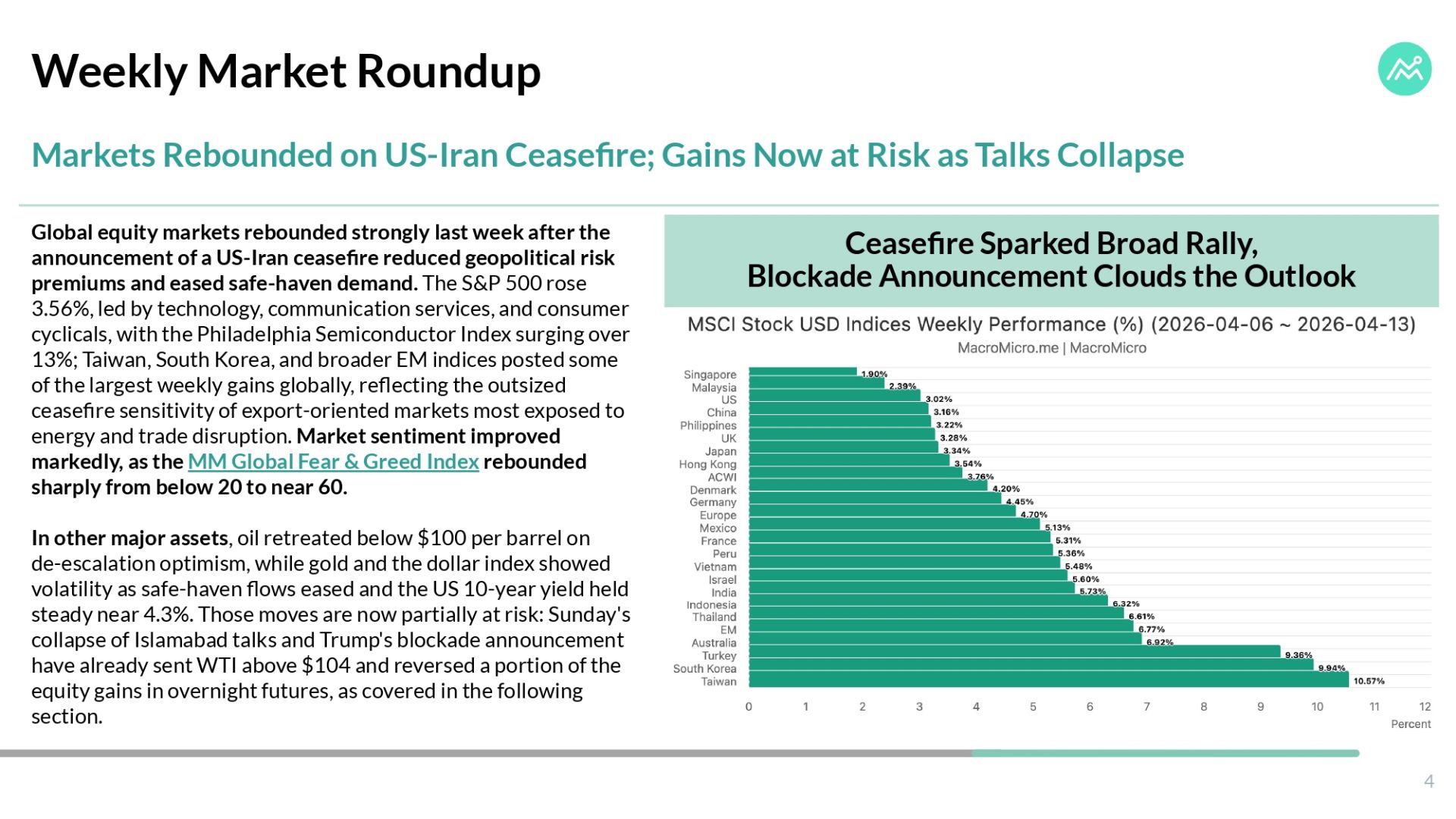
Last week's US–Iran ceasefire felt, for a few days, like it might actually hold: markets ripped, oil fell below $100, and the fear gauge shot from the floor to nearly neutral. Then Sunday happened. Twenty-one hours of talks in Islamabad, and VP Vance, Witkoff, and Kushner walked out empty-handed. Trump announced a full naval blockade of Hormuz effective this morning. Iran said it won't allow it. WTI is back above $104. The ceasefire was, apparently, just a peace of paper. This week's WEFC unpacks what the blockade means for oil markets, what March CPI actually said beneath the headline, and why Taiwan and Korea just broke export records at the same time.
Energy Lit the Headline, But Core Held Its Ground
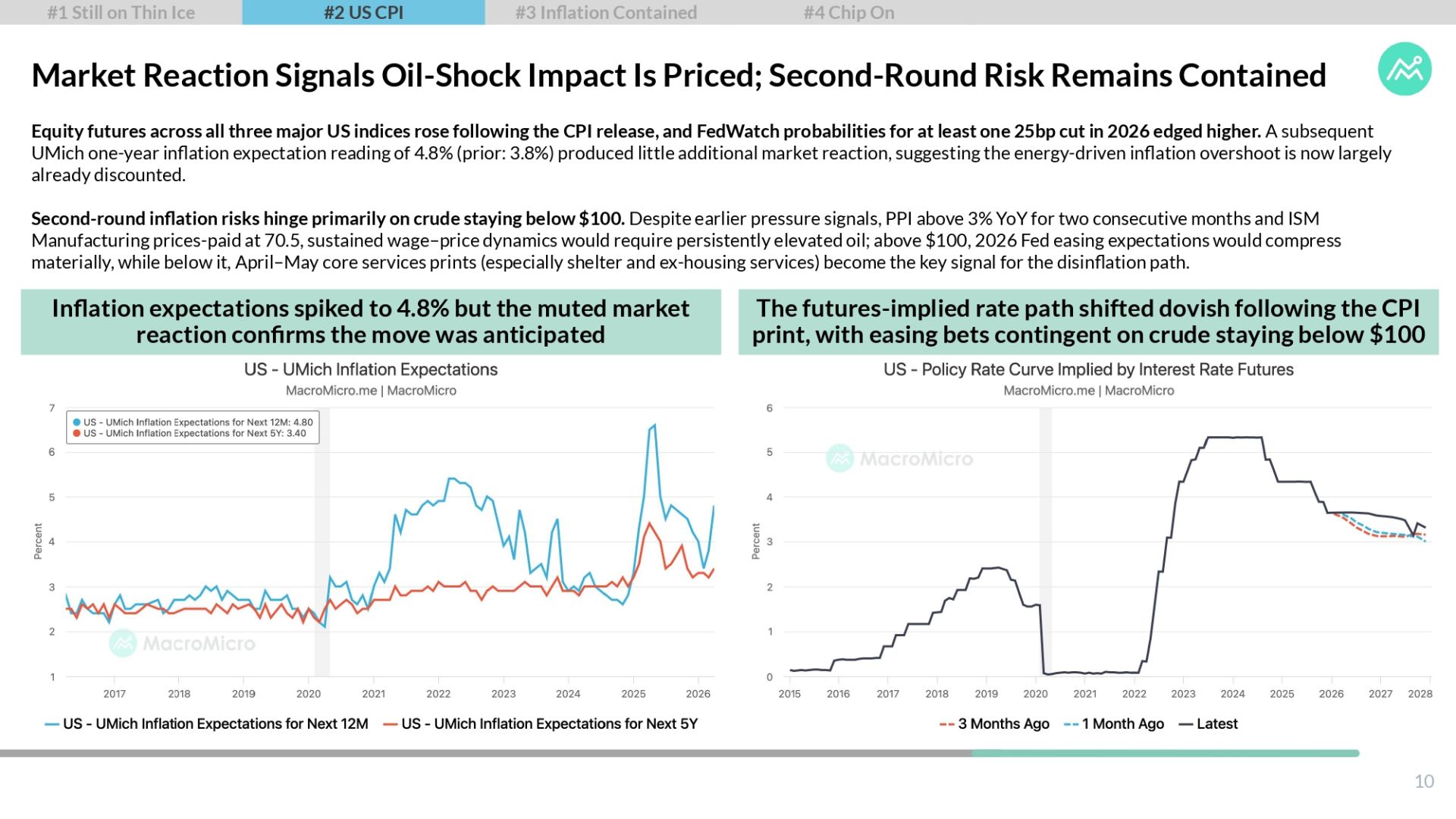
March CPI came in at 3.3% year-over-year, a number that looks alarming until you strip out energy, which surged 10.9% in a single month, the highest reading since 2005. Core printed 2.6% YoY and 0.2% MoM, beating consensus on both. More importantly, core services decelerated sequentially for the second straight month. Markets read the print constructively, equity futures rose, and FedWatch odds for at least one 2026 cut edged higher. The energy shock appears largely pre-priced. Whether it stays that way depends almost entirely on whether crude can hold below $100, a threshold that looks a lot less secure this morning than it did Friday.
The Other Inflation Story: Tariffs and AI Capex
Beyond oil, two narrower but real inflation pressures are worth watching. Tariff pass-through has already pushed PPI for steel up 22% and aluminum up 41% since end-2024. Separately, AI-driven data center buildout has sent electronic component PPI surging nearly 20% year-over-year. Neither is showing signs of bleeding into the sticky components that would constitute a genuine broadening, and shelter disinflation continues to do heavy lifting on the other side of the ledger. The policy question is less about whether prices are rising and more about whether the Fed, under incoming chair Warsh, treats this mix as transitional or structural.
Taiwan and Korea Just Broke Export Records. Simultaneously.
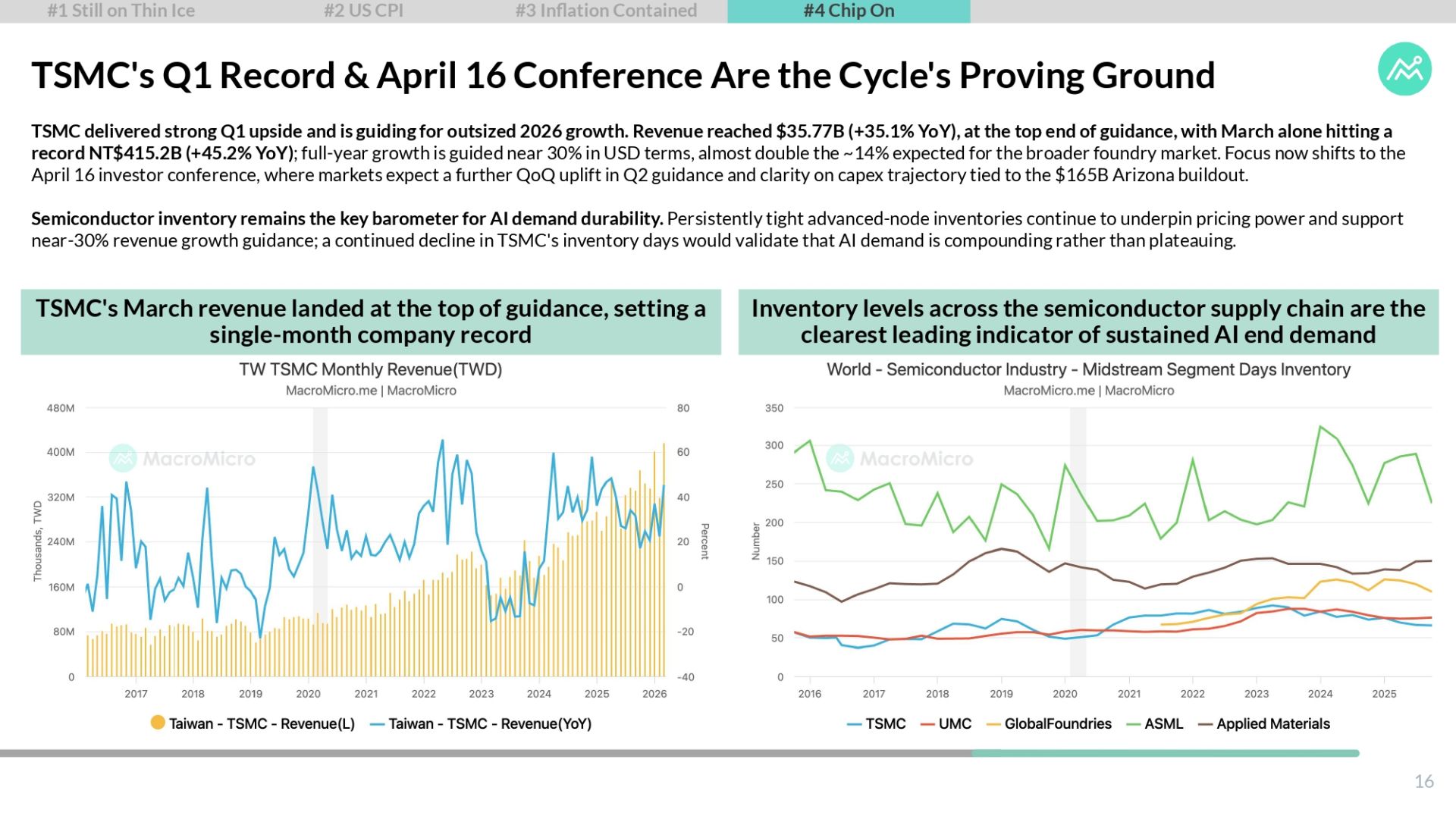
Taiwan's March exports hit $80.1 billion, up 61.8% year-over-year, nearly double consensus. Korea posted $86.1 billion, up 48.3%. In both cases, the outperformance traces almost entirely to AI-linked semiconductors and ICT hardware, while traditional categories like base metals, chemicals, and home appliances contracted. Critically, the acceleration is geographically uniform, US, China, ASEAN, and Europe all surging — which rules out tariff front-loading as the driver. This looks like structural hyperscaler capex cycling through the full supply chain. TSMC's April 16 investor conference is the next proving ground.

Already a subscriber? Click here to log in.
Full Access to Our Services

Comprehensive data at your service
with key indicators for investment insights

Exclusive flash reports
on key events and data

Create your own charts and analysis
including performance backtesting

Hub of professionals to engage
in meaningful discussions and insights
 Get answers from MM AI.
-
What was the year-over-year increase in March CPI, and what caused it?
💡March CPI increased by 3.3% year-over-year, primarily driven by a significant 10.9% surge in energy prices within a single month, marking the highest reading since 2005. This energy shock largely accounted for the elevated headline inflation figure.
-
Did core services inflation accelerate or decelerate sequentially in March?
💡Core services inflation decelerated sequentially for the second consecutive month in March. This deceleration is a key indicator that underlying inflationary pressures in the services sector are easing, which markets read constructively alongside the overall CPI report.
-
How did markets react to the March CPI report regarding equity futures and FedWatch odds?
💡Markets reacted constructively to the March CPI report, with equity futures rising and FedWatch odds for at least one 2026 interest rate cut edging higher. The energy shock appears largely pre-priced, suggesting investors view the core inflation data favorably despite the headline increase.
-
What specific inflation pressures are arising from tariffs on steel and aluminum?
💡Tariffs on steel and aluminum are creating specific inflation pressures, with PPI for steel increasing by 22% and aluminum by 41% since the end of 2024. These pass-through effects are noted as narrower but real inflation pressures, although they are not yet bleeding into sticky components.
-
How is AI-driven data center buildout affecting electronic component PPI?
💡AI-driven data center buildout is significantly affecting electronic component PPI, which has surged nearly 20% year-over-year. This increase is a distinct inflationary pressure, driven by the structural hyperscaler capex cycling through the full supply chain, separate from broader inflation trends.
-
How might incoming Fed chair Warsh view the current inflation mix: transitional or structural?
💡Incoming Fed chair Warsh will face the policy question of whether to treat the current inflation mix—characterized by energy shocks, tariff pass-throughs, and AI-driven component price surges alongside shelter disinflation—as transitional or structural. This distinction will be critical for future monetary policy decisions.
-
What were Taiwan's export figures for March, and what drove the growth?
💡Taiwan's exports for March hit a record $80.1 billion, representing a 61.8% year-over-year increase, nearly doubling consensus expectations. This significant growth was almost entirely driven by AI-linked semiconductors and Information and Communication Technology (ICT) hardware exports.
-
Which specific sectors propelled Taiwan and Korea's export growth?
💡AI-linked semiconductors and ICT hardware were the specific sectors that overwhelmingly propelled Taiwan and Korea's export growth in March. Traditional categories like base metals, chemicals, and home appliances, by contrast, experienced contractions.
-
Why does the broad geographic acceleration of exports rule out tariff front-loading?
💡The broad geographic acceleration of exports, with surges observed in the US, China, ASEAN, and Europe simultaneously, rules out tariff front-loading as the primary driver. This uniform growth pattern suggests a more structural hyperscaler capital expenditure cycling through the full supply chain instead.
-
What upcoming event is significant for understanding the AI supply chain's future?
💡TSMC's April 16 investor conference is the next significant upcoming event for understanding the future trajectory and impact of the AI supply chain. This conference will serve as a crucial proving ground for the observed structural hyperscaler capex trends.
