Last week, US–Iran talks delivered no clear breakthrough, but strong Big Tech earnings and a steady Fed decision, with no signal of renewed tightening, helped US equities extend their rally to new highs. The S&P 500 rose nearly 1%, while strength in communication services pushed the NASDAQ above 25,000.
This week’s WEFC highlights four key themes behind the current bull market and examines whether the rally is being driven by fundamentals, liquidity, AI demand, or policy expectations.
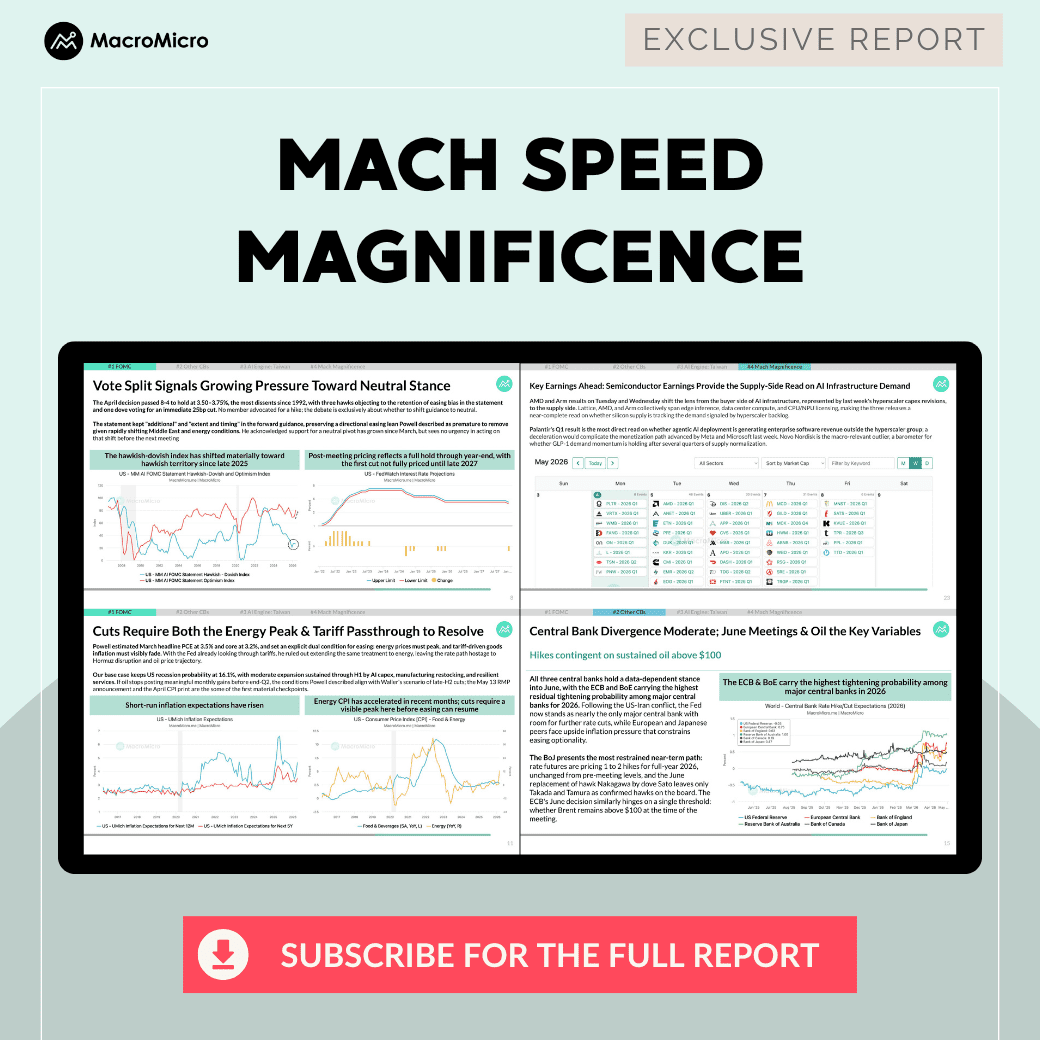
Key Focus of This Week’s Report
-
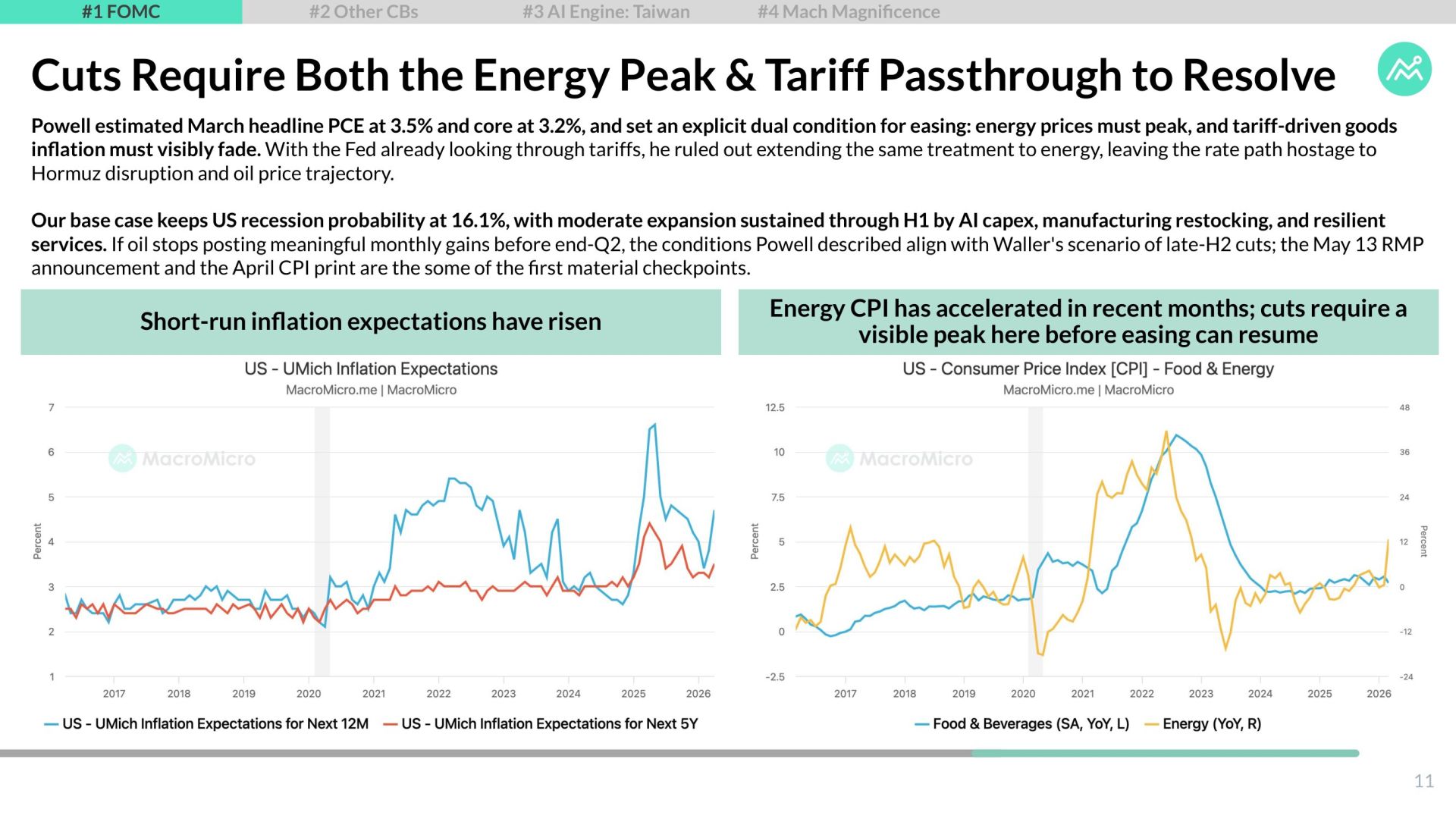
AI Is Now Strong Enough to Keep US Growth Intact Without Forcing the Fed’s Hand: The April FOMC meeting revealed a central bank still biased toward easing, but unwilling to move before inflation risks cool more visibly. The vote split, with 8 in favor of holding rates at 3.50%–3.75%, three hawkish dissents and one dovish dissent, confirms that the debate is about timing, not renewed tightening. Q1 GDP rebounded to 2.0% SAAR from 0.5%, supported by AI investment and normalized government spending.
-
The Next Global Policy Split May Be Decided by Oil, Not Growth: The ECB, BoE and BoJ all stayed on hold, yet inflation language turned more cautious as energy risks intensified. Eurozone HICP climbed to 3.0% YoY, its highest since September 2023, while the ECB confirmed that a hike was discussed. In Japan, the BoJ kept rates at 0.75%, but three members dissented for a hike and the 2026 core CPI forecast rose to 2.8%. Brent above $100 remains the key June threshold.
-
Taiwan’s Export Surge Is Becoming a Real-Time Gauge of the Global AI Cycle: Taiwan’s Q1 GDP beat was not just a local growth story; it was a signal that global AI infrastructure demand is still accelerating. Real GDP expanded 13.69% YoY, beating the official 11.46% forecast and rising from 12.68% in Q4. Exports surged 35.25%, far above the expected 25.38%, showing hyperscale CAPEX continues to flow through Taiwan’s supply chain. MacroMicro raised Taiwan’s 2026 GDP forecast to 8.6% from 5.2%.
-
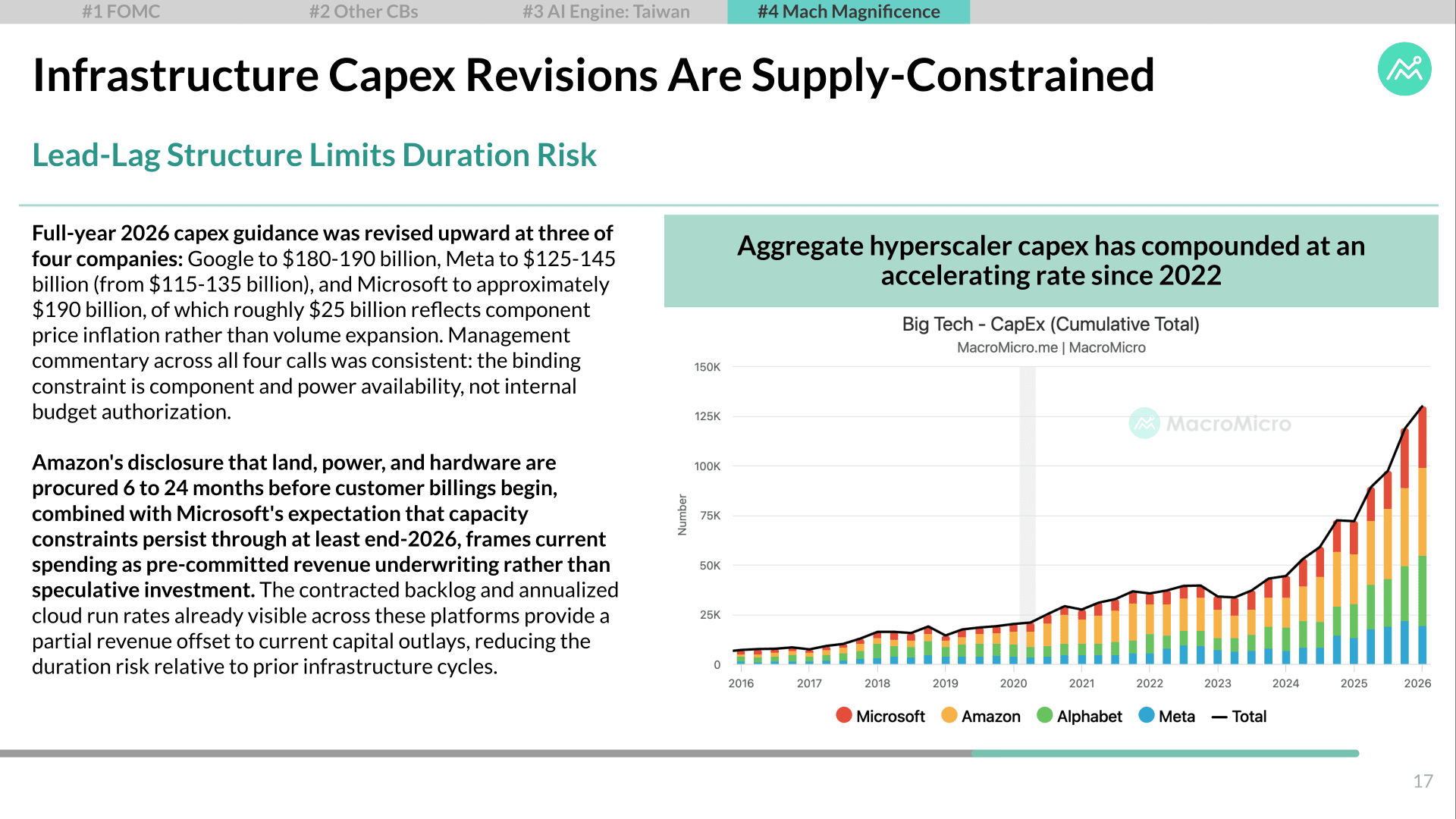
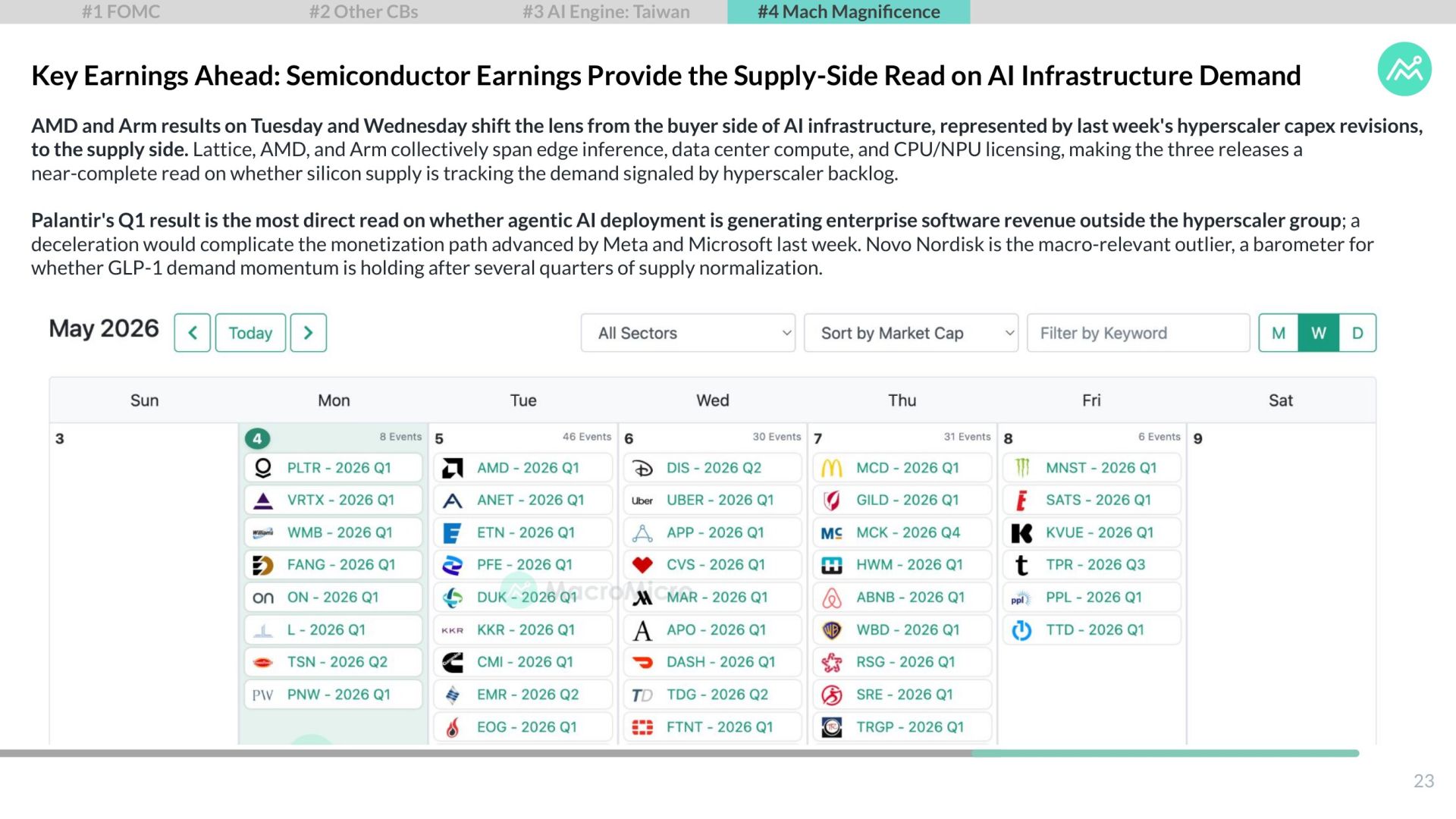
AI Earnings Are Moving from Future Promise to Present Operating Leverage: M7 results showed that AI is beginning to affect current revenue growth, margins and business efficiency, rather than remaining only a long-duration investment theme. Cloud was the clearest signal: AWS, Google Cloud and Azure all re-accelerated despite already large revenue bases, showing enterprise demand remains resilient and broadening. Platform results also pointed in the same direction, with Google Services growth improving, Meta delivering stronger ad growth and EPS expansion, and Amazon’s regional e-commerce margins recovering.

About Weekly Economic and Financial Commentary (WEFC)
The MacroMicro WEFC is published weekly, delivering rigorous analysis and in-depth insights on the most critical market-moving events. Coverage spans equities, foreign exchange, bonds, commodities, global central banks, geopolitics, and the international political economy.
At its core is a concise, roughly 20-page Chart Pack designed to help you grasp market trends at a glance. Subscribe Now » to download the full PDF report.
Already a subscriber? Click here to log in.
Full Access to Our Services

Comprehensive data at your service
with key indicators for investment insights

Exclusive flash reports
on key events and data

Create your own charts and analysis
including performance backtesting

Hub of professionals to engage
in meaningful discussions and insights
 Get answers from MM AI.
-
What role does oil price play in shaping global monetary policy decisions?
💡Oil price plays a significant role in shaping global monetary policy decisions, with Brent above $100 serving as a critical June threshold that could prompt central banks to adopt more cautious inflation language. Energy risks intensified, causing Eurozone HICP to climb to 3.0% YoY and leading the ECB to discuss a potential hike. Similarly, in Japan, despite the BoJ holding rates at 0.75%, three members dissented for a hike, and the 2026 core CPI forecast rose to 2.8%, underscoring how oil prices directly influence inflation expectations and central bank debates on future rate adjustments.
-
How does Taiwan's export surge indicate the global AI cycle's acceleration?
💡Taiwan's export surge signals the global AI cycle's acceleration by demonstrating robust demand for AI infrastructure. The country's Q1 real GDP expanded 13.69% YoY, exceeding the 11.46% official forecast, while exports surged 35.25%, far above the expected 25.38%. This significant outperformance indicates that hyperscale CAPEX is continuously flowing through Taiwan’s supply chain, directly reflecting increased global investment and demand for AI-related components and services, leading MacroMicro to raise Taiwan's 2026 GDP forecast to 8.6% from 5.2%.
-
How is AI affecting current revenue growth and operating leverage for M7 companies?
💡AI is affecting current revenue growth and operating leverage for M7 companies by transitioning from a future promise to present business efficiency and margin expansion. Cloud services, such as AWS, Google Cloud, and Azure, re-accelerated despite large revenue bases, demonstrating resilient and broadening enterprise demand for AI-driven solutions. Platform results also improved, with Google Services growth, Meta's stronger ad growth and EPS expansion, and Amazon’s regional e-commerce margins all recovering, indicating that AI investments are now translating into tangible financial performance and operational gains.
-
What were the key takeaways from the April FOMC meeting regarding interest rates?
💡The April FOMC meeting revealed a central bank still biased toward easing, but unwilling to move before inflation risks visibly cool. The vote split, with 8 members favoring holding rates at 3.50%–3.75%, three hawkish dissents, and one dovish dissent, confirmed that the primary debate among policymakers is about the timing of any future rate adjustments, not renewed tightening. This indicates a cautious approach, prioritizing inflation stability over immediate rate changes, despite robust Q1 GDP growth supported by AI investment and normalized government spending.
-
Which factors contributed to the rebound in US Q1 GDP to 2.0% SAAR?
💡The rebound in US Q1 GDP to 2.0% SAAR was primarily attributed to strong AI investment and normalized government spending. This growth surpassed the previous quarter's 0.5% SAAR, indicating a significant improvement in economic activity driven by strategic technology investments and stable public expenditure. The Federal Reserve's steady decision, with no signal of renewed tightening, further supported this growth by maintaining a favorable monetary environment, allowing these factors to propel the economy without immediate inflationary pressures.

