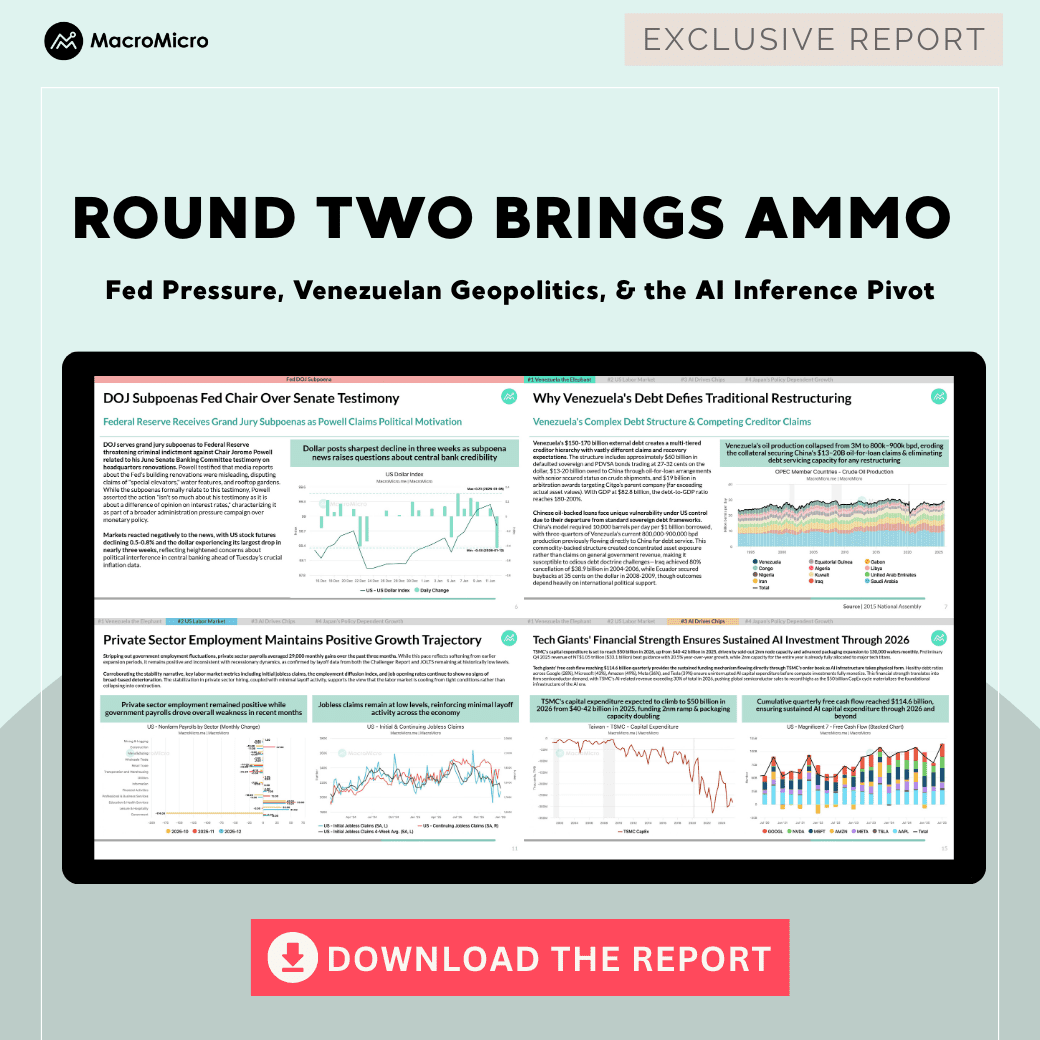
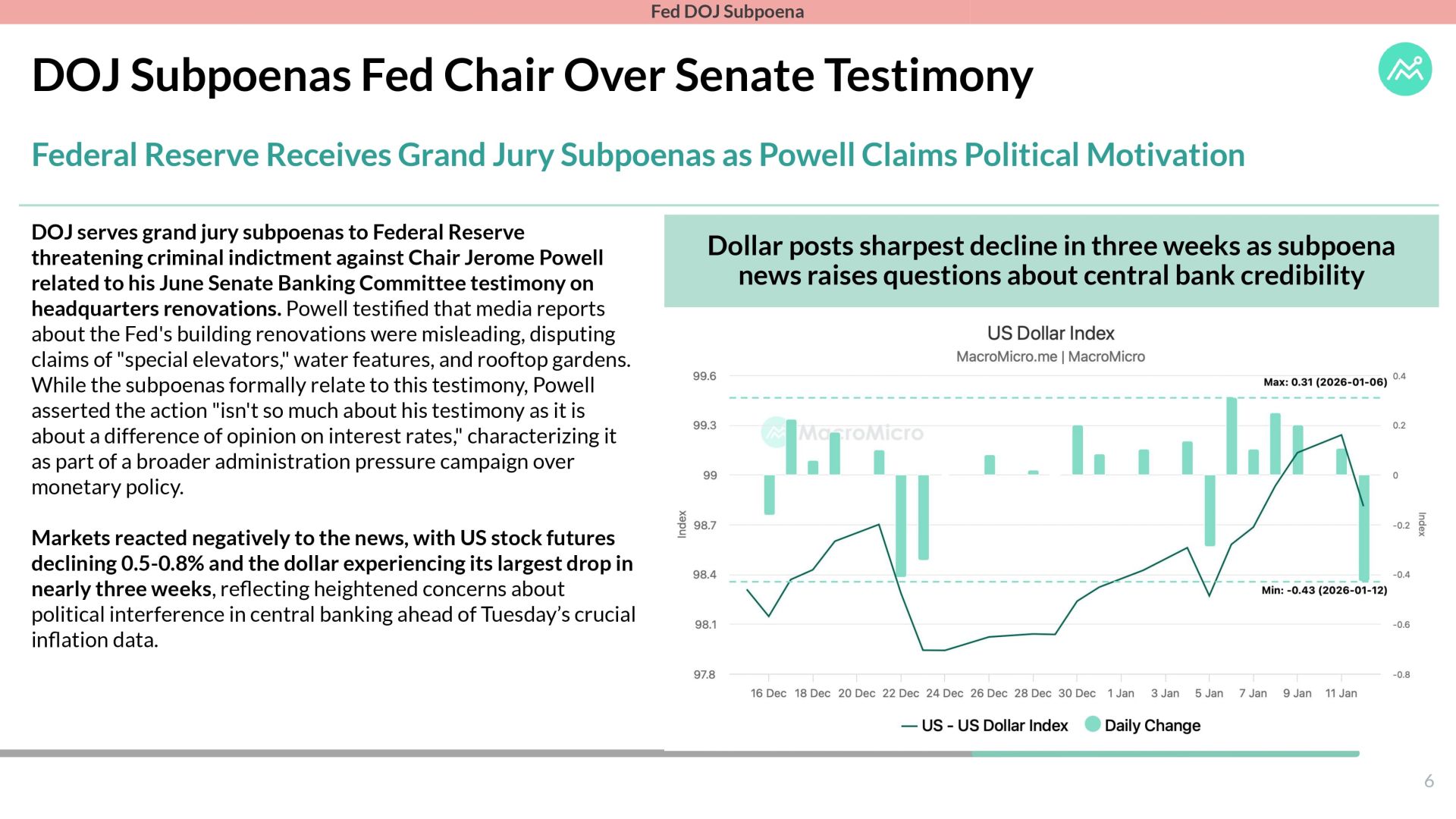
The Department of Justice served grand jury subpoenas to the Federal Reserve last week, formally targeting Chair Jerome Powell's Senate testimony on headquarters renovations but characterized by Powell as pressure over "a difference of opinion on interest rates." Markets responded with dollar weakness and equity futures declining as concerns mounted about central bank independence. The timing precedes crucial inflation data and comes as the Fed maintains its patient stance, a 95%+ probability of holding rates in January with just two cuts priced for 2026.
Beyond domestic monetary policy tensions, global markets are processing the structural implications of the Venezuela intervention. The operation severed collateral securing China's commodity-backed loans while Latin American governments fracture along US-China alignment lines. Meanwhile, the December jobs report revealed government workforce adjustments masking stable private sector fundamentals, and AI infrastructure spending is entering a critical third phase as enterprise adoption accelerates.
In this week’s WEFC analysis, we delve into these dynamics alongside more exploration of our 2026 sector outlooks.
Venezuela: Where Sovereign Debt Meets Geopolitics
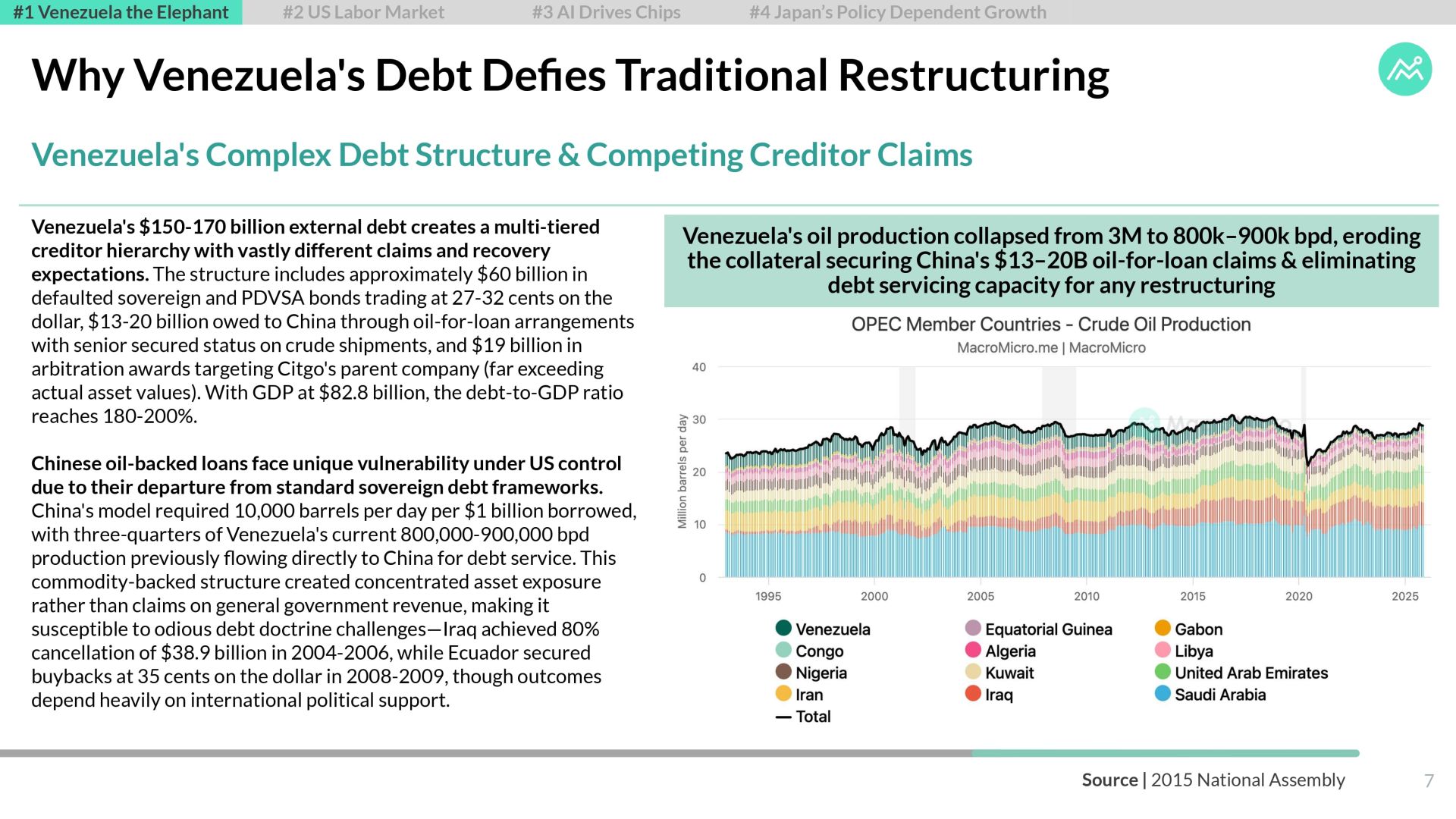
US control over Venezuelan oil infrastructure creates a strategic denial weapon more valuable than production expansion. With Venezuela's output collapsed to 800,000-900,000 barrels per day from historic peaks above 3 million, the immediate benefit lies in redirecting existing flows from Chinese buyers into US-aligned channels. China's commodity-backed lending model required 10,000 barrels per day per $1 billion borrowed—three-quarters of Venezuelan production previously serviced this debt directly. The intervention simultaneously threatens China's $200+ billion in commodity-secured lending globally while establishing enforcement precedents for "odious debt" challenges that could cascade across Belt and Road Initiative projects in 150 countries.
Government Noise Masks Resilient US Private Labor Market
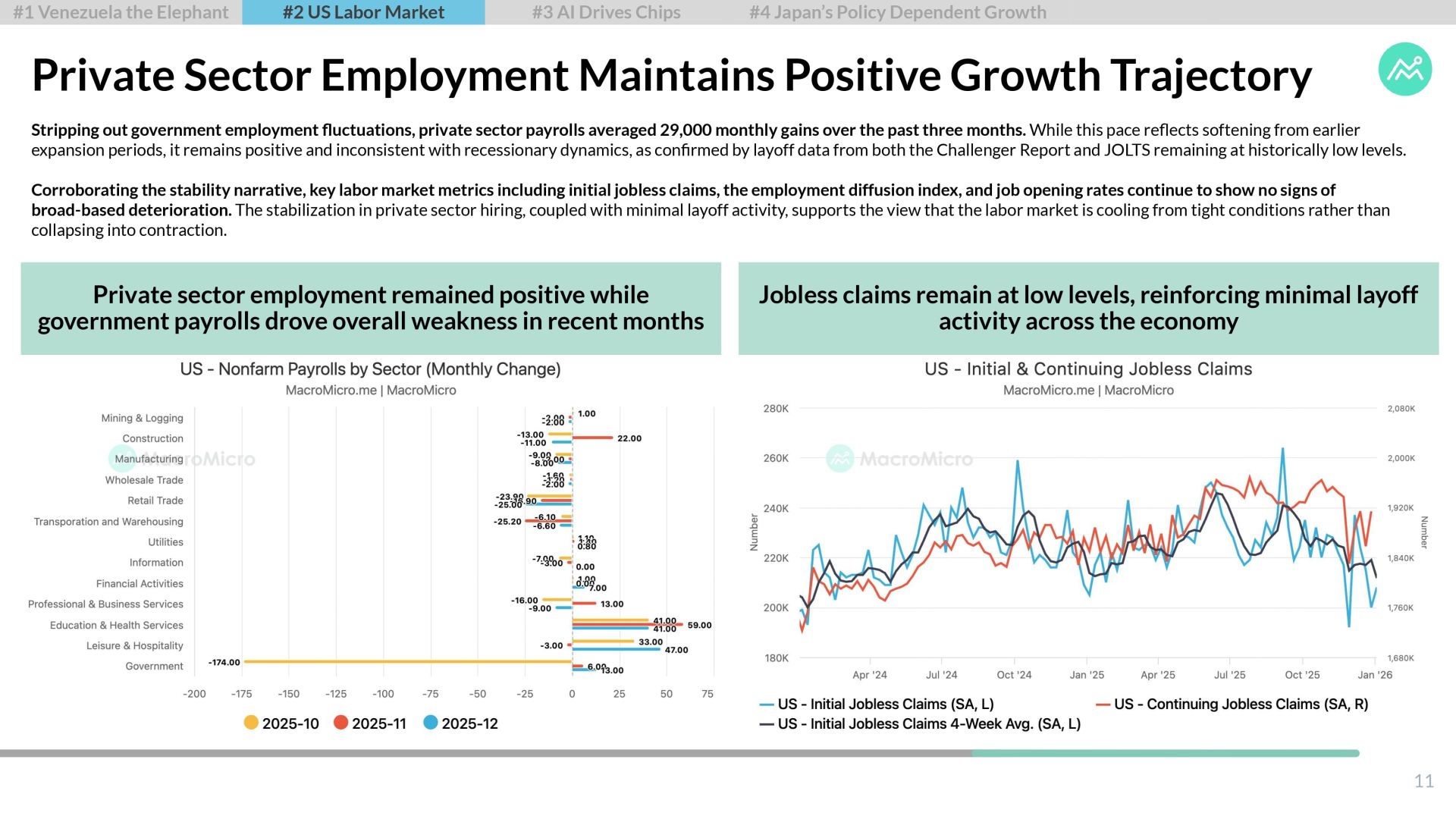
December's headline payroll weakness of 50,000 obscures the actual labor market dynamics. Stripping out government employment fluctuations reveals private sector gains averaging 29,000 monthly over the past three months—modest but positive growth inconsistent with recessionary dynamics. The unemployment rate improved to 4.4% from 4.5%, driven by a 232,000 increase in employed persons, while initial jobless claims and layoff activity remain at historically subdued levels. Fed pricing reflects this resilience, with 95%+ probability of a January hold and expectations converging around just two 25 basis point cuts for 2026—a patient normalization stance, not crisis response.
AI’s Next Phase: Inference, Not Infrastructure
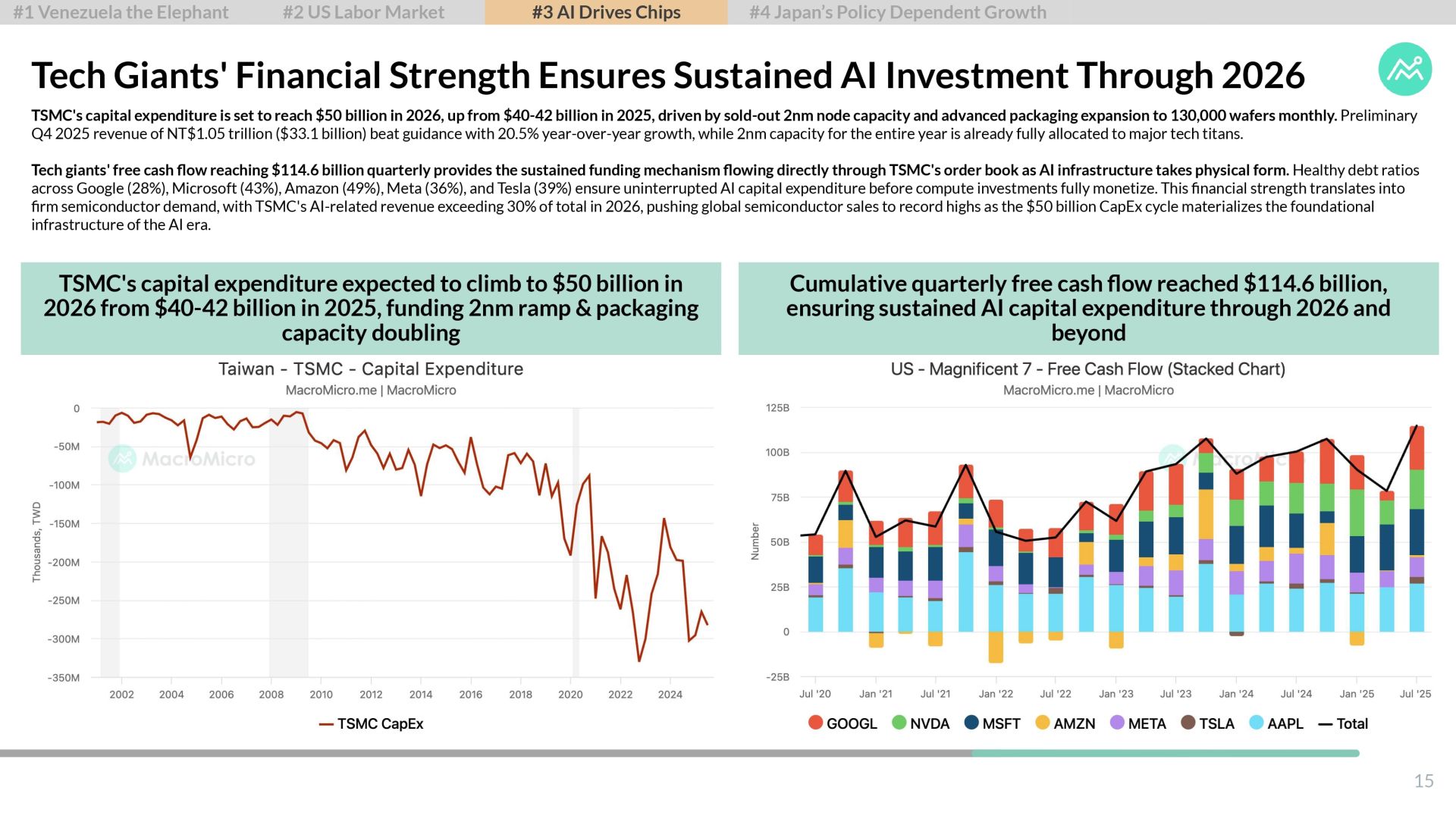
The AI investment cycle is shifting from data center buildouts to software-hardware integration as enterprise adoption and edge applications hit commercial inflection points. Meta, Google, Xiaomi, and Apple are aggressively pursuing AI wearables, while Tesla and Waymo expanded Robotaxi coverage from under 500 square miles to nearly 2,000 square miles in 2025. TSMC's capital expenditure will climb to $50 billion in 2026 from $40-42 billion in 2025, funding 2nm capacity ramps and advanced packaging expansion. Tech giants generated $114.6 billion in cumulative quarterly free cash flow with conservative debt ratios, ensuring sustained AI infrastructure spending translates into record semiconductor sales as AI-related revenue exceeds 30% of industry leaders' total output.
Japan: Liquidity Without Productivity
Japan's record ¥120 trillion FY2026 budget sustains approximately 1% GDP growth through energy subsidies and demand support, yet corporations persistently direct capital toward buybacks and overseas securities rather than domestic fixed asset investment. The Bank of Japan raised rates to 0.75%—a 30-year high—while 10-year JGB yields surpassed 2%, creating policy divergence as fiscal expansion contradicts monetary tightening. With headline CPI expected to fall below 2% in early 2026 due to energy subsidies, the BoJ will likely deliver just one additional 25bp hike. Medium-term equity performance hinges on structural reform in AI adoption and digital transformation—liquidity alone cannot substitute for productivity gains when corporate capital allocation remains misaligned with domestic infrastructure needs.
About Weekly Economic and Financial Commentary (WEFC)
The MacroMicro WEFC cuts through the noise, delivering rigorous analysis and in-depth insights on the most critical market-moving events. These topics cover equities, foreign exchange, bonds, commodities, global central banks, international political economy, and more.
At the core of WEFC is a concise Chart Pack, enabling you to grasp market trends at a glance.
Already a subscriber? Click here to log in.
Full Access to Our Services

Comprehensive data at your service
with key indicators for investment insights

Exclusive flash reports
on key events and data

Create your own charts and analysis
including performance backtesting

Hub of professionals to engage
in meaningful discussions and insights
