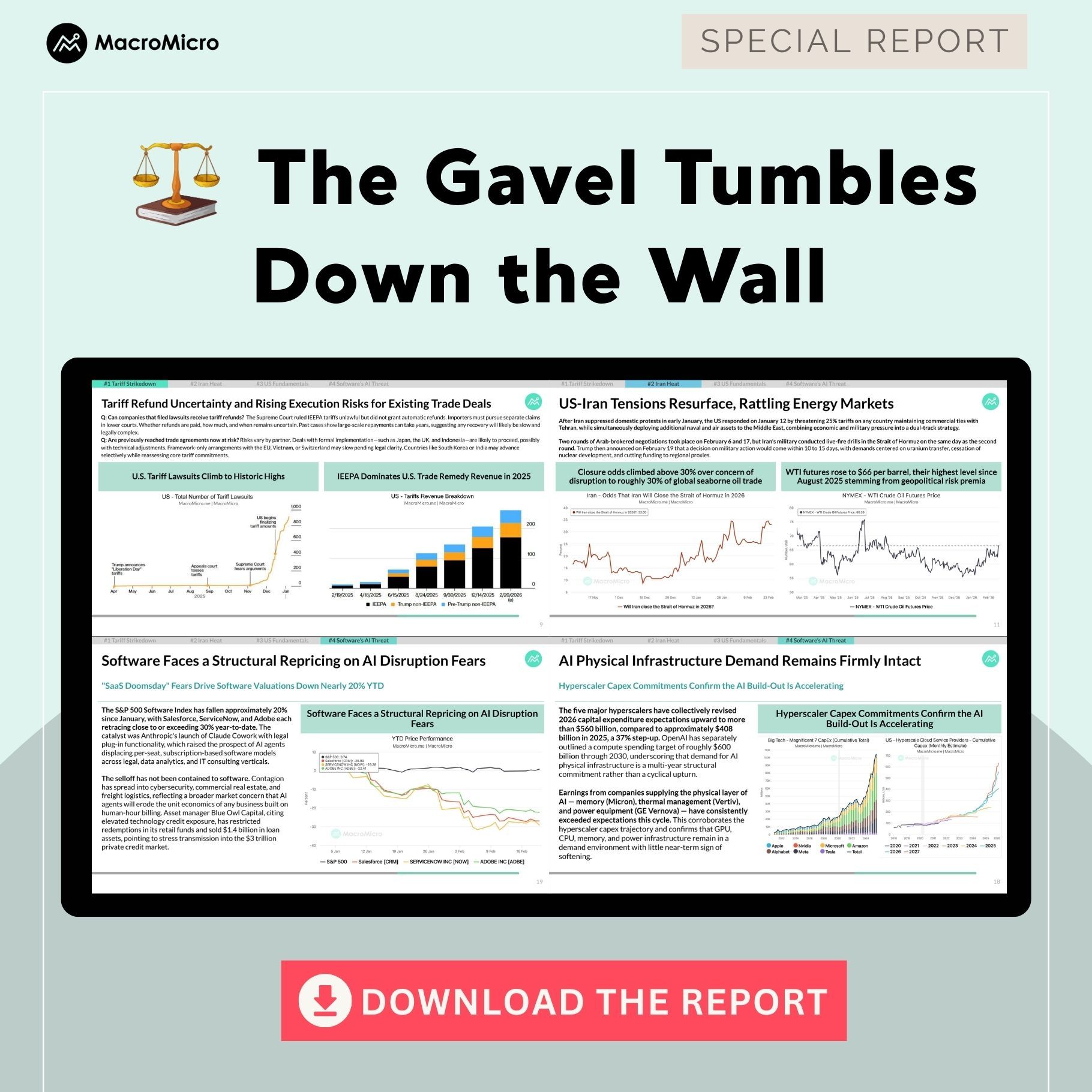
Last week, the US Supreme Court ruled Trump’s IEEPA tariffs unlawful, prompting a swift pivot to a 150-day, 10% temporary tariff under Section 122 and injecting fresh policy uncertainty into markets.
Against this backdrop, global assets turned volatile. US equities initially declined on software weakness and AI bubble concerns, but later rebounded as earnings largely beat expectations. European equities posted solid gains, while Asian markets diverged, with South Korea’s KOSPI reaching record highs on memory and AI optimism. The US dollar firmed as rate-cut expectations narrowed, Treasury yields stabilized, and oil and gold prices rose amid renewed US–Iran tensions.
This week's WEFC provides a detailed analysis.
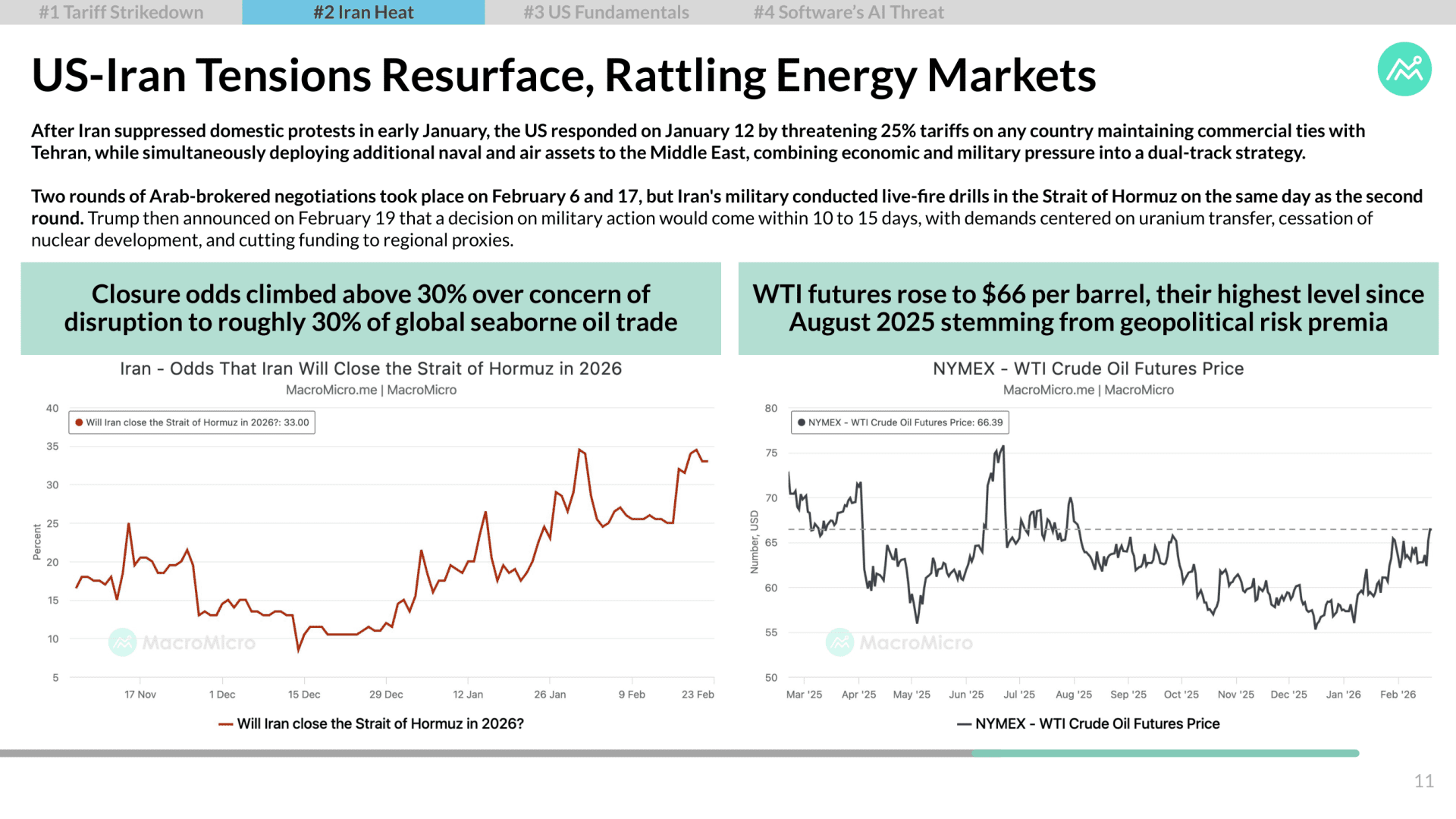
US–Iran Tensions Reignite Energy Risk Premium as Hormuz Disruption Odds Rise
US–Iran tensions resurfaced, lifting oil and gold prices. After Iran suppressed domestic unrest in January, Washington threatened 25% tariffs on countries maintaining ties with Tehran and deployed additional naval and air assets to the Middle East. Arab-brokered talks on February 6 and 17 failed to ease tensions, while Iran conducted live-fire drills in the Strait of Hormuz. President Trump then issued a 10–15 day ultimatum focused on uranium transfer and nuclear activity. With roughly 30% of global seaborne oil trade passing through Hormuz, disruption risks pushed WTI to $66 per barrel, reinforced by a surprise US inventory draw.
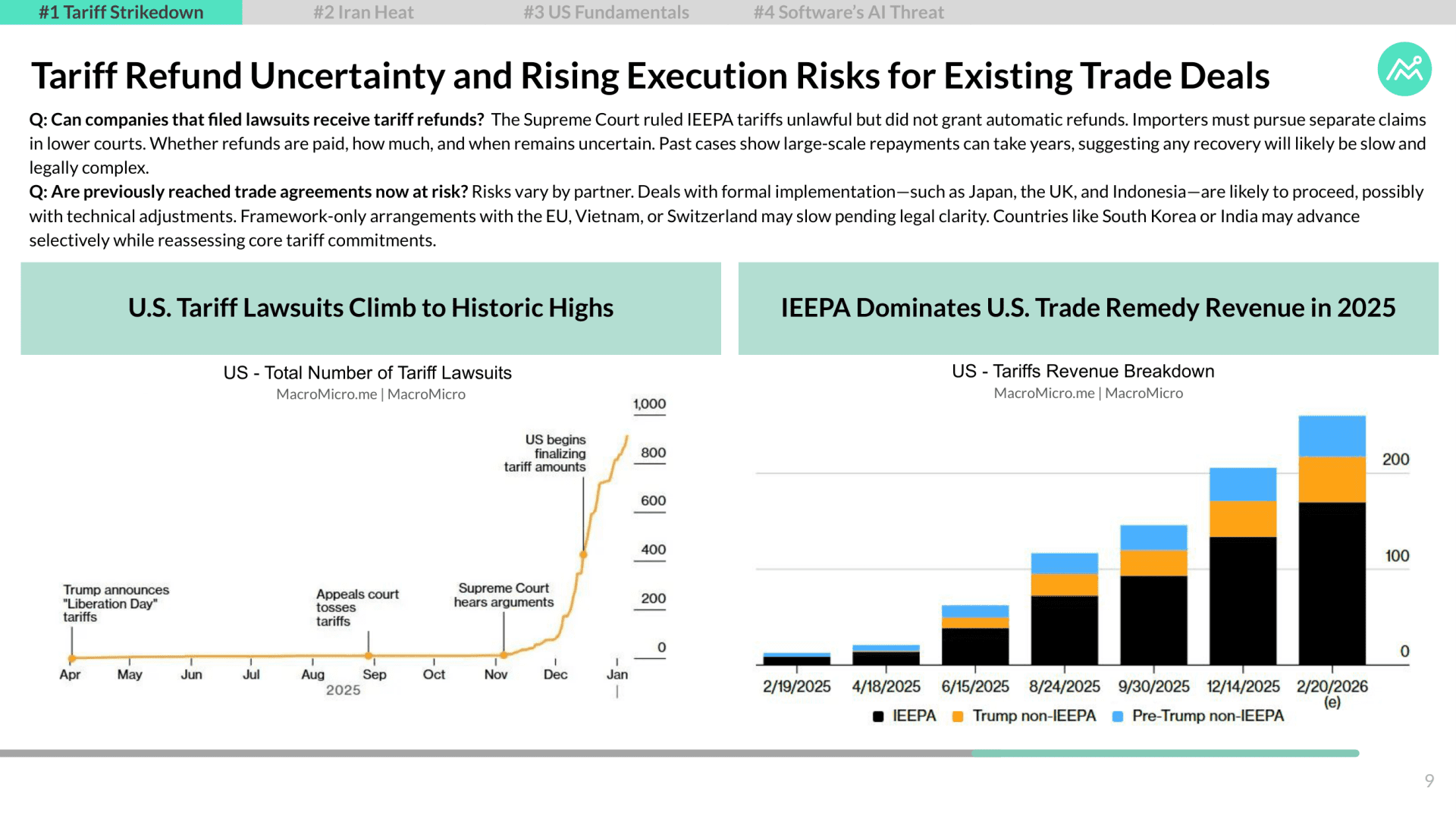
Tariff Authority Reset: Legal Constraints, Refund Uncertainty, and Transitional Trade Tools
The Supreme Court ruled tariffs under IEEPA unlawful, reaffirming that tariff authority rests with Congress. Without replacement, the effective US tariff rate could have fallen sharply. However, the administration invoked Section 122, imposing a temporary 10% tariff (potentially 15%) for up to 150 days, preserving leverage. Two uncertainties remain. First, companies do not receive automatic refunds; importers must pursue separate claims, likely a lengthy process. Second, existing trade agreements face uneven risk: formally implemented deals may proceed with adjustments, while framework-level arrangements could slow pending legal and legislative clarity.
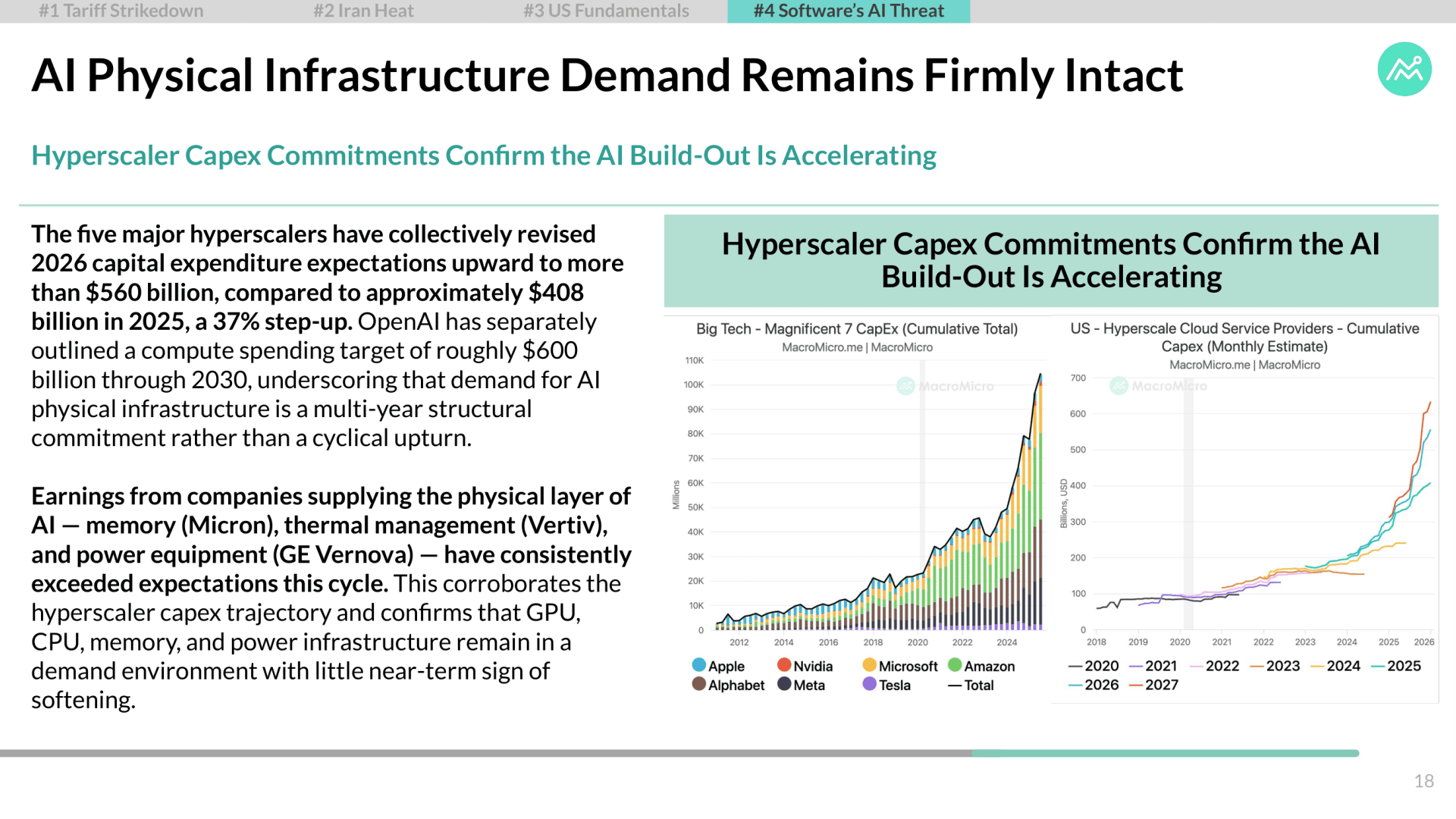
AI Leadership Fractures: Software Under Pressure, Infrastructure Demand Remains Intact
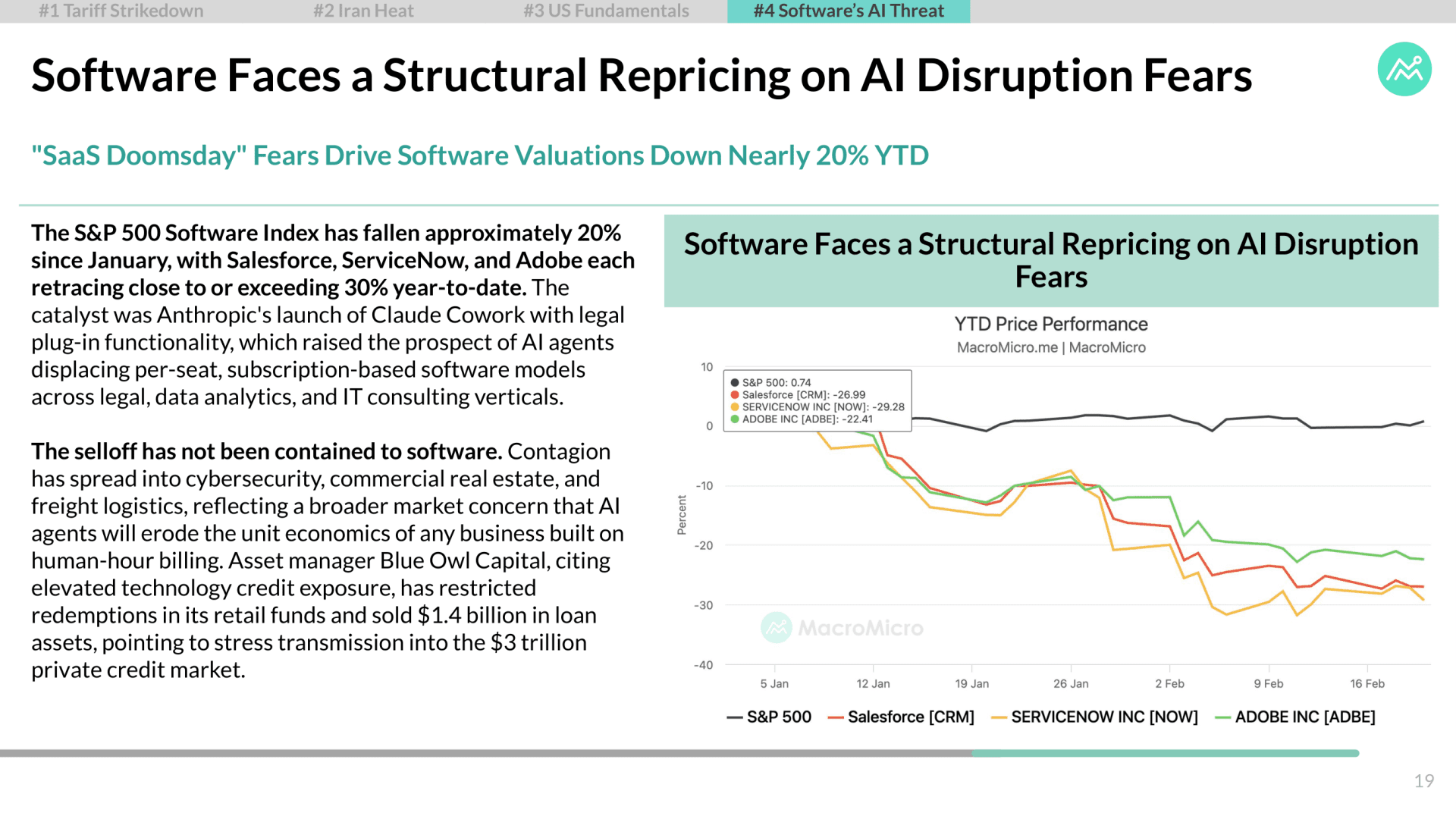
Earnings remain solid, with most S&P 500 firms beating expectations, yet leadership is shifting. Rotation: Capital is broadening beyond mega-cap tech into industrials, materials, and energy, supported by improving earnings and commodity strength. AI Software Crisis: The software sector faces valuation pressure as AI agents challenge subscription-based models. Meanwhile, AI infrastructure—chips, memory, and power equipment—continues to benefit from rising hyperscaler capex. 13F Holdings: Institutional filings show reallocation, not retreat: trimming consumer and China exposure while adding to AI hardware, semiconductors, and energy.
US Growth Holds Firm Amid Gradual Disinflation and Expanding Fed Policy Uncertainty
US Q4 GDP grew 1.4% annualized, slowed mainly by government shutdown effects rather than weak private demand. Consumer spending and business investment remained resilient, signaling steady underlying momentum. Inflation continues to ease gradually. January CPI moderated to 2.4%, with core measures also trending lower, though progress remains incremental. Core PCE aligns with Fed projections, suggesting no renewed inflation shock. The Fed is internally divided. Some officials favor cuts later this year if disinflation continues, while others prefer patience. Markets price roughly 50bps of cuts in 2025, with mid-year timing most likely.
About Weekly Economic and Financial Commentary (WEFC)
The MacroMicro WEFC cuts through the noise, delivering rigorous analysis and in-depth insights on the most critical market-moving events. These topics cover equities, foreign exchange, bonds, commodities, global central banks, international political economy, and more.
At the core of WEFC is a concise Chart Pack, enabling you to grasp market trends at a glance.
Already a subscriber? Click here to log in.
Full Access to Our Services

Comprehensive data at your service
with key indicators for investment insights

Exclusive flash reports
on key events and data

Create your own charts and analysis
including performance backtesting

Hub of professionals to engage
in meaningful discussions and insights
 Get answers from MM AI.
-
How did the Supreme Court's ruling on Trump's IEEPA tariffs affect market uncertainty?
💡The US Supreme Court's ruling that Trump's IEEPA tariffs were unlawful immediately introduced fresh policy uncertainty into markets, prompting the administration to swiftly pivot to a temporary 10% tariff under Section 122 for 150 days. This decision, which reaffirmed that tariff authority rests with Congress, initially led to market volatility, with US equities seeing a decline before rebounding, and global assets reacting divergently as the U.S. dollar firmed and Treasury yields stabilized.
-
How do US-Iran tensions increase the risk of oil supply disruptions in the Strait of Hormuz?
💡US-Iran tensions significantly increase the risk of oil supply disruptions in the Strait of Hormuz because approximately 30% of global seaborne oil trade transits through this critical chokepoint. Iran’s live-fire drills in the Strait, combined with Washington's deployment of additional naval and air assets to the Middle East and threats of 25% tariffs on countries maintaining ties with Tehran, elevate the probability of military confrontation or blockades, thereby threatening the flow of oil and pushing prices higher, as seen with WTI reaching $66 per barrel.
-
What is the new US tariff authority after the Supreme Court ruled IEEPA tariffs unlawful?
💡After the Supreme Court ruled IEEPA tariffs unlawful, reaffirming that tariff authority rests with Congress, the administration invoked Section 122 to establish a new US tariff authority. This allowed for the imposition of a temporary 10% tariff, with a potential increase to 15%, for up to 150 days, thereby preserving leverage and preventing a sharp fall in the effective US tariff rate. This transitional measure addresses the immediate void created by the invalidation of IEEPA tariffs.
-
What uncertainties do companies face regarding tariff refunds and existing trade agreements?
💡Companies face two key uncertainties regarding tariff refunds and existing trade agreements following the Supreme Court's ruling. First, importers will not receive automatic refunds for previously paid IEEPA tariffs; instead, they must pursue separate, likely lengthy, claims. Second, existing trade agreements face uneven risk: formally implemented deals may proceed with adjustments, while framework-level arrangements could slow due to pending legal and legislative clarity, creating an uncertain environment for future trade relations.
-
How is AI leadership shifting within the S&P 500 despite overall strong earnings?
💡Despite overall strong earnings, with most S&P 500 firms beating expectations, AI leadership is shifting within the S&P 500. Capital is broadening beyond mega-cap tech into industrials, materials, and energy, supported by improving earnings and commodity strength. The software sector faces valuation pressure due to AI agents challenging subscription models, while AI infrastructure—chips, memory, and power equipment—continues to benefit from rising hyperscaler capital expenditure, indicating a rotation in investor focus.
-
Why is the AI software sector experiencing valuation pressure compared to AI infrastructure?
💡The AI software sector is experiencing valuation pressure compared to AI infrastructure because AI agents are challenging the traditional subscription-based models that underpin software companies. In contrast, AI infrastructure, including chips, memory, and power equipment, continues to benefit significantly from rising hyperscaler capital expenditure, driven by the foundational demand for hardware to support AI advancements. This dynamic suggests a shift in investment preference towards the underlying physical components of AI rather than just the applications.
-
What reallocation trends are institutional investors showing in their 13F holdings?
💡Institutional investors are showing reallocation, not retreat, in their 13F holdings, according to recent filings. They are trimming exposure to consumer and China-related assets while simultaneously adding to AI hardware, semiconductors, and energy sectors. This trend indicates a strategic shift of capital towards areas perceived to have stronger growth potential and resilience, reflecting an evolving investment landscape that prioritizes foundational AI technology and commodity strength over previous market leaders.
-
What factors contributed to the 1.4% annualized US Q4 GDP growth?
💡The U.S. Q4 GDP grew 1.4% annualized, primarily reflecting resilient consumer spending and business investment, which signaled steady underlying momentum despite some slowdown from government shutdown effects. This growth indicated that private demand remained strong, supporting the overall economic expansion. The robust performance in these key sectors prevented a more significant deceleration, even amidst external factors that could have negatively impacted the growth rate.
-
How is US inflation progressing, and what are the implications for Fed policy?
💡U.S. inflation continues to ease gradually, with January CPI moderating to 2.4% and core measures also trending lower, though progress remains incremental. Core PCE aligns with Fed projections, suggesting no renewed inflation shock. The implications for Fed policy indicate a divided Federal Reserve: some officials favor interest rate cuts later this year if disinflation persists, while others prefer patience, leading markets to price in approximately 50bps of cuts in 2025, most likely by mid-year.
-
What are the Federal Reserve's internal divisions regarding future interest rate cuts?
💡The Federal Reserve is internally divided regarding future interest rate cuts, with some officials advocating for cuts later this year if disinflation continues. However, other officials prefer to exercise patience, indicating a cautious approach to monetary policy adjustments. This divergence in views suggests that while markets are pricing in roughly 50bps of cuts in 2025, with mid-year timing most likely, the exact timing and magnitude remain subject to ongoing internal debate and economic data developments.
