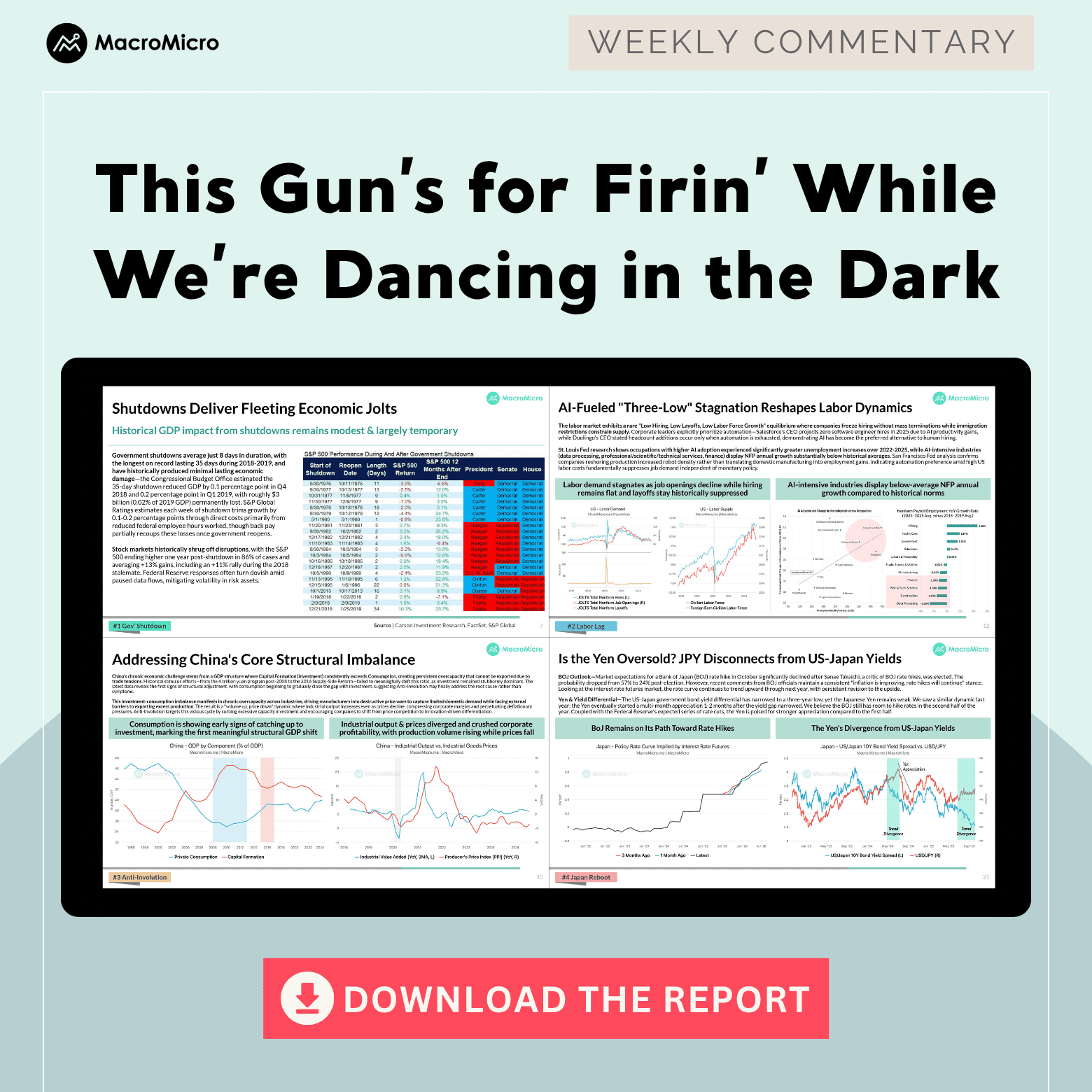
Washington descends into an unprecedented standoff where threats of permanent dismissals collide with economic policymaking in darkness. Senate gridlock has forced a federal shutdown, but this time with a critical twist: the Office of Management and Budget has instructed agencies to prepare plans for mass permanent job cuts—up to 100,000 positions—while the Bureau of Labor Statistics sits shuttered, leaving the Federal Reserve to navigate rate decisions blind. Markets rally as technology optimism defies political turmoil, but beneath the surface, the intersection of structural employment threats and a central bank flying without instruments creates volatility few fully appreciate.
This week's WEFC report examines how Washington's shutdown standoff that breaks from historical precedent with permanent layoff threats, a labor market exhibiting confusing "three-low" stagnation driven by AI substitution, China's ambitious Anti-Involution reform that targets the root causes of deflation, and Japan's dramatic fiscal reawakening under new leadership that's triggering major market repricing.
Shutdown Standoff: When the Data Goes Dark and the Firings Turn Real
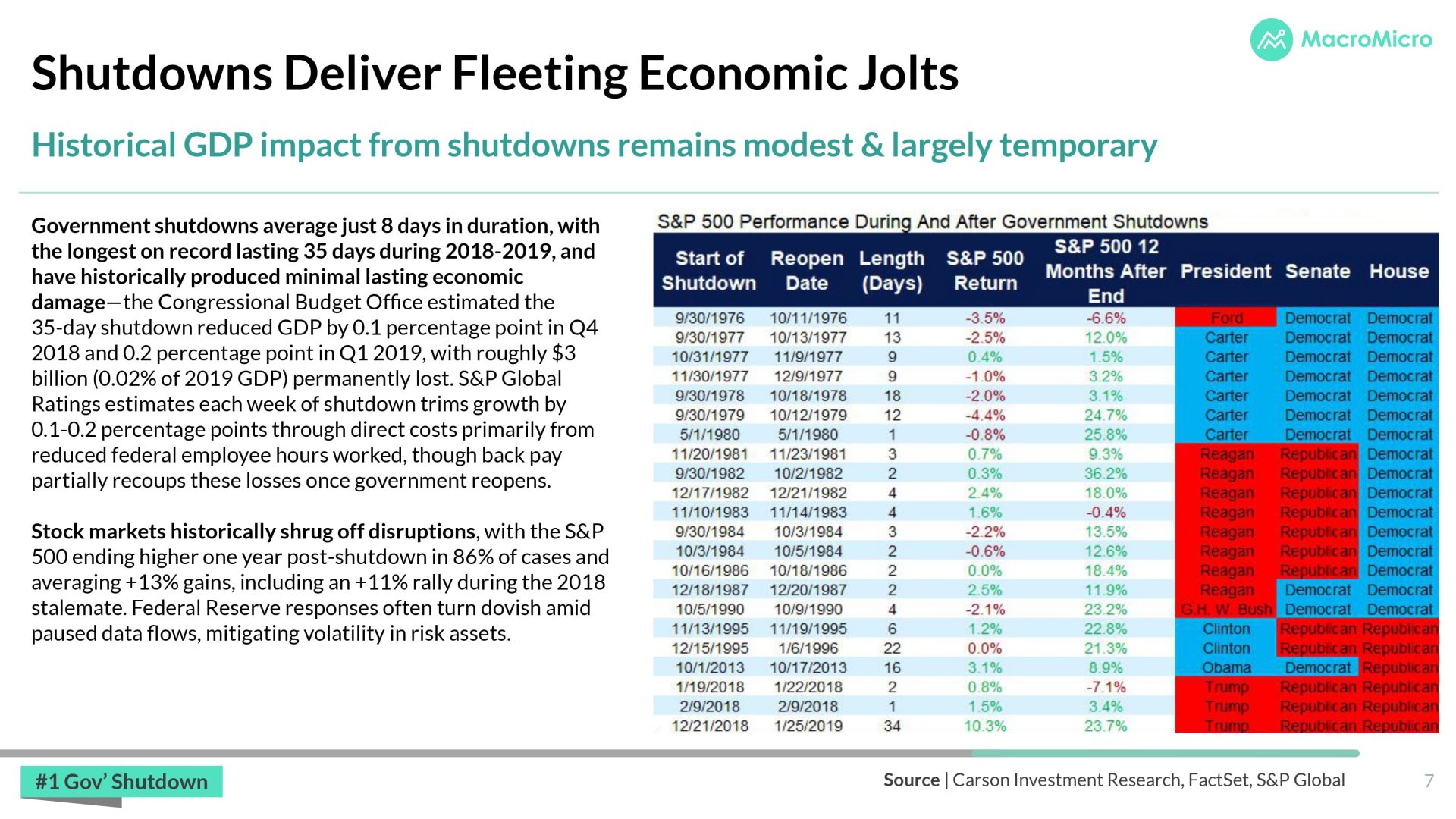
The current government shutdown differs fundamentally from its predecessors—this isn't a temporary furlough followed by back pay, but rather a deliberate restructuring with President Trump's OMB directing agencies to prepare permanent staff reduction plans. With the BLS completely offline and the September jobs report delayed, the Fed faces an unprecedented information vacuum at the precise moment it attempts to calibrate a data-dependent easing cycle. Markets historically shrug off shutdowns, averaging +13% gains one year later, but those episodes lacked both permanent employment threats and simultaneous monetary policy pivots. The real risk lies not in the shutdown's duration but in how permanent federal job cuts intersect with already-weakening private sector hiring to pressure consumer confidence and spending.
One-Eyed Labor Market: AI's "Three-Low" Stagnation Takes Hold
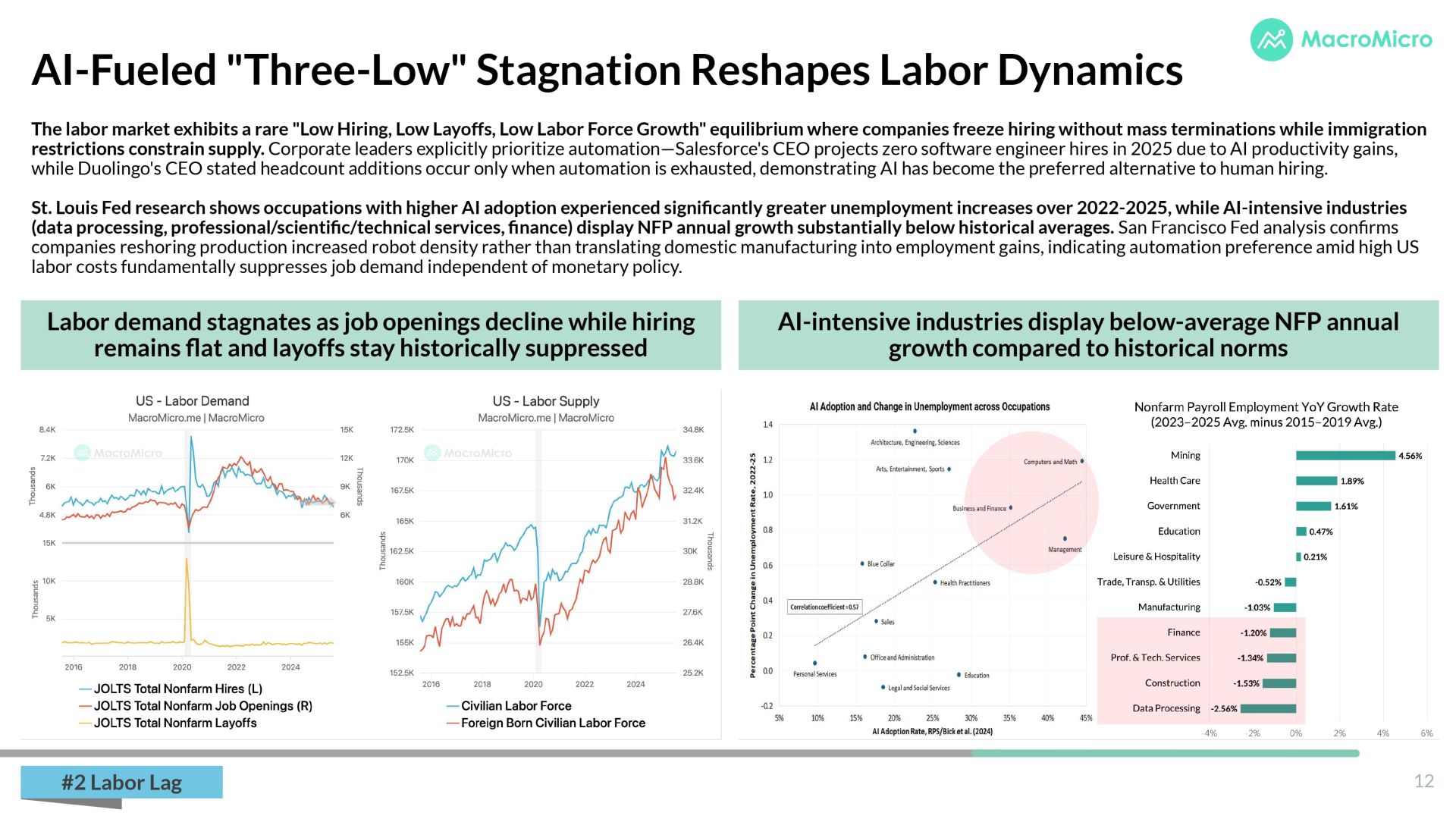
September ADP employment contracted by 32,000 workers—the second consecutive monthly decline—forcing markets to rely on private data alone as government statistics remain unavailable. But the deeper story is structural: the labor market has entered a rare "Low Hiring, Low Layoffs, Low Labor Force Growth" equilibrium where companies freeze headcount without mass terminations, explicitly prioritizing automation over human capital. Salesforce's CEO projects zero software engineer hires in 2025 due to AI productivity gains, while Duolingo's CEO stated headcount additions occur only when automation options are exhausted. St. Louis Fed research confirms that AI-intensive occupations experienced significantly greater unemployment increases over 2022-2025, while AI-heavy industries show annual payroll growth substantially below historical averages. The critical question: whether AI successfully converts to measured productivity gains that offset employment weakness—early signals suggest yes, with productivity growth exceeding 10-year averages and intellectual property investment surpassing equipment investment for the first time since 2020.
China's Anti-Involution: Reform 2.0 or Temporary Confidence Boost?
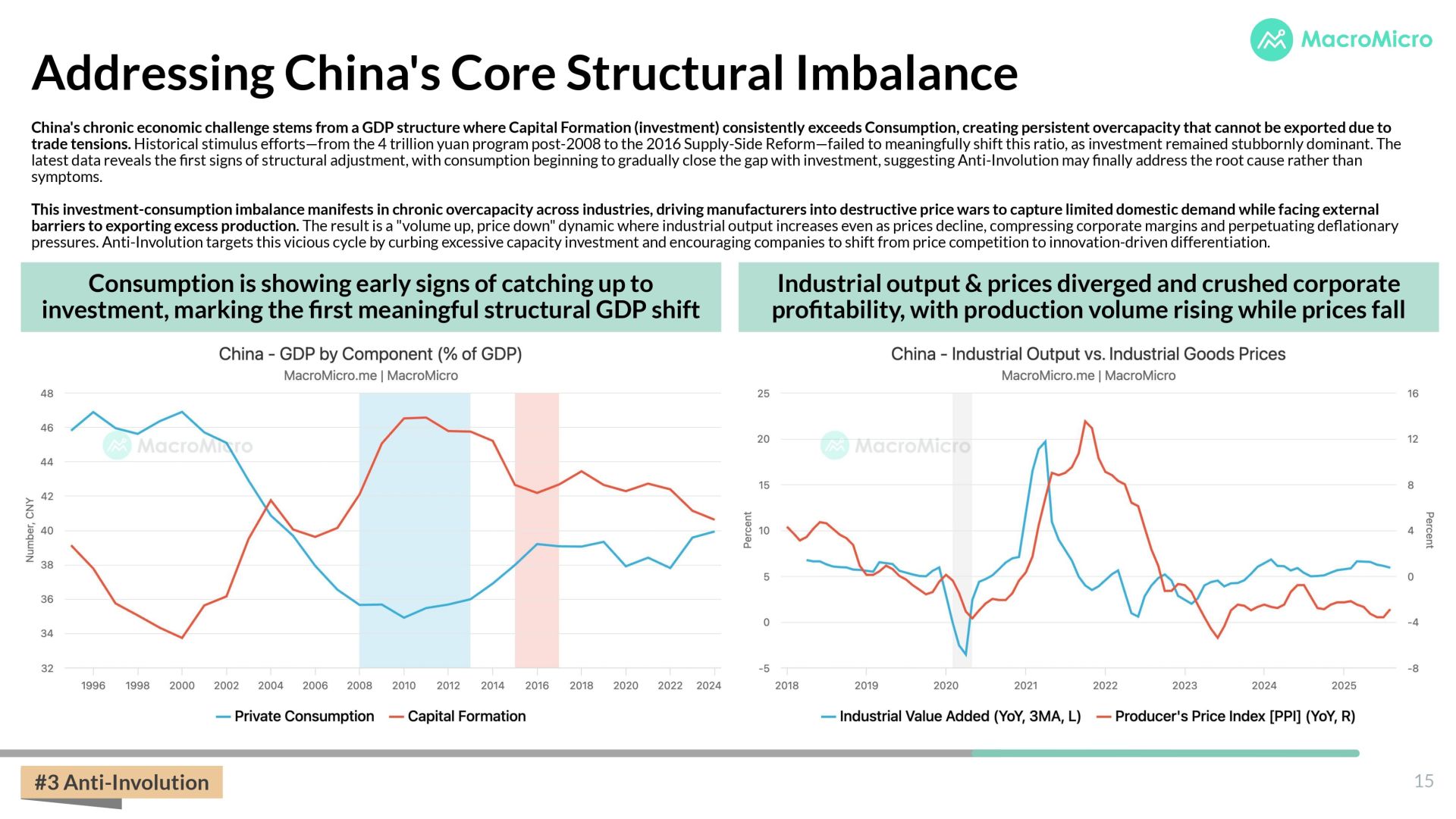
Chinese equities are surging, not on fleeting stimulus hopes, but on a new policy theme captivating foreign investors: "Anti-Involution" . This government-led crusade aims to end the destructive price wars and chronic overcapacity that have fueled deflationary pressures. Unlike the 2016 supply-side reform that used blunt, top-down cuts in state-owned heavy industries, this "Reform 2.0" takes a more market-driven approach targeting private and tech sectors. By encouraging consolidation and a shift from price competition to innovation, Beijing is attempting to address its structural imbalances without reinflating the property bubble—a fundamental change in its economic management strategy .
The "Takaichi Trade" Ignites Japan
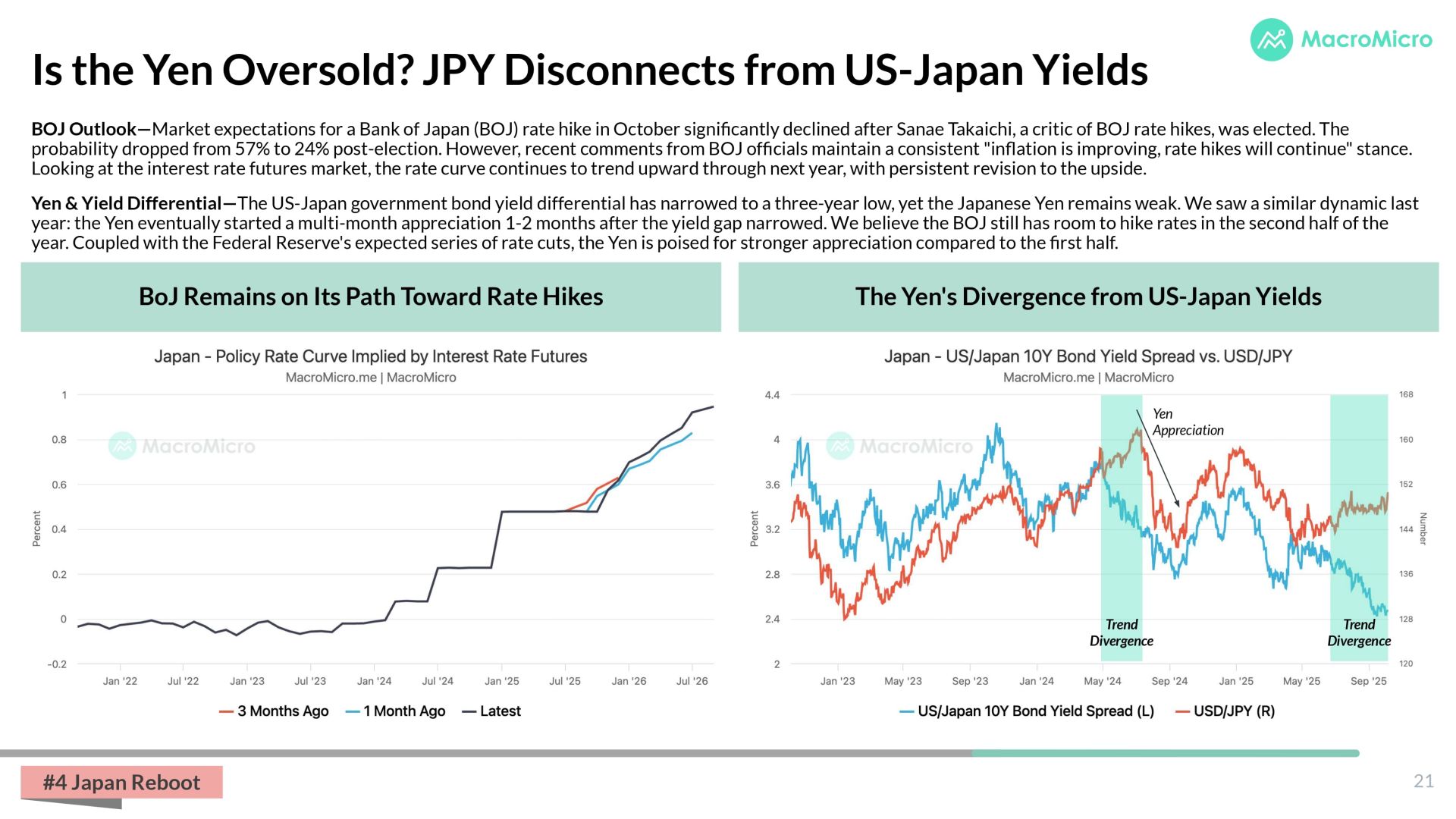
The election of Sanae Takaichi as Japan's new LDP leader has unleashed the "Takaichi Trade," a powerful market recalibration betting on aggressive fiscal stimulus paired with continued dovish monetary policy. Her victory sent Japanese stocks to record highs, JGB yields to new peaks, and the yen sliding past the 150 mark . Takaichi’s platform of "Responsible Aggressive Fiscal Policy" centers on boosting the middle class through deficit-financed spending, infrastructure investment, and a pivot back to nuclear power. While the yen has weakened on the prospect of continued loose policy, a growing disconnect between its value and narrowing US-Japan yield differentials suggests a significant rebound may be on the horizon.
Already a subscriber? Click here to log in.
Full Access to Our Services

Comprehensive data at your service
with key indicators for investment insights

Exclusive flash reports
on key events and data

Create your own charts and analysis
including performance backtesting

Hub of professionals to engage
in meaningful discussions and insights
