Last week, the Iran–US conflict escalated into direct attacks on energy infrastructure. President Trump issued a 48-hour ultimatum to Iran, warning of strikes on energy facilities, while Iran responded by threatening to fully close the Strait of Hormuz, pushing Brent crude above $110 on March 23.
Against this energy shock, which countries and sectors are most exposed? How should we assess risks and position for opportunities? See this week’s WEFC for details.
Track every US–Iran shockwave. Redeem your MM Max trial code to unlock the full report — limited time only.

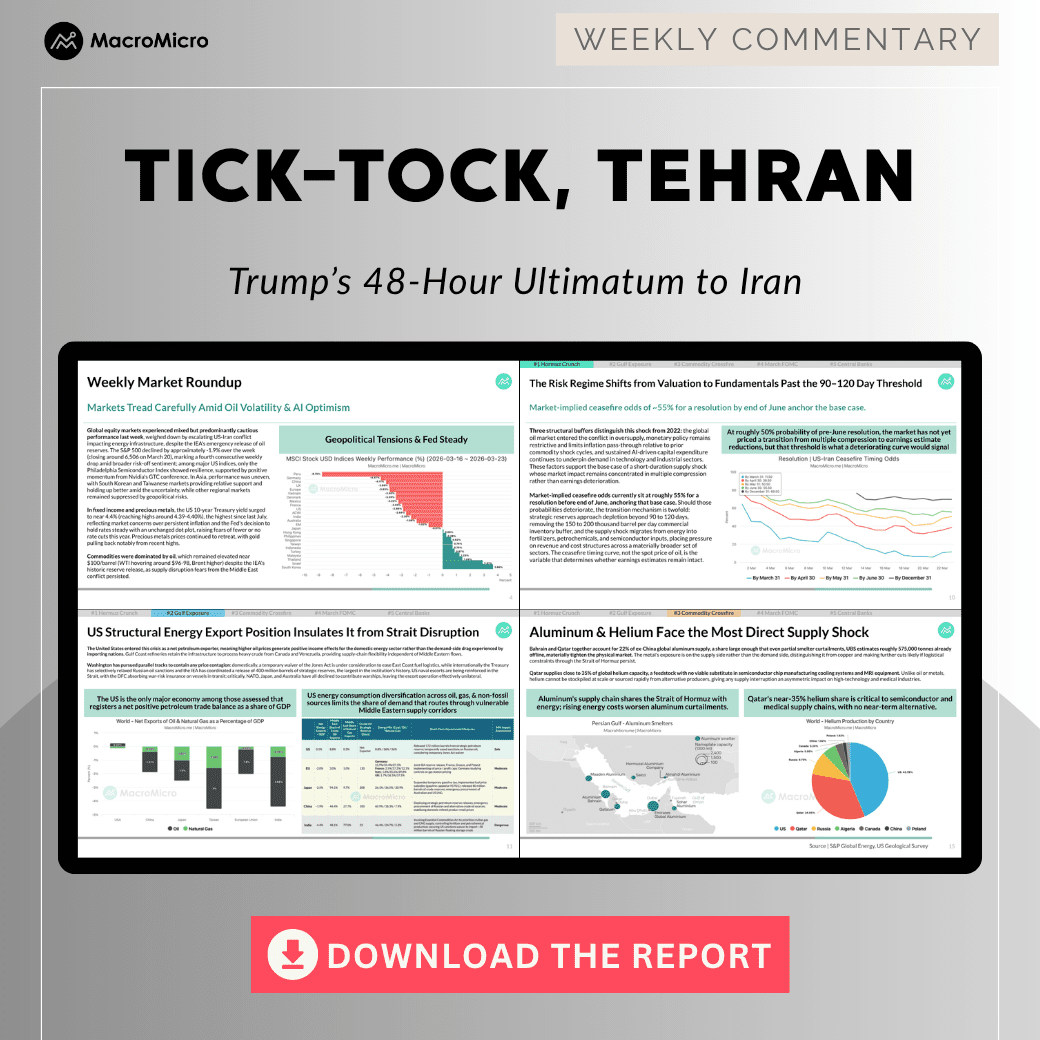
1. Energy Shock Exposure: India Most Vulnerable as Supply Disruptions Ripple Across Sectors
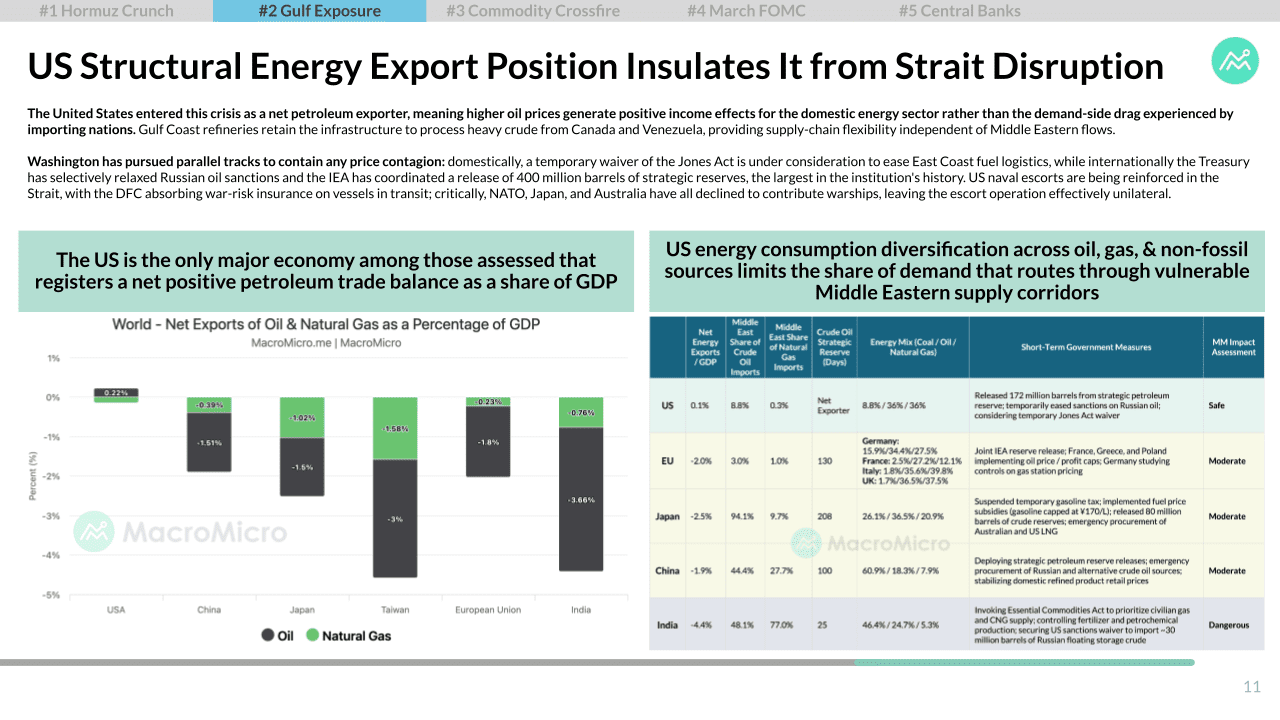
India faces the greatest damage due to thin reserves (25–30 days), high LNG dependence (60–70% from the Middle East), and strong fertilizer linkages to gas. Rising oil prices directly weigh on GDP growth and inflation. Europe and Japan benefit from large buffers (130–200 days of reserves) and diversified gas sourcing, limiting near-term impact. China’s exposure is moderate, as coal accounts for ~60% of its energy mix, and large strategic reserves (100+ days) provide insulation despite 40% crude reliance on the Middle East.
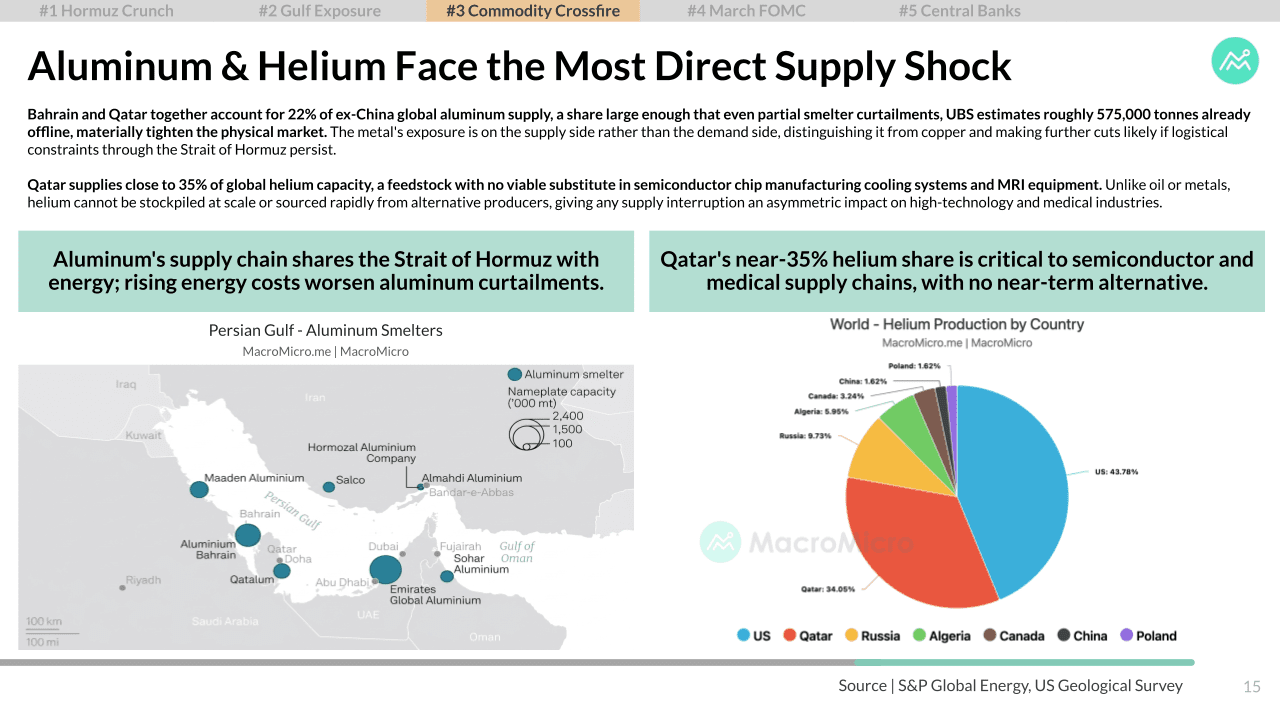
The most affected sectors include aluminum, helium-dependent industries, fertilizers, and petrochemicals. Aluminum supply is constrained by Hormuz disruptions, while Qatar supplies ~35% of global helium, a critical input for semiconductor cooling and lithography. Helium shortages could trigger 2–3 month disruptions with prolonged recovery timelines. Fertilizer production is highly exposed via LNG, raising food price risks. Semiconductor supply chains face the greatest risk through helium, while other inputs (neon, hydrogen, naphtha) benefit from substitution and inventory buffers.
The IEA release provides only ~2.5 mb/d, while the market still faces an estimated ~5 mb/d supply deficit due to the collapse in Hormuz transit. Strategic reserves address inventories but cannot replace disrupted physical flows. Oil prices are likely to remain elevated until navigation through the strait is restored.
2. Fed on Hold as Oil Prices Become the Key Policy Variable
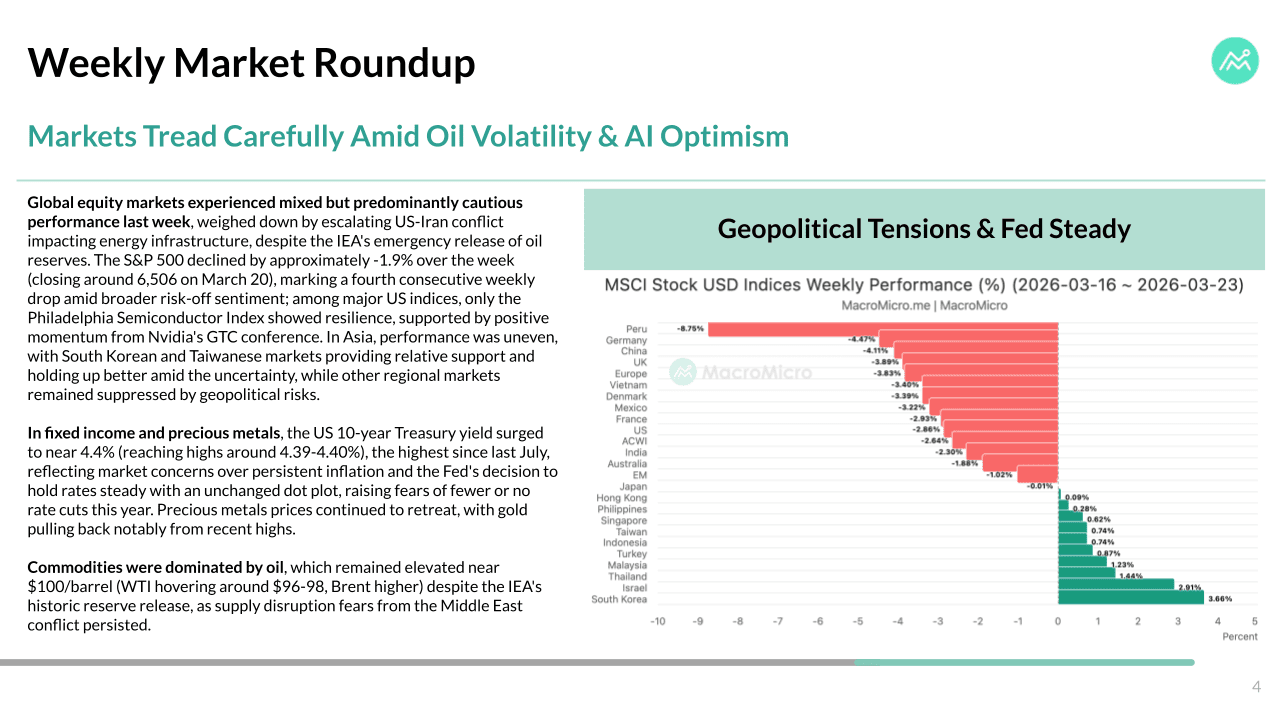
The Fed held rates at 3.50–3.75%, maintaining a neutral stance as solid economic activity is increasingly offset by rising uncertainty from the Middle East conflict. Policy remains modestly restrictive, with oil-driven inflation risks competing against weakening labor momentum.
The rate path is now highly conditional on oil prices. A decline toward $75 would keep disinflation on track, allowing one to two cuts starting as early as September. However, if oil stabilizes in the $90–100 range, 2026 cuts are likely off the table.
We expect that oil prices remaining above $100 for a prolonged period could trigger a shift back toward tightening, and we cannot rule out the FOMC resuming rate hikes in the second half of the year.
3. Global Central Banks Pivot to Inflation Risks as Energy Shock Reshapes Policy Outlook
The ECB and BOE both held rates but sharply raised inflation concerns driven by energy. The ECB revised its 2026 inflation forecast up to 2.6% and downgraded growth, while the BOE shifted to a unanimous hold, signaling a reduced easing bias. The ECB also warned that under “adverse” and “severe” scenarios, inflation could rise to 3.5% and 4.4%, respectively.
In contrast, the RBA raised rates to 4.1%, supported by strong domestic demand and above-target inflation, with further hikes expected. The BOJ held at 0.75% but remains cautious; we maintain our view that the BOJ will not deliver additional hikes in H1.
Overall, global central banks are shifting from rate-cut expectations toward hike pricing, with policy paths increasingly dependent on energy-driven inflation dynamics.
About Weekly Economic and Financial Commentary (WEFC)
The MacroMicro WEFC cuts through the noise, delivering rigorous analysis and in-depth insights on the most critical market-moving events. These topics cover equities, foreign exchange, bonds, commodities, global central banks, international political economy, and more.
At the core of WEFC is a concise Chart Pack, enabling you to grasp market trends at a glance.
WEFC Feedback Survey
We value your input! Your feedback helps us enhance our WEFC to better meet your needs. Please take a moment to share your thoughts. Thank you for being a valued reader!
Already a subscriber? Click here to log in.
Full Access to Our Services

Comprehensive data at your service
with key indicators for investment insights

Exclusive flash reports
on key events and data

Create your own charts and analysis
including performance backtesting

Hub of professionals to engage
in meaningful discussions and insights
 Get answers from MM AI.
-
Which countries are most vulnerable to the recent energy shock from the Iran-US conflict?
💡India is most vulnerable to the recent energy shock from the Iran-US conflict due to thin reserves (25–30 days), high LNG dependence (60–70% from the Middle East), and strong fertilizer linkages to gas, which will directly impact GDP growth and inflation. Europe and Japan are less exposed, benefiting from large buffers (130–200 days) and diversified gas sourcing. China’s exposure is moderate, supported by coal comprising ~60% of its energy mix and strategic reserves exceeding 100 days, despite its 40% crude reliance on the Middle East.
-
Which specific industrial sectors face the greatest risk from the Strait of Hormuz disruptions?
💡The industrial sectors facing the greatest risk from Strait of Hormuz disruptions include aluminum, helium-dependent industries, fertilizers, and petrochemicals. Aluminum supply is constrained by transit issues through Hormuz, while Qatar, supplying ~35% of global helium, faces critical disruption. Helium is crucial for semiconductor cooling and lithography, and its shortage could lead to 2–3 month disruptions with prolonged recovery timelines. Fertilizer production, highly reliant on LNG, faces increased food price risks.
-
How does China's energy mix and strategic reserves mitigate its exposure to oil price volatility?
💡China's energy mix, with coal accounting for approximately 60% of its total energy consumption, and large strategic reserves exceeding 100 days, significantly mitigate its exposure to oil price volatility. Despite a 40% reliance on Middle Eastern crude, these factors provide substantial insulation against supply disruptions and price shocks, making China's overall exposure moderate compared to other highly dependent nations.
-
What is the estimated supply deficit due to the Strait of Hormuz transit disruptions?
💡The estimated supply deficit due to the Strait of Hormuz transit disruptions is approximately 5 million barrels per day (mb/d). Although the IEA released about 2.5 mb/d from strategic reserves, this only addresses inventory levels and cannot replace the disrupted physical flows. Consequently, oil prices are expected to remain elevated until normal navigation through the strait is restored.
-
How do oil prices influence the Federal Reserve's future interest rate decisions?
💡Oil prices significantly influence the Federal Reserve's future interest rate decisions, becoming a key policy variable. If oil prices decline toward $75, disinflation could stay on track, potentially allowing one to two rate cuts as early as September. However, if oil stabilizes in the $90–100 range, 2026 cuts are likely off the table. A prolonged period of oil prices above $100 could trigger a shift back toward tightening, with the FOMC potentially resuming rate hikes in the second half of the year.
-
Under what oil price scenario might the FOMC resume rate hikes in the second half?
💡The FOMC might resume rate hikes in the second half of the year if oil prices remain above $100 for a prolonged period, as this could trigger a shift back toward tightening monetary policy. The Federal Reserve's rate path is now highly conditional on oil prices, with elevated prices posing significant inflation risks that could outweigh weakening labor momentum and necessitate further tightening.
-
How have global central banks, like the ECB and BOE, adjusted their inflation forecasts?
💡Global central banks, including the ECB and BOE, have adjusted their inflation forecasts upwards due to energy-driven concerns. The ECB revised its 2026 inflation forecast to 2.6% and downgraded growth, while the BOE shifted to a unanimous hold, signaling reduced easing bias. The ECB also warned of

