Executive Summary:
When we lowered S&P 500 year-end target a month ago, it had nothing to do with the market’s fundamental underpinnings. Our concerns remain valuation related in light of rising uncertainties in the investment backdrop. But don’t be tricked by scary surprises that send stocks southward; they could be attractive buying opportunities, say Ed and Elias, given the robust economic growth and corporate earnings we continue to expect. Today, they explain why prospective frights from four directions—geopolitical, US political, the Fed, and AI—could turn out to be opportunities in disguise. … Check out our chart collection.
Strategy: Buy the Scares
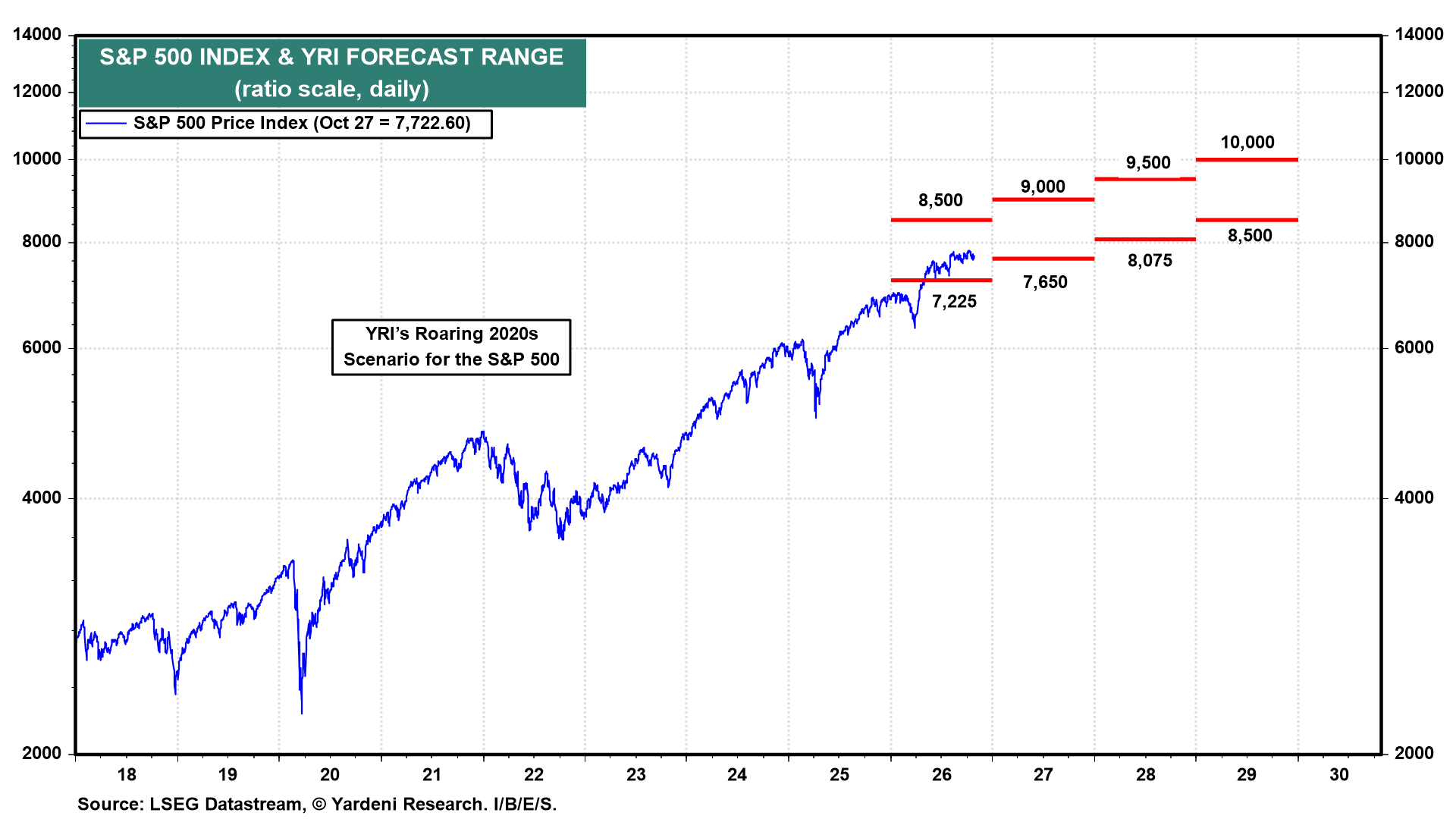
On September 15, we advised our readers to “Proceed With Caution.” We pushed out our 8,400 target for the S&P 500 from year-end 2026 to mid-2027 and set 7,900 as our new year-end target.
 ▌View Related Live Charts: US - S&P 500
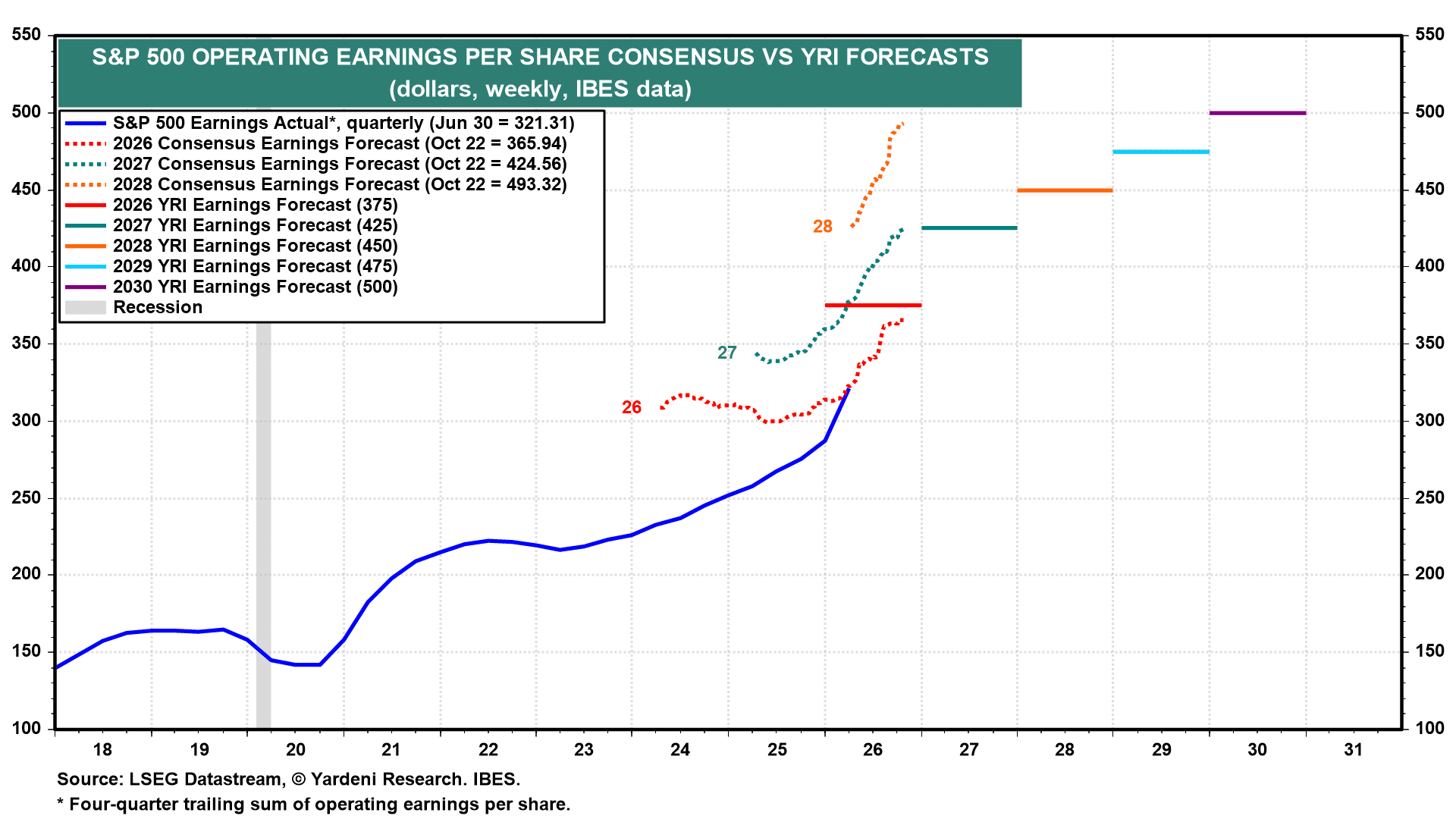
Our concern wasn’t the earnings outlook but stock market valuations. We warned that rising bond yields, renewed geopolitical tensions, mounting concerns about the AI investment boom, and domestic political uncertainty could weigh on valuation multiples. Our most immediate concern was that higher-for-longer oil prices meant stickier-for-longer inflation, requiring the Fed to tighten monetary policy. Accordingly, we lowered our year-end forward P/E forecast from 19.8 to 18.6 while maintaining our 2027 earnings forecast of $425 per share.
 ▌View Related Live Charts: S&P 500 Forward PE Ratio & 25 Year Average and 1, -1 Std. Dev
Our caution proved timely. By October 14, several risks flagged a month earlier were materializing. Risk-off sentiment returned as AI investment concerns intensified, inflation proved troublesome, and geopolitical tensions escalated. The S&P 500’s forward P/E was moving toward our...
Already a subscriber? Click here to log in.
Full Access to Our Services

Comprehensive data at your service
with key indicators for investment insights

Exclusive flash reports
on key events and data

Create your own charts and analysis
including performance backtesting

Hub of professionals to engage
in meaningful discussions and insights
 Get answers from MM AI.
-
How do geopolitical tensions, specifically in the Middle East, influence oil prices and inflation?
💡Geopolitical tensions, particularly in the Middle East, significantly influence oil prices and inflation through several mechanisms. Escalations, such as Iranian attacks on commercial shipping and energy infrastructure near critical routes like the Strait of Hormuz and Bab el-Mandeb Strait, disrupt supply chains and increase shipping costs, which directly push oil prices higher. This rise in oil prices fuels broader inflation concerns, as energy is a fundamental input across the economy. The risk of further military conflict, coupled with increased shipping expenses, explains why oil prices remain well above pre-conflict levels despite a recovery in regional exports, creating a toxic cocktail for stock market valuation multiples.
-
Why does MacroMicro believe geopolitical crises often create stock market buying opportunities?
💡MacroMicro believes geopolitical crises often create stock market buying opportunities because, historically, most geopolitical shocks trigger temporary panic attacks rather than lasting bear markets, provided the underlying economy remains resilient. While acknowledging exceptions like the 1970s oil shocks that contributed to recessions, the current assessment is that strong fundamental underpinnings continue to support the US economy. Therefore, any market selloff driven by geopolitical frights is likely to reflect temporary sentiment shifts rather than a deterioration in economic fundamentals, presenting attractive entry points for investors with cash on the sidelines.
-
What economic data supports the argument for a potential October interest rate hike by the Fed?
💡Economic data supporting the argument for a potential October interest rate hike by the Fed includes troubling inflation reports from September, which showed broad-based inflation pressures across the Consumer Price Index (CPI), Producer Price Index (PPI), and PCE Price Index. Additionally, the economy continues to demonstrate resilience with strong consumer spending, a healthy labor market, and robust business investment, alongside ongoing stimulus from wide fiscal deficits. Furthermore, inflation expectations have shown signs of becoming unanchored, increasing the risk of entrenched inflation, which could prompt the Fed to act decisively to curb price increases.
-
How might an unexpected Fed rate hike in October impact Treasury yields and stock market valuations?
💡An unexpected Fed rate hike in October could significantly impact Treasury yields and stock market valuations by pushing Treasury yields higher, compressing stock market valuation multiples, and fueling a broad risk-off sentiment on Wall Street. However, MacroMicro suggests that the initial market reaction would likely reflect the surprise element more than any fundamental economic deterioration. Such a hike would signal the economy's resilience and the Fed's commitment to containing inflation, and the policy rate would likely remain in accommodative territory. Consequently, any resulting selloff could be viewed as a temporary market correction, offering a buying opportunity rather than indicating a sustained downturn.
-
What are the potential implications of a Democratic sweep in Congress for President Trump and Wall Street?
💡A Democratic sweep in Congress could create several challenges for President Trump and Wall Street. Democrats would gain control of congressional committees, leading to increased scrutiny of the administration and potentially blocking Trump’s legislative agenda and judicial appointments. They would also acquire greater leverage in negotiations over government spending and the federal debt ceiling, possibly demanding policy concessions and setting the stage for future debt-ceiling standoffs, such as in 2027. This shift could introduce policy uncertainty and increased regulatory pressure, particularly concerning sectors like the AI investment boom.
-
How could increased scrutiny on data centers by Democrats affect the AI investment boom?
💡Increased scrutiny on data centers by Democrats could significantly affect the AI investment boom by delaying projects and raising costs. Local opposition to data centers is growing due to concerns about their impact on electricity prices, water usage, and environmental harm. While President Trump’s veto power might limit federal legislation, state and local restrictions could intensify. These constraints, stemming from political and regulatory pressures, could slow the buildout of essential infrastructure for AI, potentially weighing on the profitability and pace of the AI trade, although MacroMicro views these constraints as ultimately healthy for the boom's durability.
-
What are the three major constraints facing the current AI investment boom?
💡The three major constraints facing the current AI investment boom are financial, physical, and political. Financial constraints include investor skepticism regarding the returns on massive AI investments and concerns about the availability of sufficient capital to finance them. Physical constraints involve electricity shortages, limited grid capacity, and the practical challenges of building out extensive infrastructure. Political constraints arise from growing opposition to data centers due to their impact on electricity prices, water usage, and the environment, potentially leading to increased scrutiny and regulatory hurdles.
-
How do financial and physical constraints on AI investment reduce the risk of overinvestment?
💡Financial and physical constraints on AI investment reduce the risk of overinvestment by promoting more efficient capital allocation and moderating the pace of expansion. Restricted access to capital forces investors to scrutinize projects more thoroughly, ensuring that only the most viable and high-return initiatives receive funding. Similarly, physical limitations such as electricity shortages and limited grid capacity naturally slow down the buildout of data centers, preventing an uncontrolled surge in infrastructure development. Together, these constraints curb excessive spending and speculative ventures, fostering a more sustainable and durable growth trajectory for the AI boom.
-
Which tech giants are projected to continue significant AI spending despite investment constraints?
💡Despite investment constraints, tech giants such as Amazon, Alphabet, Meta, Microsoft, and Oracle are projected to continue significant AI spending. These companies are forecast to spend nearly $780 billion in 2026 and more than $1 trillion annually from 2027 through 2030. Their strong balance sheets and established access to capital enable them to maintain their investment pace, positioning them to navigate and potentially benefit from a more constrained investment environment by consolidating market leadership.
