Executive Summary:
Today, Elias and Ed examine lessons that emerged from last week’s financial market turbulence. While stock investors soured on AI-related stocks, pulling the S&P 500 down despite good performance from most sectors, the week yielded several insights that are encouraging for the AI trade. … Less encouragingly, last week showed how little tolerance investors now have for under-delivering AI companies. Analysts with unattainably high estimates are to blame for that. But at least such investor skepticism inhibits bubble formation. … Also: The US economy is firing on all cylinders, as the release of Q3 real GDP growth shows, and underlying demand was even stronger than the headline number suggests. … Check out our chart collection.
AI Trade I: Five Lessons from a Turbulent Week
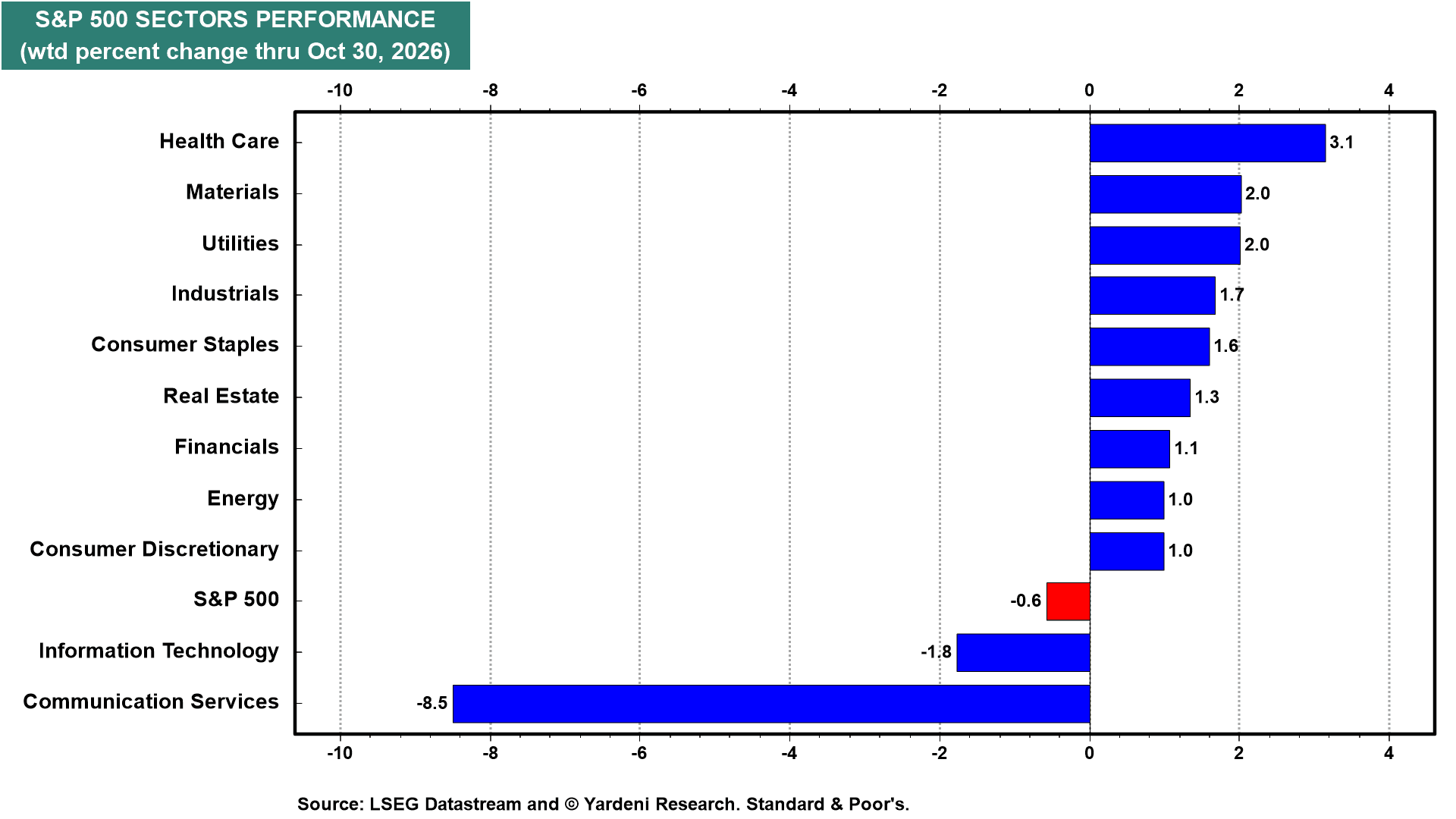
Wall Street had its own Halloween scare last week, as ghosts haunting the AI trade sent jitters through the stock market. The S&P 500 fell 0.6% during the week even as nine of its 11 sectors advanced. The Communication Services (-8.5%) and Information Technology (-1.8%) sectors were the mischief-makers that dragged the index lower.
 ▌View Related Live Charts: US - S&P 500 - Information Technology Sector
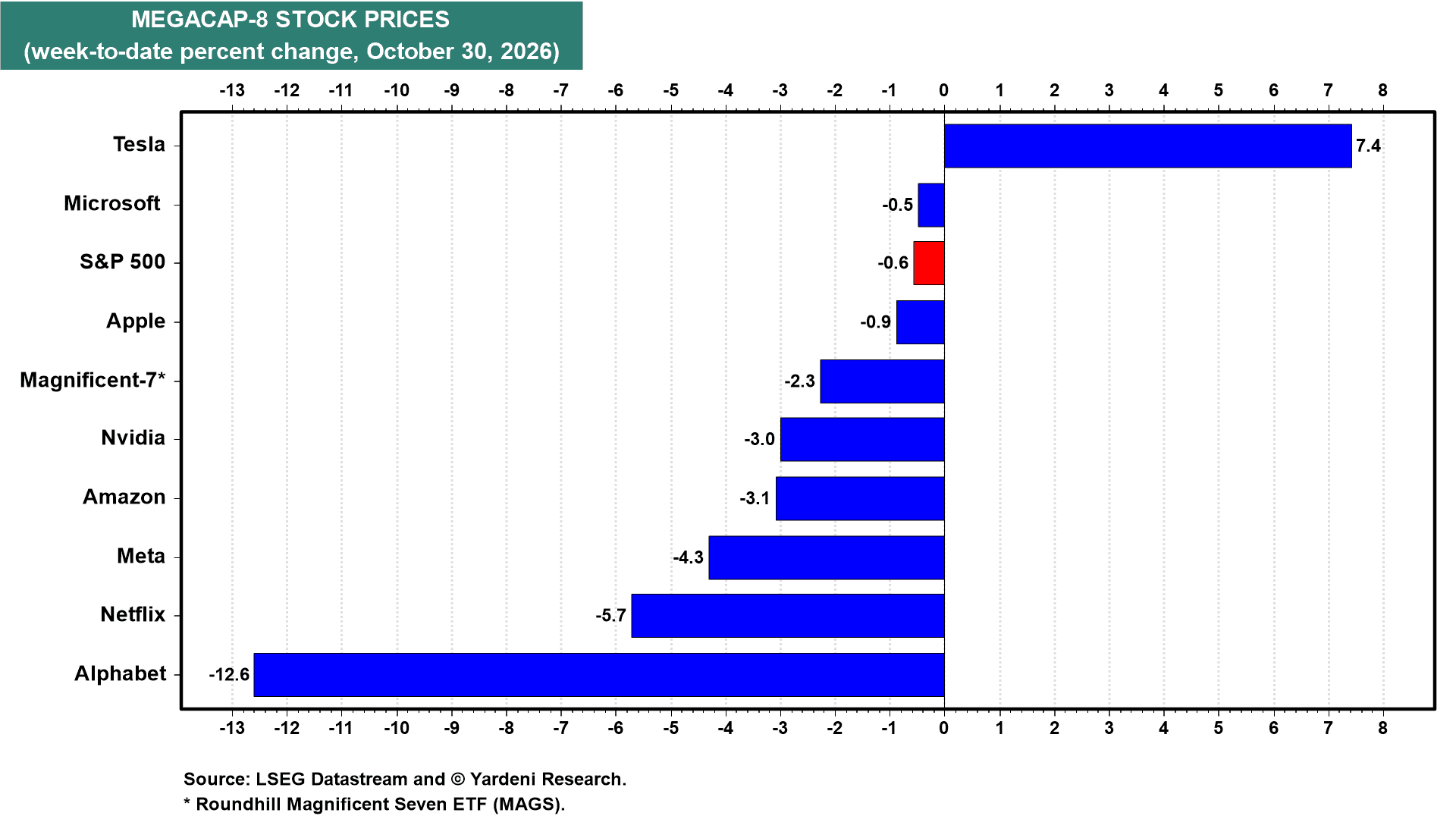
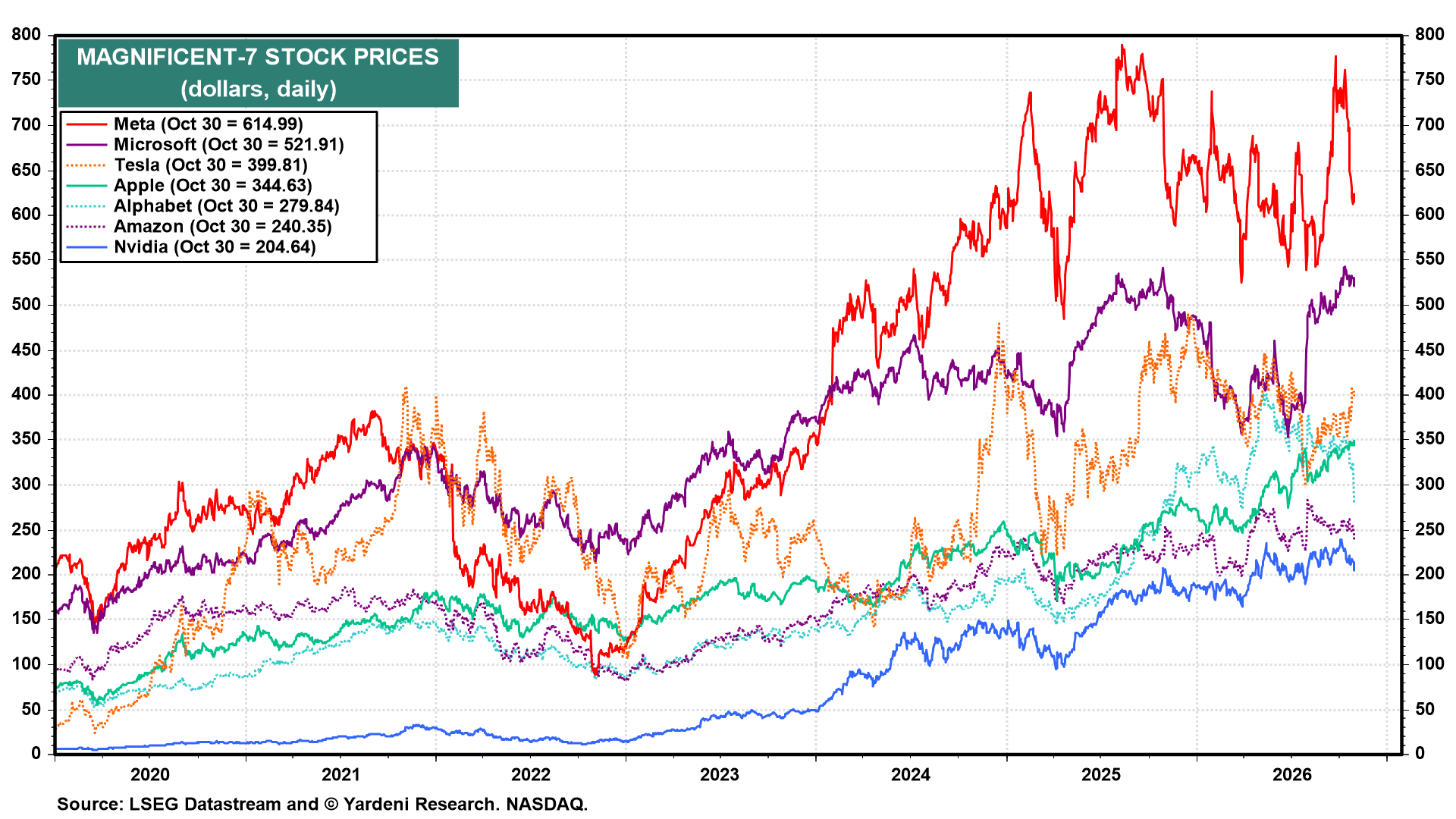
The tech-heavy Nasdaq Composite dropped 2.0%, while the Magnificent Seven fell 2.3%, with six of the seven stocks declining.
 ▌View Related Live Charts: US - Magnificent Seven Total Market Cap & Share of S&P 500
 ▌View Related Live Charts: Big Tech - Total Market Capitalization (Ranking)
The week’s Big Tech earnings were the main source of the scares. After reporting Q3 earnings, Alphabet plunged 12.6% w/w, while Amazon (-3.1%), Meta (-4.3%), and Microsoft (-0.5%) also declined. Intel tumbled 24.4% following disappointing guidance, while...
Already a subscriber? Click here to log in.
Full Access to Our Services

Comprehensive data at your service
with key indicators for investment insights

Exclusive flash reports
on key events and data

Create your own charts and analysis
including performance backtesting

Hub of professionals to engage
in meaningful discussions and insights
 Get answers from MM AI.
-
What key insights emerged for the AI trade despite recent market turbulence?
💡Despite recent market turbulence, five key insights emerged for the AI trade: the spending spree continues with over $320 billion in new financing; financing sources are diversifying beyond corporate bonds; infrastructure providers are thriving with robust demand and expanding order books; compute demand appears sustainable, evidenced by Anthropic's significant revenue growth and customer expansion; and the equity market's reaction function is becoming unforgiving, punishing underperformance but inhibiting bubble formation.
-
What is the projected AI-related financing, based on recent announcements by Meta, SpaceX, and Anthropic?
💡Based on recent announcements, projected AI-related financing exceeds $320 billion. This includes Meta's plans to raise $95 billion in equity, SpaceX securing $40 billion for AI chips and servers, Anthropic's planned IPO aiming for up to $100 billion, a $63 billion consortium financing for Broadcom's AI chips for Anthropic, and Microsoft tapping the bond market for another $25 billion.
-
How are companies diversifying financing sources for AI infrastructure buildout?
💡Companies are diversifying financing sources for AI infrastructure buildout by increasingly tapping equity markets, private credit, and asset-backed financing. This shift is illustrated by Meta's proposed $95 billion equity raise, Anthropic's planned IPO, and SpaceX's chip-and-server financing arrangements, moving away from a primary reliance on corporate bonds due to growing pushback from bond investors.
-
Which infrastructure providers are thriving from the AI buildout, and what are their key results?
💡Infrastructure providers thriving from the AI buildout include SK Hynix, which reported a record Q3 operating profit of $62 billion and expects DRAM and high-bandwidth memory shortages through 2030. GE Vernova saw a 96% year-over-year surge in organic orders, increasing its backlog by $20 billion to $197 billion. Vertiv reported over 100% organic order growth and raised its annual guidance. Corning's Optical Communication revenues jumped 44% year-over-year, with segment profits surging 80%.
-
What evidence suggests sustainable demand for AI computing, according to Anthropic’s IPO filing?
💡Sustainable demand for AI computing is suggested by Anthropic's IPO filing, showing revenues surged from $1.2 billion in H1-2025 to $16.3 billion in H1-2026, and operating losses narrowed to $693 billion in H1-2026, with Q2-2026 achieving its first quarterly operating profit. Customer growth included 11,900 clients spending over $100,000 annually and a net revenue retention of approximately 900%, indicating dramatic spending increases from existing customers. Compute efficiency improved fivefold, with revenue per compute dollar rising to $2.08, and the company held $131.7 billion in cash.
-
What criteria did companies need to meet to be rewarded by the equity market last week?
💡To be rewarded by the equity market last week, companies needed to meet four criteria: strong revenue and earnings growth demonstrating successful AI monetization, reassuring free cash flows, upbeat management guidance, and greater capital expenditure discipline. Microsoft, for instance, met these, showing 48% year-over-year Azure revenue growth and $18.6 billion in free cash flow, leading to a 3% rally in its shares.
-
Why has the equity market become unforgiving towards AI-related earnings?
💡The equity market has become unforgiving towards AI-related earnings because industry analysts are projecting extraordinarily high earnings growth, creating expectations that are difficult to meet and leave little room for disappointment. Investors are increasingly skeptical whether these ambitious forecasts, such as the S&P 500 earning nearly $500 per share by 2028, can be achieved, leading to swift punishment for companies that under-deliver.
-
What implied S&P 500 level does consensus 2028 EPS suggest by year-end 2027?
💡The consensus 2028 S&P 500 EPS forecast of $494, combined with a 20.0 consensus 2028 Price/Earnings (P/E) ratio, implies an S&P 500 level of approximately 9,900 by year-end 2027. This projection is just shy of MacroMicro's own target of 10,000, which is set for year-end 2029.
-
How does the stock market’s current skepticism help prevent an AI bubble?
💡The stock market's current skepticism, evidenced by an unforgiving reaction function to earnings disappointments, helps prevent an AI bubble by acting as an important financial constraint on the AI buildout. This market behavior inhibits irrational exuberance from developing into a full-blown bubble by demanding exceptional results and punishing underperformance, ensuring guardrails are in place to check unchecked growth.
-
How did consumer spending and business investment contribute to US GDP growth in Q3?
💡Consumer spending contributed significantly to US GDP growth in Q3, advancing 3.8% (saar) for the second consecutive quarter, its fastest pace since Q4-2024, with spending on restaurants and hotels particularly robust. Business investment also soared 12.7% in Q3, driven by the AI investment boom, specifically a 37.4% surge in information-processing equipment and a 9.6% rise in software investment, benefiting sectors like construction, machinery, and power generation.
[Black Friday Is LIVE] Max AI Annual: 12 months + 2 bonus months. Save 30%+ with full MM AI access, unlimited charts, and 8+ exclusive 2027 outlook reports. Get the Offer

[Black Friday Is LIVE] Max AI Annual: 12 months + 2 bonus months. Save 30%+ with full MM AI access, unlimited charts, and 8+ exclusive 2027 outlook reports. Get the Offer