Executive Summary:
The Bond Vigilantes have driven up Treasury bond yields recently, thundering onto the scene in alarm over the government’s huge borrowing needs, record corporate bond issuance, three inflationary supply shocks, a cloudy Fed path, resilient nominal GDP growth, a higher neutral interest rate, and a fragile yen. On the flip side, the Trump administration is determined to keep yields tethered—one way or another. Also holding yields in check are slightly cooler economic momentum, moderating labor costs, and the prospect of less policy uncertainty. Ed and Elias expect those counterweights to keep the 10-year yield mostly within our 4.00%-5.00% expectation range, the “old normal.” … Check out the accompanying chart collection.
Bulletin Board
As a result of all the recent commotion in the bond market, Dr. Ed has been receiving lots of inquiries about the “Bond Vigilantes,” the term he coined in 1983. In response, please see his Bond Vigilantes Primer, with a few of his most pertinent excerpts on them over the years.
Bond Vigilantes I: Seven Reasons Yields Are Higher
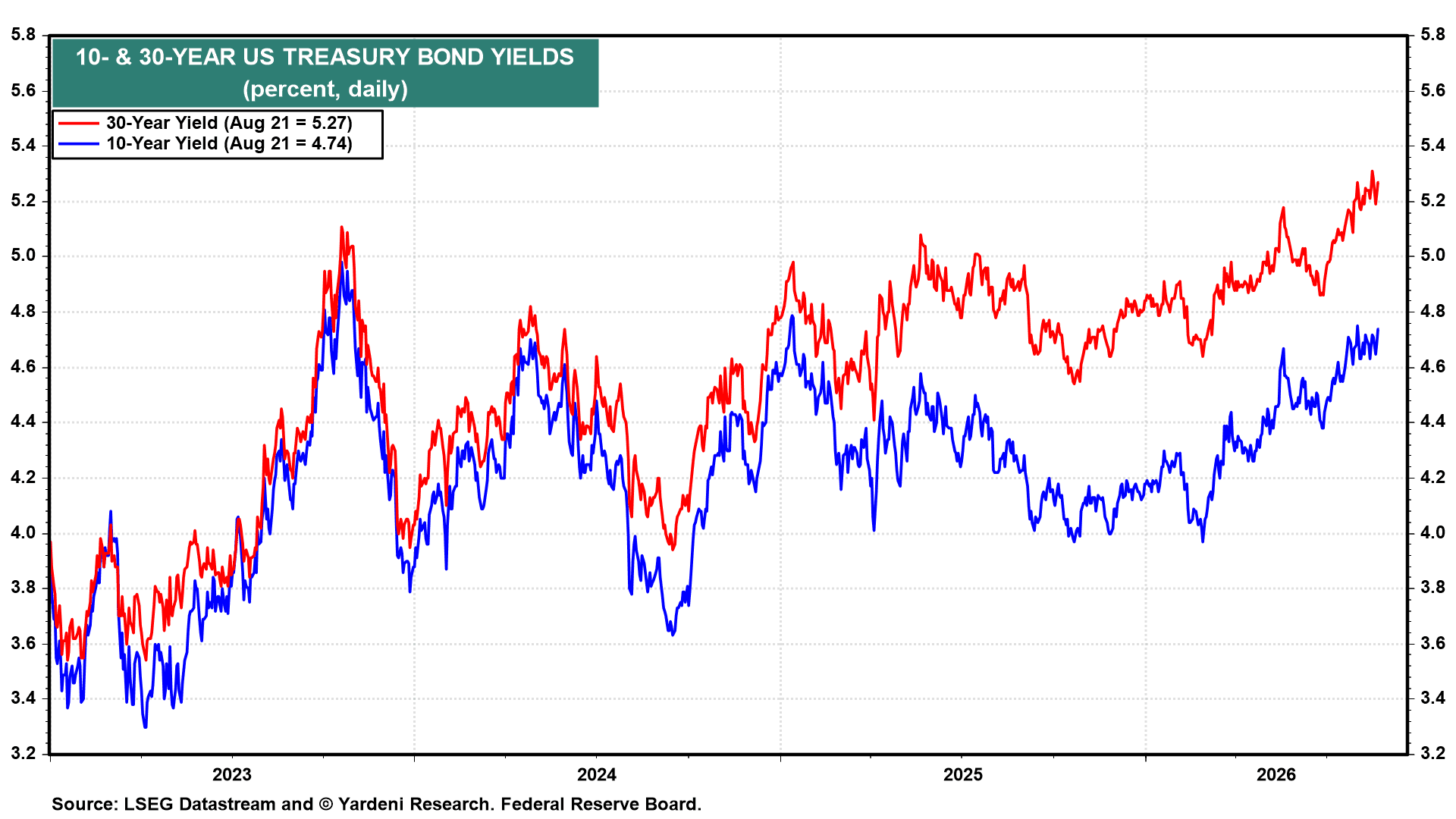
The Bond Vigilantes are back. Investors are demanding more compensation to hold long-term US government debt, generating volatility across global bond markets. The 10-year Treasury bond yield recently reached a new 2026 high of 4.74%, while the 30-year bond yield climbed to 5.33%, its highest reading in 19 years.
 ▌View Related Live Charts: US - Treasury Yields vs. Fed Funds Rate
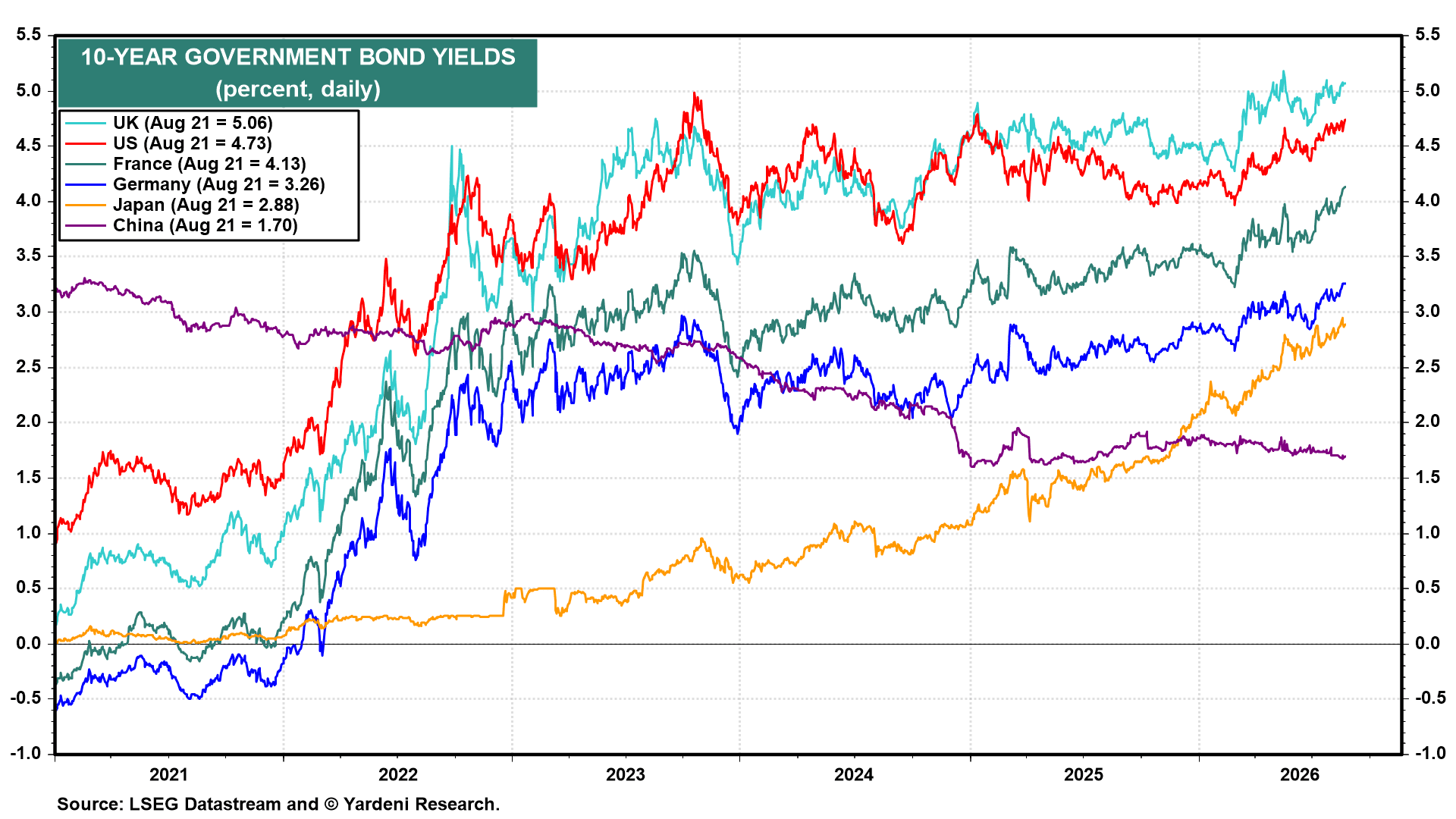
Long-term yields globally also have approached multi-decade highs
 ▌View Related Live Charts: 10-Year Government Bond Yield
We still expect the 10-year yield to remain in the 4.00%-5.00% range—the “old normal” at times of economic health prior to the 2008 Great Financial Crisis. But we count seven reasons Treasury yields have been rising recently:
(1) Fiscal anxiety. US federal debt surpassed $40 trillion last Wednesday, roughly double its level at the start of President Donald Trump’s first term.
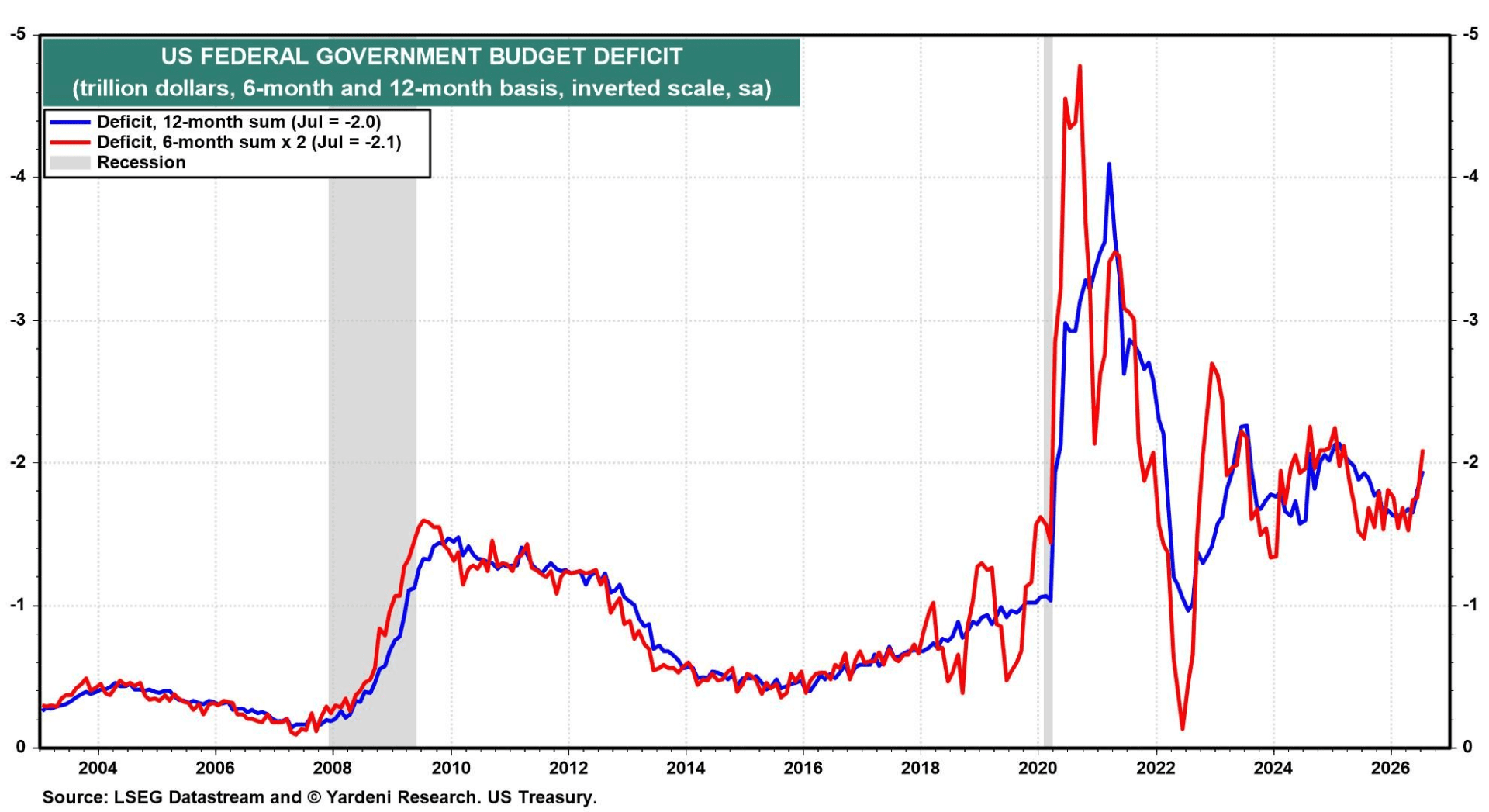
The federal budget deficit totaled $1.8 trillion during the first 10 months of fiscal 2026, $169 billion more than during the comparable period a year earlier and higher than the entire deficit of the prior fiscal year. July alone produced a $432.3 billion deficit, a record for that month and the largest monthly amount since March 2021. Both the six-month and 12-month budget deficits have been widening again recently, with the 12-month deficit at $2 trillion.
 ▌View Related Live Charts: US - Federal Surplus Or Deficit
The deterioration is occurring faster than expected. Only six months ago, the Congressional Budget Office (CBO) projected that total federal debt would reach $39.4 trillion at the end of this fiscal year; it has exceeded that already. The CBO also projects that annual budget deficits will rise from $1.9 trillion in fiscal 2026 to a staggering $3.1 trillion by fiscal 2036.
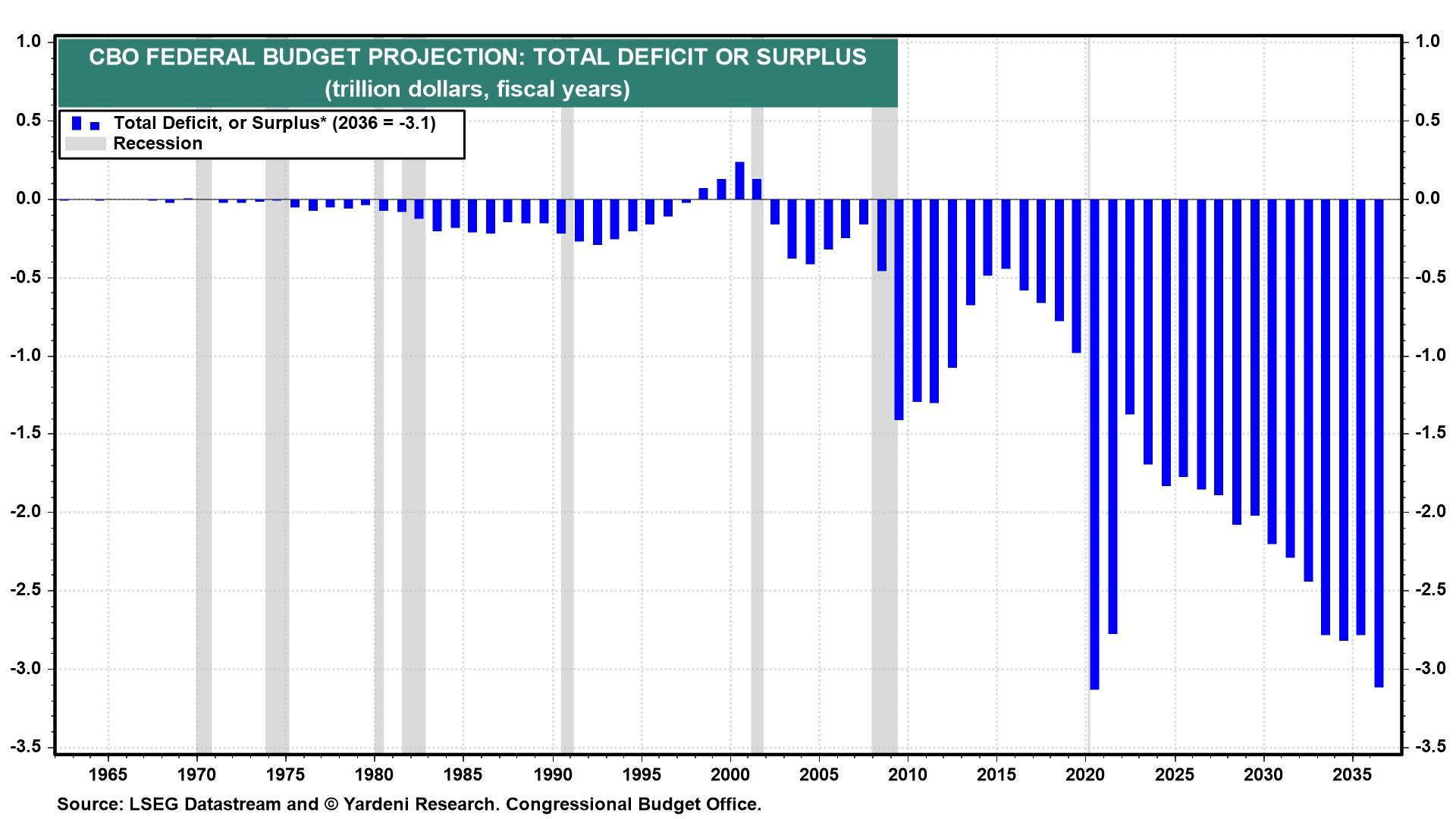
The Bond Vigilantes see ever-larger deficits requiring ever-larger Treasury auctions.
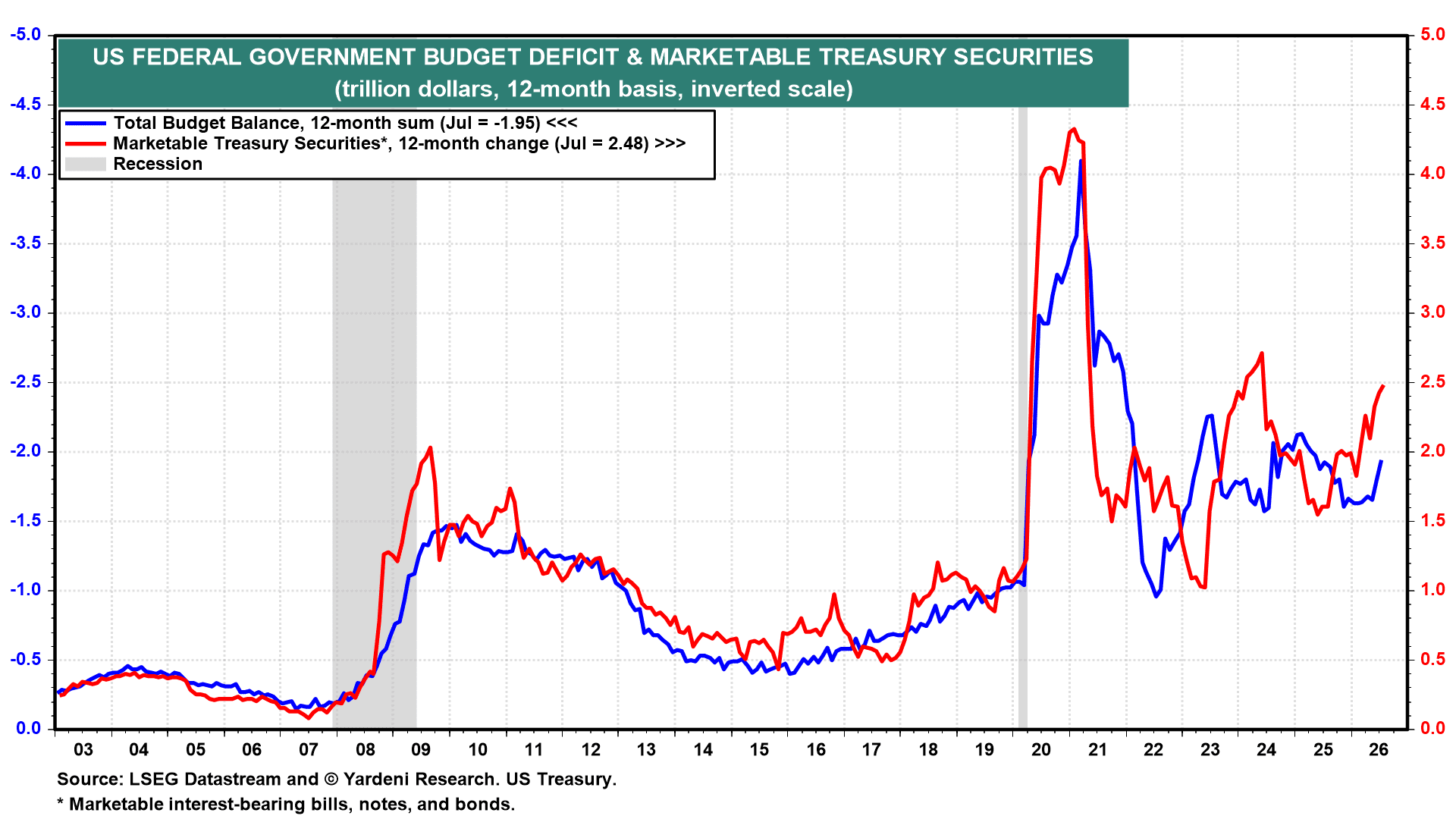 ▌View Related Live Charts: US - Federal Surplus Or Deficit
That combination raises both the supply of debt and the term premium that...
 Get answers from MM AI.
-
What are the primary reasons for the recent surge in long-term US Treasury bond yields?
💡Long-term US Treasury bond yields have surged due to seven primary reasons: fiscal anxiety driven by escalating federal debt exceeding $40 trillion, corporate issuance crowding out Treasury demand with record $2.8 trillion corporate bond issuance, inflation uncertainty from energy, tariff, and AI shocks, an unclear Federal Reserve reaction function regarding price stability, resilient nominal GDP growth around 6.5%, a structurally higher neutral interest rate, and a weakening Japanese yen. These factors collectively push investors to demand higher compensation for holding long-term US government debt, leading to significant volatility across global bond markets and the 10-year Treasury yield reaching a new 2026 high of 4.74%.
-
In what ways is corporate bond issuance, especially AI-related debt, crowding out Treasury demand?
💡Corporate bond issuance, particularly in AI-related debt, crowds out Treasury demand by diverting capital flows. US investment-grade corporate bond issuance reached approximately $1.7 trillion through July, a 27% increase over the previous year, and total corporate bond issuance climbed to a record $2.8 trillion on a 12-month basis. Despite this flood of corporate debt, strong demand for high-quality, AI-related debt has kept corporate credit spreads compressed. As a result, capital that would normally flow into Treasuries is instead being absorbed by corporate bonds, forcing Treasury yields to rise to attract sufficient buyers and clear the market. This dynamic is a classic crowding-out effect, reflected in net purchases of US corporate bonds by private foreigners exceeding their purchases of US Treasury notes and bonds over the past year.
-
Which three simultaneous supply shocks are causing inflation uncertainty and impacting bond yields?
💡Three simultaneous supply shocks are causing inflation uncertainty and impacting bond yields: an energy shock, a tariffs shock, and an AI shock. The energy shock stems from Middle East conflicts disrupting shipping and keeping energy prices elevated, with significant uncertainty about future developments. The tariffs shock involves an unclear ultimate inflation impact from initial US tariff-related price increases, as nearly half of firms surveyed by the New York Fed still plan further price hikes, and the Trump administration increasingly uses tariffs as a policy tool. The AI shock refers to the AI infrastructure buildout boosting demand and prices for scarce chips, electricity, and skilled labor, creating near-term inflationary pressures despite long-term disinflationary potential. This uncertainty about whether these effects will fade or embed in underlying inflation raises the inflation-risk premium in long-term yields.
-
How does an uncertain Federal Reserve reaction function influence the term premium in long-dated Treasuries?
💡An uncertain Federal Reserve reaction function significantly influences the term premium in long-dated Treasuries by increasing investor uncertainty. Fed Chair Kevin Warsh's commitment to lowering inflation to 2.0% is clear, but the 'what, when, and how' of his monetary policy remain opaque. Investors lack clarity on which inflation measure matters most (e.g., headline PCED, core PCED), the timeline for achieving the 2.0% target (quickly or gradually), and the specific tools he will employ (higher federal funds rate, smaller balance sheet, tighter financial conditions, or all three). Until Warsh clarifies the Fed's strategy, investors must price for greater uncertainty, leading to an increased term premium embedded in long-dated Treasuries as they demand more compensation for holding debt in an unpredictable policy environment.
-
How does a higher neutral interest rate affect the demand for capital and long-term yields?
💡A higher neutral interest rate affects the demand for capital and long-term yields by increasing the price of capital. Demand for capital is surging due to persistent fiscal deficits and the booming AI investment, while the growth of savings faces headwinds from Baby Boomer retirements and slower immigration. This combination of increased capital demand and slower savings growth implies a structurally higher equilibrium interest rate. Recent research by the San Francisco Fed estimates the medium-run real natural rate near 1.5%. When combined with annual inflation of approximately 3.0%, the implied nominal neutral rate is roughly 4.5%, which is close to the current 10-year Treasury yield, indicating that the market is adjusting to a new, higher equilibrium rate.
-
Why does a weakening Japanese yen impact US Treasury demand and yields?
💡A weakening Japanese yen impacts US Treasury demand and yields because Japan is one of the largest foreign holders of US government debt. When the yen rapidly weakens, as it did in late July to roughly 164 yen per dollar, it can trigger two main effects. First, Japanese authorities might sell dollar assets to finance intervention aimed at supporting their currency, thereby reducing demand for Treasuries. Second, private Japanese investors might repatriate capital as hedging costs rise and domestic yields become more attractive. Both channels decrease demand for US Treasuries, which, in turn, can exert upward pressure on US yields as the market requires higher compensation to absorb the available debt.
-
What is the Trump administration's 'Plan A' to address high bond yields, and how does it work?
💡The Trump administration's 'Plan A' to address high bond yields involves actions by Treasury Secretary Scott Bessent, who is doubling the size of the Treasury's buyback plan. This plan entails repurchasing Treasury securities with maturities between 10 and 30 years, increasing operations to $4 billion per cycle. The strategy aims to reduce the amount of long-dated Treasury duration that the private sector must absorb by buying longer-dated securities and financing these purchases through the issuance of more short-term debt. By shrinking the supply of long-dated securities available to investors, buybacks support bond prices and help restrain long-term yields, similar to the Fed's historical 'Operation Twist' interventions.
-
Which four key factors are expected to keep the 10-year Treasury yield within the 4.00%-5.00% range?
💡Four key factors are expected to keep the 10-year Treasury yield within the 4.00%-5.00% range: Treasury Secretary Bessent's belief that the federal budget deficit may have peaked, potentially easing fiscal anxiety; a moderation in economic momentum, indicating growth may become less exceptional; an improvement in underlying inflation, with unit labor costs rising only 1.4% y/y in Q2-2026 and expected downward revisions to core PCED inflation; and the prospect of reduced uncertainty surrounding the Fed's reaction function, particularly if Chair Warsh provides clearer guidance at the Jackson Hole symposium. These counterweights are anticipated to prevent yields from exceeding the 'old normal' range.
-
What indicators suggest an improvement in underlying inflation, potentially easing pressure on yields?
💡Indicators suggesting an improvement in underlying inflation, potentially easing pressure on yields, include subdued unit labor cost growth and anticipated downward revisions to the core PCED inflation rate. Unit labor costs, a preferred leading indicator for underlying inflation, rose only 1.4% year-over-year in Q2-2026. Since labor is the largest cost for most service-sector businesses, this moderation implies that core PCED inflation should also temper. Furthermore, the Bureau of Economic Analysis's (BEA) upcoming comprehensive revision is expected to lower the core PCED inflation rate by approximately 0.2-0.4 percentage points, potentially reducing the year-over-year rate to about 2.9% from 3.3%, primarily due to methodological changes in measuring prices for services like financial and legal sectors, and software.
-
How does the 'old normal' yield range compare to current 10-year Treasury bond yields?
💡The 'old normal' yield range for the 10-year Treasury bond, expected between 4.00% and 5.00%, refers to the levels observed during times of economic health prior to the 2008 Great Financial Crisis. Currently, the 10-year Treasury yield recently reached a new 2026 high of 4.74%, placing it within this 'old normal' expectation range. While there are significant upward pressures driving yields, such as fiscal anxiety and inflation uncertainty, analysts anticipate that moderating economic momentum and improving underlying inflation will keep the yield largely within this historical range.
