Executive Summary:
We’re still strong believers in our Roaring 2020s scenario, hinging on a productivity boom that strengthens economic growth even as it contains inflation. However, we’ve shaved the subjective odds that we ascribe to that scenario from 80% to 70% and now see a 30% chance that rising geopolitical and other risks could derail it. Today, Ed and Elias update our deepened worry list, detailing the concerning prospects, as well as reiterate the reasons that we remain bullish. We still believe that strong earnings growth will lift the S&P 500 to our 8400 price target by year-end. … Also: Check out our chart collection.
US Stock Market I: Updating the Worry List
There is no shortage of worries for investors in the current environment. The list includes higher oil prices amid escalating tensions in the Middle East, rising bond yields around the world, sticky inflation, and a Federal Reserve that will likely deliver a 25bps rate hike at the September 16-17 FOMC meeting.
Yet we are sticking with our bullish year-end target for the S&P 500 of 8400 because a key pillar of the bull market, Fabulous Earnings Momentum (FEMO), remains alive and well and so does our base-case Roaring 2020s scenario, which should keep the FEMO rolling. The essence of that scenario: A technology-driven productivity boom, fueled by AI and other innovations, will allow the economy to grow faster as it also contains inflation, boosts real wages, and supports record-high profit margins and earnings growth.
However, the recent confluence of risks has prompted us to lower the subjective probability we assign to the Roaring 2020s scenario from 80% to 70%, while raising the probability of outcomes that could derail this happy scenario to 30% from 20%. We are often optimists, but we always strive to be realists first and foremost. That is why we regularly update our worry list.
Consider the following prospective developments on our worry list:
(1) The prospect of a worsening geopolitical maelstrom. The latest Middle East conflict started on February 28, when the US and Israel attacked Iran. Most observers expected a short war after Iran’s leadership and conventional military capabilities were badly damaged. We changed our mind on the second day of the war. We argued that Iran is likely to remain effectively under the control of the Islamic Revolutionary Guard Corps (IRGC), which can continue the fight through asymmetric warfare and its network of regional proxies.
The US continues to enforce its naval blockade on Iranian shipping in the Strait of Hormuz, severely restricting Iran’s oil exports. Tehran and its allies are responding by widening the battlefield. At the end of last week, Saudi Arabia’s East-West oil pipeline was forced offline after a drone attack originating from Iraq, while the Iran-backed Houthis are strengthening their position around the Bab el-Mandeb Strait.
The IRGC has responded to the US economic war on Iran by attacking oil supplies. Their goal is to drive up the price of oil so that the Republican Party loses the midterm congressional elections. Treasury Secretary Scott Bessent has argued that the Strait of Hormuz could eventually become largely redundant as Gulf producers build more pipelines around it. Maybe so. But Iran and its proxies can attack those pipelines too, along with refineries, export terminals, and the shipping routes they feed into. That is what is happening now.
The escalation already has pushed up oil prices to above $104 for a barrel of Brent crude and above $100 for West Texas Intermediate (WTI) crude, while depleted inventories have left the oil market vulnerable to further disruptions.
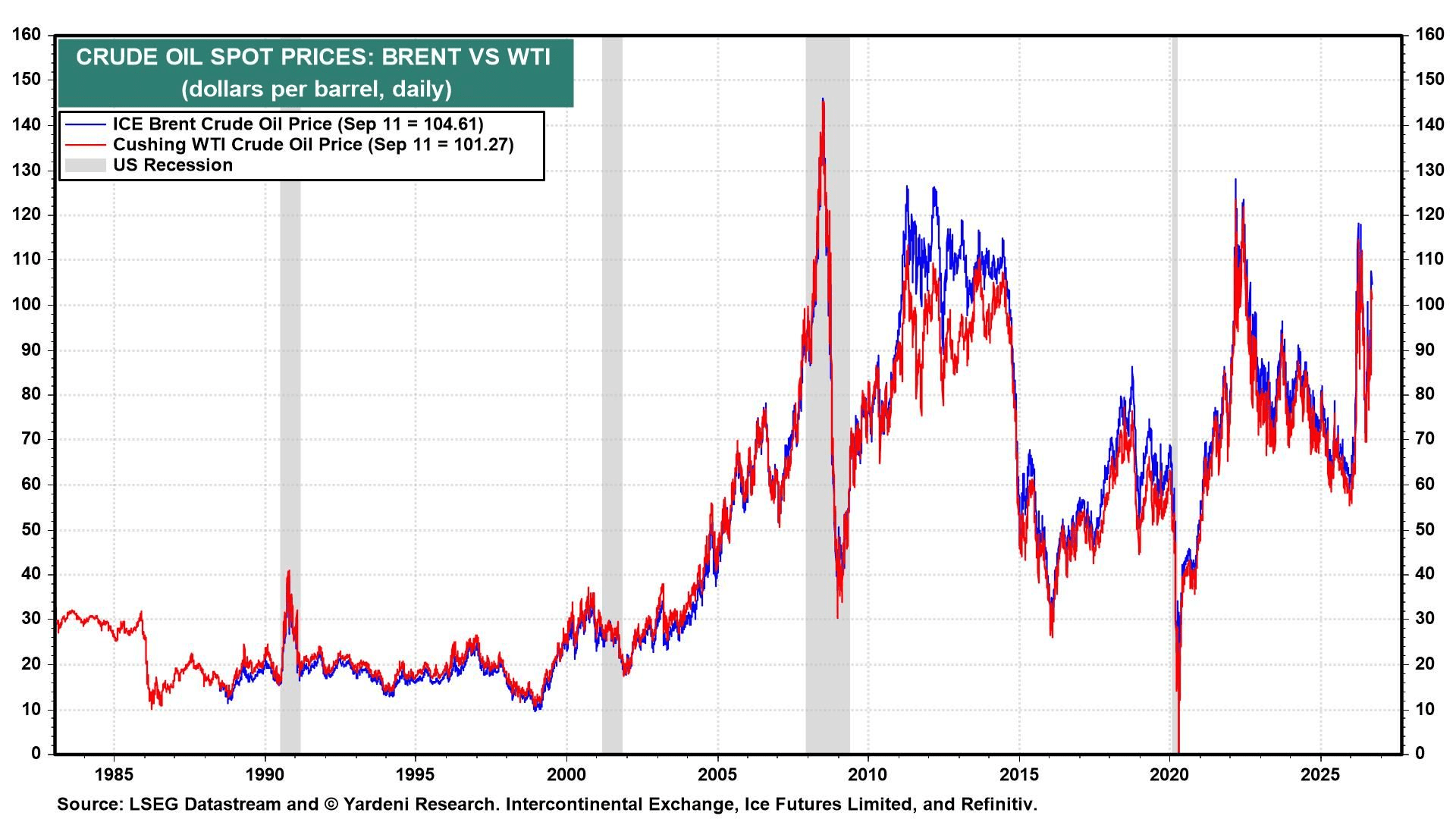
Refined products look even...
Already a subscriber? Click here to log in.
Full Access to Our Services

Comprehensive data at your service
with key indicators for investment insights

Exclusive flash reports
on key events and data

Create your own charts and analysis
including performance backtesting

Hub of professionals to engage
in meaningful discussions and insights
 Get answers from MM AI.
-
What is the updated probability for the Roaring 2020s scenario, and what are the new downside risks?
💡The updated probability for the Roaring 2020s scenario is 70%, a reduction from 80%, reflecting a 30% chance that rising geopolitical and other risks could derail it. The original 20% probability for derailing factors has increased to 30%, signaling deepened worries about a worsening geopolitical maelstrom, entrenched inflation shocks, potential wage-price spirals, aggressive Fed rate hikes, and negative fiscal outlooks from higher interest rates. The core belief in a technology-driven productivity boom containing inflation and boosting growth remains, but the increased probability of downside risks highlights a more realistic assessment of current economic headwinds.
-
Which specific inflation shocks are currently driving up prices in the US economy?
💡Currently, three major inflation shocks are driving up prices in the US economy: the AI capital-spending boom, higher US tariffs, and elevated energy prices. The AI boom fuels demand for specialized workers and materials, while increased tariffs raise import costs. Higher oil prices, exacerbated by geopolitical tensions, directly increase transportation and production expenses. These shocks are occurring while the economy remains resilient, allowing businesses to pass on higher costs to consumers. These factors contribute to inflation remaining above the Fed's 2.0% year-over-year target for more than five years, increasing the risk of second-round inflation effects.
-
What are the key differences between aggregate wage growth and the Atlanta Fed's Wage Growth Tracker?
💡The key differences between aggregate wage growth and the Atlanta Fed's Wage Growth Tracker lie in their measurement and sensitivity to workforce composition. Aggregate wage growth, represented by average hourly earnings, rose 3.1% year-over-year in August. This measure can be influenced by workforce composition changes, such as the retirement of highly paid older workers (Baby Boomers), which can pull the average lower despite underlying wage acceleration. Conversely, the Atlanta Fed's Wage Growth Tracker accelerated for a third consecutive month to 4.1% year-over-year, the fastest in a year, because it tracks wage changes for continuing workers, effectively removing retirees from the sample and providing a clearer signal of underlying wage dynamics, especially for job switchers, whose wage growth reached 5.0% year-over-year.
-
How do rising interest rates and increasing US federal debt impact the fiscal outlook?
💡Rising interest rates and increasing US federal debt negatively impact the fiscal outlook by escalating debt-service costs and requiring more Treasury issuance. US federal marketable debt held by the public surpassed $31 trillion in August, double the amount a decade prior. Treasury net interest outlays have climbed above $1 trillion on a 12-month basis. If interest rates continue to rise, higher debt-service costs will exacerbate the budget deficit, potentially provoking
-
Which factors could cause a significant slowdown in the AI capital-spending boom?
💡Several factors could cause a significant slowdown in the AI capital-spending boom, including higher interest rates, growing political and local opposition, and a broader backlash against AI. Higher interest rates would increase the hurdle rate for new projects, making investments less attractive. Political and local opposition to data centers is emerging due to concerns over electricity costs, grid constraints, water usage, and land use, potentially slowing development. Furthermore, an increasing general backlash against AI could reduce investment and public acceptance. If the AI boom loses momentum, weaker earnings expectations could trigger a stock-market pullback, a negative wealth effect, and a macroeconomic slowdown due to reduced hyperscaler capital spending.
-
How might the midterm elections and potential debt-ceiling debates impact fiscal stability?
💡The midterm elections and potential debt-ceiling debates could significantly impact fiscal stability by intensifying partisanship and increasing fiscal uncertainty. The November elections may lead to a more divided Washington, making resolutions on taxes, spending, and the deficit harder to achieve. The next debt-ceiling fight, possibly as the current $41.1 trillion limit is reached in 2027, could become a prolonged standoff with a divided Congress, forcing the Treasury to rely on extraordinary measures. This scenario would increase Treasury-market volatility and raise the fiscal risk premium. Additionally, election-year politics could encourage new spending promises or tax cuts, such as President Trump's proposed $5,000 checks, further worsening the deficit outlook and potentially putting upward pressure on bond yields.
-
What impact could mega IPOs from companies like Anthropic and OpenAI have on the stock market?
💡Mega IPOs from companies like Anthropic and OpenAI could impact the stock market by potentially weighing on existing holdings as investors reallocate capital. With Anthropic preparing for a potential $100 billion IPO at a valuation near $2 trillion, and other large private technology companies also moving towards public listings, a massive wave of new offerings is anticipated. Investors do not possess unlimited capital; therefore, if multiple mega offerings occur within a short timeframe, institutions might need to sell existing assets to free up capital for these new investments, leading to potential shifts in market composition and valuations for established stocks.
-
What are the three powerful sources of stimulus currently supporting the US economy's resilience?
💡The US economy's resilience is currently supported by three powerful sources of stimulus: the AI capital-spending boom, Uncle Sam’s government spending, and Baby Boomers’ spending. The AI boom channels hundreds of billions of dollars into semiconductors, data centers, manufacturing, construction, and power infrastructure, with no signs of abating. Government spending, projected to result in a fiscal 2026 deficit of $1.9 trillion (5.8% of GDP), continues to inject significant capital into the economy. Lastly, Baby Boomers, possessing record wealth, are increasingly spending in retirement, providing a crucial cushion for consumer demand and overall economic activity.
-
How does the Baby Boomers' spending contribute to consumer spending and economic cushioning?
💡Baby Boomers' spending significantly contributes to consumer spending and economic cushioning as they possess a record pile of wealth. This demographic increasingly has both the financial means and the willingness to spend their accumulated wealth during retirement. This spending behavior provides an important cushion for overall consumer expenditure within the economy, helping to maintain demand and economic activity. Their substantial wealth and propensity to spend contribute to the overall resilience of the US economy, acting as one of the three powerful sources of stimulus identified.
-
What are the revised S&P 500 forward earnings and P/E ratio estimates for the year-end target?
💡The revised S&P 500 forward earnings estimate for the year-end target is $425 per share, an increase from the previous estimate of $415. This estimate reflects the expected convergence of S&P 500 forward earnings and industry analysts' 2027 consensus earnings. To arrive at the 8400 year-end target, a revised forward P/E ratio of 19.8 is applied, which is a slight reduction from the previous 20.2. These revisions underscore continued bullishness based on strong earnings momentum and the underlying Roaring 2020s scenario.
