What You Should Know
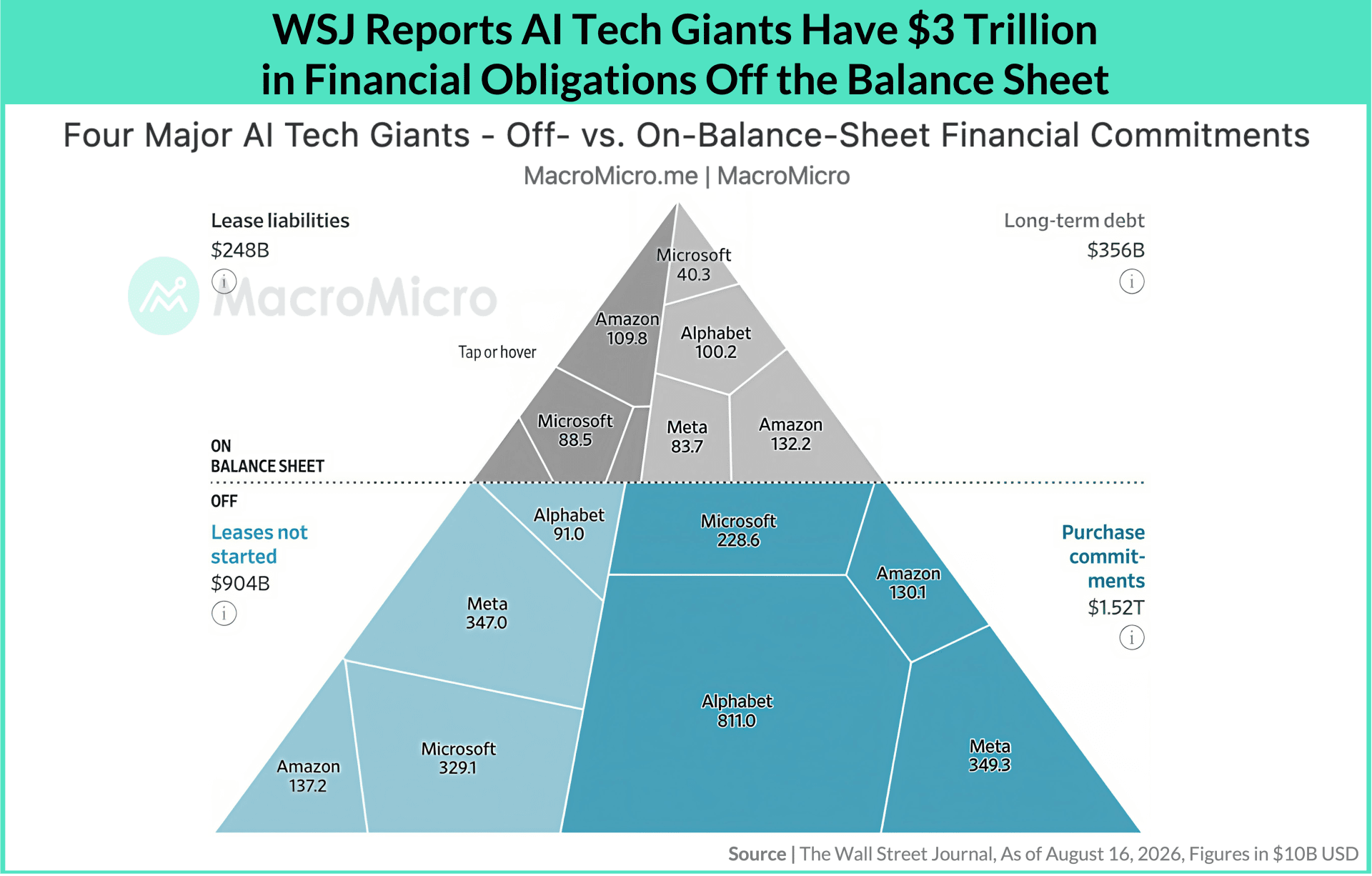
In mid-August, a Wall Street Journal (WSJ) report drew market attention by highlighting that the combined off-balance sheet commitments” of nine tech giants (Microsoft, Google, Amazon, Meta, Oracle, Nvidia, Broadcom, AMD, and SpaceX) had exceeded US$3 trillion. The report’s analysis and charts suggest that estimated 2026 Capex of more than US$800 billion is merely the “tip of the iceberg.” The four major cloud service providers (CSPs) alone have US$2.4 trillion in future equipment purchase commitments and lease commitments not yet in effect, far exceeding their existing lease liabilities and long-term debt on the balance sheet. The WSJ argues that if assumptions about AI technology and demand prove wrong, these transactions could become a significant burden for tech companies and their investors.
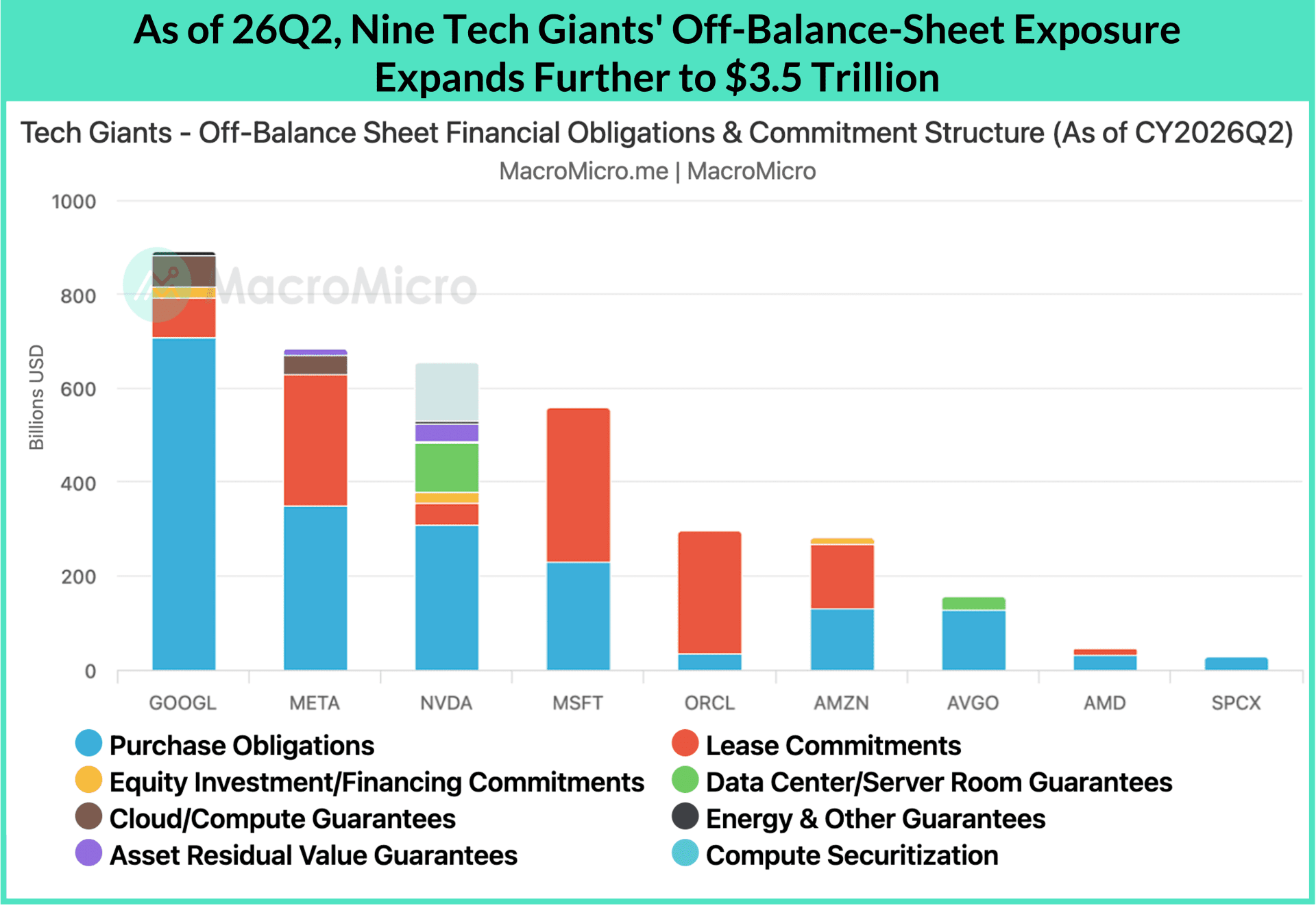
By the end of August, most publicly listed US companies had completed their 10-Q and 10-K filings. According to our calculations, the actual off-balance-sheet commitments and financing exposure of Big Tech had risen further, exceeding US$3.5 trillion. Faced with a figure of this magnitude, investors naturally have a series of questions:
- How large is US$3.5 trillion, and what exactly does it include?
- Why do signed contracts not have to appear on the balance sheet?
- Are these off-balance-sheet commitments and shadow financing simply designed to ring-fence business risks, or are they financial engineering tools for masking deteriorating financial conditions?
- Can the pace of monetization of end-user AI keep up with financing costs and cash flow expenditures?
This article takes a deep dive.
Key Takeaways
- Big Tech’s US$3.5 trillion in off-balance-sheet commitments can be broadly divided into three mechanisms: procurement and leasing that lock in future capacity, strategic equity investments in AI startups, and risk transfers through SPVs and residual value guarantees. At their core, these are accounting shifts in the timing, returns, and risks associated with Big Tech’s investments.
- The key assumption supporting this financial engineering is that AI demand continues to grow. We examine four areas of evidence: an explosion in end-user demand driven by the Jevons paradox, GPU rental rates and residual values, unit economics at AI labs and cloud providers, and the ROIC-WACC financial spread.
- Going forward, investors should closely monitor three major risk-reversal signals: the competitive moat and pricing power of US-based models, the pace of new versus old chip replacement and asset values, and financial leverage pressure arising from changes in financing conditions.
I. Big Tech’s Off-Balance-Sheet Commitments Have Swelled to US$3.5 Trillion, Unpacking the Financialization of AI
Big Tech’s business model is undergoing a structural transformation. In pursuit of artificial general intelligence (AGI) and the technological singularity, companies are rapidly expanding GW-scale data centers, chip capacity, cooling systems, and dedicated power plants. At the same time, they are transitioning from the historically high-margin, high-free-cash-flow, asset-light pure software platform model toward a capital-intensive “digital utility” model requiring hundreds of billions of dollars in hard assets.
However, concerns over this “asset-heavy” transformation are also intensifying. Once tens of billions of dollars in data center campuses, GPU server equipment, and long-term power supply contracts begin appearing on balance sheets as property, plant and equipment (PP&E) or liabilities, investors may start to see depreciation expenses surge, while core return metrics such as free cash flow, return on invested capital (ROIC), and return on equity (ROE) come under significant pressure. This is also reflected in the valuations of the four major CSPs. Their forward P/E ratios have fallen from a post-pandemic average of 26x to around 20x, compressing their valuation premium relative to the S&P 500 to near a decade low.
We previously warned that the AI capital arms race had officially begun. Big Tech would pull every lever available, including deploying massive operating cash flows from their core businesses and continuing to raise capital through equity and debt markets.
However, as AI infrastructure investment has rapidly expanded, Big Tech must also strike a balance between...
Already a subscriber? Click here to log in.
Full Access to Our Services

Comprehensive data at your service
with key indicators for investment insights

Exclusive flash reports
on key events and data

Create your own charts and analysis
including performance backtesting

Hub of professionals to engage
in meaningful discussions and insights
 Get answers from MM AI.
-
What constitutes Big Tech's US$3.5 trillion in off-balance-sheet commitments?
💡Big Tech's US$3.5 trillion in off-balance-sheet commitments are primarily divided into three mechanisms: approximately 85% for procurement and leasing to lock in future capacity, less than 5% for strategic equity investments in AI startups, and about 10% for risk transfers via Special Purpose Vehicles (SPVs) and residual value guarantees. These mechanisms essentially involve accounting shifts in the timing, returns, and risks of Big Tech's investments, moving substantial Capex, debt, and assets off their direct balance sheets through structures like long-term purchase commitments and unconsolidated entities.
-
How do strategic investments in AI startups generate profit for Big Tech?
💡Strategic investments in AI startups generate profit for Big Tech by creating a "financing-for-revenue" cycle, where investments are tied to cloud services, computing power, and chip procurement, thus securing demand for proprietary chips and cloud services. Companies like Google and Amazon investing in Anthropic, or Microsoft committing to OpenAI, not only drive cloud orders but also enable Big Tech to recognize substantial non-operating gains through the rapid revaluation of their equity holdings in these private, fast-growing AI companies. This model transforms direct AI investment into a tool for amplifying revenue and earnings.
-
How does end-user demand for AI, like Anthropic and OpenAI, support the financing ecosystem?
💡End-user demand for AI, measured by user penetration and token usage, is the critical lifeline supporting the AI financing ecosystem. The annualized revenue of leading US-based frontier AI labs like OpenAI and Anthropic is estimated to exceed US$100 billion, showcasing over 500% YoY growth and driving continuous demand for computing infrastructure. This strong revenue momentum sustains the need for GPUs and ASICs, justifies the unit economics of AI investments, and ensures positive investment returns, thus forming the fundamental pillar that prevents the collapse of massive AI Capex and associated financial engineering, particularly through the Jevons paradox effect on increased token consumption.
-
Do GPU rental rates and residual values indicate sustained demand for AI hardware?
💡GPU rental rates and residual values indicate sustained demand for AI hardware, demonstrating a rare phenomenon of "cross-generational hardware coexistence." According to Silicon Data, A100, H100, and B200 series GPUs, released in 2020, 2022, and 2024 respectively, have all seen rising rental rates this year. Cloud providers are extending leases for A100 GPUs through 2029, suggesting that older chips remain profitable for inference and enterprise deployment with CUDA architecture optimization, and that computing capacity remains structurally scarce. This sustained demand supports the underlying value of AI hardware assets used as collateral for financing.
-
What are the unit economics for AI labs and hyperscalers, and are they profitable?
💡The unit economics for AI labs and hyperscalers currently demonstrate surprisingly strong profitability, with revenue density substantially exceeding costs. For frontier AI labs like Anthropic, inference revenue density is estimated at US$50–70 billion per GW, significantly higher than annualized computing costs of approximately US$16 billion per GW, implying gross margins of 65–80%. Hyperscalers can recover their investment in a single GW in approximately 3–4 years, with annual revenue of US$15 billion per GW compared to US$50 billion in infrastructure costs. Neocloud providers, leveraging speed and scarcity, achieve even higher premiums, with SpaceX estimating a payback period of less than one year for computing infrastructure Capex.
-
What is the primary risk if AI monetization fails to keep pace with Capex growth?
💡The primary risk if AI monetization fails to keep pace with Capex growth is that the seemingly perfect off-balance-sheet financial loop, which relies on sustained AI demand, could instantly become a transmission mechanism accelerating balance sheet deterioration for Big Tech. If end-user AI applications cannot generate sustained cash flow, massive Capex under Category 1 will become low-quality assets, paper wealth under Category 2 cannot be realized, and off-balance-sheet guarantees under Category 3 will be triggered, leading to rapid increases in liabilities, credit losses, and a potential Minsky moment.
-
Which specific areas should investors monitor for risk reversal signals in AI financing?
💡Investors should closely monitor three major risk-reversal signals in AI financing: the competitive moat and pricing power of US-based models, the pace of new versus old chip replacement and asset values, and financial leverage pressure stemming from changes in financing conditions. These signals encompass potential algorithmic breakthroughs by open-source models, the sustainability of rental rates for older GPUs as new generations deploy, and rising costs of capital or credit market tightening that could amplify cash flow and debt-servicing pressures for highly leveraged AI infrastructure players.
-
What impact does the replacement speed of new versus old chips have on asset values?
💡The replacement speed of new versus old chips significantly impacts asset values. As next-generation Vera Rubin chips are deployed, investors must assess whether rental rates for H100 and B200 series chips can be sustained in line with cloud providers' assumed "six-year" chip depreciation cycles. If the value of older chips, often used as collateral for financing, declines faster than anticipated due to rapid technological obsolescence, the resulting debt gap would directly impact the balance sheets of semiconductor and equipment suppliers, potentially leading to credit losses and financial strain across the supply chain.
-
How do financing conditions and leverage pressure affect AI infrastructure cycles?
💡Financing conditions and leverage pressure critically affect AI infrastructure cycles, as historically, infrastructure cycles reverse when financing conditions tighten and the cost of capital rises. Rising Credit Default Swaps (CDS) this year suggest credit markets are already pricing in AI infrastructure risks. For highly leveraged players like CoreWeave and Oracle, even a modest imbalance in cash flow or increased interest payments due to tighter financing conditions could rapidly amplify debt-servicing pressure and erode financial flexibility, potentially triggering widespread defaults and credit losses similar to past bubbles like the 1847 UK railway bubble or the 2000 dot-com bubble.
-
What is the estimated payback period for AI data center investments for hyperscalers?
💡The estimated payback period for AI data center investments for hyperscalers is roughly 3–4 years. This calculation is based on an estimated US$50 billion in AI infrastructure costs per GW and an implied annual revenue of approximately US$15 billion per GW, assuming a GB300 cluster, a GPU rental rate of US$3 per hour, and an 80% utilization rate. This assessment aligns with Amazon CEO Andy Jassy's evaluation, indicating that the unit economics of this capital-intensive race remain viable as long as computing demand and utilization stay elevated.

