Global equity markets have recently been choppy at elevated levels, with particularly sharp swings in technology stocks. This report examines whether the capital flowing into tech giants hides any risks, whether corporate valuations remain reasonable, and why concentration in US equities continues to rise.
Key Takeaways: NVIDIA’s Q3 earnings were impressive, yet they also revealed medium- to long-term concerns beneath the broader AI megatrend. This report examines those concerns from three angles and presents five key financial indicators investors can use to monitor the potential formation of an AI bubble:
- Capital Expenditure (CapEx) Concerns: Hyperscale cloud providers are projected to spend over $400 billion in 2025. We monitor Free Cash Flow (FCF) and the CapEx-to-Revenue Ratio to assess the return on these massive investments.
- High Valuation Risk: The primary valuation concern lies not with profitable giants, but with smaller, pre-profit tech companies that have seen the steepest declines. We use the "Rule of 40" to rationally evaluate their financial health.
- US Market Concentration: The top 10 S&P 500 companies now account for over 40% of the index's total market cap, meaning their volatility heavily dictates overall market performance. We examine the link between this concentration and fundamental support by analyzing Net Income Contribution and Inventory Levels.
On November 20, NVIDIA released its 2025 Q3 (FY2026 Q3) earnings: revenue reached US$57 billion, up 62.5% YoY (previous quarter +55.6%), setting another all-time record and injecting confidence into a market recently clouded by AI-bubble fears. However, several underlying concerns emerged in the report, including NVIDIA’s inventory turnover days rising to 103 days (from 91 days previously) and slower-than-expected growth in automotive and robotics revenue—the segments most directly tied to end-user AI applications—showing a clear deceleration over the past four quarters.
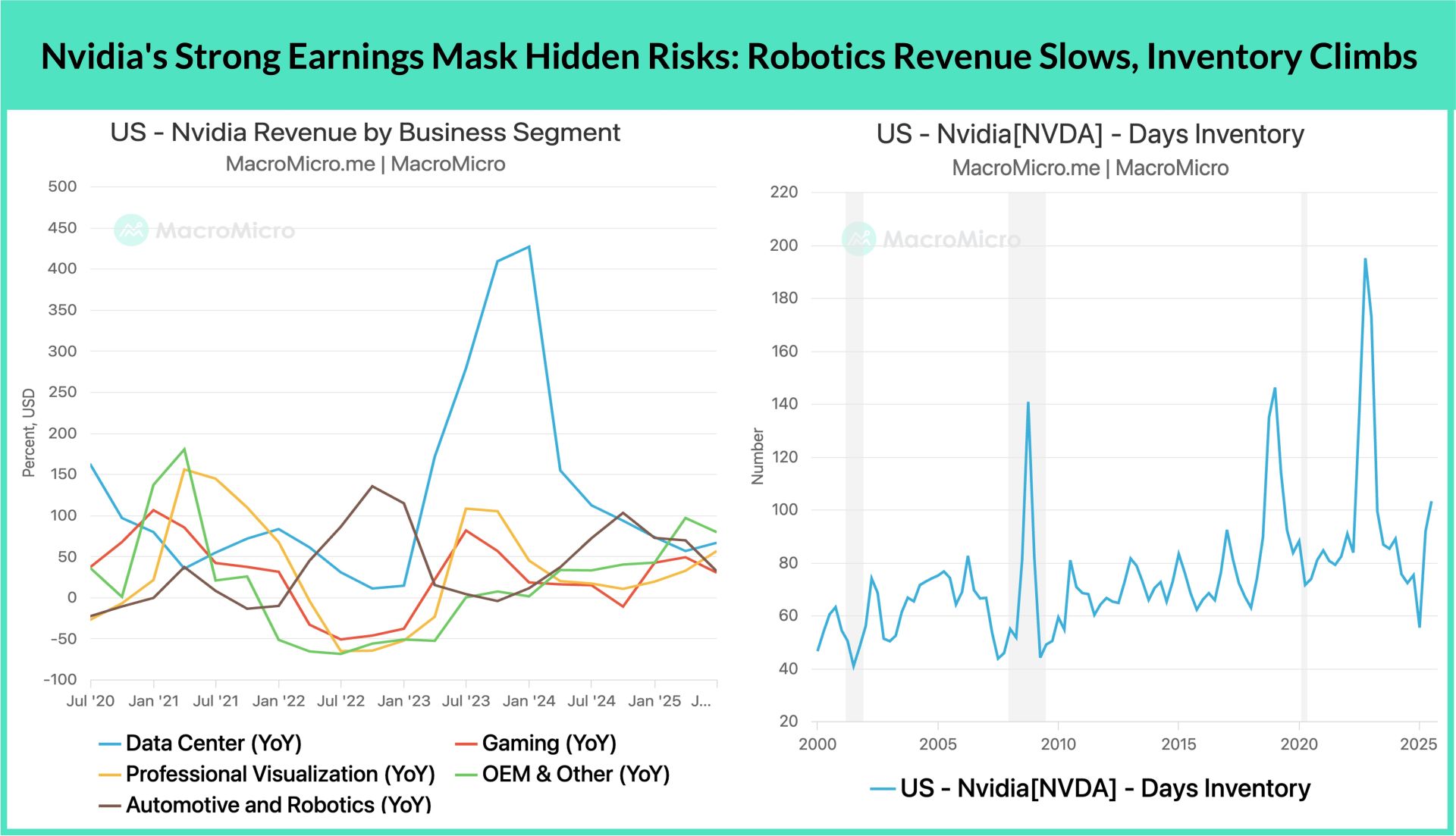
In our view, beyond the eye-catching headline numbers, NVIDIA’s report reflects deeper medium- to long-term anxieties within the AI megatrend: Under the frenzy of cloud providers’ capital spending, can end-user applications actually generate sustainable revenue? How can upstream suppliers avoid over-investment? Amid all the AI-bubble noise, how should we objectively assess risk and valuation in AI-related companies?
Using the MacroMicro Industry Intelligence Hub and US Earnings Database, this report explores three core issues—capital expenditure risks, valuation risks, and market concentration risks—and delivers five key financial metrics for tracking the AI bubble.
This article is exclusive to subscribers. If you're not a subscriber yet, take advantage of our biggest deal of the year — save 50% on MM Max Annual and gain full access to all our charts, reports, including the 2026 market outlook, and more. Subscribe Now»

1. Capex Concerns: How to Track Hyperscalers’ Massive Investments?
In our earlier report, we noted that to meet rising expectations for AI-driven downstream demand, cloud providers must invest heavily in
Already a subscriber? Click here to log in.
Full Access to Our Services

Comprehensive data at your service
with key indicators for investment insights

Exclusive flash reports
on key events and data

Create your own charts and analysis
including performance backtesting

Hub of professionals to engage
in meaningful discussions and insights
