Dear all,
Technology shares faced selling pressure toward the end of June. Taiwan, South Korea, the SOX, and Japan all experienced greater volatility, yet still delivered some of the strongest gains across major markets during the month. Meanwhile, oil prices retreated sharply, and the market impact of the US-Iran conflict faded rapidly. As we move into the second half of the year, three major themes are becoming increasingly clear: the easing of geopolitical risks, the first Federal Reserve meeting under Kevin Warsh's leadership, and renewed strength in the manufacturing cycle.
In this month's report, I provide a comprehensive outlook for the second half of 2026. Q3 remains a relatively safe window, and the case for equities outperforming bonds remains intact. Q4, however, will become a period of verification, as markets begin repricing next year's policy trajectory, economic cycle, and corporate earnings outlook.
I. Liquidity & Capital Flows: Warsh is Set to Overhaul the Fed, Returning to "Inflation" & "Employment"
The first Federal Reserve meeting led by Kevin Warsh on June 18 delivered a clear message: comprehensive institutional reform is underway. The most important shift is the abandonment of forward guidance. This was reflected not only in the post-meeting statement being shortened dramatically to just 130 words, but also in Warsh's decision not to submit a dot plot and his refusal to answer any questions regarding the future policy path during the press conference. Under Warsh's leadership, the Federal Reserve is moving toward a new framework characterized by fewer words, greater flexibility; fewer commitments, greater policy discretion.
Despite this shift, markets showed little concern. The key reason was that President Trump quickly reached an agreement with Iran following the Federal Reserve meeting, effectively removing inflation as a major source of uncertainty. As a result, will the consecutive rate hikes currently being priced by parts of the market actually materialize in the second half of the year? In my view, the probability remains low. If Warsh emphasizes a return to data dependence, then investors should also return to the Federal Reserve's dual mandate, inflation and employment, when assessing the policy path.
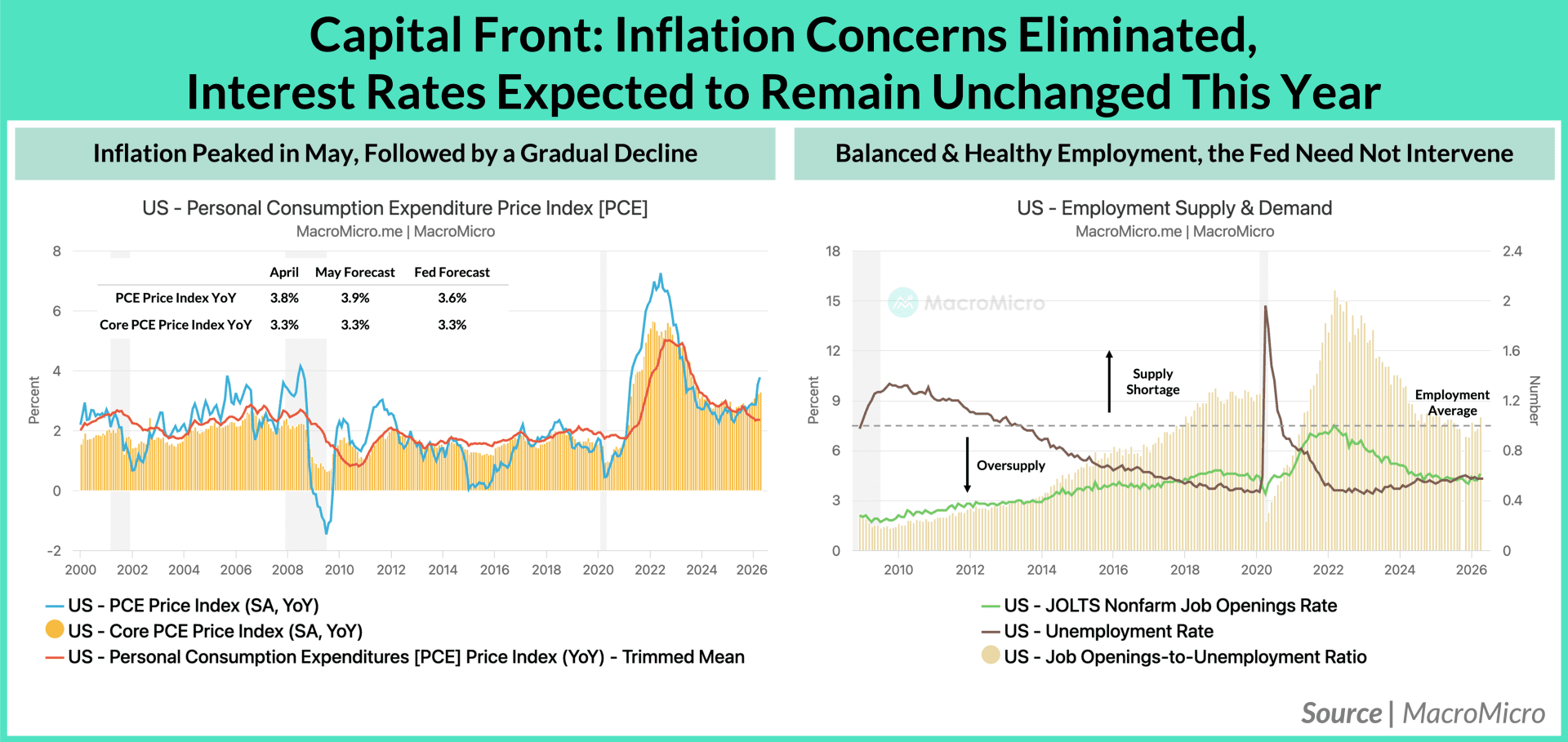
Starting with inflation, the rapid de-escalation of tensions between the US and Iran means that May was almost certainly the peak of this inflation cycle. With Core PCE currently running at 3.3%, inflation is already effectively in line with the Federal Reserve's Summary of Economic Projections (SEP) forecast of 3.3% for year-end. This suggests that the Fed is highly likely to gradually revise its inflation projections lower during the second half of the year. Assuming oil prices remain around $75 per barrel, inflation forecasts could...
This in-depth analysis of the Fed's transformation under Warsh, the evolving manufacturing supercycle, and the critical inventory signals that could determine the next phase of the market is exclusive to MM Max subscribers. Gain full access to our complete H2 outlook, detailed macro and semiconductor cycle analysis, Taiwan export insights, and ongoing coverage of global markets, monetary policy, and AI-driven growth trends. Subscribe Now»
Already a subscriber? Click here to log in.
Full Access to Our Services

Comprehensive data at your service
with key indicators for investment insights

Exclusive flash reports
on key events and data

Create your own charts and analysis
including performance backtesting

Hub of professionals to engage
in meaningful discussions and insights
 Get answers from MM AI.
-
How will Kevin Warsh's leadership change the Federal Reserve's policy framework?
💡Kevin Warsh's leadership will overhaul the Federal Reserve's policy framework by abandoning forward guidance, as evidenced by a dramatically shortened post-meeting statement of 130 words and his refusal to submit a dot plot or answer future policy path questions. The new framework will be characterized by fewer words, greater flexibility, fewer commitments, and greater policy discretion, returning the focus to the dual mandate of inflation and employment, reflecting a shift towards data dependence.
-
Why does MacroMicro believe the Federal Reserve has little need for further tightening in H2?
💡MacroMicro believes the Federal Reserve has little need for further tightening in the second half of the year because the US-Iran conflict has subsided, leading to inflation likely peaking in May. Core PCE is 3.3%, aligning with the Fed's year-end forecast, and the trimmed mean inflation measure is subdued at 2.3%. Furthermore, labor market conditions remain balanced, with the job openings to unemployed persons ratio near 1, suggesting no wage-driven inflation pressures like those seen in 2019 or 2023.
-
What is the Federal Reserve's dual mandate under Warsh's new framework?
💡The Federal Reserve's dual mandate under Warsh's new framework emphasizes inflation and employment, aligning with a return to data dependence. Warsh's approach involves fewer words and greater policy discretion, moving away from forward guidance. Investors should assess the policy path by focusing on these two key indicators, as the de-escalation of US-Iran tensions has removed inflation as a major uncertainty, allowing the Fed to prioritize its core mandates.
-
What does the trimmed mean inflation measure indicate about current price pressures?
💡The trimmed mean inflation measure, referenced by Warsh during his confirmation hearings, indicates that current price pressures remain subdued at 2.3%. This suggests that the inflation metrics Warsh focuses on are not as elevated as some market participants might assume. This lower figure, compared to the Core PCE at 3.3%, supports the view that underlying inflation is less severe, reducing the immediate pressure for the Federal Reserve to tighten monetary policy.
-
What evidence supports the strength of the current AI supply chain expansion?
💡The strength of the current AI supply chain expansion is supported by several pieces of evidence, including rising enterprise adoption of AI applications, continued upward revisions to annualized revenues among leading large language model providers, increasing capital expenditures by major cloud service providers (CSPs), and improving average revenue growth rates across the broader supply chain. Notably, Taiwan's exports reached US$78.4 billion in May, exceeding the US$70 billion threshold and leading to revised higher economic growth outlooks.
-
What stage of the classic inventory cycle is the manufacturing sector currently in?
💡The manufacturing sector is currently in the Active Restocking phase of the classic inventory cycle: Passive Destocking → Active Restocking → Passive Restocking → Active Destocking. In this stage, companies are intentionally building inventories in anticipation of continued strong orders, rather than due to weakening demand. Evidence includes new orders growing faster than customer inventories, expanding profit margins, and NVIDIA's inventory increase concentrated in raw materials and work-in-progress.
-
How should rising inventories be interpreted when new orders remain strong?
💡When new orders remain stronger than customer inventories, rising inventories should be interpreted as a byproduct of economic expansion rather than a warning signal. This indicates that companies are proactively building up stock in anticipation of continued robust demand. For example, NVIDIA's inventory increase is concentrated in raw materials and work-in-progress, reflecting preparation for strong demand, not weakening end-market consumption. The "Orders minus Inventories" measure remains positive in this scenario.
-
When will the true inflection point for inventory dynamics in the manufacturing cycle occur?
💡The true inflection point for inventory dynamics in the manufacturing cycle will occur when inventories continue rising while order growth begins to weaken. This will signal a transition from the current Active Restocking phase into the Passive Restocking stage. This shift from late Q3 into Q4 will be the most important economic indicator to monitor monthly, as it would suggest a change from expansion-driven inventory building to accumulation due to slowing demand.
-
Why is Q3 considered a safe zone for equity markets according to MacroMicro?
💡Q3 is considered a safe zone for equity markets because inflation has likely peaked, labor market conditions remain balanced, and there are virtually no conditions under Warsh's reform framework that would compel the Federal Reserve to raise rates. The US-Iran ceasefire removed oil-related risk premiums, and the manufacturing cycle remains firmly in expansion. Consequently, any valuation-driven pullback during Q3 should be viewed as a buying opportunity, with equities expected to outperform bonds.
-
What three indicators will be critical for assessing the manufacturing supercycle in Q4?
💡Three indicators will be critical for assessing the manufacturing supercycle in Q4 as markets price 2027 conditions. First, major cloud service providers must raise projected capital expenditures to US$1 trillion next year, from current expectations of approximately US$850 billion. Second, Taiwan's exports need to advance from the current US$70 billion range towards US$100 billion per month to sustain high growth rates given higher base effects. Third, the New Orders-to-Customer Inventories ratio must remain positive, avoiding a passive restocking phase.
