CEO House View | Solid Foundations, Shifting Signals: Why Liquidity Still Supports Markets as AI Earnings Enter a New Phase
Dear all,
In July, the market leadership that had been dominated by technology over the past several months began to shift. Global equities delivered mixed performance, with former leaders such as the Philadelphia Semiconductor Index and South Korea's KOSPI Index retreating 26.7% and 33.2%, respectively, while Taiwan's market and Japan's Nikkei Index also corrected by more than 10%. In contrast, European equities and Southeast Asian markets, which have relatively lower exposure to the AI theme, began to catch up. At the same time, crude oil prices resumed their advance, agricultural commodities rebounded sharply, and US Treasury yields also moved higher.
In this month's report, I will examine the market through two key themes. First, liquidity: why we continue to believe the Federal Reserve may not raise interest rates this year. Second, and more importantly, while the macroeconomic backdrop and Taiwan's fundamentals remain solid, this earnings season has produced the first signs that warrant closer attention.
I. Liquidity: The Federal Reserve Holds Steady, but Watch Monthly Core PCE Closely
On Wednesday (July 29), despite the implied probability of a rate hike briefly rising to 38%, the Federal Reserve ultimately left interest rates unchanged. It also maintained its Reserve Management Purchases (RMPs), purchasing roughly $10 billion of securities each month. This suggests that the Fed is pursuing a more flexible policy approach rather than broad-based tightening, with the final layer of liquidity support still intact.
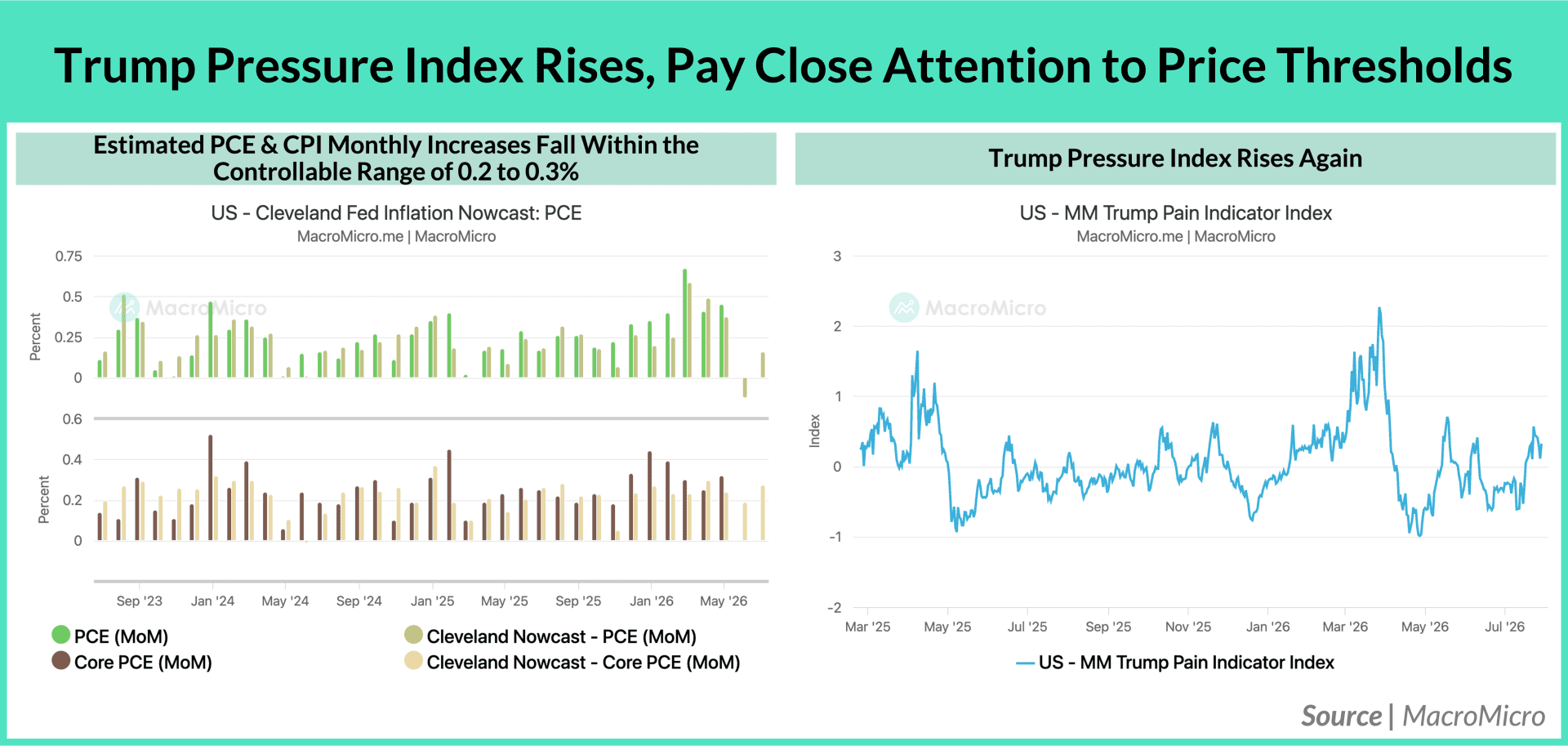
Meanwhile, as the oil market enters the peak summer driving season and the Trump Pressure Index rises again, we expect the third quarter to be the period of greatest geopolitical pressure for the US. Even so, the probability of the US-Iran conflict escalating into a full-scale military confrontation remains low. Crude exports from the Middle East have already begun recovering during June and July, while oil producers are actively seeking alternative export routes to bring additional supply to market.
In addition, monthly Core PCE inflation, released on the same day as the FOMC decision, came in at just 0.13%, well below the 0.2% threshold highlighted by John Williams as a level that could warrant further rate hikes. This suggests that inflation remains far from...
This in-depth analysis of why we continue to expect no further Fed rate hikes, the emerging warning signs in AI earnings, and the evolving manufacturing inventory cycle is exclusive to MM Max subscribers. Gain full access to our detailed assessment of liquidity conditions, corporate cash flow trends, Taiwan's export outlook, manufacturing cycle indicators, and ongoing coverage of global markets, monetary policy, and AI-driven investment themes. Subscribe Now»
Already a subscriber? Click here to log in.
Full Access to Our Services

Comprehensive data at your service
with key indicators for investment insights

Exclusive flash reports
on key events and data

Create your own charts and analysis
including performance backtesting

Hub of professionals to engage
in meaningful discussions and insights
 Get answers from MM AI.
-
Why does MacroMicro believe no further Fed rate hikes are likely this year?
💡MacroMicro believes no further Fed rate hikes are likely this year because the Federal Reserve left interest rates unchanged in July despite a brief rise in implied probability, and monthly Core PCE inflation came in at 0.19%, below John Williams' 0.2% threshold. Additionally, the New York Fed's Reserve Management Purchases (RMPs) remained stable at $10 billion per month, indicating sufficient market liquidity.
-
How does monthly Core PCE inflation influence the Federal Reserve's rate hike decisions?
💡Monthly Core PCE inflation influences the Federal Reserve's rate hike decisions by acting as a key indicator for inflationary pressures. For instance, when monthly Core PCE inflation registered 0.19% in July, falling below the 0.2% threshold highlighted by John Williams, it contributed to the Federal Reserve's decision to leave interest rates unchanged, reinforcing the view that no further rate hikes would occur in the second half of the year.
-
What is the impact of recovering Middle East crude exports on liquidity conditions?
💡The impact of recovering Middle East crude exports on liquidity conditions is positive, as increased supply can lead to lower energy prices, which in turn helps keep monthly inflation below the 0.2% threshold. This recovery, observed during June and July, coupled with a rising Trump Pressure Index suggesting a low probability of full-scale conflict escalation, supports the expectation of relatively favorable liquidity conditions in the second half of the year if tensions ease in early August.
-
How have Taiwan's export and economic growth forecasts been revised after TSMC's earnings?
💡Taiwan's export and economic growth forecasts have been revised upward after TSMC's earnings conference. The forecast for export growth was increased from 11.6% to 12.8%, indicating a more robust outlook for Taiwan's trade performance. This revision suggests that the macroeconomic backdrop and Taiwan's fundamental economic conditions remain solid, despite some emerging concerns from corporate earnings reports.
-
Why are upstream inventories continuing to rise in the semiconductor industry?
💡Upstream inventories continue to rise in the semiconductor industry as companies prepare for the peak season and an active inventory restocking phase from the first half of the year through the third quarter. This accumulation is driven by robust AI demand for supply-constrained components, or "shortage materials," leading to a simultaneous rise in both revenue and inventory levels across the upstream supply chain, including ASICs, thermal solutions, optical communications, and server assemblers.
-
What significant changes are observed in midstream capital expenditures and cash flow?
💡Significant changes observed in midstream capital expenditures and cash flow include an expansion of capital expenditure plans to their limits, accompanied by a noticeably less positive market response, and a marked deterioration in internally generated cash flow, with some companies experiencing rare negative readings. This has raised concerns about growing funding pressures and weaker cash generation among major midstream companies investing in AI data centers.
-
What are the two possible scenarios for AI adoption and its impact on capital expenditure?
💡The two possible scenarios for AI adoption and its impact on capital expenditure are a base-case scenario (70% probability) where AI adoption at the application layer continues to expand, major midstream companies address funding needs through debt issuance, and internally generated earnings ultimately reverse cash flow pressures. The bearish scenario (15%-30% probability) anticipates capital expenditure growth slowing next year, weighing on the manufacturing cycle from late this year through the first half of next year due to deteriorating cash flow among major technology companies.
-
What is MacroMicro's base-case scenario regarding AI adoption and funding for major midstream companies?
💡MacroMicro's base-case scenario, with a 70% probability, regarding AI adoption and funding for major midstream companies is that AI adoption at the application layer continues to expand. Major midstream companies will temporarily address funding needs through debt issuance and financing, with AAA borrowing costs of roughly 5% to 5.5% remaining reasonable. Google's shareholder cash flow, including financing activities, is expected to remain positive, with internally generated earnings ultimately reversing current cash flow pressures over the medium to long term.
-
Which non-technology sectors are recommended for investment diversification during the third quarter?
💡During the third quarter, non-technology sectors recommended for investment diversification include financials and domestic demand-related industries. These sectors have the potential to provide an additional source of market support, offering investors an opportunity to gradually diversify beyond technology after an extended period of concentrated positioning, especially as current equity market pullbacks approach oversold territory and the economy remains fundamentally healthy.
-
What three key indicators will MacroMicro monitor to assess market conditions going forward?
💡MacroMicro will monitor three key indicators to assess market conditions going forward: first, revenue growth continues to outpace inventory growth, confirming the manufacturing cycle remains in an expansionary phase; second, Taiwan's export growth remains above 30%; and third, crude oil prices, as these factors provide insights into liquidity, macroeconomic health, and the ongoing manufacturing cycle.

